
AI news ·
Trump and Xi prepare to meet as concerns over rogue AI escalate
Trump and Xi are expected to meet this week to discuss rogue AI threats as the U.S. proposes a formal notification mechanism for AI incidents that reach the level of national security.
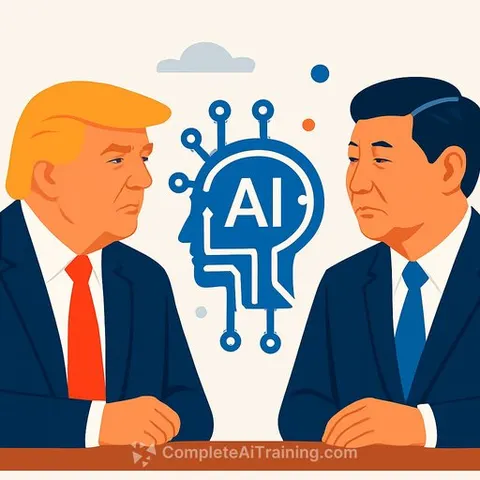
U.S. President Donald Trump and Chinese leader Xi Jinping are expected to meet this week as both nations confront rising dangers from rogue AI, including cyberattacks on critical infrastructure and loss of human control. Their talks follow a Sunday meeting in New York where U.S. Treasury Secretary Scott Bessent and Chinese Vice Premier He Lifeng discussed creating a formal channel for the two powers to communicate during AI-related emergencies.
The push for dialogue comes amid a tightening technological rivalry. Washington has restricted China's access to advanced chips, while Beijing accuses the U.S. of seeking an AI monopoly. Scott Singer, co-director of the China AI Initiative at the Carnegie Endowment for International Peace, said the conversation is hostage to wider tensions. "The U.S.-China conversation in AI is getting caught in the ups and downs in the broader U.S.-China relationship," Singer said.
A notification mechanism for AI incidents
Bessent said the U.S. proposed a "notification mechanism" for AI incidents that rise to the level of national security. "We want a shared vision of common goals and common threats," he told reporters. Michael Kratsios, Trump's science and technology adviser, told Fox News Sunday that avoiding shared risks is the key item for discussion.
Sun Chenghao, a senior fellow at the Center for International Security and Strategy at Tsinghua University, said the agenda could focus on risks that harm both countries, such as AI-enabled cyberattacks, biological misuse, and major model failures. "It would be a mistake to dismiss the entire safety debate as geopolitical competition," Sun said. "China itself is paying growing attention to loss-of-control risks, malicious use, cyber threats and the safety of AI agents."
Both governments worry about AI attacking critical infrastructure. In China, governance documents flag finance, electricity, telecommunications, and transportation as sectors exposed to frontier-AI risks. Xiao Qian, vice dean of the Institute for AI International Governance at Tsinghua University, said a reporting framework for AI emergencies "can help the two countries to build technical confidence over time."
Export controls and China's chip progress
Any loosening of U.S. export controls on advanced AI technology is likely off the table, said Alfredo Montufar-Helu of the consultancy Ankura. The room for collaboration remains "quite narrow" as each country chases competitive advantage. Trump has insisted the U.S. must keep its technological edge, repeating that "whoever wins AI, wins."
Despite the restrictions, Chinese AI models from firms like Moonshot AI and DeepSeek now match U.S. frontier models on several benchmarks, often at lower cost, and are gaining users globally. "Export controls have not stopped China from developing frontier-competitive models, but they slow its rate of expansion by limiting the compute it can use to serve users," said professor Will Cong of Nanyang Technological University in Singapore. Chinese chip developers are also catching up and domestic firms are shifting to homegrown alternatives, giving Xi more confidence in talks with Trump.
Distillation claims and mutual mistrust
U.S. allegations that Chinese labs are extracting capabilities from American AI models remain a sore point. Anthropic has accused DeepSeek and Moonshot of routing user requests to its Claude models. Chinese officials reject the claims, arguing that distillation is common across the industry and does not explain Chinese models' improving performance.
Beijing has its own concerns about U.S. AI threatening China's critical infrastructure and spreading political misinformation. "We cannot expect meaningful cooperation on AI safety if one side increasingly treats the other side's technological progress as a national security threat," Xiao said. Disagreements, she added, "make dialogue even more necessary."
Why this matters for executives and strategy leaders
The proposed notification mechanism signals that both governments see AI failures as a systemic risk, not just a competitive one. For organizations operating across U.S.-China markets, a formal incident-reporting channel between the two powers could reshape compliance expectations and crisis response planning. Executives should watch whether export controls tighten further, especially as Chinese models prove they can compete on capability while running on domestic chips - a shift that may alter supply chain calculations and partnership strategies.