
AI news ·
Trump orders federal agencies to stop using Anthropic AI as Pentagon designates it a supply chain risk
Trump ordered all federal agencies to stop using Anthropic's AI and the Pentagon labeled it a national security supply-chain risk. The dispute erupted after Anthropic refused to drop contract safeguards banning fully autonomous weapons and mass domestic surveillance.
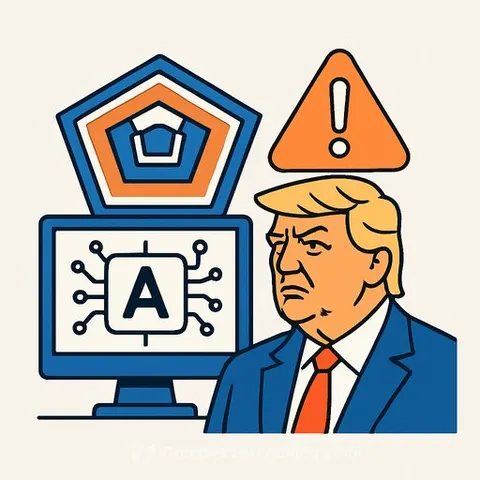
President Donald Trump ordered all federal agencies to stop using Anthropic's AI products on Friday, and Defense Secretary Pete Hegseth designated the company a national security supply-chain risk - a label usually reserved for foreign adversaries - after the company refused to drop its demands that its technology not be used for fully autonomous weapons or mass domestic surveillance.
The dual actions came as a 5 p.m. deadline passed without a deal between the Pentagon and Anthropic. Hegseth posted on social media that his supply-chain risk designation is "final" and told defense contractors they cannot use the company's AI. "America's warfighters will never be held hostage by the ideological whims of Big Tech," Hegseth said.
Anthropic will continue providing services to the Defense Department for up to six months to allow a transition to a different provider, Hegseth said. The company said it has not received "direct communication" from either the Pentagon or the White House on the status of negotiations.
Anthropic's two red lines
The dispute centers on two safeguards Anthropic demands in any government contract: no use of its Claude AI for fully autonomous weapons systems where AI makes final targeting decisions without human oversight, and no mass domestic surveillance. The company said the Pentagon's latest contract language would allow those safeguards to be "disregarded at will."
"We have tried in good faith to reach an agreement with the Department of War, making clear that we support all lawful uses of AI for national security aside from the two narrow exceptions above," Anthropic said in a statement Friday. The company called Hegseth's supply-chain risk designation "legally unsound" and said it would challenge the move in court, arguing it sets "a dangerous precedent for any American company that negotiates with the government."
The Pentagon says it has no intention of using Anthropic's AI for mass domestic surveillance or autonomous kinetic operations, but argues the company's guardrails could jeopardize military operations.
Trump's directive and a rival deal
Trump posted on social media that he was directing every federal agency to "IMMEDIATELY CEASE all use of Anthropic's technology." He added a six-month phase-out period for agencies already using the products and warned of "major civil and criminal consequences" if Anthropic does not cooperate during the transition.
Hours after the deadline, OpenAI CEO Sam Altman announced his company had reached a deal with the Pentagon to deploy its AI models on the department's classified network. Altman said the agreement includes prohibitions on domestic mass surveillance and requirements for human responsibility in the use of force. "We are asking the DoW to offer these same terms to all AI companies, which in our opinion we think everyone should be willing to accept," Altman wrote.
Congress urged de-escalation
Top members of the Senate Armed Services Committee sent a private letter to both parties ahead of the deadline, urging them to extend negotiations and work with Congress on a solution. The letter, obtained by ABC News, said the issue of "lawful use" requires additional work by all stakeholders to determine whether new legislative or regulatory language is needed.
Adam Conner, vice president for technology policy at American Progress, wrote that the Pentagon's move "could essentially declare war not on a foreign nation but on one of America's most successful frontier AI companies." He called it "an unprecedented and unnecessary peacetime move that sends the signal to other private companies that they must do the Trump administration's bidding or face existential consequences."
Why this matters for government professionals
The standoff reshapes the procurement landscape for federal agencies relying on commercial AI tools. A supply-chain risk designation against a major American AI company is a rarely used lever that could affect how other vendors approach contract negotiations with the Defense Department. Agency leaders and contracting officers should track whether Congress steps in with legislation that clarifies the boundaries around autonomous weapons and surveillance - because without statutory language, the next dispute may simply replay this one with a different company. For teams working on AI for Government, the six-month transition window means evaluating alternative platforms now, while watching how Anthropic's promised court challenge tests the legal limits of the supply-chain designation.