
AI news ·
Trump shares AI pledge with "United States" misspelled as "Unites States"
Trump and AI execs signed the non-binding "Joint Commitment on Frontier Responsibilities." The accompanying White House photo featured a typo, misspelling the country as "Unites States."
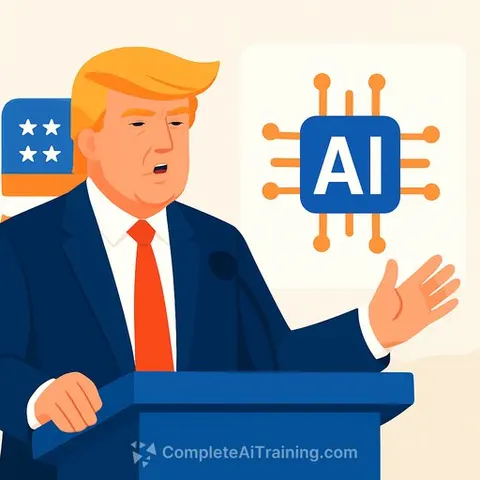
President Donald Trump and executives from Meta, Nvidia, and Anthropic signed a voluntary pledge on Tuesday called the "Joint Commitment on Frontier Responsibilities," establishing a framework for self-regulation in artificial intelligence development. The agreement, which lacks legal enforcement mechanisms, arrived alongside a typo in the official photo released by the White House: the country's name was misspelled as "Unites States" beneath the president's signature.
The mechanics of the voluntary pledge
The document outlines expectations for companies training and deploying frontier models. It requires them to ensure their technology behaves as intended and that issues are promptly identified and resolved. Signatories agree to tap independent boards for oversight and implement internal controls, but the commitment remains voluntary. There are no stated regulatory ramifications if a company breaks the pledge.
Meta CEO Mark Zuckerberg described the accord as a "start" that the "whole industry could come to," calling it "sort of a historic conversation" at a press conference following the White House gathering. The meeting featured top AI leaders, including Nvidia's Jensen Huang and Anthropic's Dario Amodei, who have previously descended on Washington to discuss advancements in the sector.
Policy shifts and terminology changes
The signing follows recent public disagreements about the pace of AI development. Weeks prior, leaders from OpenAI, Anthropic, and Elon Musk's organizations called for a deceleration in AI advancements. President Trump and Huang rejected those calls. "We're the most sophisticated country in the world, and frankly I want to keep it that way because whoever wins AI, wins," Trump said previously.
In a separate move affecting federal communications, the president issued an executive order mandating that all government departments and agencies change their phrasing from "artificial intelligence" to "superintelligence" or "SI." This linguistic shift requires immediate adjustment in official documents, press releases, and internal memos across the federal government.
Why this matters for government, legal, and PR professionals
For those working in AI Public Policy and communications, the typo in the signed agreement highlights the tension between rapid policy rollout and administrative precision. While the pledge itself is non-binding, the executive order on terminology is mandatory for federal agencies. Legal teams and PR professionals must update style guides and compliance documents to reflect the shift from "artificial intelligence" to "superintelligence" or "SI" in all official government communications.
Furthermore, the voluntary nature of the "Joint Commitment" means companies are not legally liable for failing to meet its safety standards. This creates a regulatory vacuum that policy makers and legal counsel will need to address if incidents occur. The lack of enforcement mechanisms suggests that future legislation may need to bridge the gap between industry promises and public safety expectations.