
AI news ·
U Maine researchers use AI to identify chemical makeup of sinking ocean particles
University of Maine researchers are using AI to identify the chemical contents of marine snow, backed by a nearly $700,000 NSF grant. The three-year project aims to cut hours of manual particle classification and improve tracking of carbon, nutrients, and microplastics.
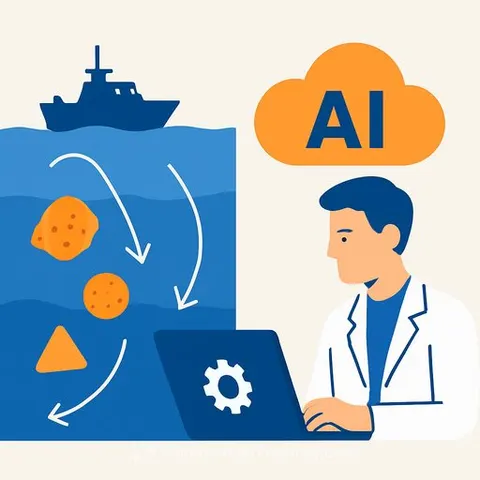
University of Maine researchers are using artificial intelligence to identify the chemical contents of "marine snow" - the steady drift of organic matter, minerals and other particles that sink from the ocean's surface into the deep sea. The project, backed by a nearly $700,000 National Science Foundation grant, could help scientists extract more information from underwater images they already collect and reduce the hours spent manually classifying particles.
The three-year project, led by oceanographer Meg Estapa and computer scientist Chaofan Chen, runs from January 2027 through December 2029. The pair will work with Melissa Omand of the University of Rhode Island to test whether AI can predict particle composition from visual characteristics visible in underwater images.
"That sinking marine snow is what makes the deeper part of the ocean have a different chemistry than the surface of the ocean," Estapa said. "The acidity is different. The oxygen is different. The types of microorganisms and fish that live there are different."
Teaching AI to read the ocean
Underwater cameras can capture large numbers of marine snow particles and reveal details such as size, shape and transparency. Image data alone, however, can't tell scientists what the particles are made of. The researchers want to close that gap.
Much of the existing work on marine snow is labor intensive. Estapa said one of her graduate students spent months classifying particles by hand. Her own research process has evolved over two decades, from collecting water samples at sea and analyzing them in the laboratory to working with large image datasets.
AI could accelerate that process, letting scientists interpret more information while spending more time on analysis and discovery. The team will test its approach using data from six major oceanographic field campaigns, including images collected off West Africa, the North Atlantic and tropical regions.
Building an interpretable model
During the first stage, Estapa's group will compile a database pairing marine snow images with information about what the particles contain, how much microplastic is present and where samples were collected. Some physical samples will also undergo laboratory analysis.
Chen will develop neural networks that learn from that data - and that can explain their conclusions. "The goal would be to broader application of these techniques," Chen said. "We are more interested in designing neural networks that easily explain conclusions to humans."
That emphasis on interpretability is central. Rather than producing a "black box" system that returns predictions without explanation, the team is building a model that shows which characteristics influenced its results. "Every new tool you want to approach with care," Estapa said. "You want to understand the benefits and the places where this tool will trip you up and mislead you."
Tracking carbon, nutrients and microplastics
Microplastics will be one focus. By identifying and quantifying plastic particles alongside naturally occurring marine snow, the researchers hope to better understand how plastic pollution moves from surface waters into the deep ocean. The same tools could also improve estimates of how carbon and nutrients cycle through the ocean.
The project will offer interdisciplinary training for graduate students in AI and oceanography, combining research with hands-on learning. For Chen, it also marks a shift in his own work. "This will be one of my first projects actually using AI for scientific discovery," he said. "It'll be an exciting new thing for me."
If successful, the approach could allow oceanographers to extract more information from existing ocean image archives and better estimate how carbon, nutrients and pollutants move through the ocean. "We hope this project will help us understand our ocean better - and our impacts on the ocean directly and indirectly," Estapa said.
Why this matters for science and research professionals
For researchers working with image-heavy datasets, this project demonstrates a practical approach to AI: models that are trained on physical samples, tested against field data and designed to show their reasoning. The same pattern - pairing visual data with laboratory analysis and building interpretable models - could apply to fields beyond oceanography, from ecology to medicine.