
AI news ·
UK public bodies struggle under flood of AI-generated complaints
UK councils and MPs' offices say correspondence has doubled since 2024 as AI-generated complaints now average 20 pages, with one hitting 200 pages. Employment tribunal claims jumped 28% in a single quarter, and some offices are so strained they've stopped responding to automated campaigns.
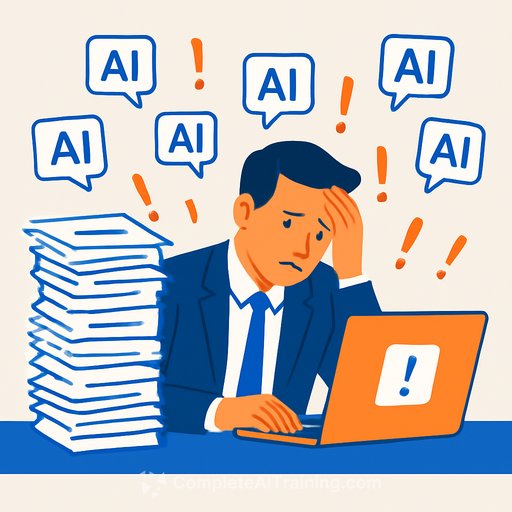
Public bodies across the UK are struggling to handle an "onslaught" of AI-generated complaints, freedom of information requests and legal challenges that take moments to create but hours to process. The surge is straining already stretched resources in councils, MPs' offices, courts and transport authorities, with some reporting that correspondence volumes have doubled or more since 2024.
"It started as a trickle in 2024 and now it's an onslaught," said Hollie Wickens, a senior caseworker in a Labour MP's office. "Half the emails we receive are some form of AI," she said, adding that requests and complaints have become much more complex and time-consuming to read and deal with. "It is definitely more taxing."
The phenomenon has been labelled "AI clog" by commenters, while researchers at the Hertie School in Berlin, the Cooperative AI Foundation and GovAI have described the practice of bombarding public bodies with AI-generated requests as "agentic flooding".
Twenty-page complaints become the norm
Before widespread chatbot use, the average complaint received by local authorities ran to about two pages. The majority are now 10 times longer, according to Deborah Evans, chief executive of Lawyers in Local Government (LLG), which represents 5,600 lawyers working in councils. "The worst one I'm aware of at the moment is about 200 pages long," she said.
Local authorities believe the length of correspondence indicates AI generation, as does the inclusion of certain phrases or heavy use of bullet points. Councillor Alessandro Georgiou, leader of Enfield council, said: "More and more residents are using it to appeal decisions of the council, such as a significant uptick in parking appeals."
Evans said AI tools often treat complaints as legal claims. "It will start referring to statute and pull out case law, but not necessarily tied to the jurisdictional boundaries in which you operate. It might find some great case law from Canada or somewhere. [AI] is also slightly prone to hallucinations so it does occasionally make things up."
Employment tribunals and the 'free lawyer' problem
The number of employment tribunal claims opened between April and June soared by 28% compared with a year earlier, representing 14,000 cases from single claimants. At the end of June, 70,000 open single claims remained unresolved. Some business owners believe AI's tendency to be overly supportive gives people misplaced confidence to pursue cases.
"Everyone's got a free lawyer now," said the founder of one technology start-up, who expects to spend £30,000 on legal fees defending a dismissal they insist was handled correctly. The founder said the AI-generated wording has "a different tone" that is immediately recognisable.
Jim Moore, an employee relations expert at Hamilton Nash, said many of his clients receive correspondence that is "unnecessarily verbose" and contains "embellished or exaggerated claims that portray relatively minor incidents as major offences". He added that AI-generated complaints often "miss out on the most important point of a complaint - what resolution are you looking for? Most of the time, they're worded to sound intimidating but forget to set out what solution the complainant wants."
Transport bodies and MPs' offices under strain
Transport for London received a record 4,769 freedom of information requests in 2025-26, a 5% increase on the previous peak. The body's audit and assurance committee reported a "noted increase" in appeals that appeared to be AI-generated, "which often contain highly technical and often inaccurate assertions and assumptions".
Vonnie Sandlan, head of office for Graeme Downie MP, said dealing with the surge has left her staff "exhausted". "They are stretched to the limits and working more hours than they are paid," she said. Her office recently stopped responding to automated "click to email your MP" campaigns to focus on genuine constituent requests.
Lisa Gillmore, president of the GMB union's MPs' and peers' staff branch, said: "AI is not lightening the load in MPs' offices. Where offices keep their own figures, that casework has doubled or more and staff are carrying it with no let-up."
Potential responses and the risk of machine-to-machine communication
Some organisations are already exploring AI tools to summarise long emails and draft initial responses. Wiltshire council is examining such options, while Stroud district council has discussed using Microsoft's Copilot for writing reports. Evans warned that every pound spent on complaints handling "is a pound that's not being spent on something else, which is why getting things under control is important".
Some ombudsman services now impose word limits for complaints or design online templates that restrict how much information can be attached. Researchers have also suggested authorities could charge fees for submitting requests or block bots from government websites. The Information Commissioner's Office has cautioned that even AI-drafted requests containing inaccuracies still require human responses.
Technology journalist Jamie Bartlett said: "Public bodies and companies are probably going to have to use some form of AI to start filtering things out, or set stricter rules on what they'll accept and what they won't. Otherwise I worry they're going to get completely overwhelmed."
Why this matters for legal, government and customer support professionals
For legal teams, council officers and customer support managers, AI clog is not a future risk but a current operational reality. The volume and verbosity of AI-generated correspondence is forcing difficult triage decisions: which cases get full human attention, and which receive templated responses. Professionals who understand how to structure AI service operations will be better positioned to design intake systems that filter genuine, resolvable complaints from AI-generated noise without losing legitimate cases. For those working in public sector roles, familiarity with AI for government courses can help teams develop practical responses that balance efficiency with the legal obligation to consider every submission.