
AI news ·
UNESCO awards AI in education prize to projects in Finland and Brazil
UNESCO's 2026 ICT in Education Prize went to Finland's Generation AI and Brazil's Redação Paraná, chosen from over 100 nominations for using AI to build rather than replace critical thinking.
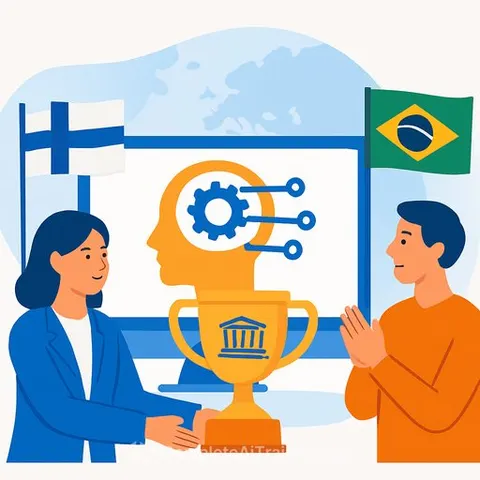
The 2026 UNESCO ICT in Education Prize was awarded on 9 September to two AI education programmes - Finland's Generation AI and Brazil's Redação Paraná - at the Digital Learning Week conference in Paris. The prize targeted projects that use artificial intelligence to build students' critical thinking and creativity rather than replacing those skills with automated tools.
UNESCO selected the two winners from more than 100 nominations. The award recognises digital technologies that develop learners' independent judgement and understanding of AI systems.
Finland's Generation AI
Generation AI is a programme developed by the University of Eastern Finland, the University of Helsinki, the University of Oulu, and other partners. It provides classroom activities and tools designed to help students understand and critically assess AI systems. UNESCO said the programme's materials have been accessed more than 200,000 times across over 50 countries. Workshops and school interventions have involved 1,500 students and teachers.
The programme takes a direct approach: teaching students how AI works so they can evaluate its outputs rather than accept them at face value. For educators building or refreshing AI for Education curricula, the Finnish model offers a concrete example of integrating technical literacy with critical analysis.
Brazil's Redação Paraná
Redação Paraná is an AI-enabled public education programme from the State Secretariat of Education of Paraná. The platform combines AI-assisted writing feedback with teacher involvement to support student writing and revision. The programme has reached approximately 850,000 students across 2,000 schools. Teachers receive training to integrate the platform's materials into their classroom instruction.
The model is notable for its scale and structure. Rather than automating assessment, the AI provides feedback that teachers mediate and contextualise. This keeps educators in the loop while handling the volume that makes individual writing feedback difficult in large public school systems.
Two models for the same problem
The two winning projects address a shared tension in education technology: how to use automated tools without sidelining student reasoning. Finland's programme focuses on AI literacy - teaching students to critique the systems themselves. Brazil's programme embeds AI into the writing process but preserves the teacher's role as the final instructional authority.
Neither project outsources judgement to the machine. That distinction mattered to the prize jury. The 2026 award specifically sought approaches that use AI while encouraging learners to retain critical thinking, creativity, and independent judgement.
Why this matters for educators
These projects provide tested reference points for schools and districts evaluating AI tools. Finland's open-access materials show what a classroom-level AI literacy curriculum looks like at multinational scale. Brazil's programme demonstrates how to deploy automated writing feedback across thousands of schools without removing teachers from the instructional loop. For teachers exploring how to integrate AI into their practice, following a structured AI Learning Path for Teachers can provide a foundation for making these judgements in their own classrooms.