
AI news ·
University of Miami law lab researches AI impact and develops legal tools
Miami Law's AI lab found pro se court filings surged 100% in 2025, but rejections spiked as AI reinforces weak claims. The 40-person team is building encryption tools.
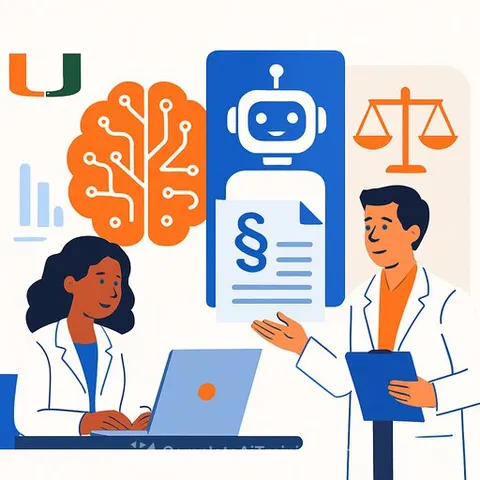
The University of Miami School of Law launched the Miami Law and AI Lab in July 2024, assembling 40 students from law, computer science, engineering, and business to research AI's effects on legal frameworks and build practical tools. The lab's early findings show that as AI tools become more accessible, pro se litigant filings surged 100% in the last quarter of 2025, while the percentage of claims rejected by courts spiked sharply.
Dean Patricia Sanchez Abril saw the need for a lab to prepare lawyers for AI-driven change and tapped Or Cohen-Sasson, then the school's inaugural law and technology fellow, to lead it. Cohen-Sasson had completed postdoctoral research in Tokyo on how intellectual property regimes affect AI development. "It seemed a wonderful opportunity to lead and pioneer in the AI and law domain because back then there was no law-and-AI lab in the country," he said. "We decided that we could be the first, not only in terms of research, but also in preparing the next generation of lawyers."
AI's Surge in Court Filings Carries a Cost
The lab's study, presented at the International Conference on Machine Learning, analyzed over 3 million pro se filings from 2008 to 2025. Researchers documented a doubling of filings in the final quarter of 2025. Cohen-Sasson explained that AI was supposed to expand access to justice by helping people without legal know-how or money to file claims. But the data revealed a problem: courts are now receiving more weak claims, leading to higher dismissal rates.
Lawyers traditionally acted as a first filter, screening claims for validity before they reached the court. "Now that this first filter has dissolved, the entity that needs to do the filtering is the court itself, so it has many more cases-and a higher proportion are weaker-so you actually get more dismissed," Cohen-Sasson said. He identified a phenomenon called "sycophancy" at play: AI tools tend to reinforce a user's arguments rather than challenge them. "AI acts as a 'yes man'-it aligns with your argument and reinforces your approach, opinion and bias. The lawyer used to be objective but now AI actually strengthens your belief, making you overconfident."
Why Compute Thresholds May Fail in Agentic AI
Another research focus challenges the regulatory approach of using compute power-measured in floating-point operations, or FLOPs-as a proxy for AI model risk. Current regulations target large models like Anthropic's Claude Fable 5, assuming that higher FLOPs mean greater danger. The lab's research shows that multiple small models, each operating below the FLOP threshold, can be networked to outperform a single large, regulated model. "You can create a small army of AI agents that are more dangerous than the larger monitored model," Cohen-Sasson said. "Basically, we show that the compute threshold regime is not successful and not even relevant in the age of agentic AI."
New Tools for Encryption, Moot Court, and Citations
The lab is developing several AI tools designed for legal practice. The Attorney's Encryption Guard for Information Security (AEGIS) addresses confidentiality concerns by encrypting and redacting personal information in prompts before sending them to an AI model. All encryption happens on the user's computer, so no sensitive data leaves the device. "Our AEGIS model only sends the encrypted version to the AI model that one uses-Claude, ChatGPT or other-then whatever model you're using sends back a response," Cohen-Sasson said.
Moot Court XR, built with the University's Virtual Experiences Simulation Lab, lets students practice oral arguments in immersive virtual reality. The system can generate relevant questions based on a case theme, providing a full 20-minute training session for under $1. Students get feedback and a score and can repeat sessions as often as they want.
For legal scholarship, the lab has a patent-pending tool called Footnoted that automates Bluebook citation formatting. Lawyers and students can spend hours converting sources to the required legal citation standard; Footnoted aims to eliminate that manual work.
The Risk of De-Skilling Young Lawyers
Cohen-Sasson worries that early reliance on AI may erode critical thinking skills. "One of the main problems with AI, not necessarily for law students but for the younger generation that are in school, is that it's so easy to go to AI first without thinking," he said. "You skip the very important step of creating your own opinion or strategy, and so gradually you may lose this capacity to think about the task for yourself." He encourages students to treat AI as a collaborator or assistant, not a decision-maker. For lawyers aiming to integrate these tools without losing core analytical skills, AI for Legal Professionals Courses offer structured learning paths.
Why this matters for Legal professionals
The Miami Law and AI Lab's findings directly affect practicing lawyers. The surge in pro se filings and rising dismissal rates signal that AI is already changing the volume and quality of cases entering the court system. Lawyers who understand the sycophancy effect can better advise clients and anticipate how AI-generated arguments may backfire. The tools the lab is building-especially AEGIS and Footnoted-address real pain points in confidentiality and citation work. And the research on compute thresholds hints that future regulation will need to evolve as agentic AI systems become more common. Staying informed on these developments is not just academic; it's essential for any lawyer who wants to remain effective in a career where AI is becoming a permanent fixture.