
AI news ·
University of Notre Dame launches data, AI and computing initiative
Notre Dame launched its Data, AI, and Computing Initiative to integrate AI across research and education. A new undergraduate minor in AI analytics starts fall 2026.
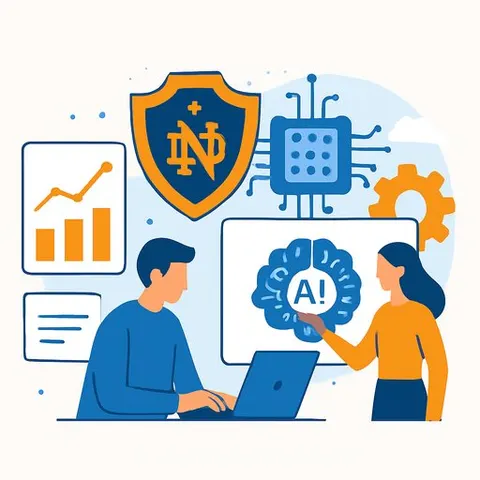
The University of Notre Dame has launched a university-wide Data, AI, and Computing (DAC) Initiative to coordinate its approach to data and AI across research, education, and societal impact. Directed by Nitesh Chawla, the Frank M. Freimann Professor of Computer Science and Engineering, the multi-year effort brings together several existing institutes and labs under a unified structure.
The initiative includes the Lucy Family Institute for Data & Society, the Scientific AI Initiative, and specialized labs in residence, all guided by dimensions of responsible, inclusive, safe, and empowering (RISE) AI. A new unit called DOME - Deployment, Operations, Modeling, and Engineering - will pool research software engineers and data scientists from the Center for Research Computing and the Applied Analytics & Emerging Technology Lab to support data and AI research across the university.
Curricular shifts and new programs
The DAC Initiative's educational work centers on evaluating how data, AI, and computational approaches can be woven into undergraduate and graduate learning. This includes exploring new interdisciplinary courses and degree programs that complement existing offerings, while creating long-term structures that let curricular growth scale across departments and colleges. A new undergraduate minor in AI Analytics in Business will launch through the Mendoza College of Business in fall 2026.
Signature programs like the Interdisciplinary Training and Research for Ethical Data Science, Research, Analytics, Data Innovation, and New Technologies, and the AI Leaders of Tomorrow already give students technical data science training alongside opportunities to examine the ethical and societal dimensions of emerging technologies. This push reflects a broader shift in AI for Education, where institutions are blending hands-on technical skills with the durable strengths employers consistently demand.
What industry leaders are saying
During an Industry Leaders Roundtable hosted by the initiative, faculty and industry professionals discussed the urgent need for graduates to have technical fluency combined with adaptability, communication, and ethical judgment. Corey Angst, the Jack and Joan McGraw Family Professor of IT, Analytics, and Operations, said: "Through our conversations with industry leaders, we're hearing a consistent message: AI is becoming part of nearly every role and every industry. That's why Notre Dame is expanding opportunities for students to build AI and analytics skills while also strengthening the critical thinking, communication and ethical judgment that employers continue to value most."
Research and societal impact
Beyond curriculum, the initiative supports working groups across RISE AI, foundational methods, AI-enabled science and engineering, computational social science, health, and digital humanities. Several of these groups contribute to research that aims to use AI to reduce poverty, improve sustainability, address health access, and promote democracy.
Chawla said: "Data, AI, and computing are already shaping the future. Through the DAC Initiative, we're helping shape that future with purpose by uniting expertise across disciplines to advance discovery that serves society, prepare students for an AI-enabled world, and ensure that technological progress remains responsible and deeply human."
Why this matters for educators
Notre Dame's cross-disciplinary model signals a shift in how higher education prepares students for an AI-driven workforce. Rather than siloing AI instruction into computer science departments, the approach embeds data literacy and ethical reasoning into business, humanities, and social science programs. For educators, this means curriculum design will increasingly need to pair technical tools with communication and critical thinking - a combination that industry leaders now call non-negotiable. The emphasis on durable skills alongside AI competence is a blueprint other institutions are likely to follow.