
AI news ·
U.S. AI strategy fractures into public view as White House and commerce department clash at G20 summit
A public feud between the White House OSTP and Commerce Department over AI policy control undercut the G20 summit, with Commerce Secretary Lutnick mocking a rival's video-link session. The rift leaves U.S.
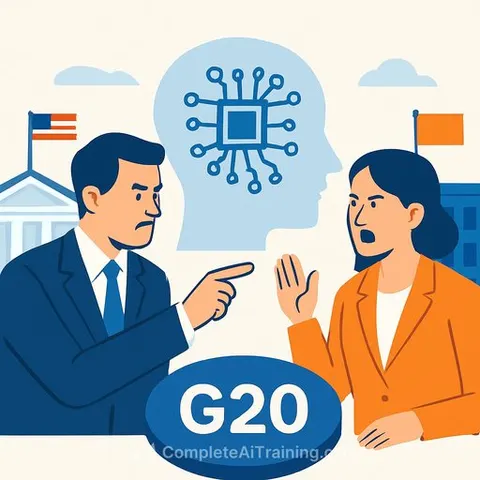
At the G20 Innovation Ministers' Meeting in Chapel Hill, North Carolina, a power struggle between the White House Office of Science and Technology Policy (OSTP) and the U.S. Department of Commerce broke into public view, undercutting the Trump administration's attempt to project a unified AI for Executives & Strategy message. The rift, which played out over two days of competing keynote sessions and pointed remarks, exposed deep fractures over who controls U.S. AI policy as the administration tries to export its deregulatory model globally.
The summit gathered influential tech leaders as the administration pitched its "light-touch" AI governance framework, contrasting it with the European Union's stricter regulatory approach. But the rivalry between two core Washington agencies over AI policy primacy muddied that message. OSTP Director Michael Kratsios led Tuesday's agenda via video link with Tesla CEO Elon Musk, Google DeepMind Chairman Demis Hassabis, and Meta CEO Mark Zuckerberg. Kratsios credited America's AI leadership to "policy flexibility and a commitment to regulatory transparency," arguing that a nimble framework encourages private-sector investment.
By Wednesday, Commerce Secretary Howard Lutnick controlled the stage. He made a point of stressing that his invited guests - including Nvidia CEO Jensen Huang, OpenAI CEO Sam Altman, Anthropic co-founder Tom Brown, and Palantir CEO Alex Karp - had all shown up in person. "I only invite people who are willing to be here in person," Lutnick said. He added, with thinly veiled sarcasm, that if certain titans could not board a plane to join the discussion among the world's top 20 economies, that was fine by him. The remarks were widely interpreted as an open jab at the "video linkup session" Kratsios had organized the previous day.
The structural roots of the conflict
The long-distance sparring reflects a fundamental tension over the AI policy landscape. The Commerce Department holds the most critical regulatory levers in U.S. AI policy, including the Bureau of Industry and Security, which oversees export controls, and the newly established AI Standards and Innovation Center. The OSTP carries a strategic coordination mandate but lacks actual regulatory enforcement power. One source familiar with the matter described the OSTP as a group of "thinkers," while Commerce is the entity that wields real regulatory authority.
This functional overlap came to a head over the handling of data centers. Trump had previously posted "Let Data Reign" on social media. Because data centers involve energy consumption and infrastructure development - a sensitive issue ahead of the midterm elections - and with Chinese representatives present, the White House had originally planned to avoid the topic during the summit. Yet Kratsios brought up data centers unprompted during his conversation with Musk. Although he later walked it back with reporters, saying data centers are ultimately "community decisions" and that local benefits accrue as long as suppliers bring their own power, the inconsistent messaging had already sparked discontent within the administration.
Conflicting accounts and unresolved policy
Internal accounts also conflict over why Musk skipped the in-person meeting. One source said Musk would have attended in person had pre-summit coordination been better. Another source disputed that claim, noting that Musk had confirmed video participation three weeks earlier and his team had chosen that format all along. The White House publicly dismissed reports of infighting as "fake news," with a spokesperson insisting that "the President's team is working closely together to showcase American global leadership" and that "Commerce and OSTP are jointly leading a productive and successful G20 Innovation Summit." Kratsios told reporters on Tuesday: "We are one team."
On regulatory specifics, consensus remains far from reached. Although the White House has finalized a framework for pre-deployment review of certain frontier models, it has yet to be released publicly. Internal discussions remain deadlocked over whether to establish an AI regulatory body akin to the Financial Industry Regulatory Authority, and how to replace the Biden-era "AI Diffusion Rule" governing exports of advanced chips and models. Trump's outside adviser and prominent investor David Sacks, speaking via video message, explicitly opposed creating a new AI regulator. "The existing legal system is already complex enough to apply to AI," he said. The stance aligns with the deregulatory narrative the administration is pushing internationally as it lobbies other countries to delay AI regulations.
Why this matters for executives and strategy
The public airing of internal divisions arrives as the global AI governance framework takes shape at an accelerating pace. Countries are watching Washington's policy direction closely, and the administration's wavering and infighting over regulatory pathways weakens its ability to export the "American model." For executives navigating cross-border AI deployment and compliance, the signal is clear: U.S. AI policy remains a moving target. The uncertainty over export controls, model review requirements, and potential new regulatory bodies means strategic planning must account for multiple regulatory scenarios. The AI Learning Path for Policy Makers provides structured guidance for those tracking these shifting governance dynamics. On the road to the commanding heights of global AI governance, the Trump administration's greatest challenge may not come from Brussels or Beijing, but from the unhealed rifts within its own ranks.