
AI news ·
U.S. prepares ultimatum for allies to choose sides in AI race with China
The U.S. State Department has drafted a letter warning the 35 countries that signed its AI statement they must choose between Washington's AI coalition and China's rival framework.
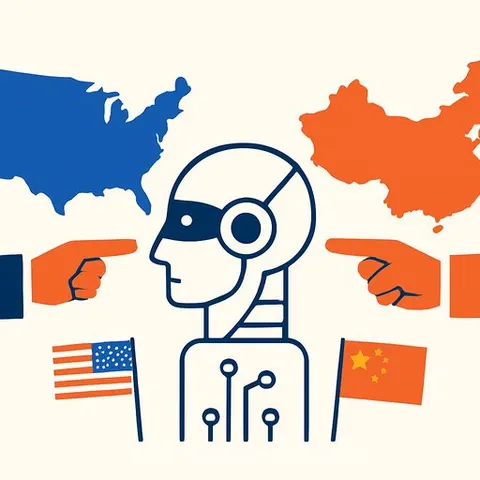
The U.S. State Department has drafted a letter telling the 35 countries that signed its AI Opportunity Statement they must choose between Washington's AI coalition and China's competing framework, according to a U.S. official and an internal draft reviewed by Reuters. The letter warns that countries joining both initiatives will be excluded from the U.S.-led Pax Silica coalition, which was launched last year to secure supply chains for AI models, semiconductors, and critical minerals.
The draft letter comes as the technology rivalry between Washington and Beijing intensifies. In July, Chinese President Xi Jinping launched the rival "World Artificial Intelligence Cooperation Organization," promoting China's open-weight technology as a direct challenge to U.S. influence over the sector. Kazakhstan is the only country known to have joined both initiatives, which has set off alarm bells in Washington.
"To be part of everything is to be part of nothing. Signature of the Pax Silica Declaration is not merely a membership subscription, but a commitment," the letter says, urging countries to "choose deliberately" on AI. It adds that membership "cannot be held alongside membership in duplicative initiatives whose expectations conflict with our own," without specifically naming China.
Supply chains at the center of the AI race
The Pax Silica agreement aims to push U.S. allies toward joint projects and export controls, reducing reliance on adversaries for critical minerals, AI models, and the semiconductor chips that power them. The U.S. touted Kazakhstan in June as the first Central Asian country to join, bringing significant reserves of critical minerals that fuel advanced technologies.
China has used its near-monopolies over critical minerals as a retaliatory weapon in the tariff war launched by President Donald Trump, who has ramped up U.S. efforts to source minerals domestically and from allies. The race has reached a pivotal moment as Chinese open-weight AI models have made rapid gains against proprietary systems from U.S. companies such as OpenAI and Anthropic.
Reuters could not determine when the U.S. intends to send the letter or whether it might be amended. The State Department declined to comment on "purportedly leaked internal documents." China's embassy in Washington said the country opposes politicizing trade and technology issues. "Such actions will only stifle global AI advances and serve no one's interests," an embassy spokesperson said.
Why the ultimatum matters
U.S. officials drafted the letter to make clear that "you can't have it both ways," the U.S. official told Reuters, speaking on condition of anonymity. "It's difficult to see how a country can credibly position themselves as trusted partners in one technology ecosystem while simultaneously signing up for an initiative designed by China to advance a competing vision for AI."
Members of Pax Silica have access to shared investment opportunities in AI-related projects, while signatories of the AI Opportunity Statement have symbolically agreed on a "common purpose" and "shared vision" with the U.S., according to the statement posted on the State Department's website.
Why this matters for government and IT professionals
For professionals working in government and IT, this policy shift signals that AI supply chain decisions will increasingly be framed as national security choices. Agencies and contractors that work with international partners will need to track which framework a country belongs to before pursuing joint AI projects, particularly those involving semiconductors, critical minerals, or model development. The practical consequence is that procurement and partnership decisions in the AI sector will require a new layer of geopolitical due diligence, not just technical evaluation.
For those in the public sector, understanding the scope of U.S. AI policy is becoming part of the job. AI for Government training can help officials and contractors understand how these policy shifts affect procurement and international cooperation. IT professionals working on AI systems should also be aware that the technology they build may become subject to export controls or supply chain restrictions based on where components originate. AI for IT & Development courses can help teams navigate these emerging compliance requirements.