
AI news ·
Venezuela's acting president orders foreign minister to unblock ChatGPT, Claude and Copilot
Venezuela's acting president ordered the foreign minister to unblock ChatGPT, Copilot, and Claude. The blocks are set by US companies, not Caracas, and affect an unconfirmed number of users.
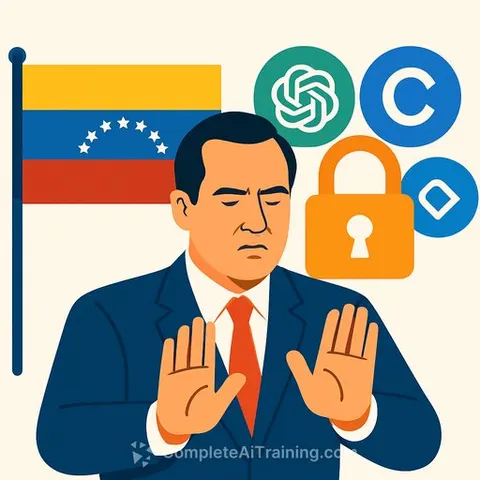
Venezuela's acting president Delcy Rodríguez ordered Foreign Minister Oliver Blanco on Friday 20 November 2026 to work toward unblocking AI chatbots including ChatGPT, Copilot, and Claude. The instruction, delivered at a meeting with entrepreneurs, targets platforms currently inaccessible to users inside Venezuela, where accessing the services triggers a regional unavailability notice. Rodríguez framed access to the tools as a matter of youth development, telling Venezuela's top diplomat not to sleep until the platforms are fully reachable.
In the Spanish-language report of her remarks, Rodríguez said Venezuela should reach AI platforms "without any type of restriction or blockade" so that "young people can have their own development." No decree, deadline, or timeline accompanied the order. The report did not name the meeting venue or city.
The block is set by US companies, not Caracas
The restriction originates with the American firms that own the tools. OpenAI's developer API supported-countries list, read on 21 November 2026, excludes Venezuela. Anthropic's supported regions policy, effective 12 November 2026, also omits the country and labels any unlisted region unsupported. Microsoft's Copilot could not be checked directly, though the original report names it among the blocked services. Neither OpenAI nor Anthropic gives a reason for Venezuela's exclusion on their public pages.
The Spanish-language report says blocks of this kind usually respond to international sanctions, mainly those imposed by the United States. Because OpenAI, Microsoft, and Anthropic are all US companies, their internal supported-countries lists govern access. Any change would require a decision from those firms, not from Caracas. Rodríguez's instruction to Blanco sets a diplomatic goal but does not itself lift the block.
Digital access and broader context
Venezuela ranks 12th out of 14 countries in The Rio Times Latin America Power Index, with 29.4 points in the November 2026 edition. The available record does not confirm how many Venezuelans are affected by the current blocks. In September 2025, then-president Nicolás Maduro announced that Venezuela would develop its own AI tool and introduce AI classes in schools, though no public record confirms the project advanced.
For professionals in government, legal, and communications roles, the episode highlights a recurring friction: AI access shaped by geopolitics and corporate compliance rather than local policy. Understanding how platform availability is governed-and where diplomatic pressure can and cannot reach-is a practical skill. Those building that expertise may find structured grounding in AI Public Policy Courses or AI for Government Courses that map the intersection of regulation, international sanctions, and technology deployment.
Why this matters for government, legal, and communications professionals
Rodríguez's order is a case study in the limits of national authority over AI access. No matter how forceful the language, the levers sit with private US companies bound by sanctions regimes. For legal and PR teams, the takeaway is concrete: when a government announces it will "unblock" a foreign-owned platform, the real story lies in the platform's terms of service and the sanctions framework behind them. Tracking those details-not the political headline-is what determines whether access actually changes.