
AI news ·
Wes Moore forms bipartisan governors group on AI, citing federal inaction
Maryland Gov. Wes Moore is forming a bipartisan governors' group to craft AI policy, citing federal inaction. He called the White House's hands-off approach a "billionaire boys club."
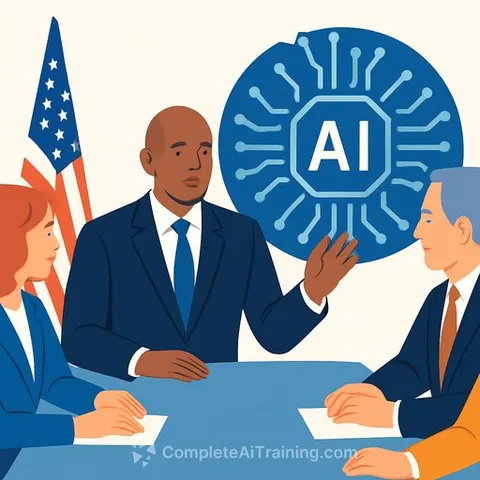
Maryland Governor Wes Moore is forming a bipartisan group of governors to develop an AI policy framework, citing the federal government's failure to act on the rapidly evolving technology. The initiative comes as states increasingly take the lead on AI regulation while Congress remains gridlocked and the White House pursues a hands-off approach that Moore dismissed as a "billionaire boys club."
Moore, a Democrat serving as chair of the National Governors Association this year, said Republican Governor Mike Braun of Indiana will partner with him on the effort. Other governors from both parties plan to participate, though Moore did not name them.
"The federal government has a unique leadership role that they have to play and that includes both the White House and Congress," Moore said after speaking at an innovation conference in Baltimore. "In the absence of that, the governors cannot just sit on our hands."
States move ahead as federal action stalls
In the past month, governors in Maryland, California, Illinois, Oregon, and Virginia have issued executive orders or taken other steps to establish standards for AI. Republican governors including Spencer Cox of Utah and Greg Abbott of Texas have moved to restrict data center development. The state-level activity contrasts with the slower pace in Washington, where legislative agreement remains elusive.
Moore acknowledged the challenge of governing a technology that spans national and global borders with tools limited to state authority. He also noted the speed of change has already made parts of his own 2024 AI executive order "antiquated now."
"The operations might move," he said. "But my values will never move."
White House approach draws criticism
President Trump met with AI executives at the White House this week, signing what he called a "morally binding" voluntary accord that includes internal and external reviews. Trump has dismissed AI fears as a "hoax" and emphasized competitiveness with China.
Moore was pointed in his criticism of that meeting. "Who in the room was advocating for more transparency or more regulatory guardrails?" he asked. "What the president did in no way, shape or form made me feel like what the governors are now doing was now unnecessary."
The White House did not respond to a request for comment.
Data centers become a political flashpoint
The debate over AI infrastructure has placed data centers at the center of state-level politics. Once viewed as economic development wins, data centers have grown broadly unpopular due to energy consumption and land use concerns. Moore signed an executive order last month establishing new rules for data centers and has called on Maryland lawmakers to repeal a tax exemption passed before he took office.
The issue could surface in the next presidential campaign. Moore has said he is not running and is focused on his reelection bid this year, but candidates who enter the field may face scrutiny for past support of data center projects.
Why this matters for executives and strategy leaders
The patchwork of state AI regulations is accelerating, and companies operating across multiple jurisdictions should prepare for compliance complexity. With no federal framework in sight, the governors' bipartisan group signals that state-level rules will likely multiply - and diverge. Executives in legal, compliance, and public policy roles should monitor the National Governors Association's AI work closely, as it may shape model legislation that spreads across states. For professionals building internal AI governance programs, AI Public Policy Courses offer structured guidance on navigating this shifting regulatory environment.