
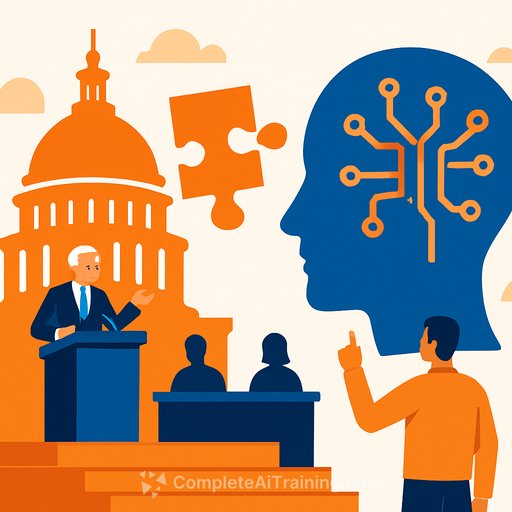
Congress Must Act to Prevent a Patchwork of State AI Laws
States are rushing to regulate artificial intelligence, creating a fragmented landscape that risks slowing innovation, increasing compliance costs, and weakening U.S. competitiveness globally. In 2023, over 450 AI-related bills were introduced across all states, Puerto Rico, the Virgin Islands, and Washington, D.C., according to the National Conference of State Legislatures.
While some state laws focus on specific local issues—like AI use in public education or election communication—many extend far beyond their borders, proposing broad regulations meant to govern AI nationwide. For example, Colorado enacted a law requiring companies to minimize harm from high-risk AI systems. California, despite Governor Newsom’s veto of a state AI safety bill, continues to regulate AI through privacy laws, notably under the California Consumer Privacy Act.
The Problem with Disjointed State Regulations
This rush to regulate resembles a chaotic intersection where every driver assumes the right of way. Some states impose strict restrictions, others propose vague rules, and some hold back entirely. The outcome is a complex patchwork of conflicting rules, duplicative requirements, and unclear enforcement risks.
Companies face growing legal uncertainty as they try to comply with dozens of different and evolving standards. This environment makes it difficult to operate efficiently across state lines and adds unnecessary burdens to innovation.
As of March 2025, more than 550 AI-related bills were introduced in this legislative session—on track to surpass previous records. If this trend continues, the U.S. will end up with inconsistent laws that fragment national AI policy, delay innovation, and create barriers to scaling AI technologies.
Strained Expertise and the Risk to U.S. AI Leadership
The flood of state legislation also strains the limited pool of AI policy experts. Researchers, technical specialists, and startups—key voices for effective, evidence-based policy—cannot engage meaningfully in hundreds of simultaneous legislative processes. This dilution of expertise reduces the quality and consistency of the resulting laws.
Unlike the U.S., China has adopted a centralized national AI strategy, aligning government, industry, and research under a unified mandate. The fragmented U.S. approach threatens startups and established firms alike with complex compliance burdens. When each state mandates different testing, deployment, or labeling requirements, national or global scale becomes nearly impossible.
Why Federal Preemption Is Necessary
Congress should step in to preempt state laws imposing broad AI requirements. This is not about removing all state involvement—local concerns like education or elections should remain under state jurisdiction. But when state laws affect interstate commerce by regulating AI development or use nationally, federal leadership is essential.
A consistent national framework would reduce complexity, lower compliance costs, and encourage innovation, while still allowing targeted safeguards where needed. It would also enable more focused stakeholder engagement, delivering smarter policy with fewer unintended consequences.
Importantly, the U.S. should resist pressure to rush broad AI laws simply to match the European Union’s pace. The EU’s comprehensive AI Act, while pioneering, risks stifling beneficial technologies before they mature. Premature broad mandates discourage the experimentation and iteration crucial for progress.
The U.S. already has strong laws covering consumer safety, discrimination, and other areas that apply to AI. Instead of reinventing the wheel, Congress should target specific harms not addressed by existing frameworks and craft narrow, effective legislation.
Examples of Focused Federal Action
One example of this approach is the bipartisan Take It Down Act, which makes knowingly sharing AI-generated sexual abuse material illegal. Introduced by Senators Ted Cruz and Amy Klobuchar with support from First Lady Melania Trump, this law addresses a clear, serious abuse of AI without overburdening the broader AI sector.
Conclusion
AI holds significant potential to improve lives, boost the economy, and support national goals—but only if innovators have clear, consistent rules to operate under. Congress should act to replace the current patchwork of conflicting state laws with a cohesive national strategy that avoids premature overregulation and keeps the U.S. competitive in global AI development.
For legal professionals and policymakers seeking to deepen their understanding of AI regulations and compliance, exploring specialized courses can be valuable. Resources such as Complete AI Training’s latest AI courses offer practical insights to navigate this evolving field.