
AI news ·
Xi announces World Artificial Intelligence Cooperation Organization and 5,000 AI training opportunities for developing countries
China will provide 5,000 AI training opportunities to developing nations over five years. Beijing also launched the first intergovernmental body for global AI governance.
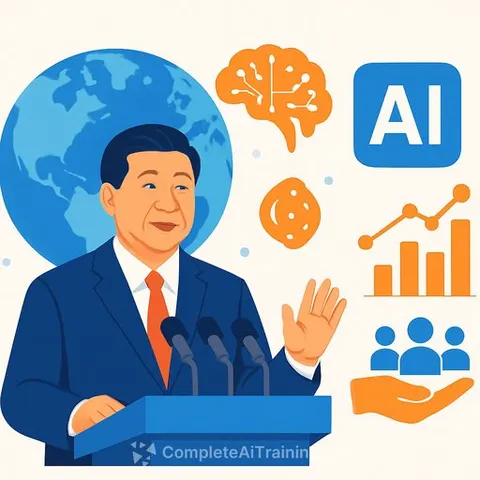
China will provide 5,000 AI training opportunities to developing countries over the next five years and has established a new intergovernmental body on artificial intelligence, President Xi Jinping announced on July 17 at the 2026 World AI Conference in Shanghai. The moves signal a push to build capacity in the Global South and create a formal structure for international AI cooperation, directly affecting IT and development professionals who will design, deploy, and govern these technologies.
Global capacity building measures announced
Xi outlined several concrete initiatives during his keynote speech. In addition to the 5,000 training slots, China will set up international AI application cooperation centers with regional blocs including ASEAN, the League of Arab States, the African Union, and BRICS. The country will also promote the deployment of MAZU, an AI-powered meteorological early-warning solution, in 30 countries. These efforts aim to localize technical expertise and infrastructure rather than keep AI development concentrated in a few nations.
The commitment includes a significant educational component that addresses a critical need for AI for IT & Development - professionals who can build and deploy systems responsibly across different regulatory and cultural contexts. The training opportunities target gaps in compute access, data resources, and technical know-how that UN Secretary-General Antonio Guterres described as a situation where "developing countries receive only a trickle of AI investment."
New intergovernmental organization established
Xi announced the creation of the World Artificial Intelligence Cooperation Organization, with headquarters in Shanghai. On July 16, representatives of 29 countries signed an agreement forming what Xi called "a major move by China to answer the call of the Global South and unite the international community." The body is the world's first intergovernmental organization dedicated to AI. Kazakh President Kassym-Jomart Tokayev said the decision was of "historic significance" and could become an important pillar of global AI governance architecture.
"It will be an important milestone in the history of AI development," Xi said. "AI development should be a symphony of international cooperation instead of a solo performance by a single country." The organization will handle alignment of development strategies, governance rules, and technical standards, aiming to form a consensus-based global governance framework under the United Nations umbrella.
Calls for inclusive and secure AI governance
Xi stressed that AI development must remain people-centered and under human control. He urged countries to strengthen legal, monitoring, early-warning, and emergency-response systems to prevent misuse or malicious use of AI, while opposing the "overstretching of national security concerns" that place one country's security above others. Guterres echoed this view, warning that "technology that will shape the future of humanity must be shaped by all humanity, and cannot be governed by only a handful of countries or companies."
Cambodian Prime Minister Hun Manet said developing countries should have meaningful and equitable access to AI technologies, data infrastructure, and localized tools, and that his country views AI as a bridge for international cooperation rather than a source of geopolitical rivalry. Thai Prime Minister Anutin Charnvirakul noted that technological progress alone does not guarantee human progress - that outcome depends on collective choices.
A chair's statement released the same day called for stronger international cooperation to tackle unequal access to resources and computing power so that Global South countries can share fairly in the benefits of AI and contribute to the UN 2030 Agenda for Sustainable Development.
Why this matters for IT and Development
The commitments made in Shanghai translate into near-term demand for developers, engineers, and architects who can work across borders and build AI systems in diverse environments. The push for open-source collaboration, innovation-driven development, and the deployment of localized solutions like MAZU means professionals will need cross-cultural technical skills and familiarity with emerging governance standards. The establishment of a formal intergovernmental organization also signals that AI standards and compliance requirements will accelerate, making knowledge of policy and ethical guardrails a practical asset for anyone building or managing AI systems.