
AI news ·
Zendesk targets language barriers with real-time voice translation as contact center AI vendors push for control
Zendesk is adding real-time voice translation to its contact center platform, letting customers and agents speak different languages on live calls starting with an Early Access Program in October.
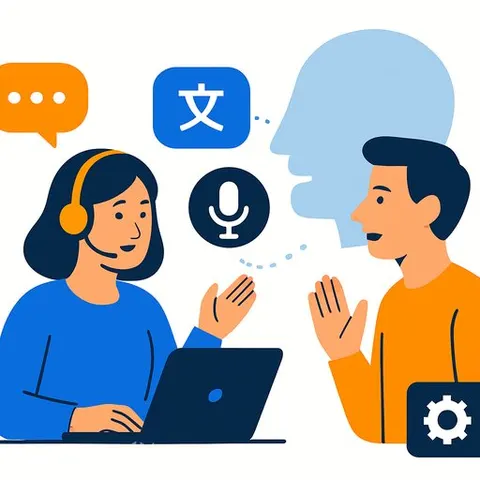
Zendesk is adding real-time voice translation to its contact center platform, a move that lets customers and agents speak different languages during live calls without routing to language-specific queues. The announcement leads a week of contact center news that also saw Genesys detail its AI orchestration plans, the New York Mets move to RingCentral, and Verint warn that fragmented data threatens AI's value.
The feature, called Real-Time Voice Translation, translates conversations in both directions. Zendesk positions it as a way to let agents focus on the issue rather than language matching. It enters a closed Early Access Program in October for eligible customers using Zendesk Contact Center Native, supporting 13 languages including Chinese, English, French, German, Hindi, Indonesian, Italian, Japanese, Korean, Portuguese, Russian, Spanish, and Vietnamese.
"Customers should not have to choose between speaking the language that feels most natural to them and getting the support they need," said Shashi Upadhyay, President of Product, Engineering, and AI at Zendesk. "Real-Time Voice Translation helps businesses make that kind of voice support available to more customers, while agents stay focused on solving the problem."
Genesys builds an AI coordination layer
At Xperience 2026, Genesys introduced its AI Control Plane and Contextual Intelligence capabilities, along with previews of Navigator and Orchestrator. Navigator acts as an AI-native front door that uses conversational understanding and customer history to determine whether a customer needs an AI agent, workflow, or human employee. Orchestrator retains the state of the customer journey and coordinates next-best actions across systems and channels.
"The future of CX is AI that understands intent, preserves memory across resources and moves the interaction forward until the customer's problem is solved," said Mike Szilagyi, SVP and Head of Product at Genesys.
The pitch reflects a market shift where vendors want to own the context and decision-making layer behind interactions, not just the routing. The risk for buyers is that another control layer could add complexity if it does not connect cleanly with existing CRM, service management, and data tools.
Verint flags the data fragmentation problem
Verint's State of Contact Center AI 2026 report offers a counterweight to the product launches. The research found that 87% of contact center leaders plan to increase spending on automated agent assistance, yet the average contact center uses technology from at least three providers. One in five uses five or more.
Fragmented systems undermine AI ambitions. An assistant cannot provide useful guidance without access to reliable customer history, knowledge content, quality data, or workforce information. The report also found that while 94% of organizations believe AI tools have improved agent performance, only 62% of consumers who noticed AI's impact on service view it as positive.
For teams implementing AI in their contact centers, these findings highlight a practical reality: the technology is only as good as the data feeding it. Supervisors evaluating AI Training for Call Center Supervisors often discover that data hygiene and integration work must precede any agent-assist rollout.
New York Mets modernize fan engagement
The New York Mets selected RingCentral to replace a legacy on-premises phone system and support communications for roughly 800 employees. The deployment includes RingEX for business communications and RingCX for contact center capabilities. The organization aims to scale ticket sales outreach and fan engagement through calling and SMS.
"Our goal is to be the most fan-friendly and technology-driven organization in baseball, that means continually investing in tools that strengthen how we connect with our fans and one another," said Oscar Fernandez, Senior Vice President of Technology for the New York Mets.
Sports franchises now manage high-value season-ticket relationships, game-day service spikes, merchandise sales, and constant digital communication. The real test will be whether interactions become more relevant and timely, not just more frequent.
Why this matters for customer support teams
Zendesk's translation feature could change how support leaders think about staffing. If the technology holds up in complex or regulated conversations, organizations could route interactions based on product expertise rather than language skills - particularly valuable for companies expanding into regions where call volumes do not justify a dedicated local team. The Verint data, meanwhile, is a reminder that AI tools deliver returns only when the underlying customer data is connected and reliable. For support teams evaluating these capabilities, integration with existing systems matters as much as the feature list.