AI tool
Waldo by Wherobots
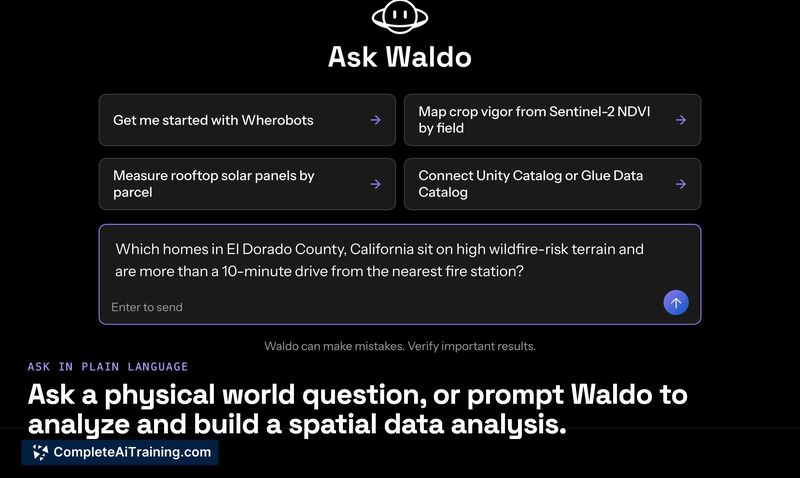
Waldo by Wherobots is an AI agent that helps data teams accelerate spatial data engineering and analytics. It lets users ask for physical world data in plain English and finds relevant open or private datasets to check for fit.
About Waldo by Wherobots
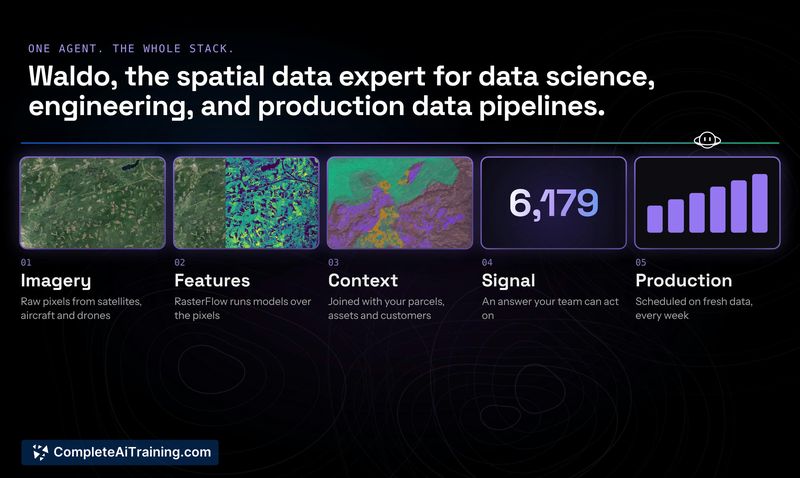
Waldo is a geospatial AI agent built by the creators of Apache Sedona. It turns plain-English questions about the physical world into analyses, maps, and production-ready data pipelines. The agent finds relevant datasets, writes and debugs spatial queries, runs inference on satellite imagery, and can schedule recurring pipelines on existing data platforms.
Review
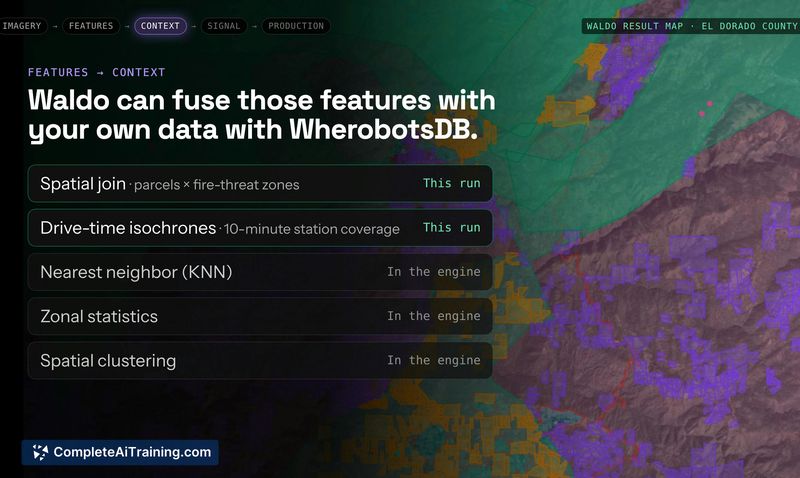

Waldo tackles a specific bottleneck: the gap between the volume of spatial data organizations collect and the scarcity of engineers who can work with it. It operates inside the Wherobots cloud platform, using WherobotsDB and RasterFlow as its compute engines. The tool is in public preview, and the team is actively shaping it based on user feedback.
Key Features
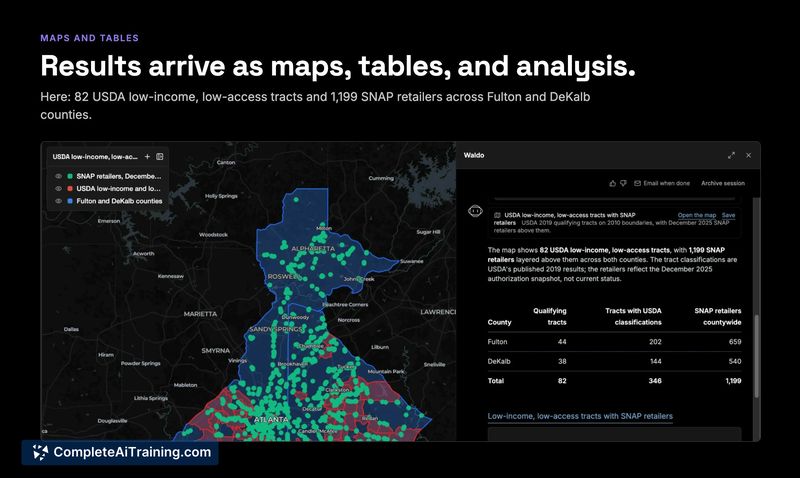
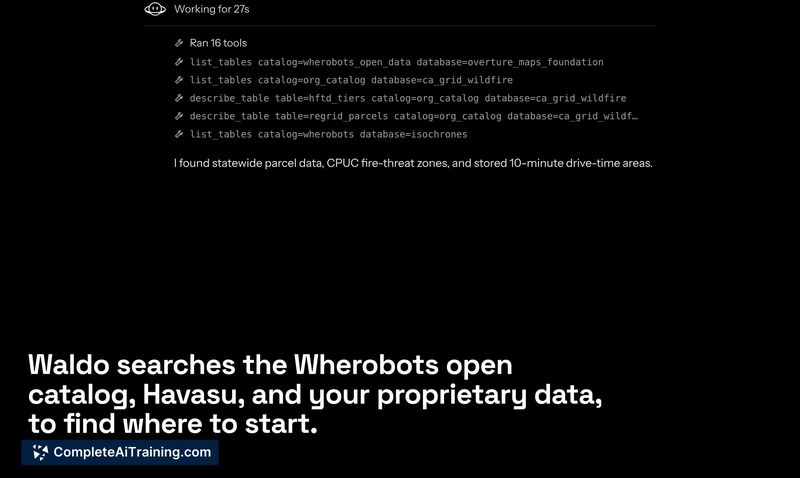
- Natural language spatial analysis. Users describe what they want to know in plain English. Waldo locates open and private datasets, checks them for suitability, writes the Python or SQL, and executes the analysis.
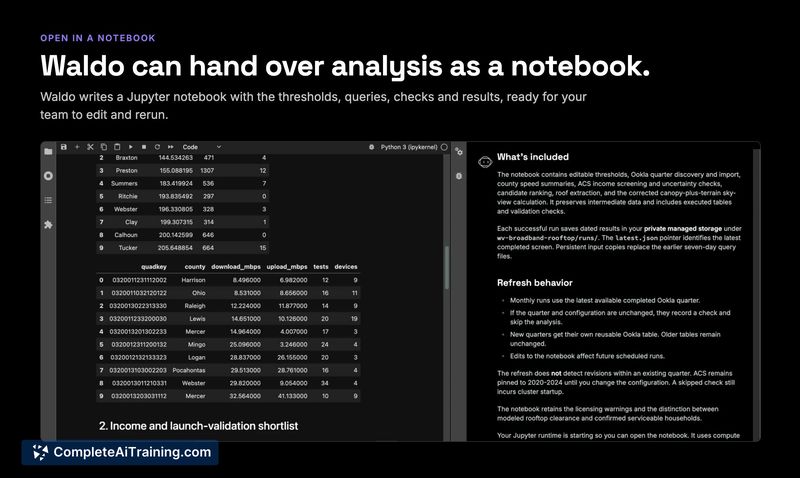
- Transparent work logs. Every result includes a "Worked" section listing the code, runtime, rows read, and source datasets with dates. This lets users inspect, copy, and build on the agent's output.
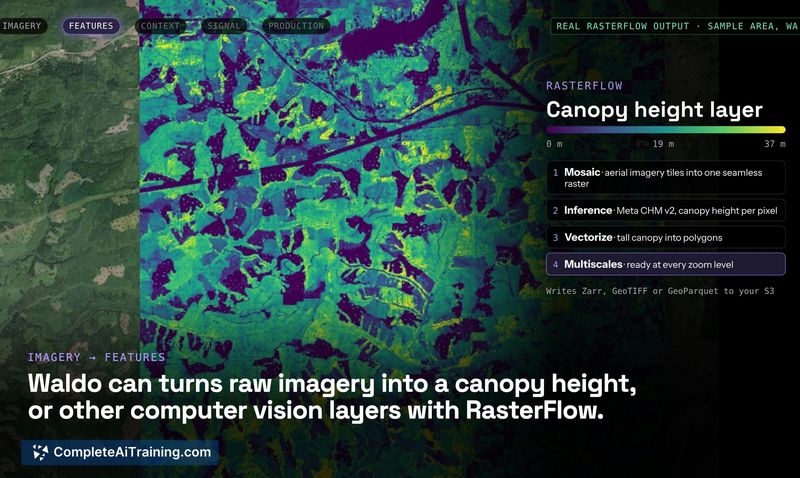
- Imagery inference at scale. Waldo invokes RasterFlow to run spatial AI models - Tile2Net, SAM3, CanopyHeights - on earth observation data without requiring users to orchestrate GPUs.
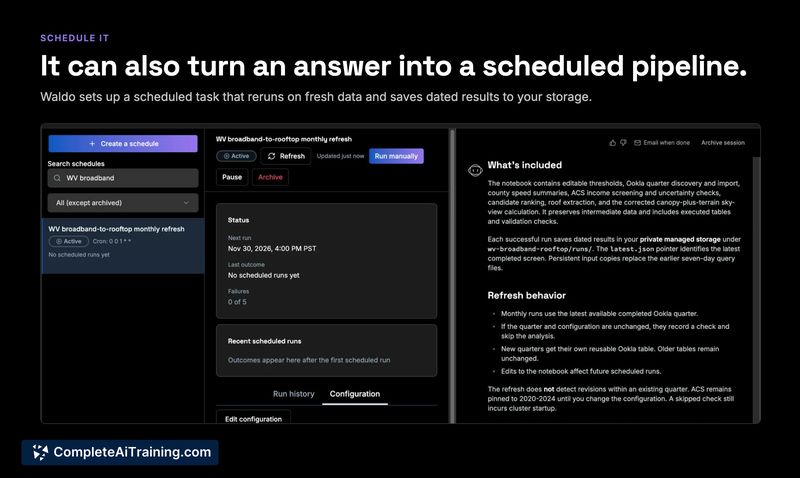
- Pipeline scheduling. When an analysis needs to run repeatedly, Waldo converts it into a scheduled pipeline on the user's existing data platform, targeting Iceberg-compatible systems like Databricks, Snowflake, or AWS Glue.
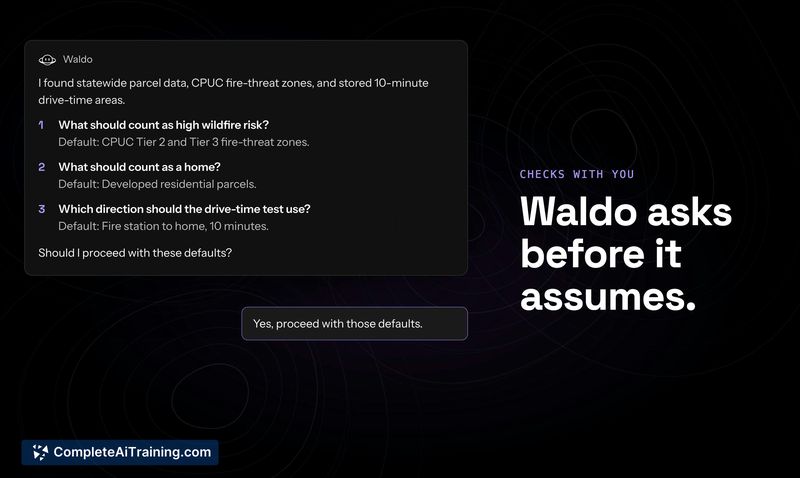
- Clarifying questions. If a prompt is ambiguous, Waldo asks up to three clarifying questions, each with a default answer, before proceeding.
Pricing and Value
During the public preview, Waldo tokens carry no additional cost - users pay only for compute. After the 14-day free trial (which includes $95 in compute credits and no credit card requirement), the Professional tier costs $95 per month in prepaid usage credits at $1.50 per Spatial Unit in US regions. An Innovation plan starts at $3,000 per month on an annual contract, including $3,000 in monthly usage credits and engineering support from Wherobots' team. Users who mention Product Hunt during signup can claim an additional $250 in trial credits.
Pros
- Reduces setup overhead by handling dataset discovery, loading, and relationship mapping automatically.
- Works across scales - from a single neighborhood to planetary datasets - using the same underlying compute engines.
- Shows its work step by step, so teams can verify results and learn spatial analysis techniques in the process.
- Integrates with existing data catalogs including Databricks Unity Catalog and AWS Glue.
- No local installation required; everything runs in the browser with managed AWS compute.
Cons
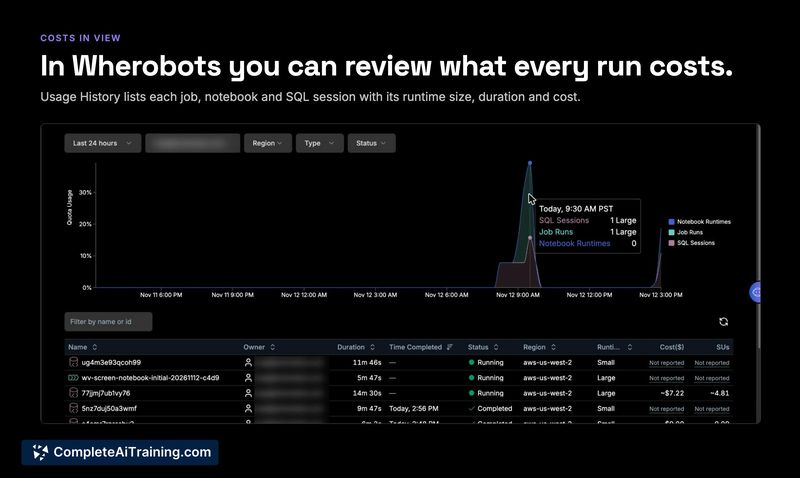
- Cost-conscious users need to monitor compute usage closely. Waldo spins up large runtimes when processing massive datasets, and the maker notes users should "be careful what you ask for."
- The tool is in public preview. Production behavior, stability, and the full scope of supported data platforms are still maturing.
- Not well suited for teams with no spatial data needs or those whose workflows don't align with the Wherobots cloud environment and Iceberg-compatible target platforms.
Waldo fits data teams that have spatial analysis backlog items piling up and lack enough specialized engineers to clear them. It's also a practical starting point for engineers new to spatial AI, since the agent demonstrates working code and data relationships rather than requiring upfront memorization of hundreds of spatial functions. Organizations already invested in Databricks, Snowflake, or AWS Glue will find the pipeline export path most directly useful.