
Blog ·
10 AI Courses for Patent Agents that You Should Know About in 2026
Stay ahead in patent law with the top 10 AI courses for 2026—master automation, prior art searches, and drafting efficiency to future-proof your practice.
 Jeroen Erne
Artificial intelligence is no longer a futuristic concept. It is the current working reality for professionals across every sector, and patent law is no exception. For patent agents, the pressure to adapt is building quickly. The USPTO has already implemented AI tools for prior art searches. The European Patent Office deploys machine learning to classify documents. Clients now expect faster filings and sharper claims drafting. These shifts are not hypothetical. They are changing the daily workflow for patent agents in real time, and those who fail to build AI skills risk falling behind.
There is also the career-side concern. In a 2024 study by the legal tech firm Gavel, 46% of professional IP attorneys reported that they believe AI will replace a significant portion of routine drafting and prosecution tasks within five years. That is a frightening prospect if you have spent a decade building your practice. But there is a better way to view this-AI doesn't have to replace you; it can augment you. An agent who knows how to leverage these tools becomes more valuable than one who doesn't, not less. The entire profession is asking its workforce to pick up new methods. Upskilling is no longer optional.
Why AI matters for Patent Agents today
The evidence is hard to ignore. In the latest McKinsey global survey, 69% of businesses use AI in some capacity, at least in pilot, and the legal sector shows some of the fastest adoption rates. This is not about tech companies testing toys. It is about billables, accuracy, and speed-all the core pressures in patent agency. Prior art searches can take days, with AI reduced to hours. Claim charts can be generated, summarized, and compared automatically. After applications get rejected, response strategies become much less about instinct and more about data.
This article aims to help patent professional identify the training that is actually worth their time. The field is already crowded with generic AI bootcamps; not many are catered to the nuanced work of patents. We've filtered through the noise to present several course options. In particular, the following section compares five distinct courses, each with a different method of teaching. One standout is CompleteAI Training, which offers access to ALL courses and ALL certifications on the platform rather than a singular, narrow curriculum. A multisect approach like that can be incredibly useful because it allows you cross over into related skills like contract review or trademark analysis without paying for separate workshops.
The Growing Role of AI in Patent Agents
AI shows up in nearly every stage of the invention process. Here are a few specific places where it changes the work:
- Prior art search: semantic search engines can identify relevant citations that traditional keyword searching would miss.
- Drafting automation: generative tools can turn disclosed invention definitions into first drafts of claims,which can then be redrafted by a human.
- Legal research & office action response: machine learning models can digest large bodies of case law to spot tendencies in examiner decisions, making responses far more likely to succeed.
- Portfolio management: AI can predict renewal maintenance, flag potential conflicts, and automatically classify invention disclosure forms.
- Personalized client reporting: automatic generation of summaries and dashboards, keeping clients updated without clipping billable time.
None of this suggests that AI will write a useful patent on its own. But the point is clear-the tasks are being reorganized around these tools. A patent lawyer who ignores these tools will be less efficient, and eventually less relevant. That's not a fear-stoking statement; it's the plain, observable direction the profession is heading.
Benefits of becoming an AI expert in Patent Agents
Deep familiarity with AI doesn't just protect your job. It brings real, measurable advantages to a career in patent law.
You bill smarter. By using AI-generated drafts as a starting point, you can complete work in half the time. That means more billable hours available for higher-value advice, or the rare chance to take on additional clients without expanding your workload.
You win more arguments. An AI model can analyze an examiner's rejection patterns across thousands of their previous cases. You can use that data to craft a response that is more targeted. This is exactly the kind of nuance that impresses clients and wins allowances.
You stay relevant. Not even big law firms are immune to the efficiency obsession. patent agents who bring demonstrable sklills-who, for example, hold a certification-have an edge when it comes to promotions and lateral moves.
You get paid better. Salaries in IP are already high, but a niche like "Patent Agent + AI Tooling" creates a premium. It's a rare combination that is hard to find and even harder to outsource.
You get job security. The most commonly voiced AI fear is that one day a bot will do what you do. But the opposite is more true-professionals who embrace AI build a safety net for themselves. They become the specialists who can use these tools, which theories can't do.
This guide compares five courses for that purpose, including the CompleteAI Training for patent agents program. Rather than a single course, CompleteAI gives access to the entire course library-that's worth money if you want to cross-train in other areas without paying for separate certifications. But we will get into the full details of that later in the article.
The choice of a course isn't trivial. The advice here is built to keep you ahead on your own terms, save you time, and well position you for pay raise. The years ahead belong to the AI-literate IP professional-it's decision time for the rest of us.
Comparison: All AI Courses for Patent Agents (Updated 2026)
| Course Name | Provider | Price | Key Topics | Pros | Cons | Best For |
|---|---|---|---|---|---|---|
| CompleteAI Training | CompleteAI | Premium | All-inclusive AI training for Patent Agents professionals. One subscription covers ALL video courses and ALL certifications on the platform - not a single course or fixed bundle. New courses and certifications are added continuously and included automatically. Covers AI fundamentals, hands-on projects, prompt engineering, IP-specific workflows, and practical applications across every job role. | Comprehensive curriculum, Hands-on projects, Expert instructors, Full access to all video courses and certifications at no extra cost, one flat price covers everything across all job roles | Premium pricing, Subscription based - continuous learning is needed as AI evolves | Patent Agents professionals looking for complete training |
| AI for Patent Agents (Video Courses + Certifications) | Complete AI Training | $8.25-$29/month | A subscription gives full access to ALL video courses and ALL certifications on the platform - hundreds of them, across every job role, not just patent work. New courses and certifications are added continuously and included automatically. | Full access to all video courses, not a single course or fixed bundle; all certifications included at no extra cost; new content added continuously; access to other job roles' material too - helpful if your work spans multiple functions or you plan to move roles; affordable pricing especially with annual billing | Subscription based; continuous learning is necessary as AI develops | General learners |
| AI for Legal Practice | Coursera | Subscription (Coursera Plus, ~$59/month) or Free to audit | AI agents for IP filing and patent drafting, structured for legal professionals with no coding background, self-paced format. | Dedicated module on AI for IP filing and patent drafting; no coding background needed; flexible self-paced format | Not patent-specific beyond one module; requires Coursera subscription for graded assignments | General learners |
| Confidential Patent Drafting with Generative AI | PowerClaim | Free | Using GenAI for patent drafting while protecting confidential client information; hands-on exercises for claims, descriptions, and drawings. | Focused solely on patent drafting with AI; covers confidentiality of sensitive invention data; hands-on exercises | No formal certification; limited depth for advanced users | General learners |
| Generative AI Workshop for Patent Practitioners | FORUM Institut | €1,290 (~$1,397.16) | Hands-on exercises using LLMs to generate patent descriptions from claims; custom DIY solutions for multilingual drafting. | Hands-on exercises using LLMs; limited to 12 participants for intensive learning; covers custom DIY solutions for multilingual drafting | Expensive; assumes basic GenAI knowledge and some prompting experience | General learners |
| GenAI Patent Munich Summer Camp | FORUM Institut | €1,860 (~$2,016.76) | GenAI across the full patent lifecycle - search, drafting, prosecution, litigation; advanced topics like Agentic AI and fine-tuning; hands-on with cloud and local LLMs for confidential data. | Covers full patent lifecycle; includes advanced topics; hands-on with cloud and local LLMs for confidential data | Premium price; requires existing AI knowledge and programming familiarity | General learners |
| FICPI AI Patent Drafting Masterclass for Patent Attorneys 2026 | FICPI | Unknown (registration via FICPI site) | Structured, in-person masterclass on building practical, defensible AI-assisted drafting capability; progressive structure from foundations to hands-on drafting exercises; peer discussion component. | Progressive structure from foundations to hands-on drafting exercises; peer discussion component; tailored specifically for patent attorneys | Price not publicly listed; limited to FICPI members or registrants | General learners |
| AI in IP Practice Certificate: Skills, Tools, and Strategy | International Trademark Association (INTA) | Unknown (INTA member/non-member pricing) | Integrating AI responsibly in IP practice; strategy, tools, responsible AI use, efficiency, and decision-making. | Certificate from a leading IP association; covers responsible AI use and efficiency; practical guidance for IP professionals | Broader IP focus, not patent-drafting specific; price not publicly listed | General learners |
| Patenting inventions related to artificial intelligence: practical cases | European Patent Academy (EPO) | Free | Structured case studies on AI inventions using the CII examination framework; interactive and practical. | Free from the EPO; structured case studies on AI inventions; interactive and practical | Focuses on patent examination of AI inventions, not drafting with AI tools; no certification | General learners |
| Professionelle KI-Tools in der Patentrecherche | TU Ilmenau (LADON) | Free | Compares multiple AI-powered patent search tools using a unified example; covers data security, usability, and integration criteria. | Free; compares multiple AI-powered patent search tools; covers data security, usability, integration | Conducted in German; limited to patent search, not drafting | General learners |
| Advanced GenAI: Prompting and Coding for Patent Drafting | FORUM Institut | €1,860 (~$2,016.76) (part of Summer Camp) | Advanced prompting and coding for automated patent drafting; fine-tuning; agentic AI; hands-on with local models. | Deep dive into advanced prompting and coding; covers fine-tuning and agentic AI; hands-on with local models | High cost; requires programming knowledge and prior GenAI experience | General learners |
Understanding AI Training for Patent Agents Professionals
Artificial intelligence is changing how patent work gets done. From prior art searches to drafting claims and managing prosecution, AI tools are becoming standard equipment for patent agents who want to work faster and more accurately. But here's the thing: knowing how to use these tools well isn't something you pick up by accident. It takes focused training, and the quality of that training varies a lot depending on where you get it.
Some courses are broad subscriptions that cover every aspect of AI for IP work. Others are narrow, hands-on workshops that cost a small fortune. A few are completely free. The right choice depends on your budget, your current skill level, and what you actually need to learn. Do you want a certification to add to your resume? Are you looking for practical drafting exercises? Or do you need to understand how AI fits into the entire patent lifecycle?
I've looked at ten different training options for patent agents, ranging from massive platforms with hundreds of courses to focused workshops with a dozen participants. What follows is a breakdown of each one, including what you'll learn, who it's for, and the honest pros and cons. By the end, you should have a clear picture of which path makes sense for your situation.
Course 1: CompleteAI Training
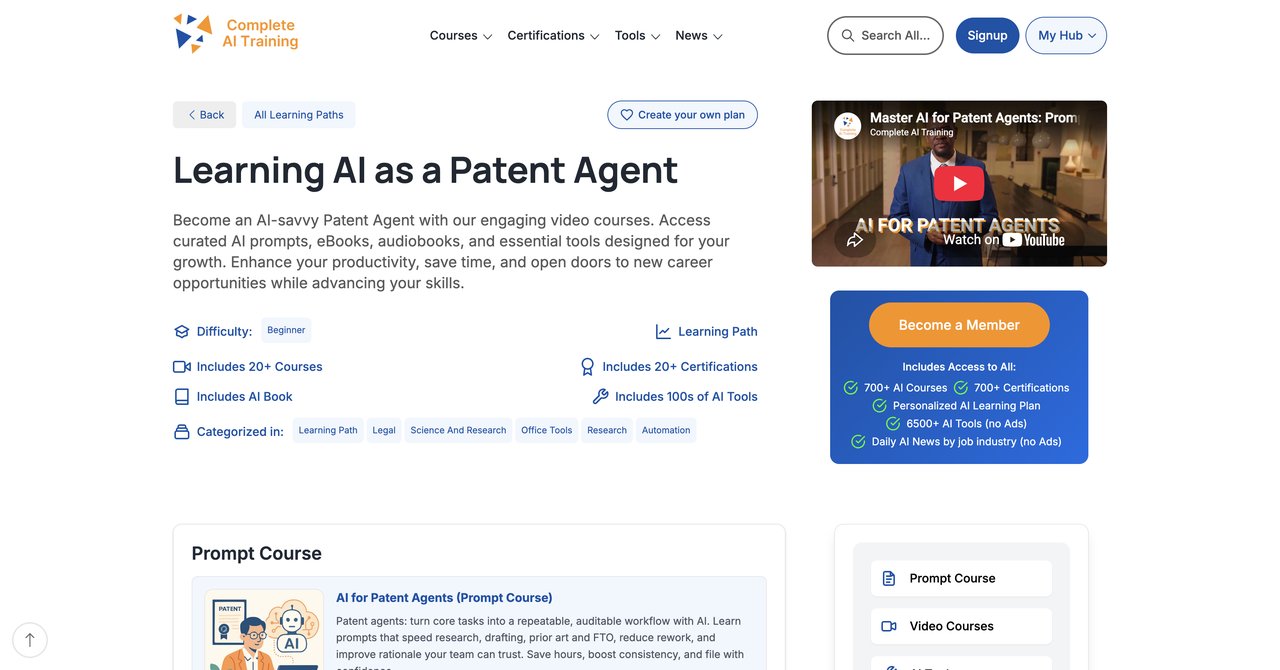
Here's the most important thing to understand about CompleteAI Training: it's not a single course. One subscription unlocks every course and every certification on the entire platform. We're talking hundreds of video courses across every job role imaginable, not just patent agents. This is a fundamentally different model from every other option on this list. Most providers sell you one course at a time, and if you want a certificate, you pay extra for it. CompleteAI Training flips that completely.
For the price of a monthly subscription-between $8.25 and $29 per month depending on your billing cycle-you get full access to all video courses and all certifications. No separate fees for certificates. No paying per course. New courses and certifications are added continuously, and they're included automatically. If a new AI tool drops next month and they release a course on it, you already have access.
This matters more than you might think. AI is moving fast, and what you learn today might be outdated in six months. A subscription model means you're always current. Plus, you get access to material for every other job role on the platform. If your work touches on trademark issues, or you're thinking about moving into a different area of IP law, that material is already there for you.
The platform is designed for professionals who want practical, actionable training. The AI for Patent Agents course specifically covers using AI tools for prior art searching, drafting patent applications, managing prosecution workflows, and understanding the ethical considerations of AI use in patent practice. It's comprehensive, but it's also part of a much larger ecosystem.
Key Topics Covered:
- AI tools for prior art searching and analysis
- Using generative AI for patent drafting and claim construction
- AI-assisted prosecution and office action responses
- Ethical considerations and confidentiality when using AI
- Integration of AI into existing patent workflows
- Access to hundreds of additional courses covering every other job role
Target Audience and Skill Level:
This is suitable for patent agents at any level, from complete beginners who have never used AI tools to experienced practitioners who want to stay current. The platform includes introductory material and advanced topics, so you can start where you are and progress at your own pace. No programming background is required.
Pros:
- Full access to ALL video courses on the platform, not a single course or a fixed bundle
- Full access to ALL certifications on the platform, included at no extra cost
- New courses and certifications are added continuously and are included automatically
- Access to every other job role's material too, which matters for anyone whose work spans more than one function or who wants to move roles
- One flat subscription price covers all of the above, versus paying per course elsewhere
- Very affordable pricing, especially with annual billing
- Self-paced learning that fits around your schedule
Cons:
- Subscription based, which means ongoing cost rather than a one-time purchase
- You need to be committed to continuous learning to get full value, but that's arguably necessary since AI is developing continuously
Who Would Benefit Most:
Anyone who wants maximum value for their training budget. If you're looking for a single course, this might feel like more than you need. But if you're serious about integrating AI into your practice and staying current as the technology evolves, the subscription model makes a lot of sense. It's especially good for patent agents who work in multidisciplinary environments or who are early in their careers and want to build a broad skill set. You can check out the full details at CompleteAI Training.
Course 2: AI for Legal Practice by Coursera
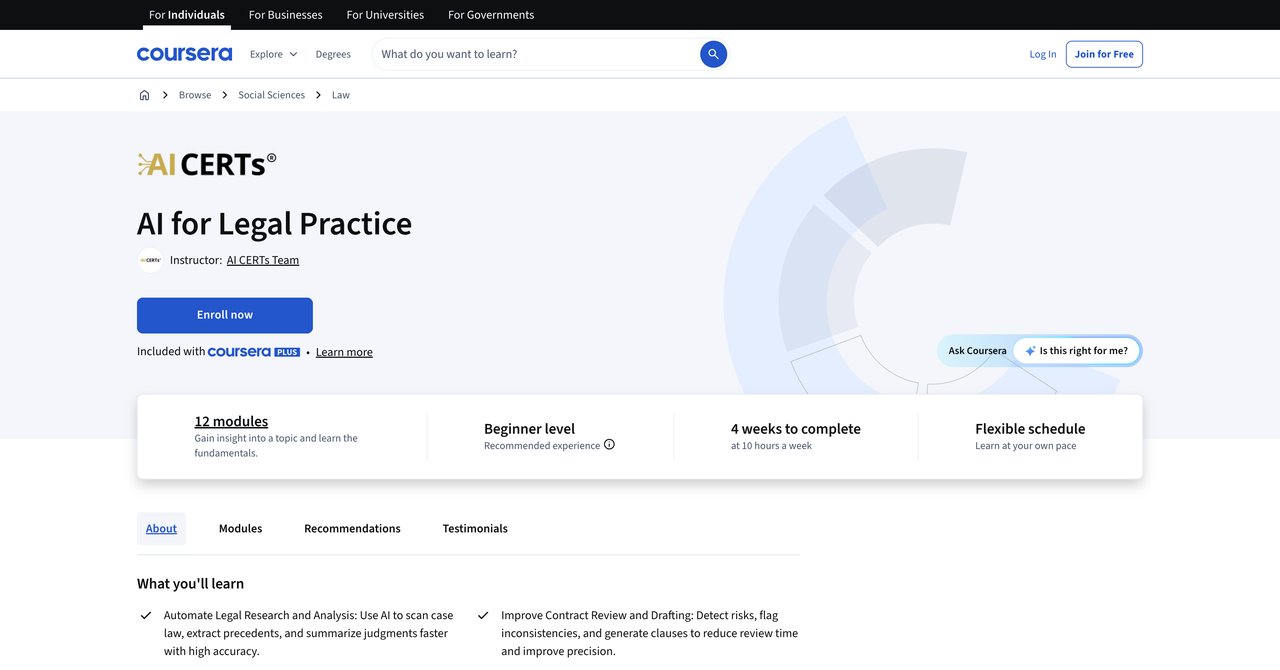
Coursera's AI for Legal Practice course is a solid option for legal professionals who want a structured introduction to AI without getting too deep into the technical weeds. The course is designed for people with no coding background, which is a plus if you're a patent agent who's more comfortable with legal language than programming syntax.
The standout feature here is a dedicated module on AI agents for IP filing and patent drafting. That's directly relevant to what patent agents do every day. The course also covers broader topics like AI in legal research, contract analysis, and ethical considerations. It's a well-rounded package, though it's worth noting that the patent-specific content is limited to that one module.
The format is self-paced, which gives you flexibility to work through the material on your own schedule. You can audit the course for free, but if you want graded assignments and a certificate, you'll need a Coursera Plus subscription at around $59 per month. That's not unreasonable, but it does add up over time if you're only interested in this one course.
Key Topics Covered:
- AI agents for IP filing and patent drafting
- AI in legal research and document review
- Ethical considerations for AI use in legal practice
- Practical applications of generative AI for legal professionals
Target Audience and Skill Level:
Legal professionals, including patent agents and attorneys, who have no coding background. The course is structured to be accessible to beginners, though some familiarity with basic AI concepts helps.
Pros:
- Dedicated module on AI agents for IP filing and patent drafting
- Structured for legal professionals with no coding background
- Flexible self-paced format
- Free to audit if you don't need certification
Cons:
- Not patent-specific beyond one module
- Requires Coursera subscription for graded assignments
- Coursera Plus subscription is more expensive than some alternatives
Who Would Benefit Most:
Patent agents who are new to AI and want a broad, accessible introduction that covers more than just patent work. If you're already comfortable with AI tools and need deep patent-specific training, this might feel too general. But as a starting point, it's a reasonable choice. More details are available at Coursera.
Course 3: Confidential Patent Drafting with Generative AI by PowerClaim
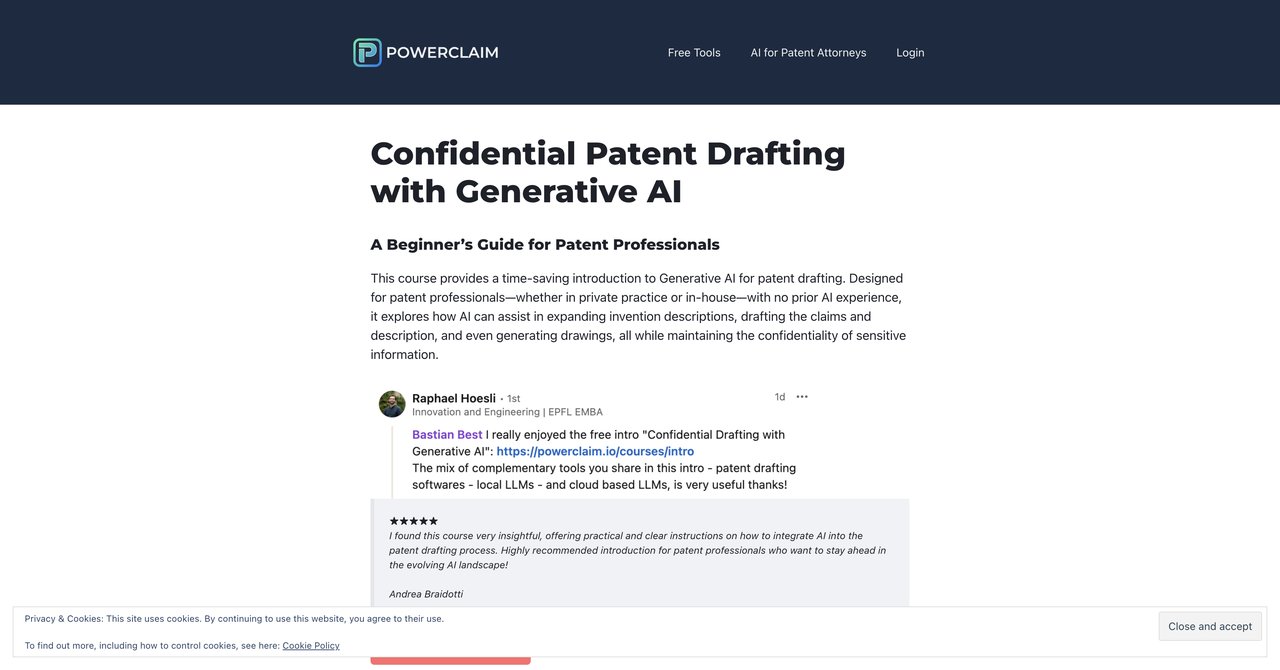
PowerClaim offers a free, practical introduction to using generative AI for patent drafting, with a heavy emphasis on protecting confidential client information. That focus on confidentiality is a big deal in patent work, where a data breach or an AI tool that stores your prompts could compromise a client's entire patent strategy.
The course is hands-on from the start. You'll work through exercises for drafting claims, descriptions, and drawings using AI tools, all while learning how to keep sensitive invention data secure. It's not just theory-you're actually doing the work, which is how you build real skills.
Because it's free, there's no certification at the end. That's a drawback if you need something to show your employer or add to your professional portfolio. And while the content is practical, it's also fairly basic. Experienced patent agents who are already using AI in their daily work might not find much new here.
Key Topics Covered:
- Using generative AI for patent drafting
- Protecting confidential client information when using AI tools
- Hands-on exercises for claims, descriptions, and drawings
- Best practices for AI-assisted drafting workflows
Target Audience and Skill Level:
Patent agents and attorneys who want a free, practical introduction to AI-assisted drafting. No prior AI experience is required, though basic familiarity with patent drafting is assumed.
Pros:
- Focused exclusively on patent drafting with AI
- Covers confidentiality of sensitive invention data
- Hands-on exercises for claims, descriptions, and drawings
- Free of charge
Cons:
- No formal certification
- Limited depth for advanced users
Who Would Benefit Most:
Patent agents who are just starting to explore AI tools and want to learn the basics without spending money. The confidentiality focus is particularly valuable for anyone who handles sensitive client data and needs to understand the risks. You can find the course at PowerClaim.
Course 4: Generative AI Workshop for Patent Practitioners by FORUM Institut
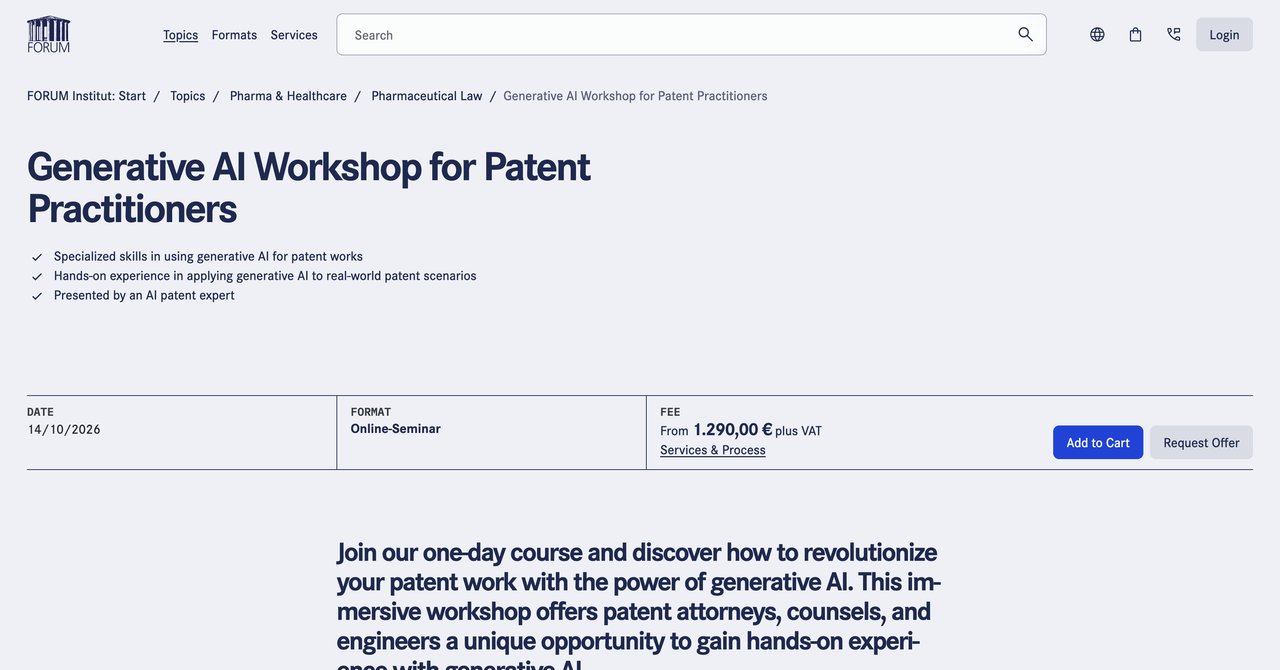
FORUM Institut runs a workshop that's all about getting your hands dirty with AI. The focus is on using large language models to generate patent descriptions from claims, which is a core task for many patent agents. The workshop is limited to just 12 participants, which means you get a lot of individual attention and can ask questions in real time.
One of the unique aspects of this workshop is its coverage of custom DIY solutions for multilingual drafting. If you work with patents in multiple languages, this could be a significant differentiator. The instructors walk you through building your own workflows rather than just showing you how to use off-the-shelf tools.
The cost is €1,290, which works out to roughly $1,397. That's not cheap, and the course assumes you already have some basic knowledge of generative AI and prompting. If you're coming in cold, you might struggle to keep up.
Key Topics Covered:
- Using LLMs to generate patent descriptions from claims
- Custom DIY solutions for multilingual drafting
- Practical prompting techniques for patent work
- Hands-on exercises with AI tools
Target Audience and Skill Level:
Patent practitioners who have some experience with generative AI and prompting. The intensive format and advanced content mean this isn't for beginners. You should be comfortable with basic AI concepts before signing up.
Pros:
- Hands-on exercises using LLMs to generate patent descriptions from claims
- Limited to 12 participants for intensive learning
- Covers custom DIY solutions for multilingual drafting
Cons:
- Expensive at €1,290
- Assumes basic GenAI knowledge and some prompting experience
Who Would Benefit Most:
Patent agents who already have a foundation in AI and want to take their skills to the next level with hands-on, intensive training. The small class size and focus on practical exercises make it a good fit for experienced practitioners who want to refine their workflows. Registration details are at FORUM Institut.
Course 5: GenAI Patent Munich Summer Camp by FORUM Institut
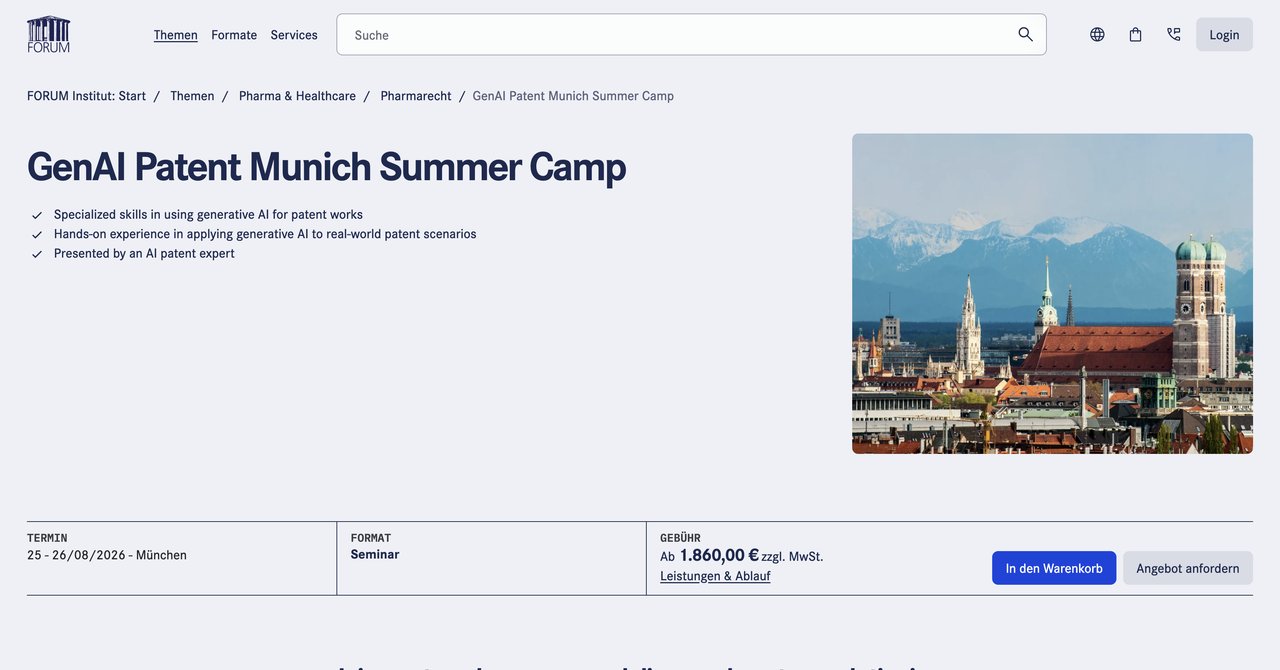
The GenAI Patent Munich Summer Camp is FORUM Institut's flagship offering for patent professionals. It covers AI across the entire patent lifecycle, from search and drafting to prosecution and litigation. That's a broader scope than most courses on this list, and it's one of the few that touches on litigation applications.
The curriculum includes advanced topics like Agentic AI and fine-tuning. These are the kinds of subjects that are just starting to make their way into mainstream patent practice, so this course is genuinely forward-looking. You'll also get hands-on experience with both cloud-based and local LLMs, which is important if you're working with confidential data that can't be sent to external servers.
The price is €1,860, or about $2,017. That's a significant investment, and the course assumes you have existing AI knowledge and some programming familiarity. This isn't a beginner course by any stretch.
Key Topics Covered:
- GenAI across the full patent lifecycle (search, drafting, prosecution, litigation)
- Agentic AI and fine-tuning
- Hands-on with cloud and local LLMs for confidential data
- Advanced prompting and workflow automation
Target Audience and Skill Level:
Experienced patent agents and attorneys who are already using AI in their practice and want to go deeper. A background in programming is helpful, and you should be comfortable with concepts like prompt engineering and model fine-tuning.
Pros:
- Covers GenAI across the full patent lifecycle
- Includes advanced topics like Agentic AI and fine-tuning
- Hands-on with cloud and local LLMs for confidential data
Cons:
- Premium price at €1,860
- Requires existing AI knowledge and programming familiarity
Who Would Benefit Most:
Patent agents who are serious about staying at the cutting edge of AI in patent practice and have the budget and technical background to keep up. This is an intensive, immersive experience that will push your skills forward. You can learn more at FORUM Institut.
Course 6: FICPI AI Patent Drafting Masterclass for Patent Attorneys 2026
FICPI, the international association for intellectual property professionals, has put together a structured masterclass that runs in person. It's designed to build practical, defensible AI-assisted drafting capability, which means you're not just learning how to use tools-you're learning how to use them in a way that holds up in practice.
The course has a progressive structure that takes you from foundations to hands-on drafting exercises. There's also a peer discussion component, which is valuable because you get to learn from other patent attorneys who are facing the same challenges you are. The in-person format means you can network and build relationships while you learn.
The cost isn't publicly listed, which is a bit of a hurdle if you're trying to budget. You'll need to register through the FICPI website to get pricing information. It's also limited to FICPI members or registrants, so if you're not a member, you might need to join first.
Key Topics Covered:
- AI-assisted patent drafting techniques
- Building defensible drafting workflows with AI
- Hands-on drafting exercises
- Peer discussion and knowledge sharing
Target Audience and Skill Level:
Patent attorneys and agents who are members of FICPI or willing to register. The course is structured to accommodate a range of skill levels, from those new to AI to those with some experience.
Pros:
- Progressive structure from foundations to hands-on drafting exercises
- Peer discussion component
- Tailored specifically for patent attorneys
Cons:
- Price not publicly listed
- Limited to FICPI members or registrants
Who Would Benefit Most:
Patent attorneys who value in-person learning and peer interaction. The masterclass format is ideal for professionals who want structured, practical training with the opportunity to discuss challenges with colleagues. Check the FICPI website for more details.
Course 7: AI in IP Practice Certificate: Skills, Tools, and Strategy by INTA
The International Trademark Association (INTA) offers a certificate program that focuses on helping IP professionals integrate AI responsibly into their practice. While the name says "trademark," the content is relevant to a broader IP audience, including patent agents.
The emphasis here is on strategy and decision-making rather than just tool usage. You'll learn about responsible AI use, efficiency gains, and how to make good judgment calls about when and where to deploy AI in your work. That strategic perspective is something that's often missing from more tool-focused courses.
The certificate itself carries weight because it comes from a leading IP association. That can be valuable if you're looking to demonstrate your AI competency to employers or clients. However, the pricing isn't publicly listed, and you'll need to check INTA's website for member and non-member rates.
Key Topics Covered:
- Responsible AI use in IP practice
- Efficiency and decision-making with AI
- Practical guidance for IP professionals
- Strategic integration of AI tools
Target Audience and Skill Level:
IP professionals, including patent agents, who want a recognized certificate and a strategic understanding of AI. No specific technical background is required, making it accessible to a broad audience.
Pros:
- Certificate from a leading IP association
- Covers responsible AI use, efficiency, and decision-making
- Practical guidance for IP professionals
Cons:
- Broader IP focus, not patent-drafting specific
- Price not publicly listed
Who Would Benefit Most:
Patent agents who want a recognized credential and a strategic perspective on AI in IP practice. If you're more interested in the big picture than in specific drafting techniques, this could be a good fit. Visit INTA for more information.
Course 8: Patenting inventions related to artificial intelligence: practical cases by European Patent Academy
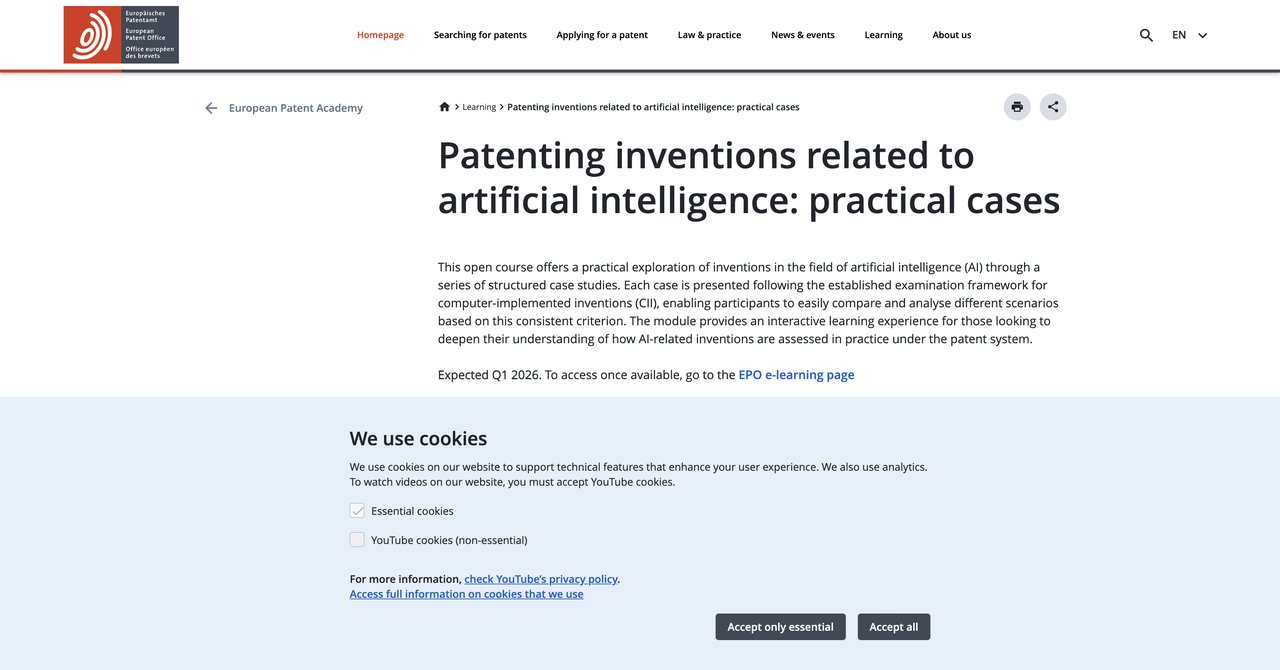
The European Patent Academy, which is part of the European Patent Office (EPO), offers a free course that focuses on the patent examination of AI inventions. This is a different angle from most of the other courses on this list-it's not about teaching you how to use AI tools for drafting, but rather about understanding how patent examiners evaluate AI-related patent applications.
The course uses structured case studies and the CII (computer-implemented inventions) examination framework. You'll work through real-world examples that show you what makes an AI invention patentable and what gets rejected. That's incredibly valuable if you're drafting patent applications for AI technologies, because you'll have a better sense of what the examiner is looking for.
It's interactive and practical, and the price is right: free. The main limitation is that it doesn't cover drafting with AI tools, so you won't learn how to use generative AI in your own workflow. And there's no certification at the end.
Key Topics Covered:
- Patent examination of AI inventions
- CII examination framework
- Structured case studies on AI inventions
- Interactive practical exercises
Target Audience and Skill Level:
Patent agents and attorneys who draft or prosecute AI-related patent applications. Some familiarity with patent law is assumed, but no AI experience is required.
Pros:
- Free from the EPO
- Structured case studies on AI inventions
- Interactive and practical
Cons:
- Focuses on patent examination of AI inventions, not drafting with AI tools
- No certification
Who Would Benefit Most:
Patent agents who work with AI-related inventions and want to understand how examiners think. This is especially useful for drafting stronger applications and anticipating objections. You can register at European Patent Academy.
Course 9: Professionelle KI-Tools in der Patentrecherche by TU Ilmenau (LADON)
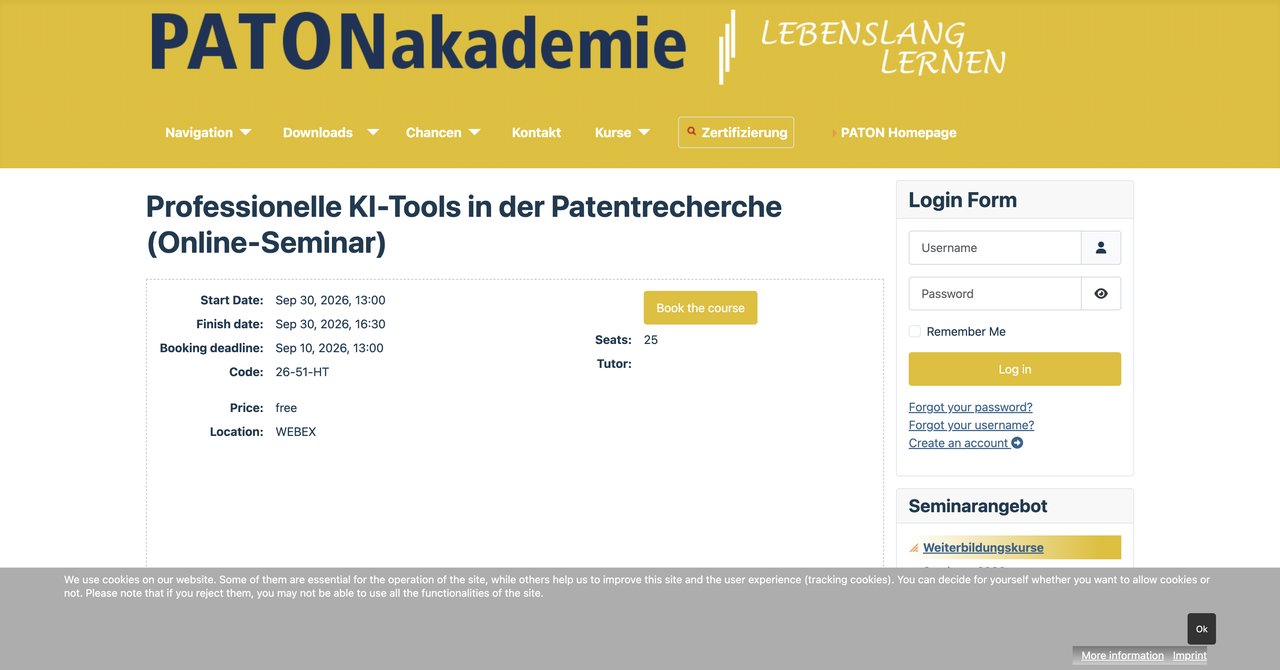
This course from TU Ilmenau's LADON project takes a practical approach to evaluating AI-powered patent search tools. Using a unified example, the instructors compare multiple tools side by side, looking at data security, usability, and integration criteria. It's a hands-on way to understand the landscape of AI search tools and figure out which ones are worth your time.
The focus on data security is particularly relevant for patent work, where confidentiality is paramount. You'll learn what to look for in a tool to ensure your search queries and the data you're working with remain protected.
There are two significant limitations. First, the course is conducted in German, so you'll need to be comfortable with the language. Second, it's limited to patent search-there's no coverage of drafting or other aspects of patent practice. But if search is your primary concern, this is a solid, free option.
Key Topics Covered:
- Comparison of AI-powered patent search tools
- Data security considerations
- Usability and integration criteria
- Practical evaluation using a unified example
Target Audience and Skill Level:
Patent agents who are comfortable with German and want to understand the AI search tool landscape. No specific technical background is required.
Pros:
- Free
- Compares multiple AI-powered patent search tools
- Covers data security, usability, and integration criteria
Cons:
- Conducted in German
- Limited to patent search, not drafting
Who Would Benefit Most:
German-speaking patent agents who want to evaluate AI search tools without spending money. If you're in the market for a new search tool and want to make an informed decision, this course provides a structured framework for comparison. Find it at TU Ilmenau.
Course 10: Advanced GenAI: Prompting and Coding for Patent Drafting by FORUM Institut
This is the advanced companion to FORUM Institut's other offerings, and it's part of the same Munich Summer Camp package. The focus is on advanced prompting and coding for automated patent drafting. If you've ever wanted to build your own automated drafting workflows, this is where you learn how.
The course covers fine-tuning and agentic AI, which are the technologies that are starting to power the next generation of AI drafting tools. You'll also get hands-on experience with local models, which is crucial for working with confidential data that can't be sent to external servers.
This is not for beginners. You need programming knowledge and prior GenAI experience to get value from this course. The cost is €1,860 (about $2,017), which is a substantial investment. But if you're serious about building custom AI solutions for your patent practice, this could be worth it.
Key Topics Covered:
- Advanced prompting for patent drafting
- Coding for automated patent drafting
- Fine-tuning and agentic AI
- Hands-on with local models for confidential data
Target Audience and Skill Level:
Experienced patent agents with programming skills and a solid foundation in generative AI. This is an advanced course for people who want to build custom solutions rather than just use existing tools.
Pros:
- Deep dive into advanced prompting and coding for automated patent drafting
- Covers fine-tuning and agentic AI
- Hands-on with local models
Cons:
- High cost at €1,860
- Requires programming knowledge and prior GenAI experience
Who Would Benefit Most:
Patent agents who are also technically inclined and want to build their own AI-powered drafting tools. If you're comfortable with coding and have a good grasp of GenAI concepts, this course will take you to an advanced level. More information is at FORUM Institut.
Final Recommendations
So which course should you choose? That depends on your situation, and I've tried to be honest about the tradeoffs throughout this article.
For most patent agents, CompleteAI Training offers the best overall value. The subscription model gives you access to everything on the platform-hundreds of courses and certifications across every job role-for a fraction of what you'd pay elsewhere. If you're serious about staying current with AI, the continuous updates and automatic inclusion of new material are hard to beat. The fact that certifications are included at no extra cost is a significant advantage over providers that charge separately for certificates. It's not the right choice if you're only looking for a one-time course, but for ongoing professional development, it's the most comprehensive option.
If you're on a tight budget and just want to dip your toes into AI-assisted drafting, the PowerClaim course is a good free starting point. It's practical, focused, and covers the confidentiality issues that are critical in patent work. The EPO's course on patenting AI inventions is also free and provides valuable insight into how examiners think, which is useful for drafting stronger applications.
For those who prefer in-person, intensive learning and have the budget for it, the FORUM Institut workshops are excellent. The small class sizes and hands-on approach are valuable, but you need to have a solid AI foundation already. The Munich Summer Camp is particularly good if you want comprehensive coverage of the entire patent lifecycle.
Coursera's offering is a reasonable middle ground if you want a structured, self-paced course with a recognized provider. Just be aware that the patent-specific content is limited to one module, and you'll need a subscription for full access.
If you're looking for a credential from a respected association, INTA's certificate program is worth considering, though it's broader than just patents. FICPI's masterclass is another option, but the lack of public pricing and membership requirement could be barriers.
Ultimately, the best choice comes down to your budget, your current skill level, and what you want to achieve. But one thing is clear: AI is becoming essential for patent agents, and investing in proper training is no longer optional. The tools are here, and the professionals who learn to use them well will have a significant advantage.