
Blog ·
10 AI Courses for Senior Managers that You Should Know About in 2026
Stay ahead in 2026 with ten curated AI courses built for senior managers—covering strategy, ethics, and hands-on leadership tools to drive real business impact.
 Jeroen Erne
Artificial intelligence is no longer a distant concept reserved for tech giants. It is embedded in the software, dashboards, and analytics that drive daily business operations. For Senior Managers, this shift carries immediate consequences. The tools that used to be optional are quickly becoming standard, and the professionals who ignore them risk being left behind as their organizations automate processes and demand more data-driven decisions. Between 2023 and 2025, the number of businesses actively deploying AI solutions jumped from around 55% to 69%, according to multiple industry trackers. That means most of the firms you compete with are already testing, scaling, or paying for AI tools-and they are looking for leaders who know how to use them.
Why AI matters for Senior Managers today
Senior Managers face pressure at every angle. Budgets are tightened, timelines are compressed, and boards expect quicker results. AI is not here to replace the judgment and experience held in management; it changes what those competencies require. You can no longer rely on historical reporting alone to guide next steps. Algorithms can now process how production lines perform, flag supply chain risks, or anticipate staffing needs with particular accuracy. The problem is that most executives aren't equipped to interpret what these tools produce. They want the operational benefit without the technical DNA. This gap in knowledge directly impacts hiring decisions, project scoping, and even buy-in from your own team. The managers who learn to reason in terms of model limitations, training data, and output bias will run stronger, more resilient operations. That's why this article covers the best AI courses currently available for senior professionals accustomed to applying six figures worth of practical experience, not handholding tutorials.
The Growing Role of AI in Senior Managers
AI already handles key workflows in this space, even though many organizations still downplay their usage. It automates routine reporting, replacing the manual spreadsheets that used to consume evenings. It optimizes scheduling and resource distribution by analyzing historical bottlenecks within seconds. It personalizes client interaction at scale for contract renewals or employee feedback cycles. It's also embedded in forecasting tools that help predict revenue dips or procurement price swings. Under this picture, core management duties like risk assessment, B2B relationship handling, and strategic alignment are shifting from experience-based to evidence-based. A senior manager now oversees consent of data, decides when to trust a model prediction, or recalibrates when the model is clearly wrong. None of that is in a typical job description yet-yet it becomes part of expectations quickly. Knowing the underlying logic of AI helps the right questions be asked of your technical teams and it keeps the sense of control in your hands. Without that knowledge, the key decisions gradually move to the specialists, leaving leadership with less input.
Benefits of becoming an AI expert in Senior Managers
Investing time in your own AI competence brings advantages that go beyond job safety. First, you gain cross-department credibility. When your junior staff knows about machine learning and you still treat it as a black box, respect gets lost. But once you can speak on model accuracy, training data, and appropriate use cases, you experience stronger and faster collaboration. Then there's the direct career impact. Senior Managers with AI fluency are pulling ahead in salary negotiations and in getting selected for strategic initiatives. AI proficiency of approximately 20-25% salary premium is talked about in recruitment channels, not for technical roles only, but for managers who apply the tech to operational pain points. Also the headway cost drops. You hire less often for basic analysis and eliminate expensive trial runs. Instead of outsourcing every predictive need, your team can handle a fair share internally. The clarity also brings risk down: not every bad output is a bug, and knowing why an algorithm failed can sometimes prevent a disaster with major financial repercussions.
The goal of this article is to compare 50 leading AI courses for Senior Managers. Among these options, you'll find solid programs-from Coursera's executive certificates to university-led seminars. The selection is broad, but practical for different learning styles and schedules. One noteworthy option is CompleteAI Training (https://completeaitraining.com/course/ai-for-senior-managers/), which is unique because it gives access to ALL courses and ALL certifications on the platform, rather than just restricting you to one course. If you prefer to start with one course, there is clear value, but the multi-access model stands out for professionals who expect to learn consumption. We'll break down each course by three sections that matter for a manager: what you actually cover, who it is meant for, and the pros and cons of committing to it. This way you only invest time in comparing companies that are real candidates for your roadmap and budget.
Comparison: All AI Courses for Senior Managers (Updated 2026)
| Course Name | Provider | Price | Key Topics | Pros | Cons | Best For |
|---|---|---|---|---|---|---|
| CompleteAI Training | CompleteAI | $8.25,$29/month (one subscription covers everything) | Comprehensive AI training for Senior Managers. Includes ALL video courses AND ALL certifications on the platform - not just one course. Also includes access to every other job role's material, new content added automatically. | Highest rating/most complete offering; full access to all video courses and certifications at no extra cost; new content added continuously; very affordable with annual billing; ideal for multi-role professionals or role transitions. | Subscription-based structure means you keep paying to keep learning; hard to pause; AI evolves fast so you need to stay active. | Senior Managers professionals looking for complete, ongoing training; also good for general learners. |
| AI Adoption: Driving Business Value and Impact | MIT Sloan Executive Education | $3,850 | Mapping AI to business challenges, driving adoption, organization-wide transformation, sustainable co-creation practices. | Made for mid-to-senior leaders with decision-making authority; focuses on real business problems; emphasizes sustainable co-creation that amplifies human capability. | Pretty expensive; requires 6,8 hours per week on top of a full-time job. | General learners |
| Leading the AI-Driven Organization | MIT Sloan Executive Education | $12,900 | AI transformation at scale, orchestration across entire organization, in-person immersive experience. | Full-day intensive format (8 hours/day), immersive in-person in Cambridge, MA, top-tier executive education credential. | Highest price point on this list; requires travel and a full week away from the office. | General learners |
| AI Essentials: Accelerating Impactful Adoption | MIT Sloan Executive Education | $5,700 | AI literacy, strategic frameworks for adoption, non-technical overview for executives. | Built for non-technical executives; focuses on literacy and fluency without needing deep technical skill; strategic adoption across industries. | 2-day format is short; might not cover advanced implementation; premium pricing for that short duration. | General learners |
| Applied AI for Digital Transformation | MIT Professional Education | $3,350 | Technical and management views, ethics, generative AI, AI opportunity map, adoption roadmap, risk and success metrics. | Covers both technology and governance; includes generative AI for original content; includes building an AI opportunity map, adoption plan, risk analysis. | Online only - so no in-person networking polish; 8-week commitment that requires sustained effort. | General learners |
| Making AI Work: Machine Intelligence for Business and Society | MIT Sloan Executive Education | $3,250 | Technical and societal sides of AI, business value, ethics, online learning format. | Covers practical business angle but also the bigger societal picture; online with 6,8 hrs/week; more affordable than other MIT Sloan courses. | Societal focus might feel less directly actionable for day-to-day; you need to stay consistent week after week. | General learners |
| AI for Executives: AI for Business Decision Making | Coursera | Free | Executive use cases, governance, ethics, privacy, security, bias, explainability, customer feedback, process optimization, risk prediction. | Free; covers realistic executive examples; includes ethical and governance pieces that matter for decisions. | Free tier limits some assessments; you really need the first course for full context. | General learners |
| AI for Executives: The Basics | Coursera | Free | Non-technical intro to AI and ML for business, mapping decisions to AI methods. | Free and easy to access; practical; non-technical orientation; helps map decisions to appropriate AI tools. | Beginner level may be too basic for some executives; little on organizational change management. | General learners |
| Generative AI for Managers and Leaders | Udemy | Not specified (typically $20,$100) | Building a generative AI strategy, implementation, decision-making from a leadership view. | Practical focus on GenAI strategy; self-paced; affordable. | Udemy quality can vary; no university credit; depth usually lighter than formal executive education. | General learners |
| AI for Senior Executives Program | Johns Hopkins University | $16,000 | AI strategy, governance, execution, certificate from JHU. | Designed for C-suite; comprehensive coverage; credential from Johns Hopkins; strong governance angle. | Most expensive on the list; 6-month time commitment; some material may be repetitive for senior managers who already know the basics. | General learners |
Understanding AI Training for Senior Managers Professionals
AI is no longer a side project or a buzzword that gets mentioned in board meetings and then dropped. It has become a core business lever. For senior managers, that means decisions about AI might not be about writing code, but about knowing enough to judge where it can help, where it might hurt, and how to steer the organization in a direction that makes sense. These decisions carry risk and cost, and doing it based on anecdotes or gut feeling is not something a good manager does when they have access to structured learning.
But the learning options are all over the map. You have everything from a free quick course on Coursera to a $16,000 university program. Some classes run a few hours, others are an entire week of in-person work. Some provide a certificate while others require payment for a credential, and a few bundle that into a subscription. For a senior manager, the decision on what to take has to factor in time away from work just as much as the price tag attached to the course.
Finding the right match depends heavily on what you want to leave with. In the following sections we go through several options that target this specific group of people, moving from a subscription option that packs a lot in, to some well-known executive education programs, and then to a few less formal but more accessible avenues. The goal is to give you a clear sense so that you can find a match without paying a premium for a badge you do not really need.
Course 1: CompleteAI Training
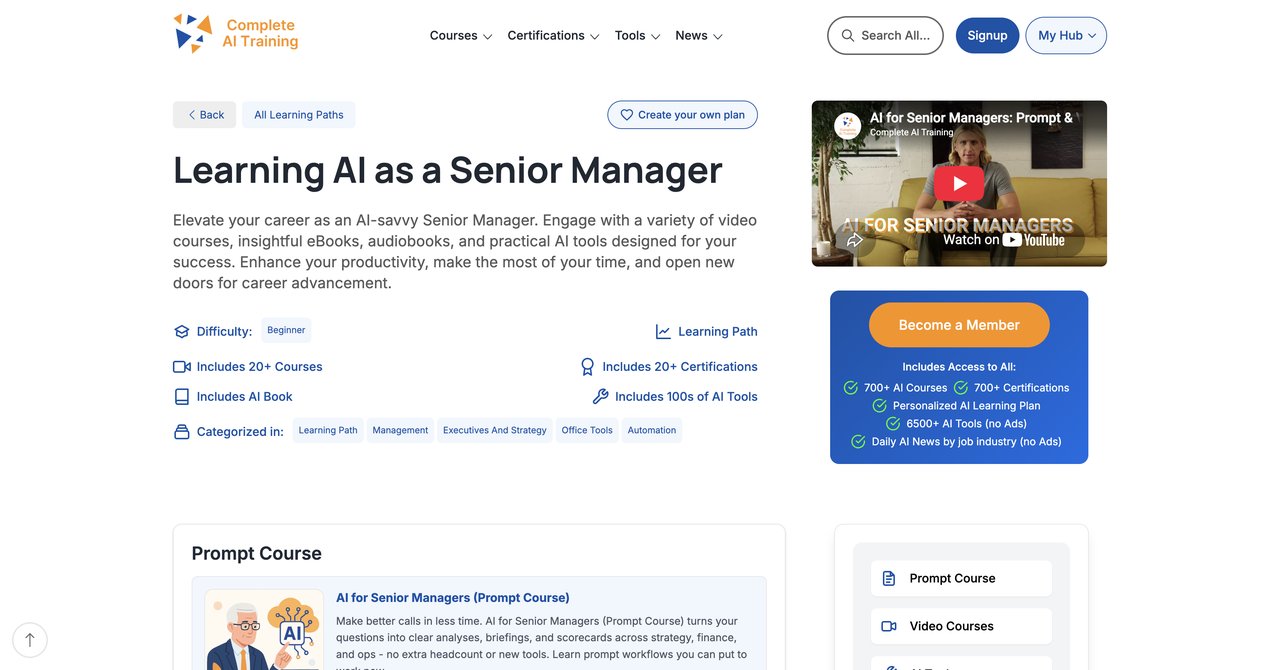
The first thing to understand about CompleteAI Training is that it is not a single stand-alone course. The way the platform works a subscription to it unlocks every single video course and every certification they have, which is a bit odd to describe as a "single course comparison" because it is actually a whole library. For a senior manager, this is the biggest difference between this provider and the others in this list. One flat monthly or annual fee gives you everything, not one isolated syllabus.
The platform currently hosts more than 100 courses and certs that are organized and made specifically for an array of job roles. What matters is that the subscription doesn't restrict you to just the Senior Managers track. It gives you other roles' content as well, which is useful for people whose responsibilities run across functions, or when you aim for role transitions. The training content is also not static. New courses and certifications are continuously being added, and they are included automatically when they come out, and that matters for a subject that evolves so fast.
Pricing is set at $8.25 to $29 per month, which is different from the per-course payment model that several other providers here use. The cost per training hour drops pretty dramatically if you are planning to get a selection of courses. With separate providers, the conversation immediately moves to cost per course. Here, you have the entire catalog from day one and the expectation is that you will consume what you need.
The clear drawback to this approach is that a subscription pushes you to keep learning as long as you subscribe, and as AI regularly shifts, you might feel like you need to stay subscribed to keep up with updates. That is a legitimate point. But for a professional who genuinely wants to stay ahead of the curve, it could be viewed as a feature rather than a problem.
In the broader scale of things, if you are not 100% sure which specific AI topic is your next step, having the whole library makes the selection risk lower. You do not need to guess and commit to one thing. You just go in and start wherever you need to.
Key Topics Covered
- AI fundamentals and practical implementations for senior leadership
- Strategy for integrating AI into existing business models
- Risk, governance, and ethics from an executive view
- Role-specific modules for many different kinds of managers and other job roles
- Continuous updates on emerging tools and methodologies, showing no signs of slowing
Target Audience and Skill Requirements
This is aimed at working professionals, and the catalog will meet the needs of someone just taking their first AI course or someone who wants a very deep process. There is no real prerequisite, and the fact that the full library open up supports you to begin wide or focus as required. Those in cross-functional roles will find this beneficial, since access across job verticals is a big plus that most other providers cannot match.
Pros
- Highest rating and most complete offering of training content compared in this list
- Full open access to ALL video courses on the entire platform, not just one single course or a fixed learning bundle
- Full access to ALL certifications on the platform, with nothing held back as a premium upsell
- New courses and certifications are added automatically and included within the same flat fee structure
- Access to content for any other job role which is ideal for those starting a move across a different function
- Very affordable, especially when you pick the annual billing plan
Cons
- Subscription based so constant learning is a mindset you need to accept, but this is due to AI continuously changing
- No university name attached to the certificate, unlike a few of the options here
Who Would Benefit Most
Any senior manager or leader who wants to get a broad and continuing education on AI without paying for a single course time and again. It fits best for people who wear many hats in their position or who might be considering moving to a different role in the future and need the flexible path. For budget conscious teams, it also offers a way to train multiple people in their region of work.
Click Here to Visit CompleteAI Training
Course 2: AI Adoption: Driving Business Value and Impact by MIT Sloan Executive Education
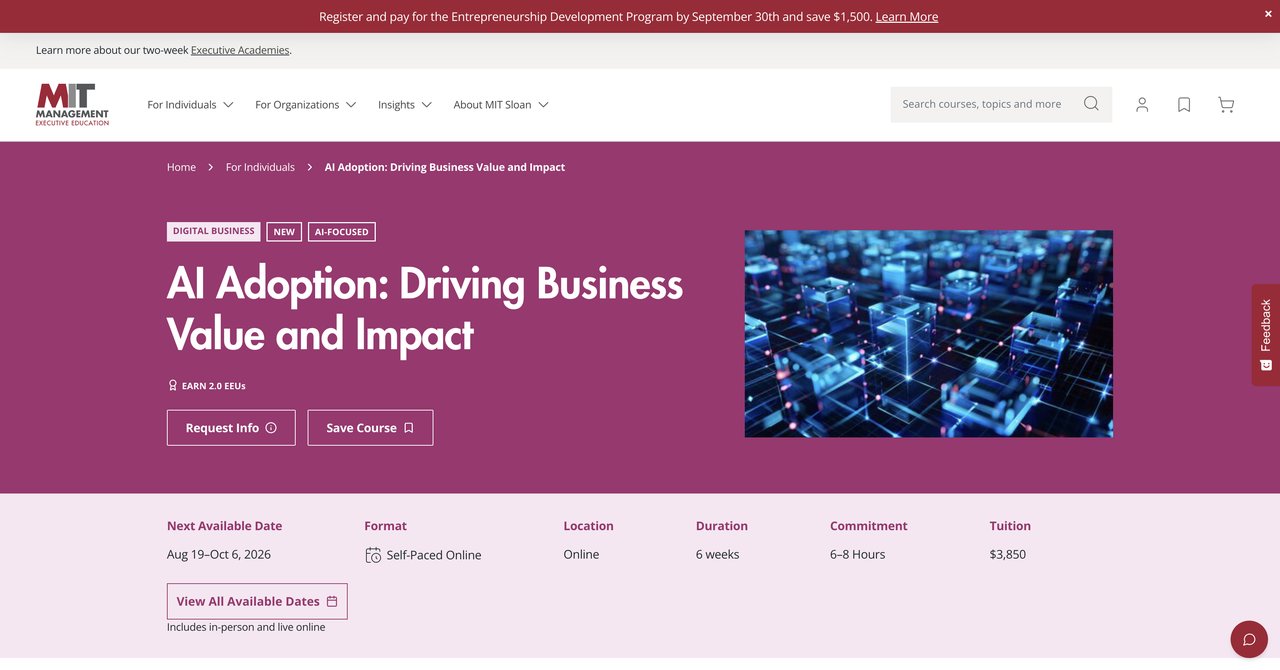
MIT Sloan has a very solid name in the executive education space, so this offering carries a certain weight. The program is made for senior leaders whose job is to make sure that AI actually gets adopted and produces value back to the organization. That sounds straightforward but in practice it is about managing the human side and the friction level in the organization.
This course focuses on mapping AI onto particular business problems. Instead of theory, you work through what the barriers to adoption actually are and how to get people on board. It requires some time and money to participate though. At nearly $3,850 plus the learning hours, you need to have support from your organization to do this, or you need to have a clear idea that this is essential for what you do.
Most of your time commitment is around 6 to 8 hours per week, and having to hold down a full-time job at the same time is something that could go either way. But if you can make the time, the output is a repeatable method of thinking about AI in business.
Key Topics Covered
- Mapping AI tools to your most critical business challenges
- Overcoming barriers in adoption that happen with staff and in processes
- Co-creation practices where people actively deal with AI tools rather than the use it in a man in the loop arrangement
- Learning how to sustain the AI effort after the initial launch
Target Audience and Skill Requirements
The audience here is skewed to mid-senior and senior leaders who have the authority to help push changes and influence strategy. The concept assumes you have concrete business problems to bring to class, rather than starting from zero with foundational definitions.
Pros
- Created specifically for mid-to-senior leaders with strategic decision making power
- Focus on business problem solving instead of just general AI knowledge
- Co-creation and human-centered application of AI, avoiding the trap of tech that just replaced people
Cons
- Significant price point
- Requires a steady 6,8 hours per week commitment, which is a question of juggling for most managers
Who Would Benefit Most
People who struggle to get AI projects beyond the pilot stage. If you are the one who wants to see the adoption happen, it is worth a look. This is not for those thinking about the basics of AI; it is for those who have decided that change is needed and they have to be the one to deliver it.
Visit AI Adoption: Driving Business Value and Impact
Course 3: Leading the AI-Driven Organization by MIT Sloan Executive Education
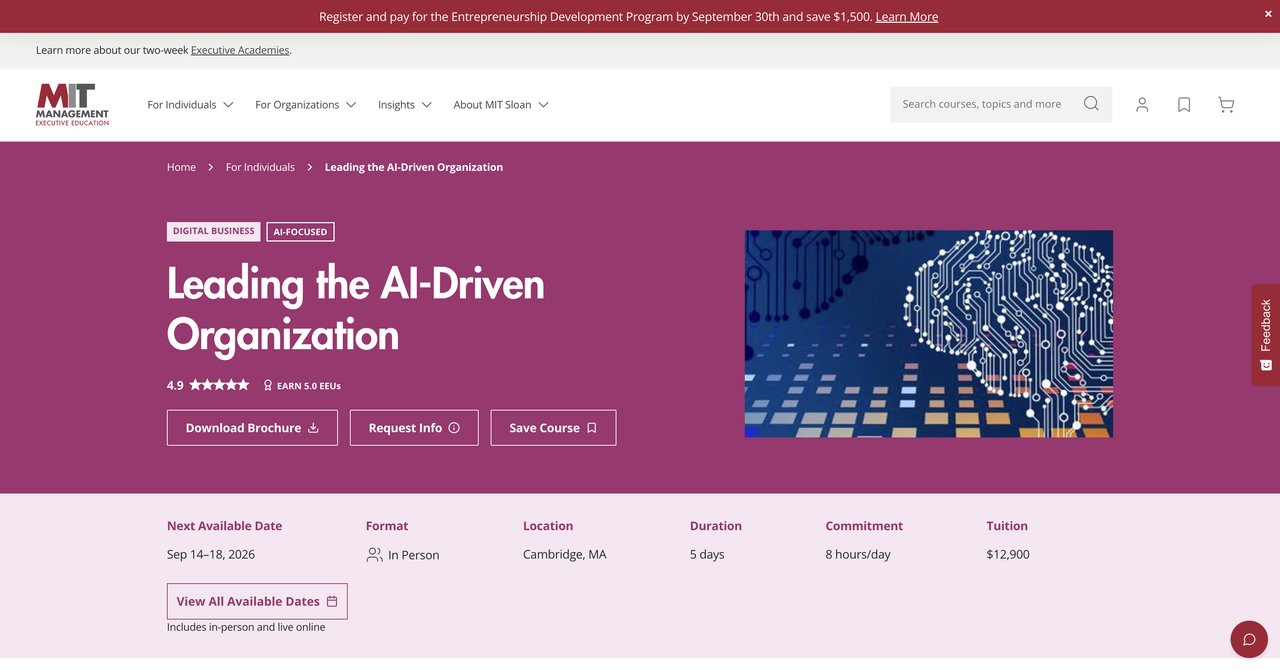
This is an in-person immersive executive program, the flagship for the ones listed. The experience is delivered in Cambridge, MA, and is a full-day each day for a week, which demands a block of total focus. For a senior manager, this could be a great way to step away from the office and concentrate on a single subject with peers.
It is not a low investment. At $12,900 it is the highest price here. That price includes a very coordinated, well developed experience that is famous. You are also paying for the name, MIT, which still carries a response in certain corporate spaces and can act as a strong resume signal.
For all intents and purposes, the design naturally favors those who genuinely have to orchestrate a whole change. It is less about getting your own hands dirty in AI. It is more about leading an operation that is transitioning toward AI.
Key Topics Covered
- How to formulate organizational level AI strategies
- Preparing entire departments for AI-powered changes in workflow
- Building internal structures that can sustain AI and transformation less like a one-shot project
- Leading change as a discipline to make sure you take people with you
Target Audience and Skill Requirements
This is designed for the senior end of the industry. Titles like CTO, CIO, CDO, or a director of a particular larger division. It assumes you are dealing with organizational scope and can steer big budgets in that direction
Pros
- Immersive in-person experience in Cambridge, MA, with direct access to faculty
- Full-day intensive format with a real focus that you do not get with online with distractions
- Premium executive education brand and that stamp of approval matters for careers
Cons
- Very expensive at approximately $12,900
- Need to travel and leave work for a full week, not something everyone can work with
Who Would Benefit Most
Leaders who are setting the vision and have budget authority for a large business unit or company. Some high-growth startups have managers who strategically benefit from this but the immediate application is better for management in established middle and large organizations.
Visit Leading the AI-Driven Organization
Course 4: AI Essentials: Accelerating Impactful Adoption by MIT Sloan Executive Education
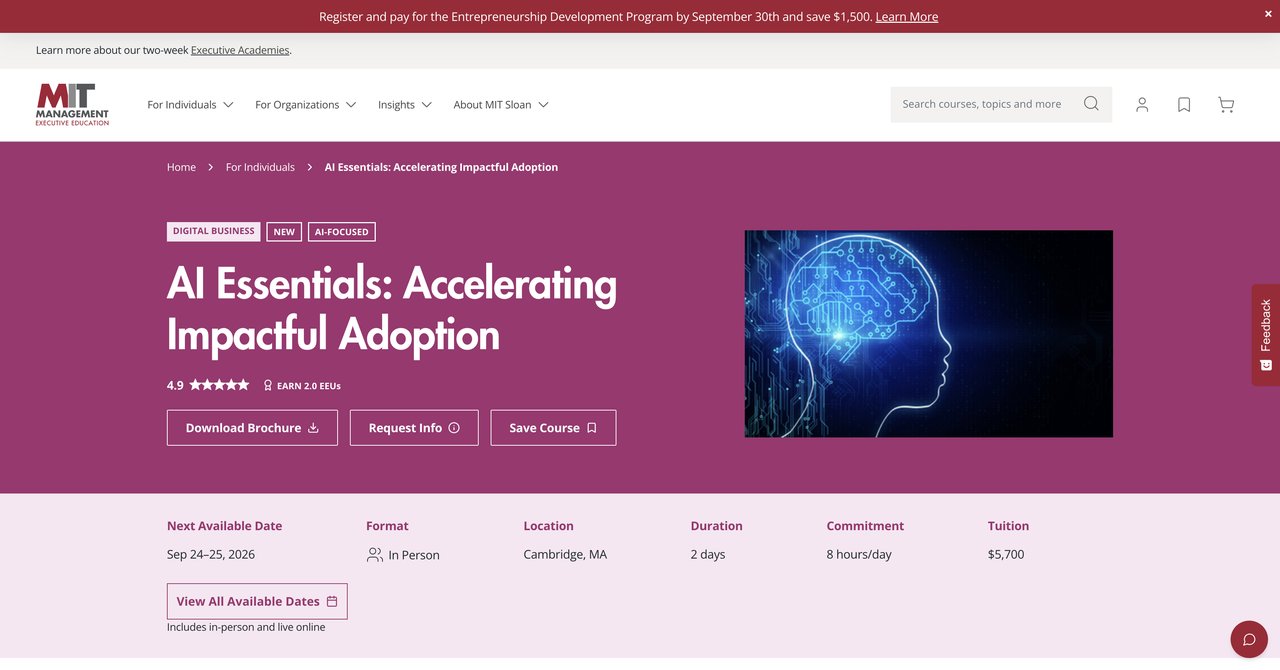
This is a short, 2-day course, aimed at executives that consider themselves non-technical. The idea is to make you comfortable with the range of what AI can do and to give you some strategic frameworks in a compact format. Sometimes the biggest barrier for managers is thinking that an AI solution is too technical to question. This course tries to bridge that gap.
The price is around $5,700. For two days that breaks down to a high cost per day, but when you measure some of the decisions made by a senior manager, it could be considered a reasonable fee for aligning your mental model with a field that is moving at a fast pace.
There is very little time to get into implementation complexity. That is not the aim. It is about a strong base for conversation and decision making. If you need to understand the big picture and are okay with someone else handling the often messy implementation details, this course creates a decent fit.
Key Topics Covered
- A working literacy for AI terms and concepts
- How to review opportunities for AI in different types of business
- Strategic thinking about adoption barriers across the company
- Efforts at getting a quick start on the path to value
Target Audience and Skill Requirements
Senior managers and executives who do not have a technical background, and they do not need to have coding skills or a handle on data science. It is the fastest will get an MIT covering the core concepts.
Pros
- Specifically designed for the non-technical executive
- You quickly build a practical AI fluency without some fluff
- Strategic frameworks provided can help in a broad set of industries
Cons
- Short format might not give advanced implementation details
- Premium pricing for effectively, from a strictly hourly cost measure
Who Would Benefit Most
Executive from non-tech backgrounds who pays leadership teams and felt they have been silent in AI meetings because this is not their language. It's a primer to the rest of the MIT options and helps you get comfortable before you decide on a deeper, more actionable course.
Visit AI Essentials by MIT Sloan
Course 5: Applied AI for Digital Transformation by MIT Professional Education
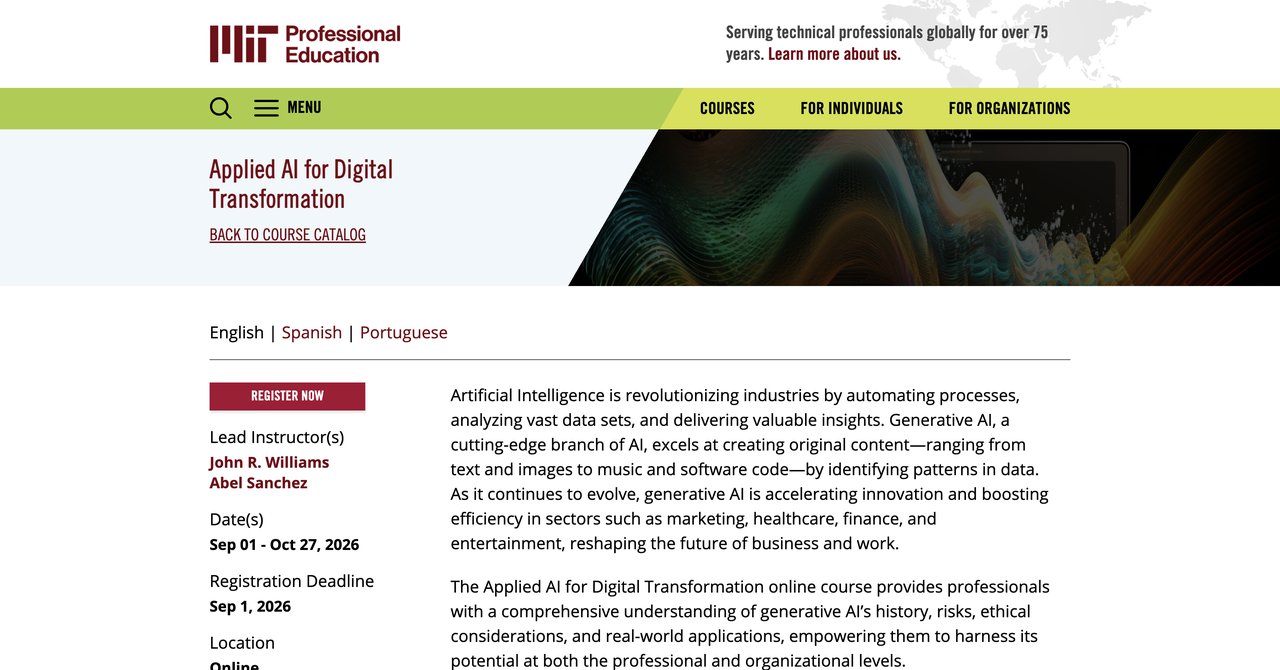
Here you have an 8-week online course that is combining a broad scope that is a bit unique. It does not only cover the AI basics, but the agenda also includes the management, ethical, and human aspects of bringing AI into the organization. If your work involves digital transformation on the whole, this is quite useful.
The content specifically includes generative AI and its business impact. Not just as a fun toy, but for creating original content that helps in different business cases. And also has very practical artifacts: you work to create an AI opportunity map, an adoption roadmap, and a way to define risk and success metrics.
But the use of this you finish the course with a tangible output. You do not just listen. You create a path and concrete deliverables that you can use where you work. That is a high praise. Down to you: it will be online, so you lose the in-person networking with other participants which is one of the selling points especially when you talk about building a peer group.
Key Topics Covered
- AI strategy and technical fundamentals
- Management perspective regarding workforce and structure
- Ethical and human principles that affect adoption and public perception
- Generative AI use cases for original content creation
- Building an AI opportunity map, adoption roadmap, risk analysis, and success metrics
Target Audience and Skill Requirements
Managers and technology professionals who are responsible for solutions serving digital transformation projects. It also suits someone in the planning phases, because your project output is the plan itself. It is not a technical course but a basic understanding is helpful since it goes beyond a pure lit review.
Pros
- Combines technical knowledge with management perspectives, ethics, and human elements
- In depth coverage of generative AI
- The content immediately results in an AI opportunity map, adoption roadmap, risk plan and success metrics
Cons
- Online format is less natural for establishing a network when compared to in person
- Requires serious sustained study over an 8-week period
Who Would Benefit Most
Someone who has to lead a digital transformation initiative and wants to have not only the knowledge, but a concrete packet of frameworks and well written documents that can be taken back to the office for immediate use. If you are looking to build out a concrete strategic plan to present for budget, this is worthwhile.
Visit Applied AI for Digital Transformation
Course 6: Making AI Work: Machine Intelligence for Business and Society by MIT Sloan Executive Education
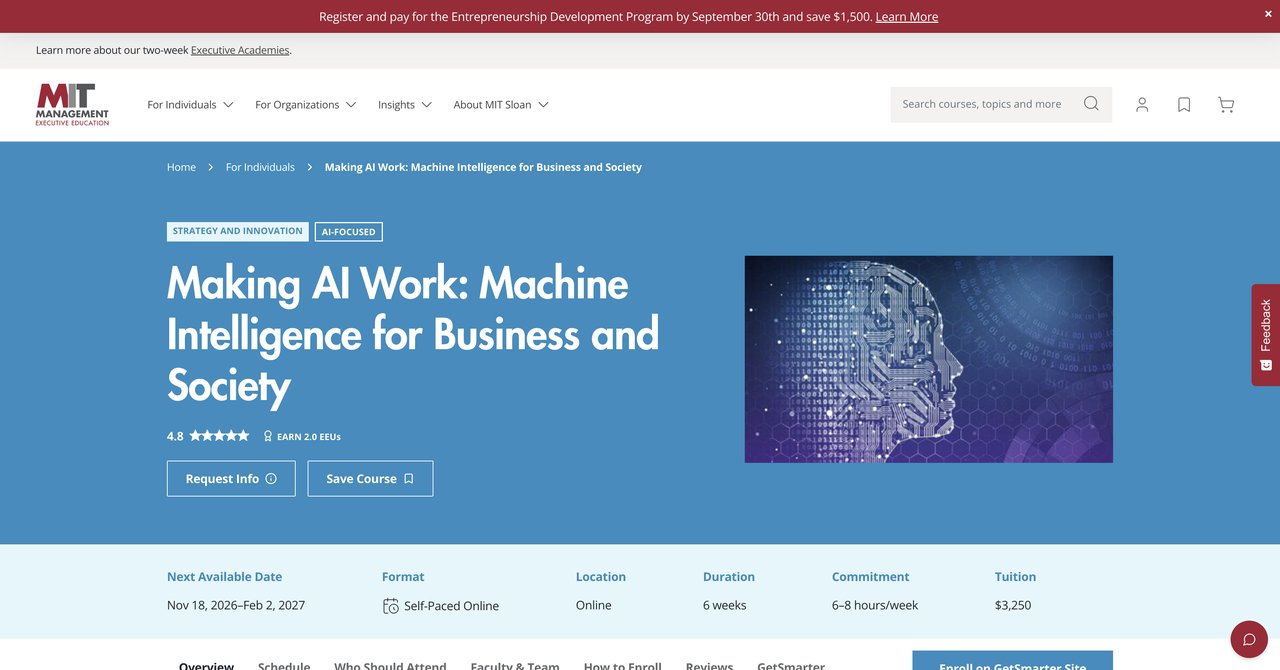
This course pushes itself in a slightly different direction. It considers AI through its impact on the broader society, but still in the frame of making business understand the value and the implications. For a senior manager, that is an important consideration when you are the one deciding on tooling and policies around AI in the company.
The program is administered online and is scheduled over 6-8 weeks, with a commitment of about 6 to 8 hours a week, a cadence that many managers can fit into their busy calendars.
With the price. It is around $3,250. This is the more modest MIT Sloan options, and the focus around ethical dimensions will give a different angle when compared to the others. It touches on questions that you will eventually need to answer for a customer or maybe for a public body that wants to know how your AI handles risk and governance.
Key Topics Covered
- How machine intelligence works, but from a business lens
- Societal concerns about AI and how they reflect business risk
- How to measure value and outcomes such as efficiency
- Ethical considerations you have to factor into any decision
Target Audience and Skill Requirements
Senior managers who need to grasp a broad overview and then communicate about AI with stakeholders. There is no technical requirement. It is a good option for those in regulation-heavy industries who need to have an advocacy-sound view.
Pros
- Considers both the technical and societal dimensions of AI
- Online format with a sustained but manageable time requirement
- More affordable in access point for AI than many other MIT Sloan courses
Cons
- Broader focus on society might feel less immediately actionable
- Requires consistent weekly engagement, which can be tricky when work schedules shift
Who Would Benefit Most
Leaders in the public sector think so or in an organization heavily influenced by regulation and public perception. Adding it to the core business use cases is going to help when you discuss AI in the context of your company's social license or compliance policies.
Course 7: AI for Executives: AI for Business Decision Making by Coursera
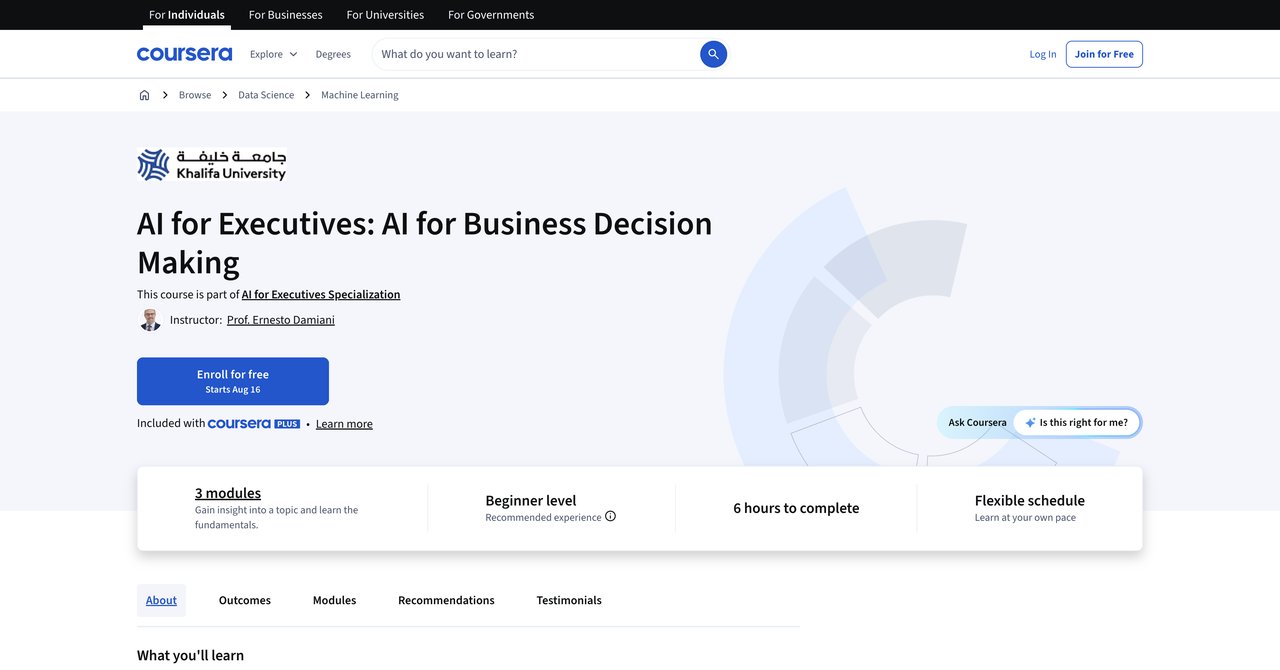
Coursera also offers an entry, but you can take part and you can without spending any upfront cash. This one is the second in a two-course series. It covers the practical part of "how to use" from an executive angle, showing you examples from real companies. Specifically, you review customer feedback, process optimization, and forecast risk.
Governance and ethics are not overlooked. There are modules on privacy, security, bias, and explainability. That rounds out what is otherwise a very results oriented topic set. Just keep in mind that the free tier might have limitations on assessments, and some peer review features lack the depth that maybe self-testing you might get elsewhere.
This is not a university certificate, but you can still get a professional certificate to put on LinkedIn if they want. As a low-stakes starting point, it is worth trying before you start paying hundreds or thousands of dollars.
Key Topics Covered
- Real executive use cases from customer service and analysis to process optimization and risk prediction
- Governance and ethics, including data privacy, security, bias, and explainability
- How to frame up a potential project and choose what AI does or does not do
Target Audience and Skill Requirements
Executives and junior senior manager who have already taken the first Foundations course or have an equal knowledge. It introduces a structure, but is not rigorous and does not need to be.
Pros
- Covers actual scenarios and cases, not just AI definitions
- Includes governance and ethics topics that often never make it into managers "quick overviews"
- Builds on foundational knowledge so you are not strangled
Cons
- Free tier offers limited assessment features
- Requires completing the first course for a complete picture
Who Would Benefit Most
Someone without money or organizational budget for formal training. Free is a strong on-ramp and if you do not need a big credential, you can easily enter and walk away at any point and still catch a lot of value out of one of the modules.
Visit AI for Executives: AI for Business Decision Making
Course 8: AI for Executives: The Basics by Coursera
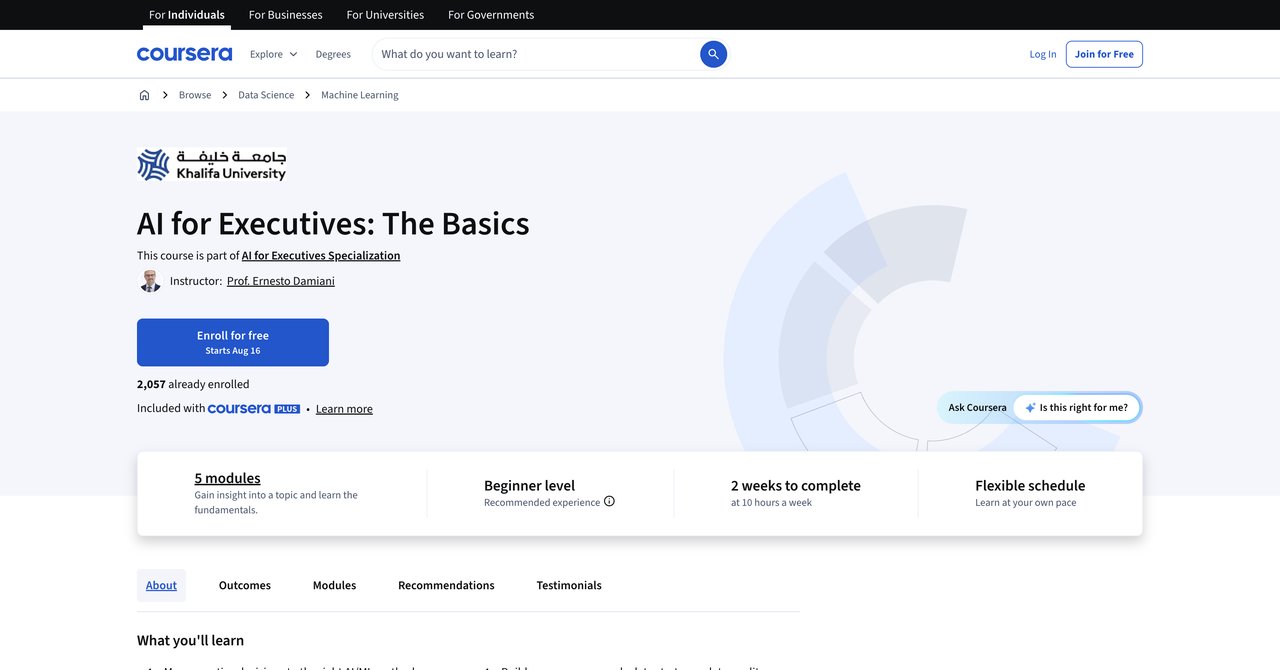
This is a free, non-technical overview of AI and ML. It's built to help people who deal with decisions, not code. It is a good place to start from zero. You get an idea of what AI can do, and how to roughly map an executive decision to the right AI/ML method.
The important part is that it is completely free. There is no risk. For a manager in any role, this is a zero friction way to get exposed to the basics. But this level of content might be too basic to leaders who have already read books or followed how AI is shaping their industry.
There is also no focus on organizational change management. There are no discussions of how to get an entire company ready for AI. It is a one-topic intro, and it does not pretend to be more.
Key Topics Covered
- Definitions varies of AI and types of machines
- Business Use Cases that explain the difference between narrow AI and general AI
- How to map decisions to the right method
Target Audience and Skill Requirements
Executives who have no AI background and are required to become familiar in a short time. There requirement. The course is what you might view as a starting point.
Pros
- Free and accessible
- Practical, non-technical introduction to AI/ML
- Covers how to map executive decisions to the appropriate AI/ML methods
Cons
- Beginner level might be too basic for some senior managers
- It does not cover organizational change management in any meaningful way
Who Would Benefit Most
Executives who are moving from a completely unrelated field and need to get to a common language in a very short span of time. It's low commitment but a great way to fill in the blanks if you were always afraid to ask.
Course 9: Generative AI for Generative Managers and Leaders by Udemy
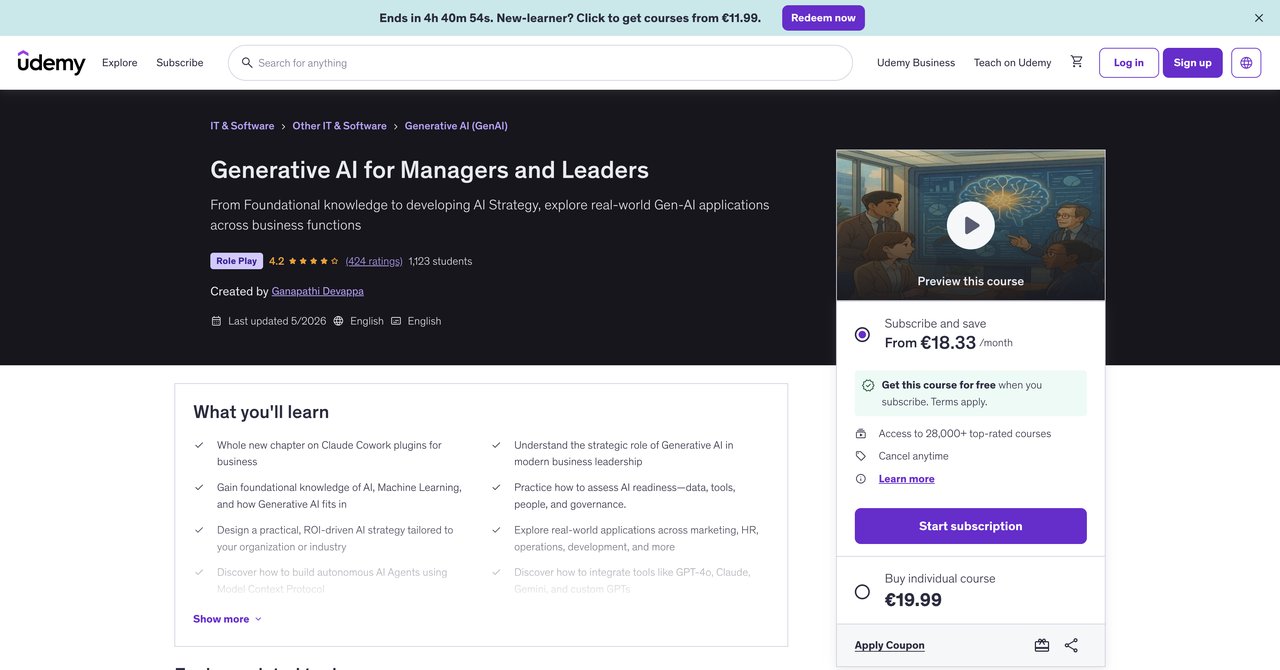
Udemy is in many ways the opposite of the MIT courses. It is self-paced, very affordable, and often lacks that university brand stamp. For managers who just want a practical grasp of generative AI, you can get exactly that from a decent seat. Usually, it costs within the range of $20 to $100 depending on if you shop Udemy sales.
This particular course is designed around building a generative AI strategy from the ground. The emphasis is on the practical steps for making use of the content and different mechanisms for a decision, not the technical underpinnings. Instead of being a developer, you focus on capabilities and prioritization.
If you need a certificate, this course will give a tangible of degree in programming but it won't have the brand any recognition. For an internal requirement, many managers just want the core learning and that is enough.
Key Topics Covered
- Generative AI and the "content on demand" kind dynamic
- Building a strategy that relates to your business case
- Practical methods of implementation inside processes
Target Audience and Skill Requirements
Senior managers who want to be informed about Generative AI without reading papers. It is also for anyone who is considering how that tech might change a specific part of their business and wants to move quick.
Pros
- Focused only on Generative AI strategy
- Practical approach to building your Gen-AI plan in steps
- Self-paced and affordable, specially during regular Udemy promo
Cons
- Udemy course quality can vary significantly from one mentor to the next
- No university credential from a recognized school
- Depth might not be enough for a complex business unit
Who Would Benefit Most
Leaders that need to have a working position on generative AI as a trend and that want to be able to lead a specific experiment within their team soon after. If your company already has high-end MIT programs, maybe not, but most practical environments do not.
Visit Generative AI for Managers and Leaders
Course 10: AI for Senior Executives Program by Johns Hopkins University
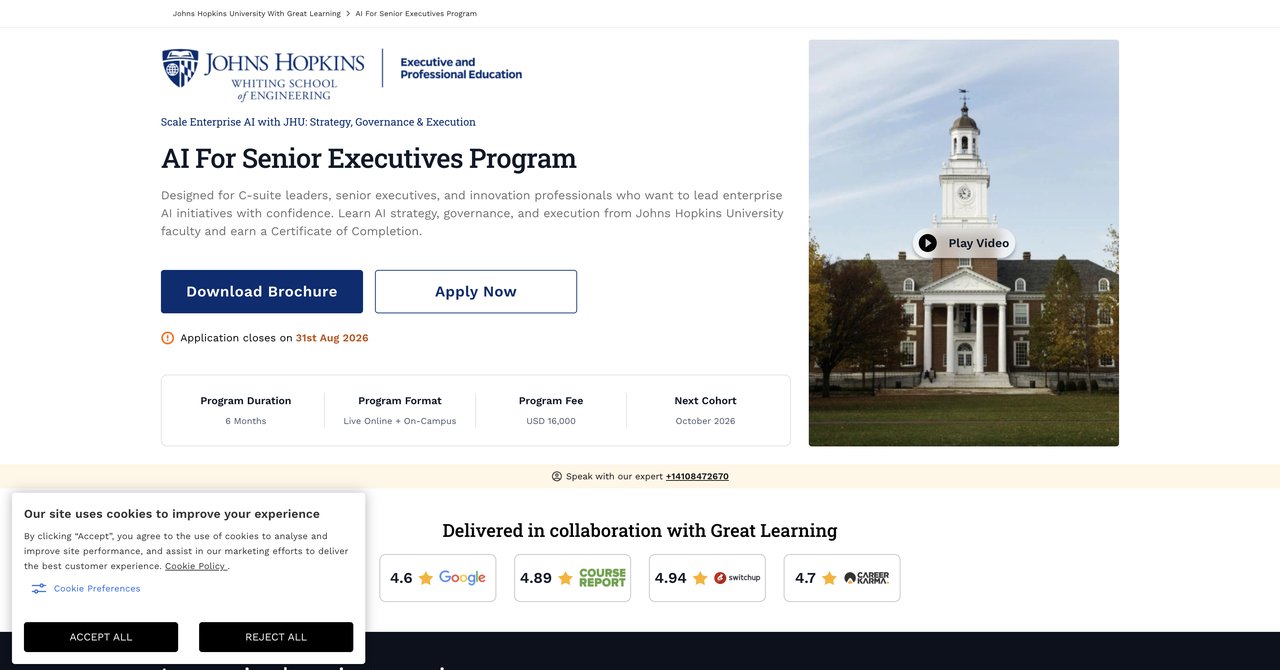
This is a big one. The hefty price tag and the length alone signal that this is not a casual addition to your workday. Over six months, this program takes you through AI strategy, governance, and execution with pretty heavy detail and hands on from a top school.
At $16,000 it is an investment for the executive team with need for the thorough. There is something to be said for a Certificate of Completion from Johns Hopkins that can often be a key piece of a career change narrative, or it can be a justification for a promotion because the organization is paying enough attention to learning budgets.
But there is a huge catch. A lot of topics covered here will be things that many senior managers might have already seen through MIT, company internal, or from direct practical experience. Do not underestimate what you already gained through experience. So the real differentiator, then, is the credential and that cohort of your peers.
Key Topics Covered
- AI Strategy at the C-suite level
- Governance, risk, and compliance frameworks
- Execution pathways for broad implementation
- Change management at scale
Target Audience and Skill Requirements
This fits a senior executive or C-suite leader who is expected to be the business owner leading AI planning and executions across all divisions. No technical experience is needed, but you have to have a well-rounded experience running operations or strategy.
Pros
- Purpose-built for C-suite board level senior executives
- Comprehensive in strategy, governance, and execution
- Earn a Certificate of Completion from an excellent global source like Johns Hopkins
Cons
- The most expensive option on this list and for some budgets it is not even a high spend cohort
- Six month schedule is big and you have to keep up, which is has a huge extra weight
- Potential is that they are already get most use through a cheaper method
Who Would Benefit Most
Executives with big budgets, major role changes, or those that want to be checked on the box of a formal university school certification. If you work at a big corporation or in the government sector where a credential adds to your credentials, this is built for you.
Visit AI for Senior Executives by Johns Hopkins
Final Summary and Honest Overall Recommendation
If you have to pick an option quickly, he would base it either on your role scope and how core AI is to your function. For a large-scale involvement, with huge budgets and change requirements, the MIT offer options are direct gateways.
If you want a course from a top school but cannot take a week off work and have a tighter budget, the MIT Sloan "AI Adoption" course or "Applied AI for Digital Transformation" offer a great options. They are still fairly expensive, but they deliver concrete frameworks and produce outputs that respond to the needs of a manager who has to act.
If you are more focused on a small specific area business case, the Generative AI for Managers and Leaders from Udemy, or free Coursera modules are a smart way to start. They are not going to force a rigid process onto you and they allow the time to think about what you want in your own context. Given the hard cost of university courses, that is worthwhile.
If you are a C-suite person who needs to lead from the front and wants the stamp of a relationship, Johns Hopkins, and obvious $16,000 route might have some place. Your need for credential will make that argument clear to you rather than us.
Now, for the majority of senior managers who want practical coverage without complexity and in towards any paywall for every topic, the CompleteAI Training subscription is hard to dismiss. The pricing is unusually cheap for the volume. More relevantly, they give the option to open access to all courses and all certifications for everyone, which takes the "I guess I'll pick one course and then I'll get charged for the next whenever I need it" problem out of the picture. The added benefit of having courses in other job roles also helps a manager who acts as a bridge any divisions, or one who is building toward a new role. The subscription gives you total flexibility to move between concepts without the switching friction.
No one got promoted and kept a full team relied on one course. The skill comes from the consistent application of the practice. In that sense, the option that keeps you coming back and that offers variety will give you that process of engaging with material again and again. That is the reason you should consider Complete AI Training as the base line, and then you can decide any of the more expensive courses if you need a certificate, a network, or a specific structured rigor.