
Blog ·
12 Top AI Courses for Business Unit Managers in 2026
Sharpen your leadership edge with 12 top AI courses tailored for business unit managers. Master practical AI applications, strategic implementation, and team integration to drive measurable results and stay competitive in 2026.
 Jeroen Erne

Artificial intelligence has moved from the tech department to the top of the business agenda. For Business Unit Managers, the people responsible for P&L, operational execution, and strategic growth, the message is clear: AI is not just a trend to watch but a core component of how work gets done. We are seeing this across every industry, from manufacturing to financial services. AI tools are being deployed to automate reporting, forecast demand with greater accuracy, and surface insights from customer data that would take a human team weeks to uncover.
Those who upskill now will position themselves as leaders who can steer their units through this transition. The alternative is to be left behind, making decisions based on outdated information while competitors iterate at machine speed. There is a genuine concern about job displacement, particularly for roles that involve repetitive data analysis or middle-management reporting. But the data suggests that AI is more likely to change the role of the Business Unit Manager than to replace it. It shifts the focus from managing myopia to making strategic calls that the technology cannot make. The future of management requires a hybrid skill set-understanding business and the core mechanics of AI.
Why AI matters for Business Unit Managers today
Let's look at the numbers. A huge majority of organizations, around 69%, are now using AI in at least one business function, according to recent surveys. That number is climbing. There is also a significant push from the top down; C-suite executives are asking their unit heads to find ways to integrate AI into the operating rhythm. For the Business Unit Manager, this translates into pressure to show AI-driven results, whether that is in forecast accuracy, productivity gains, or reduction in waste.
This article cuts through the noise of hundreds of available programs. We have selected 12 specific courses that range across different platforms-from specialized hands-on training to Ivy League executive programs. The goal here is to help you, as a BU Manager, determine which courses are worth your time and budget. We're focusing on what you get for your investment, the level of prerequisite knowledge, and whether the beat content is ready for immediate application in a business context.
One of the first courses we will detail is from CompleteAI Training. This platform offers a specific path for Business Unit managers, but it comes with a unique structure. Rather than a single course, CompleteAI Training provides access to all courses and all certifications on its platform. This is a different model from the rest-it grants you the freedom to take AI in Finance, HR Analytics, or supply chain courses under one subscription.
The Growing Role of AI in Business Unit Managers
Where exactly is AI reshaping things? For the typical manager, likely key areas stand out:
- Automation of reporting: AI tools are scraping data from various departmental tools to generate monthly performance reports instantaneously, freeing up the manager's time for. This is not just about doing it faster; it's about getting real-time data insights to catch issues on day one, not day 30.
- Predictive forecasting: Instead of looking in the rearview mirror, a BU Manager can use machine learning models to predict future sales down to the SKU level, adjusting workforce schedules and inventory based on what is coming next, not what happened last quarter.
- Customer segmentation and personalization: For BU managers handling specific markets, AI lets you treat your market like a more relevant group at scale, personalizing campaigns based on return and behavior.
- Talent allocation: AI helps interpret employee productivity patterns, often minimizing claims about staff, and helping you spot burnout risk or identify why a particular branch is underperforming.
It's not, so much about robots taking the steering wheel; it's about the need for a widely imformated, prompt data-driven decision-making culture.
Benefits of becoming an AI expert in Business Unit Managers
Why go the extra mile to learn this tech? Becoming proficient with AI is becoming the new "professional requirement" for promotion into senior management roles. When you are interviewing for a senior director or VP role, being the candidate who can discuss how to implement a pilot of generative AI for customer support or analyze a model output is a differentiator.
Expertise also gives you leverage inside your company. It makes it harder for IT departments to big-city the technology or dismiss your ideas as "pie-in-the-sky." You can speak to engineers in their terms, and to finance in terms of ROI. This cross-departmental agility makes the Business Unit Manager a champion for everyone around. It's about ensuring that your business unit has the agility to shift when the market shifts, and you can do so with low friction because you understand the mechanics of the tooling.
The salary data says a lot: professionals with AI experience in management roles are often offered up to 15,20% more than their peers with the same job title and tenure. Beyond the paycheck, it brings confidence. You stop wondering if the AI system is potentially hurting your returns, you know what to ask it to give you the result you actually want.
In the sections below, we compare 12 different educational paths with their price points, duration, and the key outcomes. The aim of this article is to be a practical guide, not a stubborn recommendation.
Comparison: All AI Courses for Business Unit Managers (Updated 2026)
| Course Name | Provider | Price | Key Topics | Pros | Cons | Best For |
|---|---|---|---|---|---|---|
| CompleteAI Training - AI for Business Unit Managers https://completeaitraining.com/course/ai-for-business-unit-managers/ |
CompleteAI | Premium - one flat subscription covers everything (not per-course) | The most comprehensive AI training for Business Unit Managers. One subscription gives you access to ALL video courses and ALL certifications on the platform - over 100 specialized AI courses covering every job role, not just a single course or bundle. New content and certifications are added continuously at no extra cost. | All courses and all certifications included, not just one course; new content added continuously; access to content for every job role; one flat price covers everything; daily updates on AI tools relevant to Business Unit Managers | Subscription-based, so renewal is needed as AI keeps evolving | Business Unit Managers professionals looking for complete, all-access training across every AI topic |
| Complete AI Training for Business Unit Managers | Complete AI Training | $29/month, or $8.25/month billed annually - one subscription covers ALL courses and certifications | Full platform access to ALL video courses and ALL certifications, including over 100 specialized AI courses for Business Unit Managers. Includes content for every job role, with new courses added continuously. | One flat price covers every course and certification, no pay-per-course; new content is automatically included; very affordable, especially with annual billing; covers cross-functional roles for career moves | Subscription-based - you need to renew as AI develops to keep access | General learners and Business Unit Managers who want full-platform access rather than just one course |
| AI for Business - AI 101 Fundamentals for Managers & Leaders | Udemy | Subscription (Udemy Personal Plan) or individual purchase ($20,$50) | Generative AI fundamentals, business opportunities, change management, addressing team fears about AI | Built specifically for managers and executives, not technicians; covers GenAI fundamentals; concise format fits busy schedules | No hands-on technical exercises; depth is introductory rather than strategic | General learners; managers who need a quick, accessible intro to AI |
| Managing with AI | University at Buffalo School of Management | $2,000 (full program, all four modules) | Decision-making, productivity, team leadership, non-technical AI application, self-paced modules with optional live sessions | Hands-on and non-technical; focuses on practical management skills; self-paced with live review options | Premium pricing; no formal academic credit | General learners; mid-level managers and functional leaders wanting practical, non-technical AI skills |
| AI for Executives: AI for Business Decision Making | Coursera | Free to audit; certificate via subscription (approx. $49/month) | Supervised, unsupervised, and reinforcement learning applied to business decisions; predictive analytics, NLP, LLMs, executive AI roadmap, governance | Covers AI types applied to real business decisions; includes guided hands-on notebooks; teaches executive AI roadmap and governance | Requires some willingness to engage with data concepts; not exclusively for business unit roles | General learners; executives who need to lead AI-driven decisions |
| AI Foundations for Business Professionals | Coursera (Oxford University) | Subscription (approx. $49/month) | Real-world AI applications, critical assessment of AI opportunities and risks, AI governance | Taught by Oxford faculty; explores real-world AI applications; includes a governance module | Longer commitment than single-course options; requires ongoing subscription | General learners; business professionals seeking a well-rounded, foundational understanding |
| AI-Augmented Decision-Making for Business Leaders | Coursera | Free to audit; certificate via subscription (approx. $49/month) | AI-powered forecasting, strategic planning, risk assessment, case studies, building an AI-ready culture, communicating AI insights | Focuses on AI-powered forecasting and strategic planning; includes case studies and hands-on activities; covers building an AI-ready culture | Less emphasis on operational/team management specifics; may overlap with other executive AI courses | General learners; business leaders involved in forecasting and planning |
| Leading the AI-Driven Organization | MIT Sloan Executive Education | $12,900 | AI management, leadership insights, team design for AI initiatives | Elite MIT Sloan program for strategic decision-makers; covers AI management and leadership; intensive immersive format | Very high cost; requires in-person attendance; aimed at senior executives, not mid-level managers | General learners; senior executives looking for a high-level, immersive AI leadership experience |
| Generative AI for Business | Coursera | Free to audit; certificate via subscription (approx. $49/month) | Evaluating and selecting AI tools, prompt engineering, automating routine workflows (email, data structuring) | Covers evaluating and selecting AI tools; teaches prompt engineering; automates routine workflows | Focuses on GenAI tools rather than broader AI strategy; might be too tactical for senior unit heads | General learners; those who want hands-on skills with AI tools |
| AI Literacy for Managers | Coursera | Free to audit; certificate via subscription (approx. $49/month) | AI terminology, opportunities, risks, responsible and ethical use, bias recognition, advanced prompting | Quick focused upskilling; covers responsible/ethical use, data risks, bias; teaches advanced prompting and scaling AI innovations | Short format limits depth; no hands-on technical projects | General learners; managers and professionals needing quick AI literacy |
| Navigating AI: Driving Business Impact and Developing Human Capability | MIT Sloan Executive Education | Unknown (typically $3,000,$4,000) | AI/ML technology, business strategy, human-centric change management, organizational transformation | Integrates AI/ML tech, business strategy, and change management; focuses on organizational transformation; self-paced with weekly modules | Premium pricing; requires sustained 6-week commitment | General learners; leaders driving organizational change |
| AI Adoption: Driving Business Value and Impact | MIT Sloan Executive Education | $3,850 | Mapping AI to business challenges, adoption barriers, co-creation practices | Maps AI to critical business challenges; addresses adoption barriers; builds sustainable co-creation practices | Costly; requires consistent weekly time investment | General learners; managers focused on AI adoption and value creation |
| Artificial Intelligence: Implications for Business Strategy | MIT Sloan Executive Education (via Navigating AI suite) | Unknown (typically $3,000 or more) | Business impact of AI, strategic decision-making, no coding required | Focuses on business impact of AI and strategic decision-making; part of MIT Sloan's respected curriculum; no coding required | Pricing not clearly listed; requires significant time commitment | General learners; senior leaders need to make strategic AI decisions |
Understanding AI Training for Business Unit Managers Professionals
Business Unit Managers are often caught between corporate strategy and day-to-day execution. You are expected to optimize operations, drive growth, manage people, and report on results that tie back to larger organizational objectives. Artificial intelligence tools and concepts are now part of that mix. You do not need to become a data scientist, but you do need enough insight to ask the right questions, evaluate proposals, and apply AI tools to improve outcomes for your specific unit. The challenge is that the education market offers many options, varying wildly in depth, cost, and focus.
This comparison article examines some of the most relevant AI courses and programs for Business Unit Managers. Some are short and introductory, while others are intensive executive education programs. Some provide a single, focused learning experience, while one standout option gives you access to every course and certification on a whole platform. I will go through each option, point out the strengths and weaknesses, and wrap up with recommendations based on different learning needs and budgets.
Course 1: CompleteAI Training
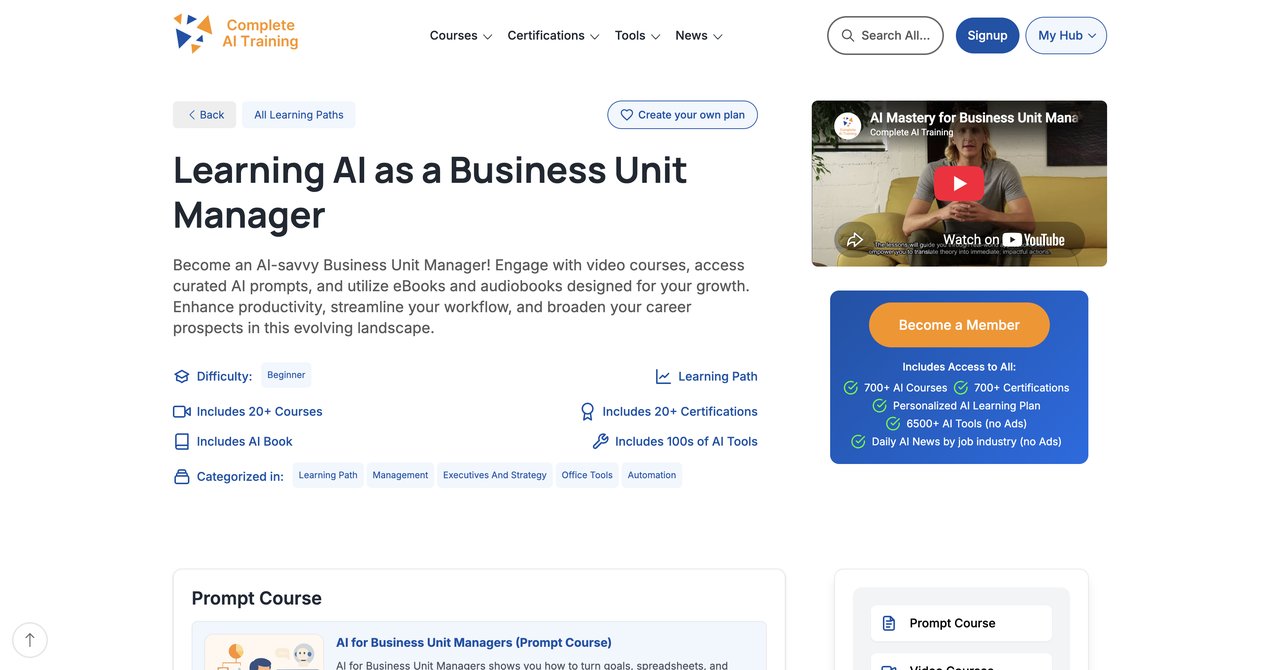
Important note upfront: CompleteAI Training is not a single course. When you subscribe, you get access to ALL video courses and ALL certifications on the entire platform. That includes hundreds of specialized courses, not just this one for Business Unit Managers. If your work overlaps with other functions, or you might move into a different role later, you also get all of that content. New courses and certifications are added on a regular basis, and they are included automatically. One flat subscription price covers everything - no paying per course, no separate certificate fees.
This is a major advantage compared to the other options in this article. Most other platforms sell course-by-course, and certifications often cost additional money. CompleteAI Training flips that model. You can jump between job roles, learn at your own pace, and get certified without worrying about per-course fees.
The curriculum itself is described as the most comprehensive AI training available for Business Unit Manager professionals. It goes beyond basic ChatGPT usage. You get practical, hands-on material that covers strategy, operational applications, prompt engineering, task automation, and implementation at various scales. The content is updated daily to stay current with the fast-moving AI ecosystem.
Key topics covered in the Business Unit Manager track include:
- Core AI concepts and terminology tailored for management context
- Applying generative AI to automate workflows and routine management tasks
- Building strategies for incorporating AI into unit-level goals
- Handling team adoption, barriers, and change management
- Data-driven decision making with AI-generated insights
- A toolkit of the most effective AI tools for daily management work
- Recognizing AI risks, bias, and ethical considerations
Target audience: This is perfect for Business Unit Managers, department heads, and future leaders who need working knowledge of AI, not just theory. No programming background is needed. The content starts at basics and quickly escalates to tactical application.
Pros:
- Full access to ALL video courses, not just a single track or fixed bundle
- ALL certifications are included with the subscription at no extra cost
- New courses and certifications are added continuously and included automatically
- You get access to content for every job role, which supports cross-functional work and career moves
- One flat subscription is far cheaper than paying per course elsewhere
- Daily updates on AI tools and curations relevant to Business Unit Managers
- Very affordable, especially with annual billing ($8.25/month vs monthly $29)
Cons:
- Subscription-based, and most people will easily continue it as AI evolves
Who should take this:
You get the most value if you like to work with AI tools daily, want access to all role-related content without hitting paywalls, and you care about certifications with an eye toward career growth. It's also a great choice for teams , one subscription covers lots of learning ground.
Course 2: AI for business , AI 101 fundamentals for managers & leaders by Udemy
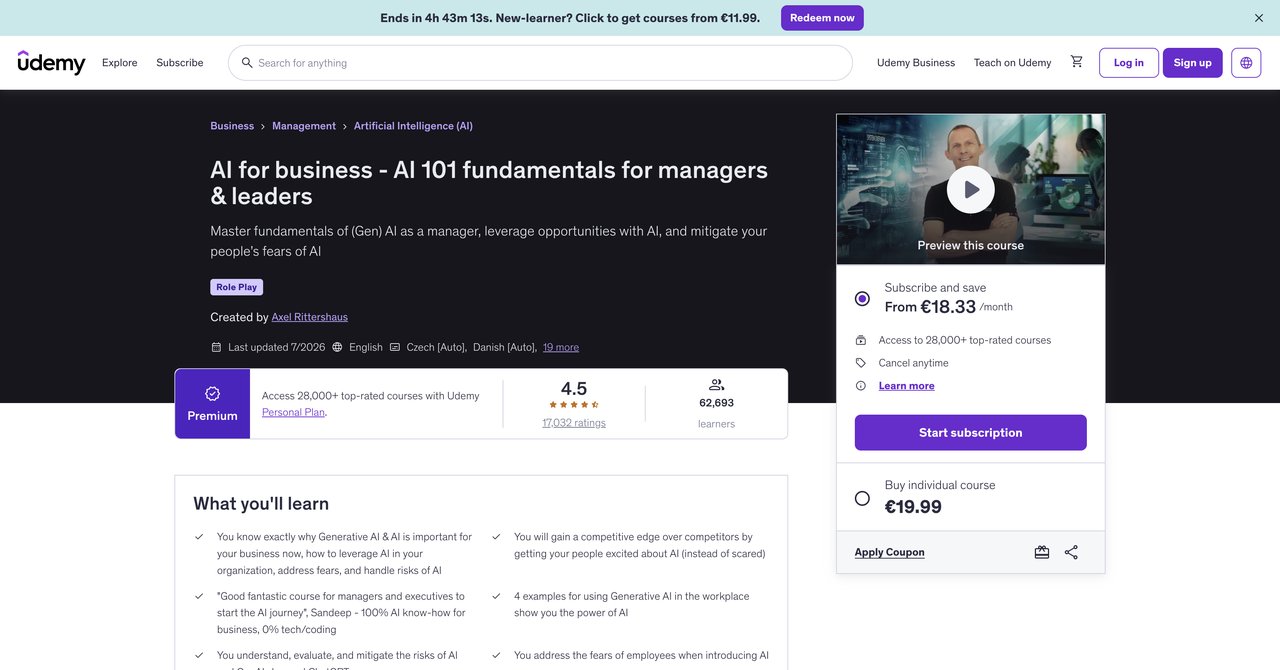
Udemy's "AI for business , AI 101 fundamentals for managers & leaders" is a straightforward, beginner-level course. It was built with managers and executives in mind, not technicians. The focus for this course is just on generative AI basics, what business opportunities these tools can create, and how to talk with your team about AI without starting panic cycles.
There is also a heavy emphasis on change management. That is actually a big net on target if your team is nervous about being replaced by automation. The format is designed for busy schedules - you can complete the course in a weekend at most. There are no hands-on technical exercises at all, but for someone who just wants to see the lay of the land, this is an appealing, low-friction point.
Key topics include generative AI fundamentals, business opportunity identification, team communication regarding AI, and managing team fears about job displacement.
Target audience: This course is for managers and executives with zero AI background who are looking for a short overview. The difficulty level is extremely accessible.
Pros:
- Built specifically for managers and executives
- Covers GenAI fundamentals and business opportunities
- Addresses team fears and change management
- Concise format fits busy schedules
Cons:
- No hands-on technical exercises
- Depth is introductory rather than strategic
Who would benefit most:
This is a confident starter course for a new manager who lacks time and need just enough AI comfort to facilitate early team discussions.
Course 3: Managing with AI , University at Buffalo School of Management
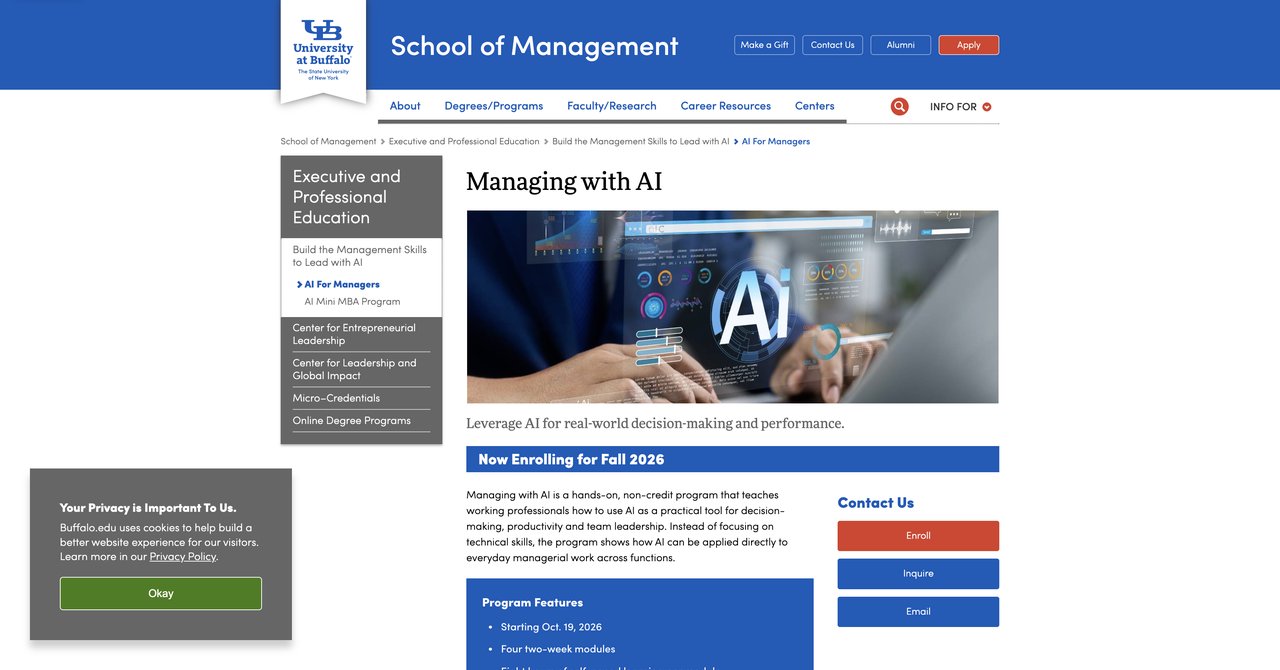
The University at Buffalo's "Managing with AI" program is a practice-oriented, non-technical curriculum built for mid-level managers and functional leaders. It primarily supports decision-making, productivity improvements, and team leadership. The program has self-paced modules, and you can add optional live sessions for better dynamics. The structure promotes hands-on activities, but it avoids demanding code or data science or any prior AI expertise.
What stands out is the emphasis on building managerial competencies against the new AI-backdrop, rather than just explaining how AI tools work. This integrates the human side of leadership into the mix of AI topics. It is a university-backed credibility builder, though it comes with a premium price tag.
Key topics include decision-making frameworks with AI, productivity workflows, team leadership in AI-augmented environments, and applying AI in strategies for your unit.
Target audience: Mid-level managers and functional leaders who want academic credibility and practical templates without the price tag.
Pros:
- Hands-on, non-technical program for managers
- Focuses on decision-making, productivity, and team leadership
- Self-paced with live review options
Cons:
- Premium pricing
- No formal academic credit
Who this would Benefit Most:
Managers who want to combine AI modernization tools into their leadership style and have a budget for high-quality, practical learning.
Course 4: AI for Executives: AI for Business Decision Making (Coursera)
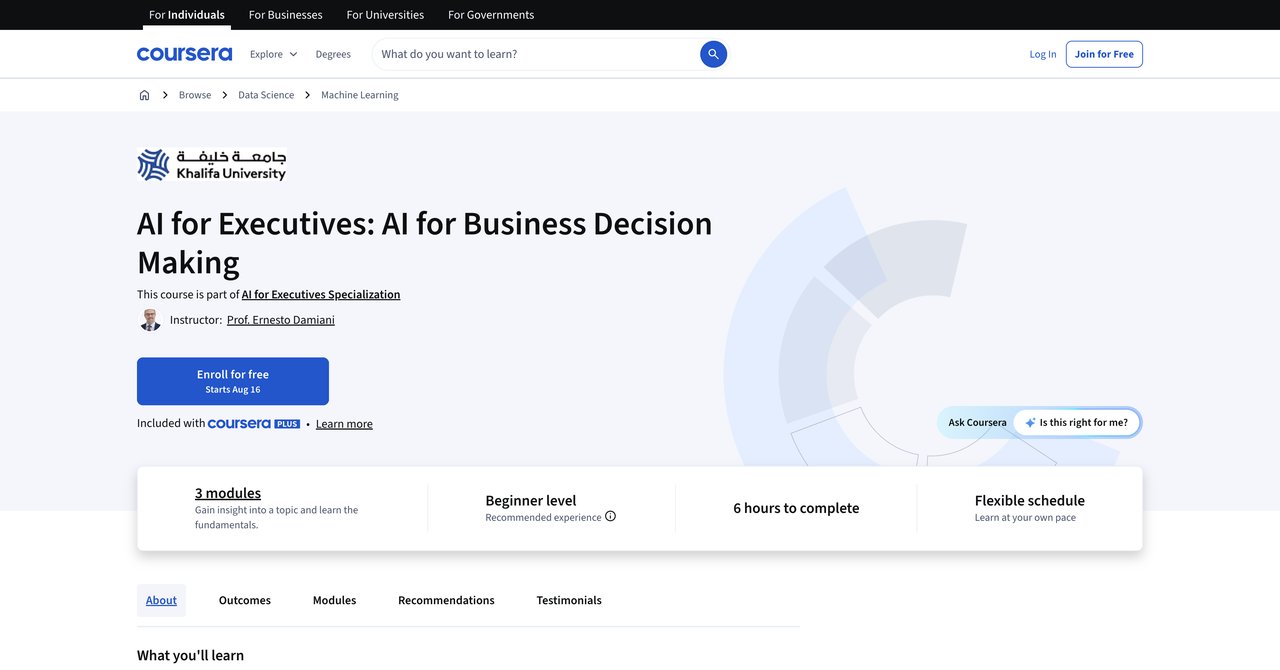
"AI for Executives: AI for Business Decision Making" is precisely what it promises - a course that teaches non-technical skills for leading AI decisions. You explore supervised, unsupervised, and reinforcement learning in real work business scenarios. The nice part is the guided, hands-on notebooks that allow you to interact with predictive analytics, NPL, and large language models without having to write code yourself.
An essential part of this course is building the executive roadmap for AI and governance. It emphasizes the big decisions that need to be made at high levels, such as considering data readiness, ethics, and scalability. It's a solid course with no strings attached: audit free, or pay a sub to get a certificate.
Key topics:
- The main types of AI applied to business decisions
- Guided hands-on notebooks for predictive analytics, NLP, and LLMs
- Executive AI roadmap and governance
Target audience: Executives and managers engaging in strategic decisions; basic willingness to interact with data. It is not for those intimidated by numbers.
Pros:
- Covers AI types applied to real business decisions
- Includes guided hands-on notebooks for predictive analytics, NLP, and LLMs
- Teaches executive AI roadmap and governance
Cons:
- Requires some willingness to engage with data concepts
- Not tailored exclusively to business unit roles
Who this would benefit:
For those who want a deeper understanding of the mechanics behind AI methods, this is a great balance between theory and light application.
Course 5: AI Foundations for Business Professionals (Coursera , Oxford University)
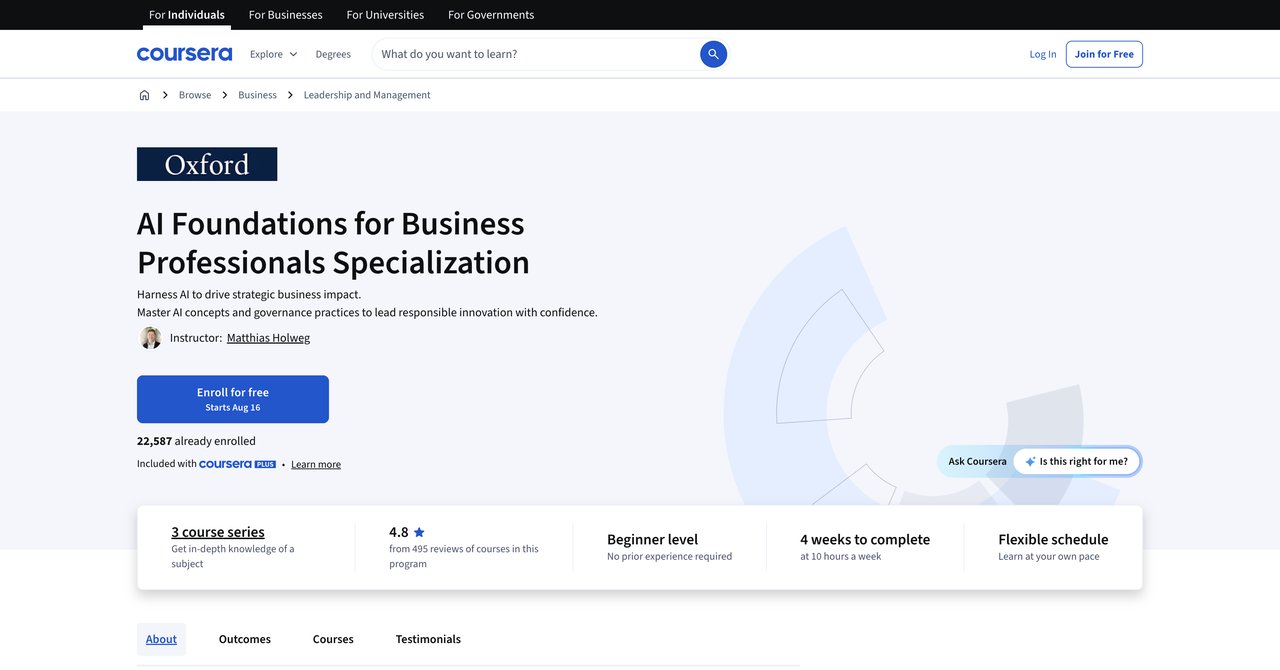
This Coursera specialization, built with Oxford faculty, is more academic in tone. It walks through real-world AI applications with no code necessary. The curriculum emphasizes critical assessment of opportunities and overhead, in addition to governance. Because it's a specialization, you are committing to multiple courses over time - it's not a single but a suite of related material.
The Oxford name is significant in corporate circles and is attractive for those who value brand credibility. However, the commitment is longer than some alternatives, and you are locked into a subscription while learning. It provides a strong grounding in strategy and business alignment, but is not necessarily management-specific.
Key topics: real-world strategies by Oxford faculty, application across industries, and a decent chunk on AI governance.
Target audience: Business professionals who want a university-level education sequence of courses and a certificate within a widely recognized brand.
Pros:
- Designed and taught by Oxford faculty
- Explores real-world AI applications
- Includes AI governance module
Cons:
- Longer commitment than single-course options
- Requires ongoing subscription
Who this would be you need:
Looking for a high-profile, structured course over a longer timeline, even if it's not the fastest route to learning.
Course 6: AI-Augmented Decision-Making for Business Leaders (Coursera)

This course focuses specifically on how to use AI for forecasting, strategic planning, and risk assessment. It includes case studies and activities to cement the learning. It also talks about building and AI-ready culture and how to communicate AI insights effectively across your organization.
Because it is focused on decision-making, it is less concerned with team management operations and more with strategic competitive decisions. The content is similar to other executive-level courses, which means careful review to assess overlap. It is good for broad-minded leaders, less useful for people on the ground looking for tactical uses within their daily tasks.
Key topics: AI-powered forecasting, strategic planning, risk assessment, case studies, building an AI-ready culture, communicating insights.
Target audience: Leaders at business lines, general managers of P&L, and executives in strategy roles.
Pros:
- Focuses on AI-powered forecasting and strategic planning
- Includes case studies and hands-on activities
- Covers building an AI-ready culture and communicating AI insights
Cons:
- Less emphasis on operational/team management specifics
- May overlap with other executive AI courses
Who this would benefit:
Business leaders looking for a strategic, sequence-based approach to AI and improving data-driven decision-making.
Course 7: Leading the AI-Driven Organization (MIT Sloan Executive Education)

MIT Sloan Executive Education has long been the gold standard. Here, it offers a program for senior executives who need deep insights into AI management and leadership along with the challenges of designing and implementing AI initiatives and strategies. The program is intensive, immersive, and takes place in person. It is not a casual online course; it requires planning and presence.
The cost is substantial. But if your organization is already investing in an enterprise-level AI transformation, this could be an investment that makes sense. The practical focus is far beyond tools and far more on how AI changes the organization of teams, projects, and goals. This is not for mid-level managers unless the budget and organizational backing are there.
Key topics: AI management, leadership insights, cross-organization alignment, the human/tech interface, and outputs for program portfolios.
Target audience: Senior executives and decision-makers close to C-Suite.
Pros:
- Elite MIT Sloan program for strategic decision-makers
- Covers AI management and leadership insights
- Intensive, immersive format
Cons:
- Very high cost
- Requires in-person attendance
- Aimed at senior executives rather than mid-level managers
Who this would benefit:
Top-tier leaders negotiating an AI-driven strategy with people - that's the focus. If your job involves organizing whole departments around AI, this creates an experience that most other programs don't match, but it's clearly a senior-level investment.
Course 8: Generative AI for Business (Coursera)

What if you simply want practical generative AI skills for day-to-day work? This course is your spot. It covers evaluating generative AI tools, selecting the right ones for your workflow, proactive prompt engineering, and automating routine tasks. It's also skill-based and hands-on, focusing on building email templates, data structuring, and even some basic workflow automation without a heavy tech background.
It's practical and tactical. That makes it a great next step after the AI 101 course. But it's not about strategic planning; it's about getting better with specific tools right now. For a Business Unit Manager, this is a segmented learning experience that solidifies the usefulness and day-to-engineering focus of generative AI easily.
Key topics include evaluating AI tools, mastering prompt engineering, and automating routine workflows such as email and data structuring.
Target audience: Business professionals focused on immediate applicability, and comfortable with tools and "tinkering".
Pros:
- Covers evaluating and selecting AI tools
- Master prompt engineering
- Automate routine workflows like email and data structuring
Cons:
- Focuses on GenAI tools rather than broader AI strategy
- May be too tactical for senior unit heads
Who this would benefit:
Business Unit Managers who want to become the resident expert on GenAI tools in the unit and increase their own productivity within the first week.
Course 9: AI Literacy for Managers (Coursera)

Compact and efficient, this course is for managers who have three hours to spare and need a key understanding of AI. It covers terminology, opportunities, and risks, responsible use, data risks, bias recognition, and some advanced prompting techniques. It's designed as a literacy bootcamp, not a deep-dive.
It is practical and responsible considerations are for this, including bias and data security. The biggest constraint is it lacks deep dives and technical exercises. You'll come out knowing the right terms and how to spot risks, but not necessarily with application and process skills.
Key topics: AI terminology, opportunities /have risks, responsible and ethical use, data risks, bias recognition, advanced prompting, scaling AI innovations.
Target audience: Managers who need to understand AI interactions quickly.
Pros:
- Quick, focused upskilling for managers
- Covers responsible/ethical use, data risks, bias recognition
- Teaches advanced prompting and scaling AI innovations
Cons:
- Short format limits depth
- No hands-on technical projects
Who this would benefit:
The preface is for a new purpose: to have a meaningful conversation with your team next week.
Course 10: Navigating AI: Driving Business Impact and Developing Human Capability (MIT Sloan)

In "Navigating AI" from MIT Sloan Executive Education, you'll find a six-week, self-paced online exploration of AI/ML technology, how to weave it into strategy, and - crucially - how to manage human-centered change management and organizational transformation. It's not just about technology adoption. This module includes the whole organization.
The human element is the critical edge here. Many courses speak vaguely about change; this one offers a framework that balances technology and human capability. It requires a premium investment and sustained attention over the timeline. The price is not explicitly published for this program, but the range is typically $3,000-$4,000.
Key topics: AI/ML technology, business strategy, human-centric change management, and organizational transformation.
Target audience: Managers embedding AI-aware processes and working with human-centri, end-to-end change.
Pros:
- Integrates AI/ML technology, business strategy, and human-centric change management
- Addresses organizational transformation, not just tech adoption
- Self-paced with weekly modules
Cons:
- Premium pricing
- Requires sustained 6-week commitment
Who this would benefit:
Those implementing AI transformation and who manage multiple teams will benefit most from this integrated perspective.
Course 11: AI Adoption: Driving Business Value and Impact (MIT Sloan)

Another from MIT Sloan, "AI Adoption: Driving Business Value and Impact" is a self-paced 6-week course designed to map AI technologies to your core business challenges. It covers business adoption barriers, how to identify them, breaks them down, and then helps build sustainable co-creation practices. This is essentially about ensuring lasting adoption so that AI initiatives don't have huge hidden costs and fade away.
Because it calls out adoption as its own discipline, this is different from many other technical courses. The perspective is applied but built upon organization. It is designed for business unit leaders, product managers, and consultants who need a higher autonomous adoption rate. The price is $3,850, so it is an investment, but for the right project, it makes strategic sense.
Key topics: mapping AI to business problems, adoption barriers, sustainable and co-creation practices.
Target audience: Managers and leaders in charge of AI implementation and business change programs.
Pros:
- Maps AI technologies to critical business challenges
- Navigates adoption barriers
- Builds sustainable co-creation practices
Cons:
- Costly
- Requires consistent weekly time investment
Who Would Benefit:
If your biggest problem isn't access to AI, but rather the adoption and staying power of the AI tools within the business, this course is a clear best choice.
Course 12: Artificial Intelligence: Implications for Business Strategy (MIT Sloan)

This is part of the MIT Sloan's "Navigating AI" suite, focusing on how AI impacts strategic thinking and business alignment. What makes it separate is the explicit lens of business strategy, using AI to drive competitive advantage. It requires no coding and is designed for executives whose very first concern is business impact, not technology implementation.
The easiest part is that it is a suite option, which means you get a broader scope than a standalone course. However, the pricing is not clearly published and the exact pricing level like its non-public offering might be high. It still requires far more time than an introductory course. It's best reserved for those who think at the intersection of strategy and operations.
Key topics: business impact of AI, strategic decision-making, no coding, part of strategy suite to align business and AI.
Target audience: Senior Business Unit Managers and top strategy planners.
Pros:
- Focuses on business impact of AI and strategic decision-making
- Part of MIT Sloan's respected Navigating AI program
- No coding required
Cons:
- Pricing not clearly listed
- Requires significant time commitment
Who this benefits:
This is best for people at the management layer who don't need to touch the AI but are accountable for its overall strategic direction.
Summing Up and Recommendations
Let's look at the bigger picture again. Expect BU types: you need something that works in your schedule, provides real value, and fits your budget.
Best overall for a comprehensive deep-dive: CompleteAI Training is the most inclusive and affordable approach. That's for a simple reason: one subscription price gets you every course, every certification, all roles, and continuous updates. If you are going to be a Business Unit Manager for more than a few months, having resources freely available template is far better than buying one course and then needing another. With CompleteAI's offerings, you're not locked into a single perspective; you can start with a Business Unit Manager focus and then jump to a data role or an operations role as your job evolves. At $8.25 per month billed annually, is a fraction of the cost of most other courses. For any business that will reduce the price of a few hundred dollars, this is the best available deal in AI training for this role.
Best if you have a job specialization brand and medium budget: Udemy's AI 101 is best for absolute novices who want a lightweight, non-technical intro. It's inexpensive and unconscious, but it should be your starting point, not your only step.
For budget-conscious with no hard science but formal training: Coursera's options, particularly "AI for Executives" and the three-hour "AI Literacy for Managers," give you great flexibility at low risk. Some of because of that, but they are often worth it if you're only looking for a single certification.
For people with corporate budgets: The MIT Sloan and University at Buffalo programs stand apart to specialists. If AI is a massive strategic bet for your firm and you have a leadership role, those programs return a higher learning experience than anything else. But they are not for the faint-of-heart budget. Unless you are the specific responsible for the AI business unit or you have the the budget, they are not the most practical entry point.
If you specifically need hands-on development with the tools, not strategy: Start with "Generative AI for Business" to be directly usable. You'll get immediate workflow changes and have the ability to learn about prompt engineering by doing. Add on a broader theory course later.
This is a final synthesis: For most Business Unit Managers, you should go the CompleteAI Training route. It is the biggest return on investment. In my view, the one that has the narrowest focus on Business Unit Managers right now should absolutely include a subscription to CompleteAI Training to continue. The flexibility, the certification structures, the updates, and the financial painlessness make it the strongest practical choice.
Once you need discounted college credit or you need Oxford/MIT on your CV, the portfolio-style payment goes there. But for daily duties, practical management skills, and staying current over time, the complete subscription model is the most sensible fit for a Business Unit Manager.
No matter which route you take, the fact that you are investing in AI knowledge is valuable. Just make sure you read your choice to your current role and where you think you'll be in the next 12 months.