
Blog ·
11 Best AI Courses for Business Analysts to Future-Proof Your Career in 2026
Discover the 11 top AI courses tailored for business analysts—master data storytelling, predictive analytics, and automation to stay ahead of the curve and land future-proof roles by 2026.
 Jeroen Erne
The numbers are hard to ignore. AI is no longer a distant concept reserved for tech giants; it is embedded in the software, dashboards, and workflows that businesses rely on daily. For Business Analysts, this is a pivotal moment. The tools you use to gather requirements, map processes, and recommend solutions are being reworked with intelligent automation. The question isn't whether AI will influence your job-it's how quickly you can adapt to it. Reports suggest that a significant number of businesses are already experimenting with AI tools, and those who fail to keep pace risk being left behind in project reviews and strategic planning sessions.
Your ability to interpret data and predict outcomes now has an AI component. Understanding how to leverage these models-rather than just documenting them-can set you apart from peers who stick to traditional methods. That's why this guide is designed to cut through the noise. We will compare 11 specialized AI courses for Business Analysts, dissecting what each one offers so you can pick the right path forward without wasting time debugging a syllabus that doesn't fit your needs.
Why AI matters for Business Analysts today
Right now, demand for AI-skilled analysts is high. A recent study showed that a significant portion of businesses are already using AI tools, and that number is growing steadily. But that doesn't mean every analyst is equipped to work with those tools. Many stumble through the fine points of prompting, struggling with model outputs, or missing the nuances of how AI processes large data sets. That's a gap in skills, not potential.
The modern business analyst isn't just a mediator between stakeholders and developers anymore. They're also the person who needs to spot where AI can streamline a process. When you can understand how a machine-learning model predicts churn or flags a data anomaly, you become more than a data translator-you're a strategic advisor. This comparison attempts to highlight how these courses provide those skills. Whether it's about improving your company's forecasting or simply automating routine reporting, the right training tends to help you break away from chasing the backlog.
The Growing Role of AI in Business Analysts
AI is more than just a fancy add-on. It's being used to automate routine tasks like report generation and data cleansing, which frees up time for high-level strategic planning. Consider:
- Automated insight generation: AI tools flag trends in client feedback automatically, so you don't have to spend hours reading through surveys and spreadsheets.
- Enhanced decision-making: Natural language processing (NLP) helps analysts query data with plain language, cutting down ad-hoc analysis time.
- Predictive modeling: Forecasting what customers might do next is no longer a guessing game. AI systems handle the statistical load.
- Process automation: From simple workflow triggers to complex user stories generation.
This transformation isn't theoretical. It affects the daily routine: the artifact you write, the requirements you document, and the way you structure tangible deliverables. AI is continually moving the baseline for what "good" looks like in the role. Therefore, investing in problem-solving and practical implementation skills isn't just a nice-to-have. It's about updating your toolkit.
Benefits of becoming an AI expert in Business Analysts
Gaining such expertise doesn't just give you a certification to hang on your wall-it's how you build immediate trust. When you can speak confidently about how a potential AI solution might impact an existing system, you become someone whom stakeholders rely on when budgets are tight. This translates into shorter onboarding time on projects, quicker wins, and a better ability to forsee risks before they get played out.
Financial benefits also play a role. Many specialized AI roles command higher salaries compared to general BA positions. That's not to say money is the only consideration, but it's worth having the conversation. More importantly, the depth of technical knowledge allows you to pivot into roles like data product manager, AI consultant, or lead business architect. It lays out an incentive to fully commit to learning, rather than repeating the same basic theory.
One standout option among the ten is CompleteAI Training, a platform that stands out because it gives you access to ALL courses and ALL certifications on its site, instead of just the AI for Business Analysts single course. That means you're building a broader proficiency, not just taking a clasp course.
As you read through the rest of this article, you'll see there is no single, foolproof answer for every business analyst. Some courses lean heavy on the code, while others focus purely on practical applications. But the goal all of them is the same: to help you move beyond learning about AI and into using it to find a distinct edge in constant change.
Comparison: All AI Courses for Business Analysts (Updated 2026)
| Course Name | Provider | Price | Key Topics | Pros | Cons | Best For |
|---|---|---|---|---|---|---|
| CompleteAI Training for Business Analysts | CompleteAI | Premium (Subscription-based; one flat fee covers everything) | Comprehensive AI training covering the full BA workflow: requirements gathering, elicitation, documentation, process modeling, stakeholder communication, decision support, prompt crafting for ChatGPT/Gemini/Copilot, responsible AI, plus daily updates on AI tools and curated industry news. Includes over 100 specialized video courses and certifications, with new ones added automatically. | Most comprehensive offering; hands-on projects; expert instructors; one subscription gives full access to ALL video courses and ALL certifications on the platform, not just this one course - includes material for every job role for multi-function work or role transitions; daily updates on AI tools and news; highest rating; very affordable especially with annual billing. | Premium pricing; subscription requires ongoing commitment. | Business Analysts professionals who want complete, all-access training and certifications in one place. |
| Generative AI for Business Analysts Specialization | Coursera | Free to enroll (Coursera subscription may apply for graded content) | Full BA lifecycle from requirements gathering to stakeholder communication; prompt crafting for ChatGPT, Gemini, and Copilot; responsible AI implementation. | Beginner-friendly; covers the entire BA lifecycle; teaches practical prompt engineering for multiple AI tools; includes responsible AI. | Graded content may require a Coursera subscription; starts Aug 4, 2026. | General learners starting out with generative AI in BA work. |
| AI for Business Analysts: Automate, Analyze, Deliver | Udemy | Not specified | Accelerates core BA deliverables like story writing and documentation; requirements analysis; process modeling; user story creation; structured prompting and multi-step workflows. | Includes 40+ ready-to-use templates; covers requirements analysis, process modeling, and user story creation; updated April 2026. | Price not listed; rating and level not published. | General learners wanting a workflow-focused, template-heavy approach. |
| AI for Business Analysis | Udemy | Not specified | Integrates AI (LLMs), process mining, and predictive analysis into daily BA workflows; business intelligence, strategy, data cleaning, and visualization. | Covers multiple pillars: AI, process mining, predictive analytics; includes business intelligence and data visualization; updated Jan 2026. | No public rating; duration and price not advertised. | General learners wanting a broader mix of AI and data analysis for BA. |
| Business Analysis with AI (AI-Powered Data & Analytics Specialization) | Coursera | Free to enroll | Applies Microsoft Copilot, Claude, and Gemini for data analysis and drafting into requirements; dashboards, reports, presentation workflows; ends with a reusable library of prompt templates. | Beginner-friendly; hands-on with multiple major AI tools; includes dashboard and reporting workflows; gives a reusable prompt template library. | No rating yet; focused more on applied tools rather than core BA theory. | General learners who want to use Copilot, Claude, and Gemini for BA tasks. |
| AI for Business Analysis | UBC Sauder School of Business | $395 | Practical analysis techniques for BAs; real use cases; reusable frameworks; real-world scenarios for BA work. | University-backed; practical, real-world focus; frameworks that can be reused; aimed directly at BAs. | Self-paced schedule not specified; price not clearly listed publicly (though listed here as $395). | Learners wanting a university-backed, practical approach. |
| AI-Accelerated Business Analysis | Maven (Angela Wick) | $649 | Live interactive cohort redesigns BA workflow; preserves traceability, judgment, and risk control while implementing AI into BA tasks. | Live cohort with recorded sessions; taught by well-known BA leader Angela Wick; intermediate level; focuses on practical workflow redesign. | Schedule limited to Sep 14,17, 2026; requires live attendance for the live experience. | BAs who want an immersive, cohort-based learning experience. |
| AI Literacy for Business Analysts | Maven (Angela Wick) | $499 | AI capabilities from a business and functional use perspective; helps BAs recommend AI solutions; live sessions. | Teaches AI from a business lens, helps BAs analyze and recommend AI solutions; includes live sessions; beginner to intermediate level. | Focus is on AI literacy rather than hands-on certification or a deep technical dive. | BAs wanting to build foundational AI understanding for client advice. |
| Certified AI for Business Analysts (CAIBA) | Tonex Training | Not specified | AI as a practical support tool for decision support, documentation, process improvement, and insights generation for BAs. | Certification-focused; designed around industry credentials; covers decision-support, documentation, process improvement, and insights. | Price and schedule not published; partner-based certification program. | BAs seeking a certification credential in AI. |
| AI for Business Analysts , Foundation | Ratio | Not specified | Works with ChatGPT, Claude, Perplexity, and Gemini on real BA tasks; emphasizes requirements quality and stakeholder analysis; builds AI workflows with governance controls. | Hands-on with multiple AI tools; focuses on requirements quality and stakeholder analysis; governance controls included; recorded live. | UK specialist provider with limited global reach; pricing not listed. | BAs wanting a practical foundation with governance in mind. |
| Free AI for Business Analysts Course (7-Language Certificate) | Catch Wisdom | Free | Covers elicitation, documentation, and decision support for BAs, requirements engineers, and systems analysts. | Completely free; 7-language certificate; covers key BA tasks; beginner-friendly. | Unknown duration and rating; limited reputation compared to larger platforms. | BAs and systems analysts wanting a free, multi-language introduction. |
Understanding AI Training for Business Analysts Professionals
AI is no longer a nice-to-have skill for Business Analysts. It's becoming a core part of how requirements get gathered, how data gets analyzed, and how stakeholders get communicated with. The challenge is that the market is flooded with courses, each promising to be the one that finally makes AI practical for your daily work. Some are deep and technical, others are broad overviews, and a few are just repackaged content from other fields. This makes it genuinely hard to figure out which one is worth your time and money.
I've spent a good amount of time looking at the current landscape of AI courses specifically designed for BAs. What I found is a wide range of options, from subscription platforms that give you everything to single focused courses on specific tools. There are university-backed programs, live cohort-based classes, and self-paced video libraries. The right choice really depends on where you are in your career, what you're trying to achieve, and how you prefer to learn.
Before you commit to anything, it's worth thinking about a few things. Are you looking for a certificate to add to your resume? Do you need hands-on practice with specific AI tools like ChatGPT or Copilot? Or are you more interested in the strategic side of AI, like figuring out which problems are worth solving with machine learning? Your answers to those questions will point you in the right direction. Let's break down the main options so you can see what's actually out there.
Course 1: CompleteAI Training
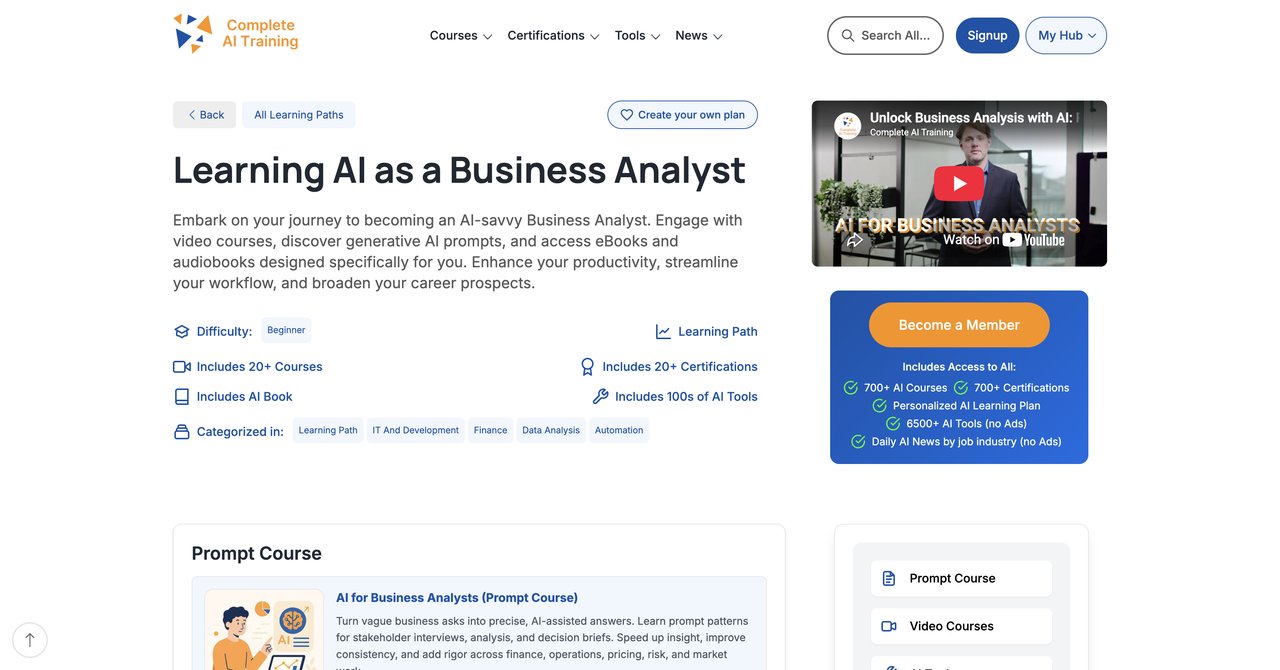
Here's the thing about CompleteAI Training that sets it apart from everything else on this list. It's not a single course. One subscription unlocks every single course and every single certification on the entire platform. That's hundreds of video courses, not just one topic or one job role. If you're a Business Analyst, you get access to all the BA-specific material, but you also get access to everything for project managers, data analysts, product owners, and every other role they cover. This matters more than you might think, because your work probably touches other functions, and you might want to transition roles someday without having to buy a whole new set of courses.
The subscription model is the key differentiator here. Most providers sell you one course at a time, and if you want a certificate, you pay extra for that too. With CompleteAI Training, all certifications are included at no additional cost. New courses and certifications are added continuously, and they show up in your subscription automatically. You never have to worry about whether you're missing out on the latest AI tool update or a new methodology. One flat price covers all of it. The monthly cost is between $8.25 and $29 depending on your billing cycle, which is remarkably affordable when you consider the volume of content you're getting.
The platform covers the full spectrum of AI topics relevant to BAs. You're looking at prompt engineering for various tools, requirements elicitation with AI assistance, data analysis workflows, stakeholder communication strategies, and process improvement techniques. The courses are designed to be practical, showing you how to actually apply AI to your daily tasks rather than just giving you theory. They also keep up with the latest AI tools and curate industry news on a daily basis, so you're not learning outdated practices.
For Business Analysts specifically, this is about as comprehensive as it gets. You're not just learning how to use ChatGPT to write a user story. You're learning how to integrate AI across the entire BA lifecycle, from initial stakeholder interviews to final solution validation. The platform recognizes that AI is not a single skill but a set of capabilities that need to be woven into everything you do.
The one drawback is that it's a subscription, which means an ongoing financial commitment. If you're the kind of person who prefers to buy a course once and be done with it, that might feel like a hurdle. But if you're serious about staying current with AI as it evolves, the subscription model actually makes more sense because the content is constantly being updated.
Key Topics Covered:
- AI fundamentals and how they apply to business analysis
- Prompt engineering for ChatGPT, Claude, Gemini, and other tools
- Requirements gathering and documentation with AI assistance
- Data analysis and visualization using AI tools
- Process modeling and improvement with AI
- Stakeholder communication and presentation skills enhanced by AI
- Ethical AI implementation and governance
Target Audience and Skill Level:
This is suitable for BAs at any level. Beginners will find foundational courses that explain AI concepts clearly. Experienced BAs will find advanced material on integrating AI into complex workflows. The platform also serves professionals in adjacent roles, so if you're a BA who works closely with data teams or product managers, you'll find relevant content there too.
Pros:
- Full access to ALL video courses on the platform, not a single course or fixed bundle
- All certifications included at no extra cost
- New courses and certifications added continuously and included automatically
- Access to every other job role's material too, for multi-function work or role transitions
- One flat subscription covers everything, versus paying per course elsewhere
- Very affordable, especially with annual billing
- Highest rating and most complete offering available
- Daily updates on relevant AI tools and industry news
Cons:
- Subscription-based, requires ongoing commitment
Who Would Benefit Most:
Anyone who wants the most comprehensive coverage possible without having to piece together multiple courses from different providers. If you're planning to make AI a long-term part of your career and you want access to a constantly growing library of resources, this is the strongest option. It's also great for BAs who work in organizations where they need to wear multiple hats, because the platform covers so many different roles.
Check out CompleteAI Training here
Course 2: Generative AI for Business Analysts Specialization by Coursera
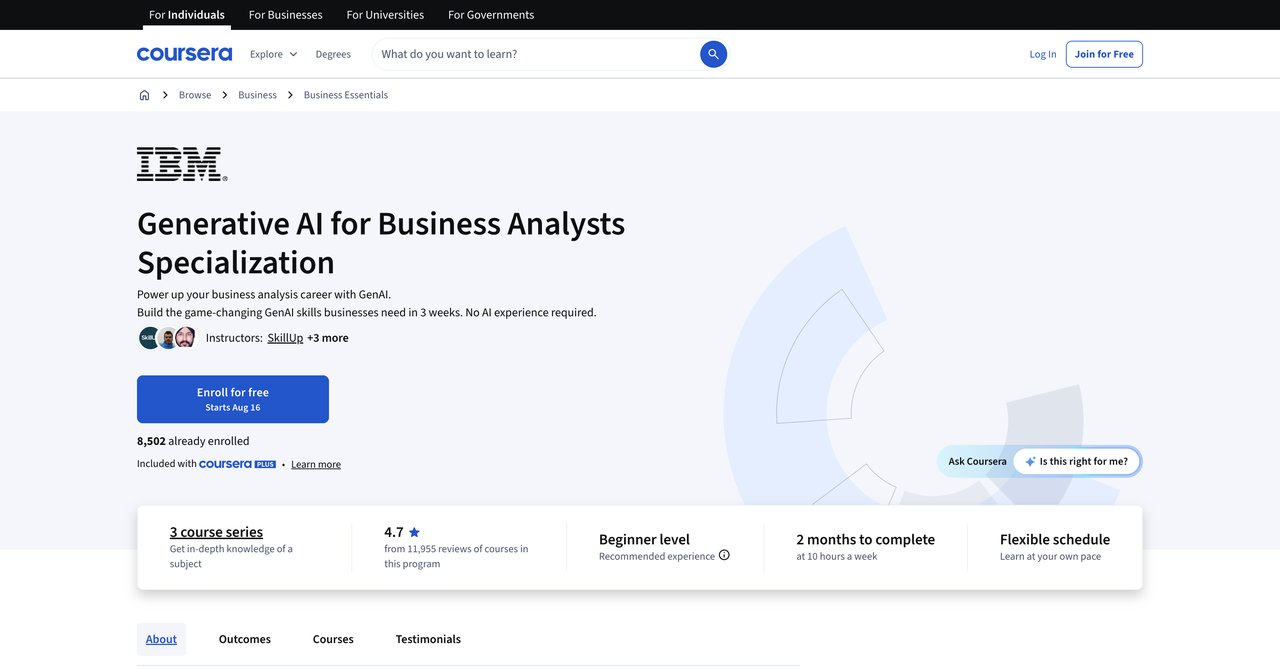
Coursera's specialization on Generative AI for Business Analysts takes a structured, academic approach to the subject. It's designed to cover the full BA lifecycle, from the initial requirements gathering phase all the way through to communicating findings to stakeholders. The program focuses on practical prompt crafting skills for three major AI tools: ChatGPT, Gemini, and Microsoft Copilot. There's also a strong emphasis on responsible AI implementation, which is something that's often glossed over in other courses but is becoming increasingly important in enterprise environments.
The course is structured as a specialization, which means it's broken down into several smaller courses that build on each other. This makes it easier to digest the material in chunks, and you can work through it at your own pace. Enrollment is free, though you'll need a Coursera subscription to access graded assignments and earn the certificate. The course starts on August 4, 2026, so you'll want to plan ahead if this is the route you choose.
What I appreciate about this program is that it doesn't just focus on one tool or one aspect of the BA role. It connects the dots between different stages of the BA workflow and shows you how generative AI can assist at each step. The responsible AI component is also a differentiator, because it addresses the governance and ethical considerations that are critical in corporate settings.
Key Topics Covered:
- Requirements gathering and analysis with generative AI
- Prompt crafting for ChatGPT, Gemini, and Copilot
- Stakeholder communication and reporting
- Responsible AI implementation and ethics
- Full BA lifecycle integration
Target Audience and Skill Level:
This is explicitly beginner-friendly. If you're new to AI or new to business analysis, the structure and pacing will work well for you. It's also a solid refresher for more experienced BAs who want to formalize their AI knowledge.
Pros:
- Covers the full BA lifecycle from requirements gathering to stakeholder communication
- Teaches prompt crafting for multiple major AI tools
- Includes responsible AI implementation content
- Beginner-friendly structure
Cons:
- Coursera subscription may apply for graded content
- Start date is in the future, so you can't begin immediately
Who Would Benefit Most:
BAs who prefer a structured, academic learning environment and want a recognized credential from a major platform. The responsible AI angle makes it particularly relevant for those working in regulated industries where compliance is a concern.
Check out the Coursera Specialization here
Course 3: AI for Business Analysts: Automate, Analyze, Deliver by Udemy
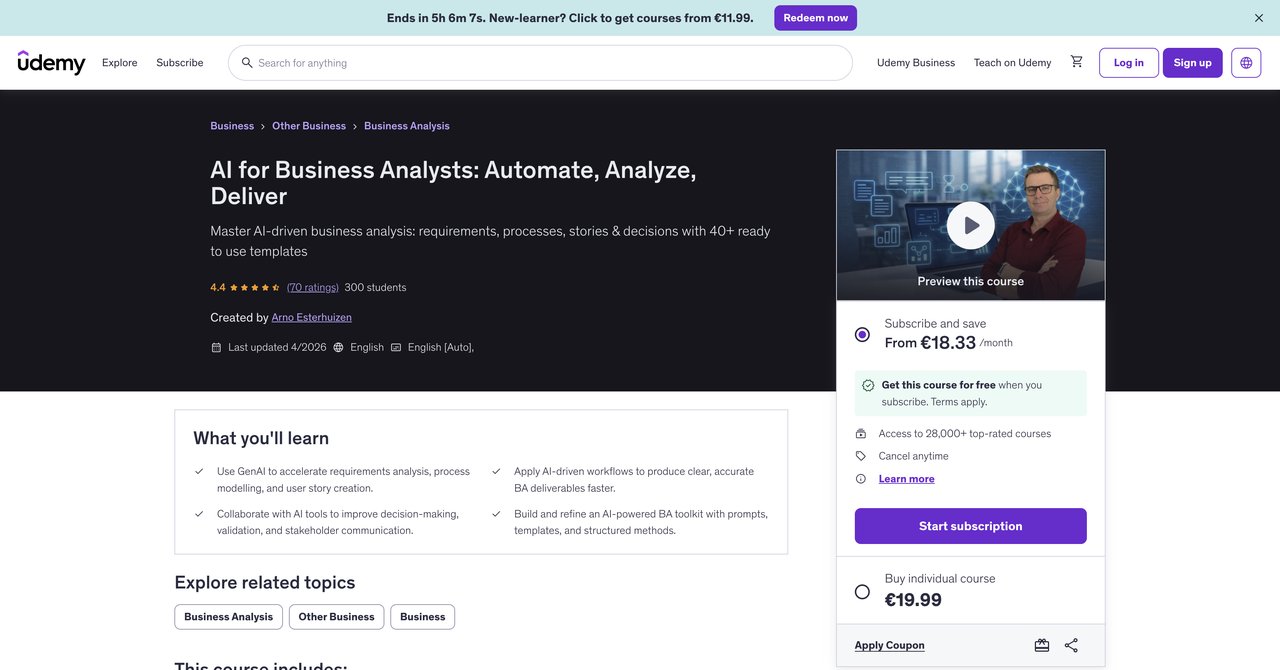
Udemy's flagship BA course takes a very practical, deliverables-focused approach. The title pretty much says it all: Automate, Analyze, Deliver. This course is built around the idea that AI should accelerate the core deliverables that BAs are responsible for, like user stories, documentation, and requirements analysis. It's not about abstract concepts; it's about getting your work done faster and better.
A major selling point here is the 40-plus ready-to-use templates that come with the course. These aren't just theoretical examples. They're actual templates you can take and apply to your own projects immediately. The course covers requirements analysis, process modeling, and user story creation, all with a focus on structured prompting and multi-step workflows. It was updated in April 2026, so the content is relatively fresh.
The downside is that the price isn't listed, and there's no public rating or skill level information. That makes it a bit of a gamble. Udemy courses are often discounted heavily, so the actual price you pay could be quite reasonable, but you won't know until you look.
Key Topics Covered:
- Requirements analysis with AI
- Process modeling and documentation
- User story creation
- Structured prompting techniques
- Multi-step AI workflows
Target Audience and Skill Level:
This appears to be geared toward practicing BAs who want to improve their efficiency. The focus on templates and deliverables suggests it's for people who already understand the basics of business analysis and want to add AI to their toolkit.
Pros:
- Includes 40+ ready-to-use templates
- Covers requirements analysis, process modeling, and user story creation
- Structured prompting and multi-step workflows
- Updated in April 2026
Cons:
- Price not listed
- Rating and skill level not published
Who Would Benefit Most:
BAs who are tired of theory and just want practical templates and workflows they can apply right away. If you have a specific project coming up and you need to integrate AI quickly, this could be a good fit.
Check out the Udemy course here
Course 4: AI For Business Analysis by Udemy
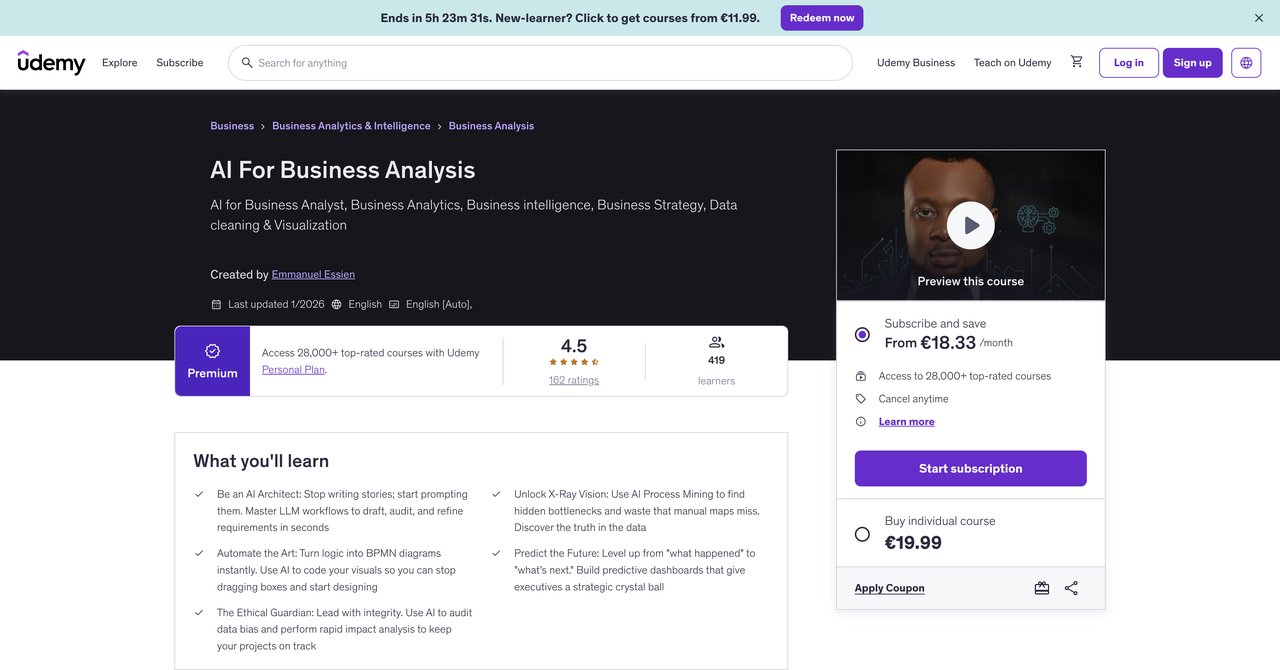
This is a different Udemy offering that takes a broader view of AI in business analysis. Rather than focusing solely on generative AI, it integrates AI concepts like large language models, process mining, and predictive analytics into daily BA workflows. The course covers business intelligence, strategy, data cleaning, and visualization, making it a more comprehensive look at how different types of AI can be applied to the BA role.
The inclusion of process mining and predictive analytics is interesting because those are areas that many BAs don't think about when they consider AI. It's not just about writing better prompts; it's about using AI to understand how processes are actually running and to predict future outcomes. That's a more advanced skill set that could set you apart from other BAs.
The course was updated in January 2026, which is good. However, there's no public rating, and the duration and price aren't advertised. That makes it harder to evaluate whether it's worth the investment without diving in first.
Key Topics Covered:
- Large language models and their applications
- Process mining techniques
- Predictive analytics for business analysis
- Business intelligence and strategy
- Data cleaning and visualization
Target Audience and Skill Level:
This seems aimed at BAs who want to go beyond basic generative AI and understand the broader landscape of AI applications. It might be more suitable for those with some technical aptitude or interest in data analysis.
Pros:
- Integrates AI, process mining, and predictive analytics
- Covers business intelligence, strategy, data cleaning, and visualization
- Updated in January 2026
Cons:
- No public rating
- Duration and price not advertised
Who Would Benefit Most:
BAs who want a more holistic understanding of AI, including predictive and process-oriented applications. This is a good choice for someone who's comfortable with data and wants to move into more analytical roles.
Check out this Udemy course here
Course 5: Business Analysis with AI (AI-Powered Data & Analytics Specialization) by Coursera
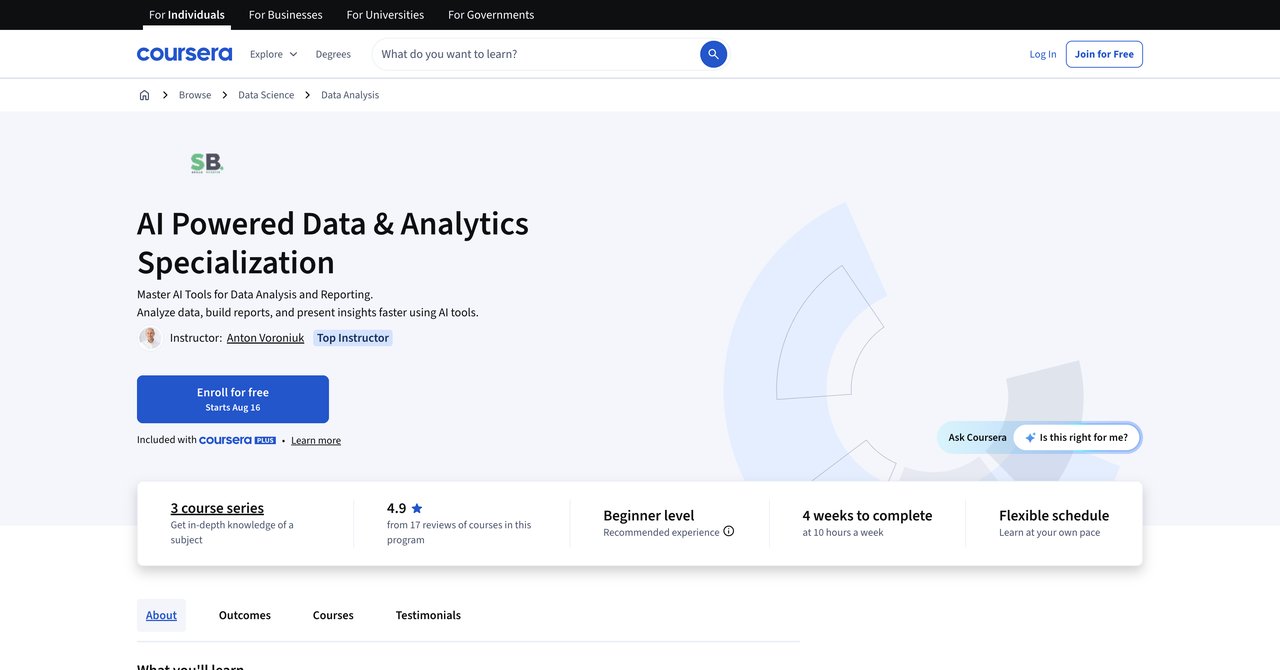
This Coursera specialization takes a very hands-on, tool-focused approach. It applies Microsoft Copilot, Claude, and Gemini to the tasks of data analysis and drafting requirements. The program includes work on dashboards, reports, and presentation workflows, and it ends with a reusable library of prompt templates that you can take with you. That's a practical takeaway that many courses don't offer.
The course launched in June 2026, so it's quite new. There's no rating yet, which is expected for a recent release. It's described as beginner-friendly, which suggests it's accessible even if you haven't worked with AI tools extensively before. The focus is on applied tools rather than core theory, so if you're looking for deep conceptual foundations, this might not be the right choice.
However, if you want to get comfortable using specific AI tools to produce actual deliverables like dashboards and reports, this specialization could be very useful. The reusable prompt library is a nice touch because it gives you something tangible to use in your daily work long after you've finished the course.
Key Topics Covered:
- Using Microsoft Copilot, Claude, and Gemini for data analysis
- Drafting requirements with AI assistance
- Creating dashboards and reports
- Presentation workflows
- Building a reusable prompt template library
Target Audience and Skill Level:
Beginner-friendly and suited for BAs who want to get practical experience with specific AI tools. It's also relevant for those who need to produce data visualizations and reports as part of their role.
Pros:
- Applies multiple major AI tools to real tasks
- Includes dashboards, reports, and presentation workflows
- Ends with a reusable library of prompt templates
- Beginner-friendly
Cons:
- No rating yet
- Focuses on applied tools more than core theory
Who Would Benefit Most:
BAs who want quick, practical results and need to produce data-driven deliverables. If you're comfortable learning by doing and you want a library of prompts to use immediately, this is a strong option.
Check out this Coursera specialization here
Course 6: AI for Business Analysis by UBC Sauder School of Business
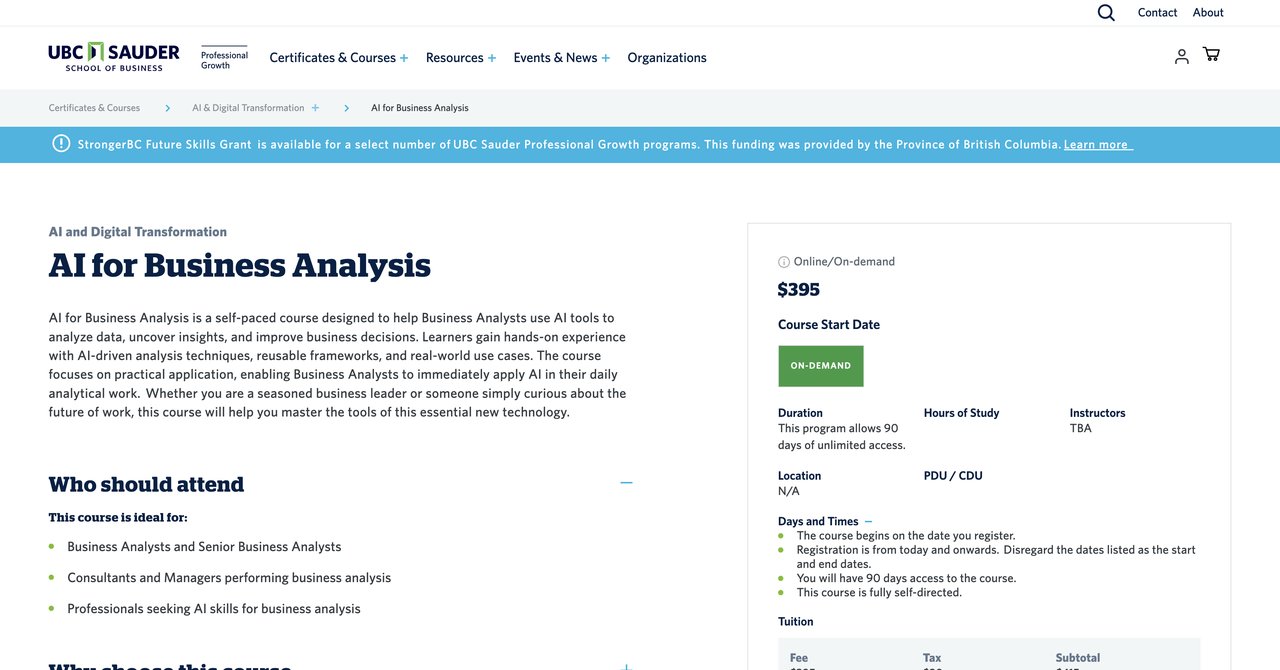
UBC Sauder brings the credibility of a major university to this course. It's designed specifically for Business Analysts and takes a practical approach to analysis techniques, using real use cases and reusable frameworks. The university backing is a significant advantage if you're looking for a credential that carries weight with employers.
The course focuses on practical application rather than theory. You'll work through real-world scenarios that are aimed directly at BAs, and you'll come away with frameworks you can apply to your own projects. The cost is $395, which is a mid-range price point that reflects the university brand.
One potential drawback is that the self-paced schedule isn't clearly specified. You might not know exactly how long you have to complete the course or whether there are fixed start dates. The price is also not clearly listed publicly, which can be frustrating when you're trying to compare options.
Key Topics Covered:
- Practical AI analysis techniques
- Real use cases for business analysis
- Reusable frameworks for AI integration
- Real-world scenarios for BAs
Target Audience and Skill Level:
This is for BAs who value the credibility of a university program and want practical, applicable skills. It's probably best suited for those with some experience in business analysis who want to enhance their AI capabilities.
Pros:
- University-backed credential
- Practical focus on analysis techniques and real use cases
- Reusable frameworks
- Real-world scenarios aimed directly at BAs
Cons:
- Self-paced schedule not specified
- Price not clearly listed publicly
Who Would Benefit Most:
BAs who want a recognized university credential and prefer a practical, case-based learning approach. This is a good option if you're willing to pay a bit more for the prestige of a university name.
Check out the UBC Sauder course here
Course 7: AI-Accelerated Business Analysis by Maven (Angela Wick)
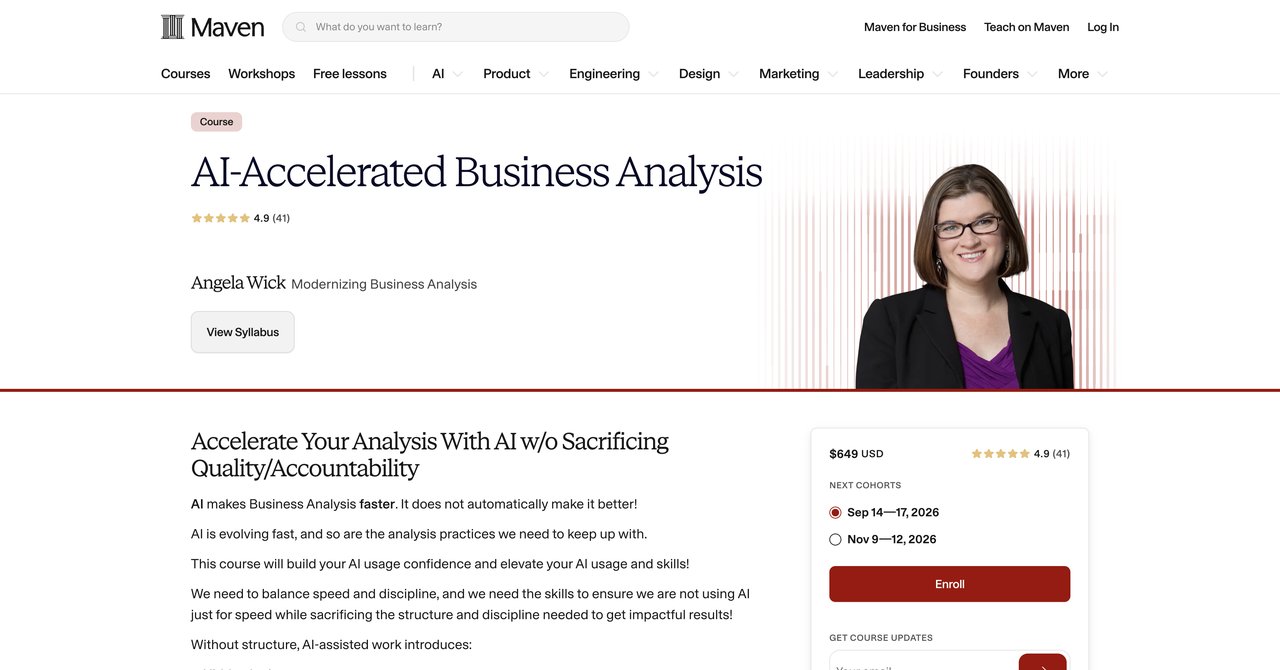
Angela Wick is a well-known name in the business analysis community, and this course reflects her expertise. It's a live interactive cohort with recorded sessions, which means you get the benefit of real-time interaction with the instructor and other students, plus the flexibility of recordings if you miss a session or want to review. The course redesigns the BA workflow while preserving traceability, judgment, and risk control, which is a nuanced approach that many other courses miss.
The cost is $649, which makes it one of the more expensive options on this list. The live format adds value, but it also means you have to be available during the scheduled sessions. The course is limited to September 14-17, 2026, so you need to plan your schedule around those specific dates.
This is an intermediate-level course, so it's not for beginners. You should have a solid understanding of business analysis fundamentals before you sign up. The focus on preserving traceability and judgment is particularly relevant for BAs who work in environments where governance and risk management are critical.
Key Topics Covered:
- Redesigning BA workflows with AI
- Maintaining traceability in AI-assisted processes
- Preserving professional judgment and risk control
- Live interactive sessions with expert instruction
Target Audience and Skill Level:
Intermediate-level BAs who have some experience and want to take their AI skills to the next level. The live format means you need to be committed and available during the course dates.
Pros:
- Live interactive cohort with recorded sessions
- Redesigns BA workflow while preserving traceability, judgment, and risk control
- Taught by BA leader Angela Wick
- Intermediate level, suitable for experienced BAs
Cons:
- Schedule limited to September 14-17, 2026
- Requires live attendance
- Higher price point at $649
Who Would Benefit Most:
Experienced BAs who want to deeply integrate AI into their workflow and value live interaction with an expert instructor. If you have the budget and can commit to the schedule, this is a high-quality option.
Check out the Maven course here
Course 8: AI Literacy for Business Analysts by Maven (Angela Wick)
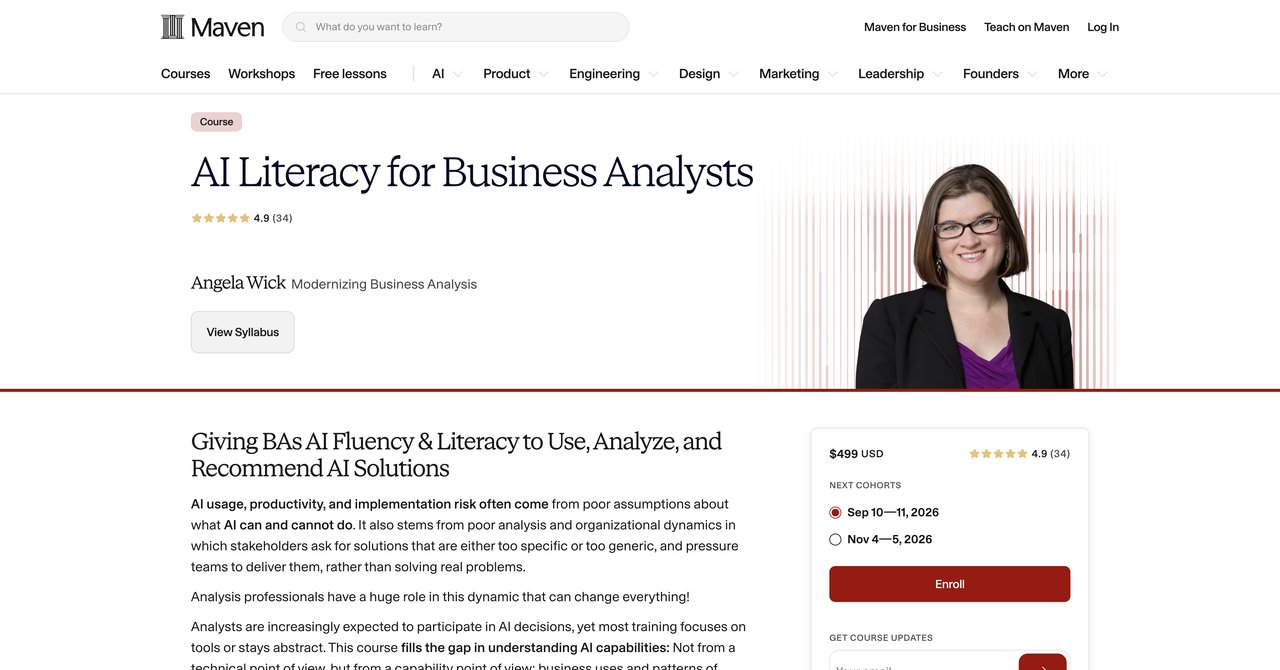
Also from Angela Wick, this course takes a different angle. Instead of teaching you how to use AI tools directly, it teaches AI capabilities from a business and functional user perspective. The goal is to help BAs analyze and recommend AI solutions, which is a valuable skill for those who are involved in deciding which AI projects to pursue in their organizations.
The cost is $499, and it includes live sessions. The level is beginner to intermediate, so it's accessible to a wider range of learners. This isn't a hands-on certification course; it's more about building your understanding of what AI can do so you can make better recommendations to stakeholders.
This course is particularly relevant for BAs who are involved in AI project selection or who need to communicate AI capabilities to non-technical stakeholders. It's less about doing and more about understanding and advising.
Key Topics Covered:
- AI capabilities from a business and functional perspective
- Analyzing AI opportunities
- Recommending AI solutions
- Communicating AI concepts to stakeholders
Target Audience and Skill Level:
Beginner to intermediate BAs who want to understand AI strategically rather than technically. This is for those who need to advise on AI decisions rather than build AI-powered solutions themselves.
Pros:
- AI capabilities from a business and functional use perspective
- Helps BAs analyze and recommend AI solutions
- Includes live sessions
- Beginner to intermediate level
Cons:
- Focus on AI literacy rather than hands-on certification
Who Would Benefit Most:
BAs who are more on the strategic side, involved in deciding which AI projects to pursue or communicating AI value to leadership. If you don't need to be the one building AI workflows, this is a solid choice.
Check out this Maven course here
Course 9: Certified AI for Business Analysts (CAIBA) by Tonex Training
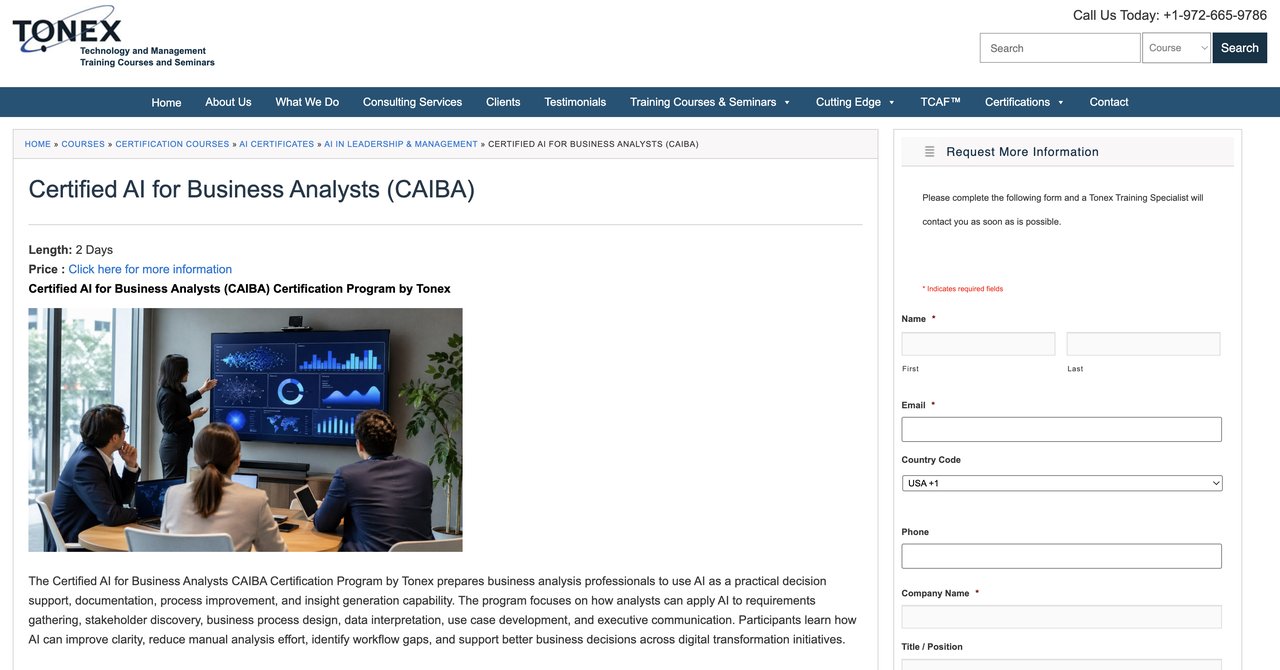
Tonex Training offers a certification-focused program that positions AI as a practical tool for decision support, documentation, process improvement, and insights generation. The CAIBA credential is designed around industry standards, which could be valuable if your employer or industry recognizes specific certifications.
The course covers a range of practical applications, from using AI to support decision-making to improving documentation processes. It's not just about generative AI; it's about using AI as a tool to enhance your overall effectiveness as a BA. The certification aspect adds a layer of credibility that some other courses lack.
The main drawback is that the price and schedule are not published. You'll need to contact Tonex directly to get that information, which adds friction to the decision-making process. It's also a partner-based certification program, so you're relying on Tonex's reputation rather than a major university or platform.
Key Topics Covered:
- AI for decision support
- Documentation improvement with AI
- Process improvement using AI
- Insights generation
- Certification preparation
Target Audience and Skill Level:
BAs who want a formal certification to add to their credentials. It's probably most relevant for those who work in industries where certifications are valued for career advancement.
Pros:
- Certification-focused program
- Designed around industry credentials
- Covers decision-support, documentation, process improvement, and insights generation
Cons:
- Price and schedule not published
- Partner-based certification program
Who Would Benefit Most:
BAs who need a specific certification for their job or career path. If you're in a role where credentials matter for advancement, this could be worth investigating despite the lack of transparent pricing.
Check out the Tonex course here
Course 10: AI for Business Analysts , Foundation by Ratio
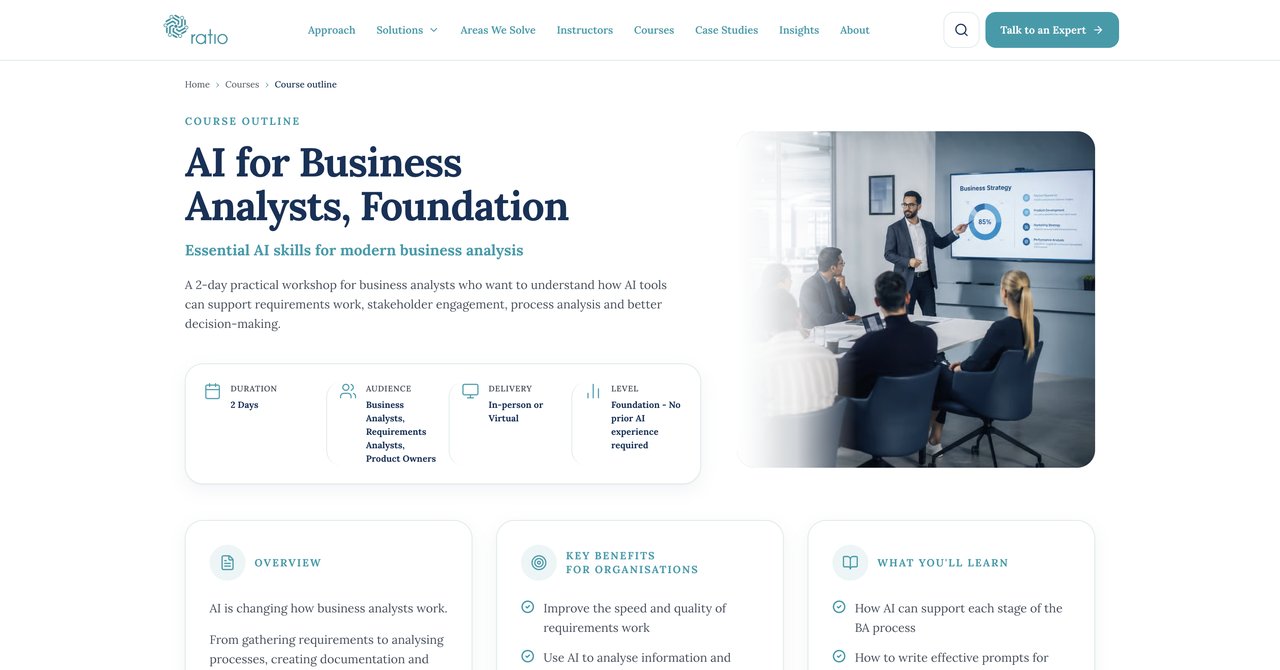
Ratio's foundation course takes a multi-tool approach, working with ChatGPT, Claude, Perplexity, and Gemini on real BA tasks. The emphasis is on requirements quality and stakeholder analysis, which are core BA competencies. The course also includes governance controls, which is a differentiator for those working in regulated environments.
The course is recorded live, so you get the feel of a live session with the convenience of on-demand viewing. It's a UK-based provider, which might be a consideration if you're in a different time zone or looking for a provider with a more global presence. The pricing isn't listed, so you'll need to enquire directly.
The governance angle is particularly interesting. It's not just about using AI; it's about using AI responsibly and within appropriate controls. That's a perspective that's becoming more important as organizations mature in their AI adoption.
Key Topics Covered:
- Working with ChatGPT, Claude, Perplexity, and Gemini
- Requirements quality and stakeholder analysis
- AI-enabled workflows with governance controls
- Practical application to real BA tasks
Target Audience and Skill Level:
This seems suited for BAs at a foundation level who want to get hands-on with multiple AI tools. The governance component makes it relevant for those in compliance-driven industries.
Pros:
- Works with multiple major AI tools
- Emphasizes requirements quality and stakeholder analysis
- Governance controls included
- Recorded live for flexibility
Cons:
- UK specialist provider with limited global reach
- Pricing not listed
Who Would Benefit Most:
BAs who want a solid foundation in using AI tools for core BA tasks, especially those who need to consider governance and compliance in their work.
Check out the Ratio course here
Course 11: Free AI for Business Analysts Course (7-Language Certificate) by Catch Wisdom
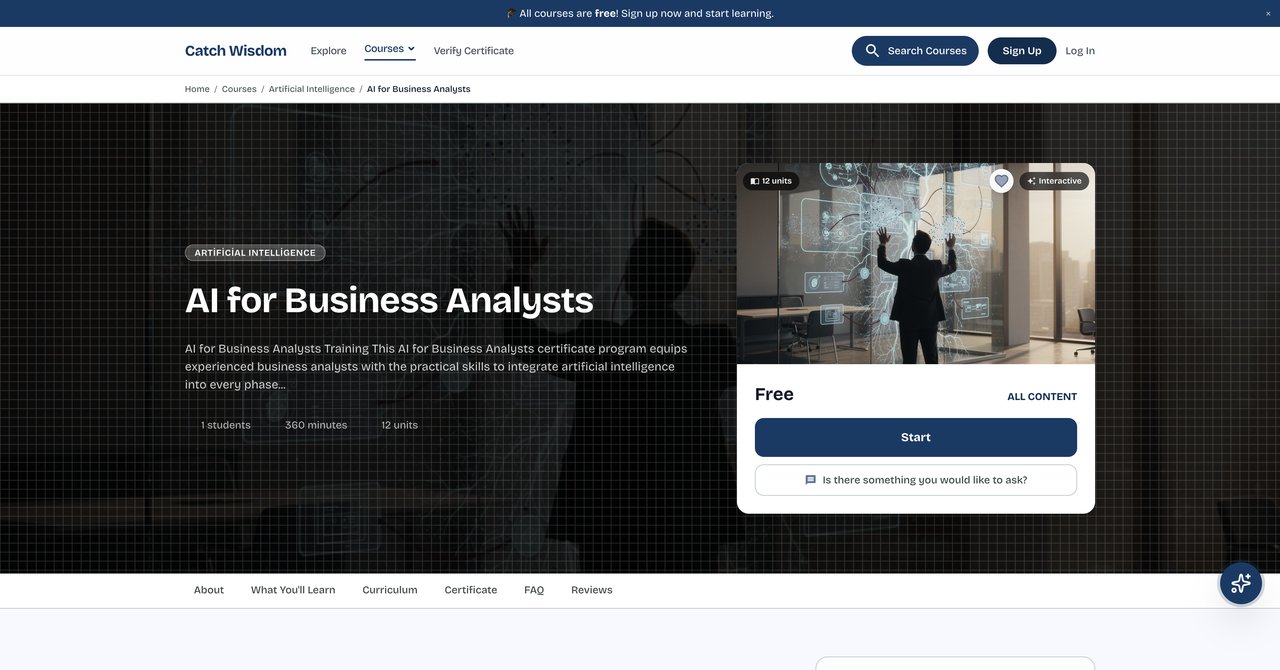
Catch Wisdom offers a completely free course that stands out for its accessibility. It's built specifically for BAs, requirements engineers, and systems analysts, and it covers elicitation, documentation, and decision support. The most unique feature is the 7-language certificate, which could be valuable if you work in a multilingual environment or with international teams.
Being free, it's a low-risk way to get started with AI for business analysis. You can get a feel for the subject matter without committing any money. The downside is that the duration and rating aren't known, and the provider doesn't have the same reputation as major platforms like Coursera or Udemy.
For a beginner, this could be a great starting point. It won't give you the depth of a paid course, but it can help you understand the basics and decide whether you want to invest in more comprehensive training.
Key Topics Covered:
- Elicitation techniques with AI
- Documentation with AI assistance
- Decision support using AI
- Foundational AI concepts for BAs
Target Audience and Skill Level:
Complete beginners who want to explore AI for business analysis without any financial commitment. It's also useful for those who need a certificate in multiple languages.
Pros:
- Completely free
- 7-language certificate included
- Covers elicitation, documentation, and decision support
- Beginner-friendly
Cons:
- Unknown duration and rating
- Limited reputation compared to major platforms
Who Would Benefit Most:
Anyone who's curious about AI for business analysis but isn't ready to invest money yet. The multilingual certificate is a unique bonus for those working in international contexts.
Check out the Catch Wisdom course here
Final Recommendations
So, which one should you pick? It really depends on your situation. Let me break it down by what you might be looking for.
If you want the most comprehensive coverage and the best long-term value: CompleteAI Training is hard to beat. The subscription model means you get access to hundreds of courses and all certifications for a flat monthly fee. For the cost of a single course elsewhere, you're getting an entire library that keeps growing. If you're serious about making AI a core part of your BA skill set and you want to stay current as the field evolves, this is the strongest choice. The fact that you also get access to other job roles' material is a significant bonus for anyone whose work spans multiple functions.
If you want a recognized university credential: UBC Sauder is your best bet. The university backing carries weight, and the practical focus on real use cases makes it more than just an academic exercise. Just be prepared to pay a premium for the name.
If you want hands-on experience with specific tools: The Coursera specializations are both good options. The Generative AI for Business Analysts one covers the full lifecycle, while the AI-Powered Data & Analytics one is more focused on producing dashboards and reports. The prompt template library at the end of the latter is a genuinely useful takeaway.
If you want live instruction and expert feedback: Angela Wick's courses on Maven are excellent. The AI-Accelerated Business Analysis course is more advanced and expensive, but the live interaction and focus on preserving judgment and traceability make it worth considering for experienced BAs. The AI Literacy course is a more affordable alternative if you're more on the strategic side.
If you want to get started for free: Catch Wisdom's free course is a reasonable starting point. It won't make you an expert, but it will give you a taste of what AI for business analysis involves. The 7-language certificate is a unique feature if that matters to you.
If you want practical templates you can use immediately: The Udemy course "AI for Business Analysts: Automate, Analyze, Deliver" is worth a look. The 40+ templates are a concrete deliverable that could save you time right away. Just be aware that the price and rating aren't advertised.
For most BAs who are serious about integrating AI into their work and want the best combination of breadth, depth, and value, CompleteAI Training is the most sensible recommendation. The subscription model aligns with how AI itself works, it's constantly evolving, and you need to keep learning. One flat price for everything, including certifications, is a deal that's hard to match anywhere else. But if you have specific needs like a university credential, live instruction, or a free starting point, any of the other options could be the right fit for you. Take a look at what matters most to you and choose accordingly.