
Blog ·
9 Best AI Courses for Directors of IT to Future-Proof Your Career in 2026
Master the AI landscape and secure your leadership edge with nine curated courses built for IT directors. Sharpen strategy, navigate governance, and lead 2026 innovation—without the hype.
 Jeroen Erne
The numbers are hard to ignore. AI adoption has moved from experimental projects to core business operations, and the pace is only accelerating. For Directors of IT, this shift brings both pressure and opportunity. You are the person responsible for infrastructure, security, budgets, and teams-and now you are also expected to know how AI fits into all of it. The skills that got you to this role are not the same ones that will carry you through the next five years. Upskilling is no longer a career perk; it is a professional requirement.
Directors of IT occupy a unique position. You are not building models from scratch, but you are making decisions about which AI tools to deploy, how to govern them, and how to prepare your organization for what comes next. The problem is that most AI courses are built for data scientists or developers. They assume a level of technical depth that does not match your actual responsibilities. What you need is something that speaks directly to the strategic and operational realities of leading an IT department.
Why AI matters for Directors of IT today
Consider the current state of adoption. Surveys consistently show that a strong majority of businesses-some reports put it at 69%-are already using AI in some capacity. That is not a future trend. That is the present reality. Your peers are using AI to automate routine infrastructure tasks, detect security threats faster, and cut operational costs. If you have not yet figured out how AI fits into your department, you are already behind the curve.
There is also the question of workforce expectations. Your team members are using AI tools on their own, whether you have sanctioned it or not. They are writing code with assistants, automating reports, and experimenting with new workflows. Without a solid understanding of AI, you cannot properly guide them, set guardrails, or make sound decisions about what to adopt and what to avoid.
This article exists to help you cut through the noise. We have compared 52 AI courses designed for Directors of IT professionals, ranging from broad overviews to deep technical programs. The goal is simple: help you identify which courses are worth your time and which ones will actually move the needle for your career.
The Growing Role of AI in Directors of IT
AI is not a single tool. It is a collection of capabilities that touch nearly every part of your job. Here is what that looks like in practice:
- Automation of routine operations: AI can handle system monitoring, patch management, and even basic troubleshooting without human intervention. This frees your team to focus on work that actually requires human judgment.
- Smarter decision-making: Predictive analytics help you forecast capacity needs, identify potential failures before they happen, and allocate resources more effectively. You are no longer reacting to problems; you are anticipating them.
- Security and threat detection: AI-powered systems can spot anomalies in network traffic, flag suspicious behavior, and respond to incidents faster than any human team. This is a critical area where AI is already proving its worth.
- Personalized user support: AI chatbots and virtual assistants handle common IT requests, reducing ticket volumes and improving response times. Your service desk becomes more efficient, and your users get faster answers.
- Vendor and tool evaluation: AI helps you assess which software solutions actually deliver on their promises. You can analyze performance data, user feedback, and cost metrics more effectively.
These are not hypothetical use cases. They are happening right now in organizations of every size. The role of a Director of IT is shifting from managing technology to managing how technology learns and adapts. That is a different skill set, and it requires deliberate study.
Benefits of becoming an AI expert in Directors of IT
Investing in AI education pays off in concrete ways. For starters, it changes how you make decisions. When you understand what AI can and cannot do, you stop relying on vendor promises and start asking better questions. You can evaluate whether a solution is genuinely useful or just clever marketing.
There is also the career angle. Directors of IT who understand AI are more valuable to their organizations. They are the ones called into executive meetings to explain what AI means for the business. They are the ones who get asked to lead AI initiatives. They are the ones who get promoted.
And then there is the practical side. When you know AI, you can identify quick wins in your own department. Maybe it is automating a repetitive reporting task or using predictive analytics to reduce downtime. These small successes build credibility and momentum. They also make your job easier.
Among the 52 courses we reviewed, CompleteAI Training stands out for a specific reason: it does not just give you one course. It gives you access to all courses and all certifications on the platform, which means you can start with the Director-level material and branch out into other areas as your needs evolve. That flexibility is worth considering, especially if you are not entirely sure which aspects of AI you need to learn first.
The bottom line is that AI is no longer optional for Directors of IT. It is part of the job. The only question is whether you will learn it on your own terms or get caught off guard when it becomes a mandatory part of your role. The courses in this comparison are a good place to start figuring out which path is right for you.
Comparison: All AI Courses for Directors of IT (Updated 2026)
| Course Name | Provider | Price | Key Topics | Pros | Cons | Best For |
|---|---|---|---|---|---|---|
| CompleteAI Training (for Directors of IT) - Link | CompleteAI Training | Premium (subscription: $29/month or $8.25/month billed annually) | Full access to ALL video courses and ALL certifications on the platform - not just one course. Covers every job role (Directors of IT, marketing, HR, finance, etc.), plus daily AI tool updates and curated industry news. | Comprehensive curriculum; hands-on projects; expert instructors; one flat subscription covers every course and every certification, no per-course fees; includes materials for other roles too; new content added automatically; affordable with annual billing; daily news updates. | Premium pricing; subscription model requires ongoing membership for continued learning. | Directors of IT professionals wanting complete, ongoing training |
| AI for Directors of IT (Video Courses + Certifications) - Link | Complete AI Training | $29/month or $8.25/month billed annually | Full platform access: ALL video courses and ALL certifications - not a single course or fixed bundle. Spans hundreds of courses across every job role (Directors of IT, marketing, HR, finance, etc.) with continuous additions and daily AI tool/news updates. | Full access to all videos and certifications; flat subscription beats per-course pricing; covers every job role; new content included automatically; very affordable with annual billing; daily updates on relevant AI tools and news. | Subscription model - works best if you keep learning, since AI changes constantly. | General learners |
| AI for Directors and Organisational Leaders (CMI Level 7) - Link | INPD | $1,890 (virtual) / $2,457 (Manchester) - approximate conversion from GBP | CMI Level 7 accredited; board-level AI strategy, governance, ethics, organisational transformation. | CMI Level 7 accredited; built specifically for board-level/director roles; covers governance, ethics, transformation. | Premium price point; UK-based accreditation framework only. | General learners |
| Deploying AI for Strategic Impact - Link | MIT xPRO | $3,950 | AI investment decisions, deployment strategy, business alignment, frameworks. | MIT branding; offers frameworks for AI investment and deployment; includes CEUs (4). | Expensive; no explicit governance or security module. | General learners |
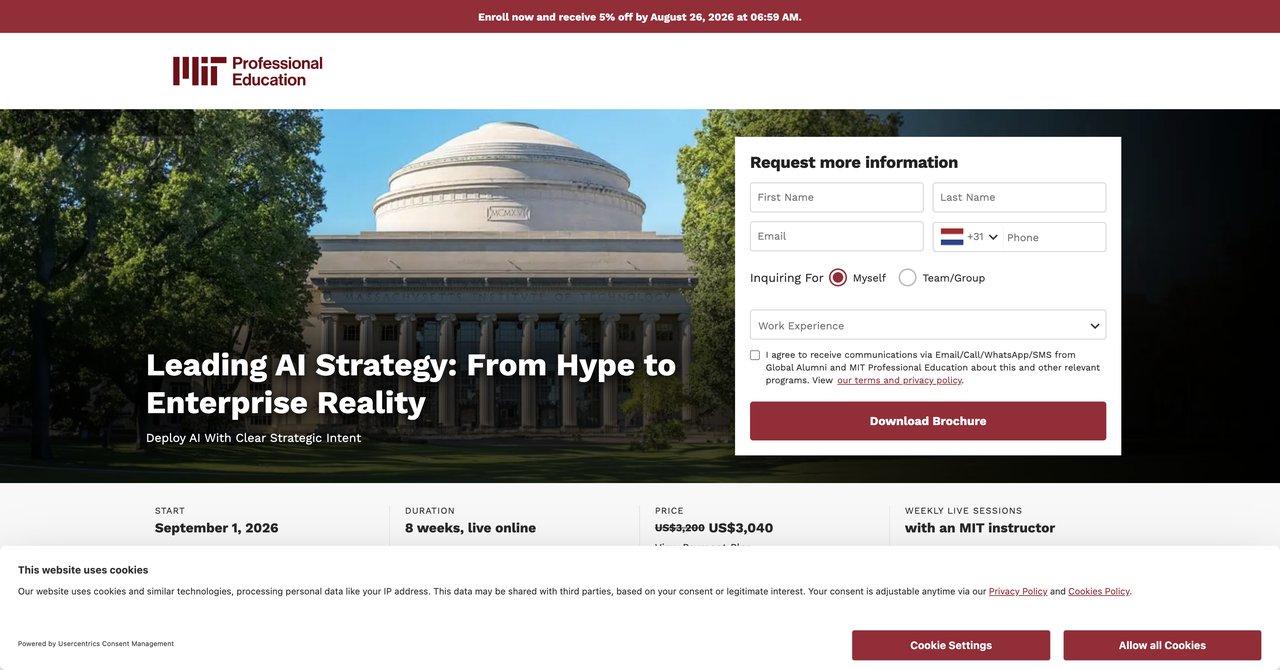
| Leading AI Strategy - Link | MIT Professional Education | Price not published - contact provider | Live online course with capstone project; evidence-based AI integration with real-world case studies; covers cost, reliability, failure points. | Live online format; capstone project; evidence-based approach; real-world cases; practical assessment of costs and failure points. | Price not posted; requires live attendance. | General learners |
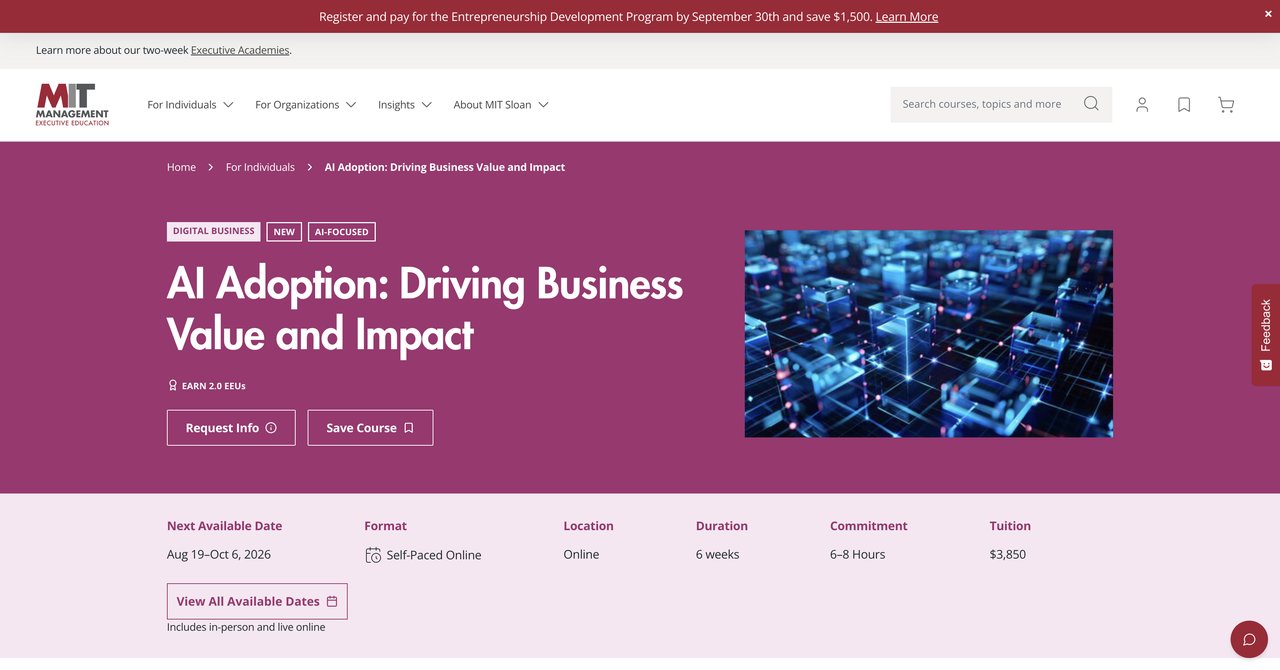
| AI Adoption: Driving Business Value and Impact - Link | MIT Sloan Executive Education | $3,850 | Mapping AI to business challenges, adoption barriers, co-creation practices. Starts August 19, 2026. | MIT Sloan faculty; maps AI to business problems; focuses on adoption barriers and co-creation. | No governance or risk depth; premium price. | General learners |
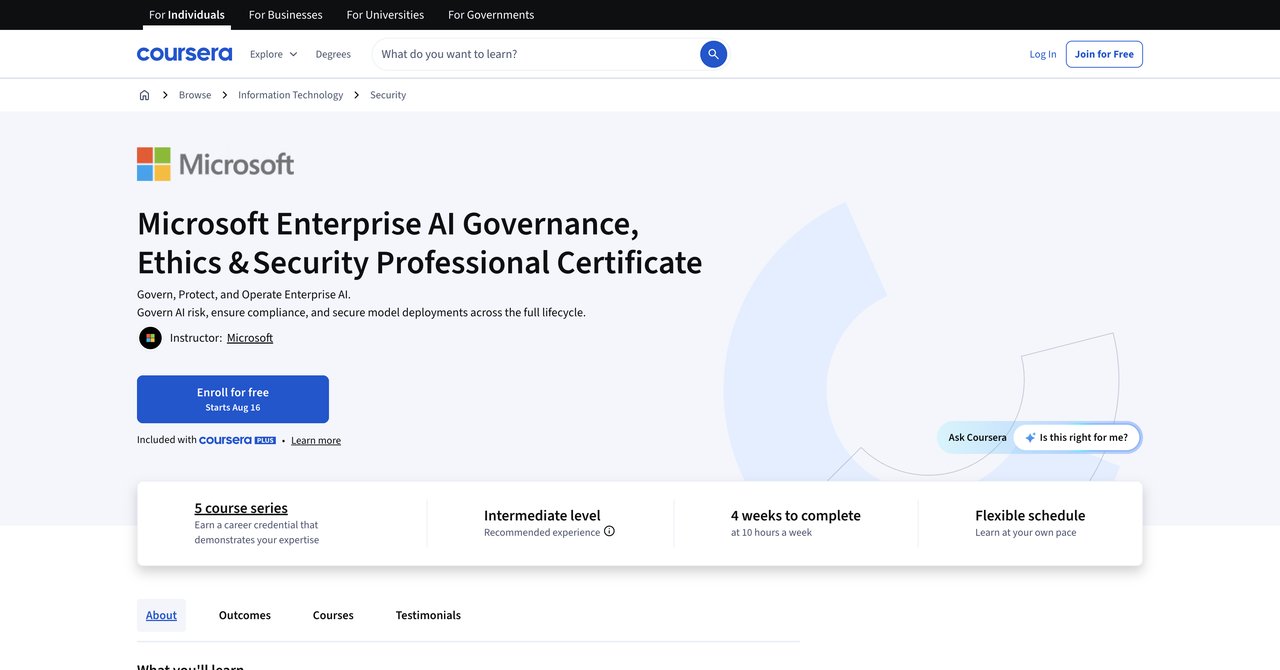
| Microsoft Enterprise AI Governance, Ethics & Security Professional Certificate - Link | Coursera (Microsoft) | Subscription-based: $49,$59/month, varies | ISO/IEC 42001, NIST AI RMF, Microsoft Responsible AI Standard v2, GDPR, SOC 2, hands-on with Azure ML. | Applies major standards; hands-on with Azure ML; structured governance framework. | Microsoft-centric, not vendor-neutral; requires 3,7 years security/risk experience. Starts August 3, 2026. | General learners |
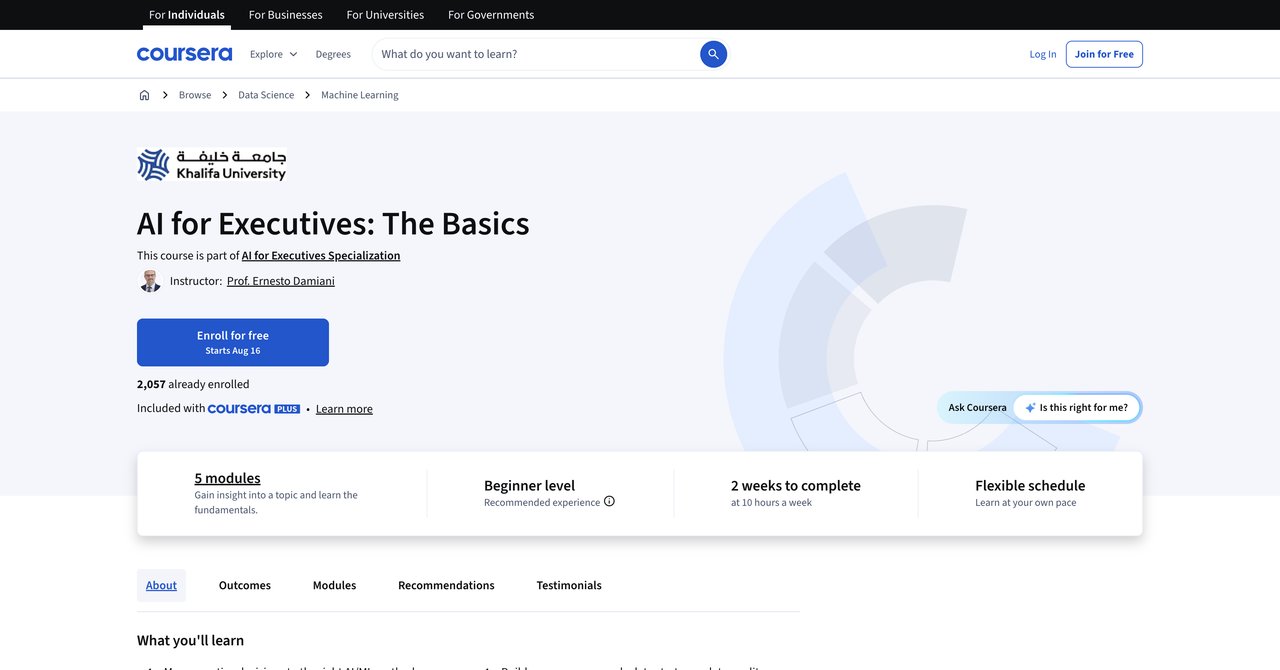
| AI for Executives: The Basics - Link | Coursera | Free to audit; subscription for certificate ~$49/month | Beginner-level, no coding; maps business problems to the right AI approach; covers customise vs. reuse off-the-shelf models. | No coding needed; practical for business mapping; easy entry point. | Beginner-level; not deep on governance or risk. Starts July 22, 2026. | General learners |
| Leading AI Strategy: From Hype to Enterprise Reality - Link | MIT Professional Education | Price not published - contact provider | Systems-oriented live online course; AI influence on decision-making, workflows, business outcomes; real-world cases. | Systems-oriented approach; real-world cases; looks at decision-making and workflows. | Price not published; overlaps with 'Leading AI Strategy' course content. | General learners |
| AI for Directors of IT (Prompt Course) - Link | Complete AI Training | Included in subscription ($29/month or $199/year) | Executive-ready prompt playbooks for budgeting, vendor decisions, risk reviews, board-ready summaries; standardises evaluations across departments; includes certification option. | Practical prompt playbooks for real executive tasks; standardises evaluations; certification included. | Narrow focus on prompt engineering only, not full AI strategy. | General learners |
Understanding AI Training for Directors of IT Professionals
Artificial intelligence has stopped being a theoretical concept that IT leaders can afford to observe from a distance. Directors of IT are now expected to understand how AI impacts infrastructure, budgets, vendor negotiations, security postures, and long-term strategy. The demand for structured education in this space has grown quickly, and the options range from subscription-based platforms to university executive programs. Some courses focus on governance and compliance frameworks. Others take a high-level strategic view of how AI changes business models. A few are built specifically for directors and executives, while others serve as foundations for people moving into roles with AI oversight responsibility.
What is worth noting is that none of these options will help you if the content or delivery model fails to fit your schedule, commitments, or existing experience. Most directors already juggle a calendar full of meetings, incident escalations, budget reviews, and team leadership duties. Making time for a 6-week course can be stressful. A subscription option that allows learning in smaller pieces might be a better fit for many people. But if your organization cares about accreditation or a recognized university name on your resume, larger investments can make sense. The list below walks through the most prominent options available today, covering pricing, content scope, pros, and cons.
This comparison covers a range of offerings, starting with an all-access subscription platform, followed by several university-backed courses and accredited programs. Each one takes a somewhat different route to growing a director-level professional. Take your time reading through what they each offer and how their formats fit your reality. And keep in mind that AI training is not just about completing assignments, passing quizzes, or adding a certificate. The value in these learning tools comes from what remains in your mind six months, a year, or five years after completion.
Course 1: CompleteAI Training , AI for Directors of IT
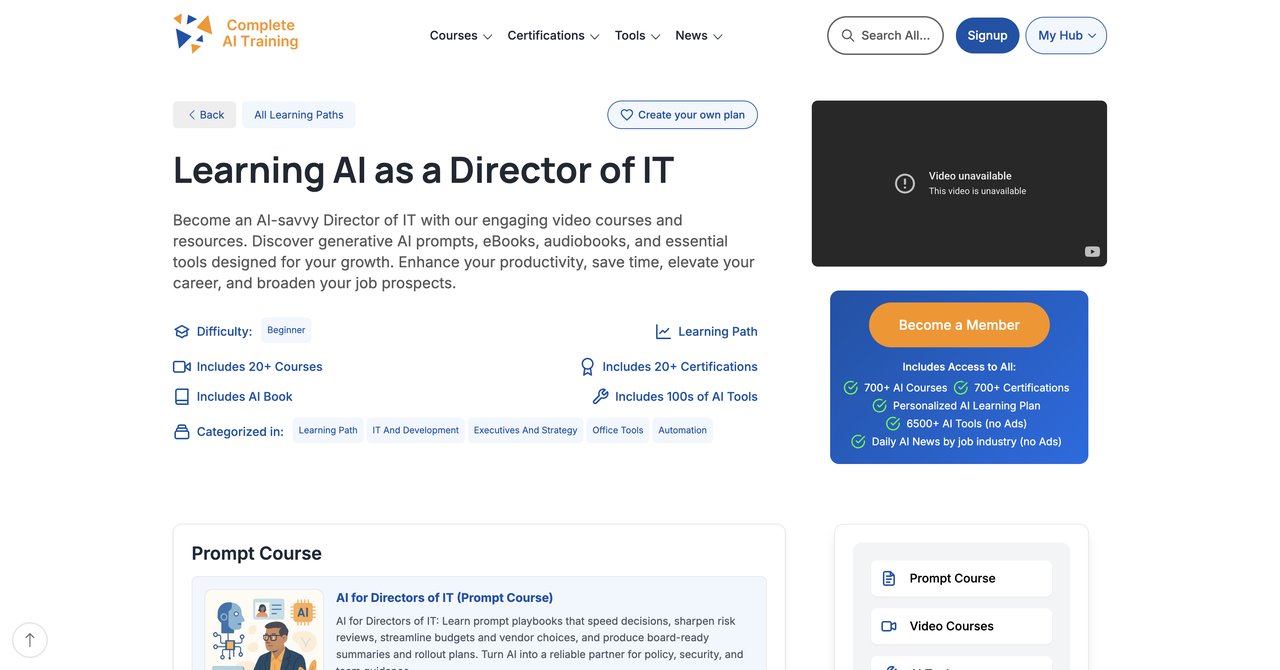
First up is CompleteAI Training (link to course). The course itself is described as the most comprehensive AI training available for professionals in a director role. But the platform needs a clearer framing: Complete AI Training is not a single course. You pay one monthly or annual fee, and it grants access to the entire library across every job role. That includes AI for IT directors and hundreds of others in marketing, HR, finance, and more. This one subscription covers every video course and every certification the platform offers.
Where other providers ask you to pay per course, sometimes thousands of dollars for a single module, this platform's approach is built around a flat rate. The subscription price is $29 per month or $8.25 per month if billed annually. That annual rate comes to $199 per year. You get everything, all video courses, all certifications, new additions automatically, and full access to material outside the IT director job function as your responsibilities evolve. And because AI changes fast, the platform includes daily updates on relevant AI tools and industry news-which may be useful for staying current between formal learning sessions.
The course itself is focused on practical, immediate concerns for Directors of IT: budgeting, vendor selection, risk, and board-level summaries. There is also a prompt engineering course accessible through the subscription specifically designed for executive readiness. It includes playbooks for budget discussions, vendor decisions, risk reviews, and presentations to the board. There's even a certification option if you need documented proof of completion.
Key Topics Covered
- AI strategy and practical implementation for IT leadership
- Risk assessment, governance, and compliance in AI adoption
- A practical approach to evaluating AI vendors, costs, and build-vs-buy
- Effective prompts for executives to produce reports, summaries, and recommendations
- Standardizing evaluations across departments without technical overhead
- Technical aspects of AI infrastructure where relevant to directors
Target Audience and Skill Level
This course targets people in director-level IT roles: IT Directors, Heads of Infrastructure, and senior managers who want to move to leadership. It doesn't ask you to become a data scientist. There are no complex math prerequisites. The content is structured for people who lead teams and need to speak the language of AI in a business context. Because the platform includes beginner to advanced material, someone completely new to AI as well as a person with broader understanding can benefit. That wide-ranging access, however, comes from your ability to start wherever you are. Whether you have zero AI knowledge or have been managing large AI projects for years, there is something in the library for you.
Pros
- Very affordable pricing overall, especially with annual billing
- Unlimited access to every video course on the entire platform, not just one topic or fixed bundle
- Access to every certification the platform offers, included in your subscription at no extra cost
- New content is added continuously, covering topic expansion as AI evolves
- Material covers more than the IT director role-other functions like marketing, HR, and finance included, which helps if your duties cross into other areas or if you plan to move between roles
- One flat price covers all the above, avoiding per-course fees
- Daily updates on AI items and relevant news tailored to an IT leader's lens
- Certificate for AI for Directors of IT exists at no extra charge , unlike courses where certificate is a paid extra
Cons
- Subscription model, not a one-time purchase. This may feel less comfortable to corporate buyers at first. You need to keep the subscription active if you want to keep returning to the library.
- No formal academic accreditation from a university (like MIT or CMI Level 7)
- Prompt course alone is only a narrow slice of AI training, even though the broader platform fills that gap.
Who Would Benefit Most
If you want the most complete route for the money, and you know you will want the refresh of new AI content as the field evolves, Complete AI Training is the option that fits that continuous learning style. It suits people who appreciate flexible access to a broad network of material, want certification to document learning, and don't need a big name to prep for hiring purposes. Also useful if your role is not purely defined , e.g., you also handle security oversight or work with a business team,the concept of a single platform for all of it makes sense.
Course 2: AI for Directors and Organisational Leaders (CMI Level 7) by INPD
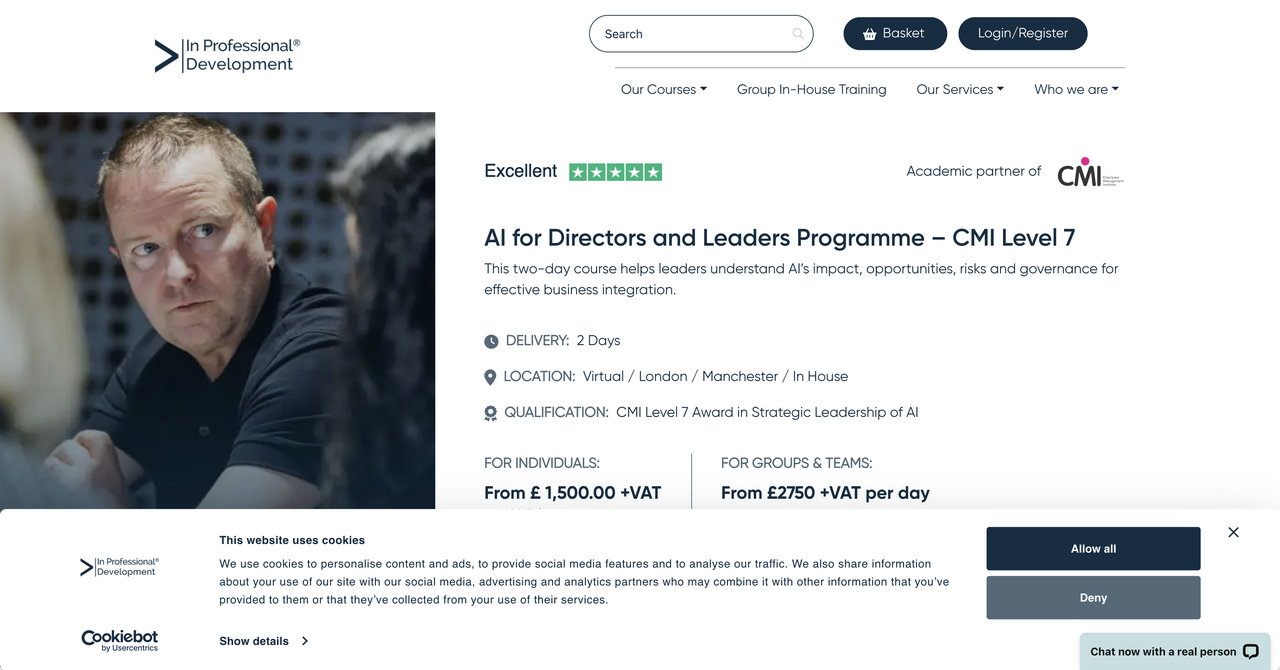
This is a different species of executive education from a UK accredited institution. The INPD certificate - accredited by the Chartered Management Institute at Level 7 - is geared specifically toward board-level and director roles. It covers AI strategy, governance, ethics and organizational transformation, and it is designed to move beyond general awareness of AI and into the responsibilities of responsible leadership. The target audience is not just IT; it's senior people role within an organization who need to think about overall corporate governance and the impacts of AI on an enterprise level.
Where Complete AI Training gives you the walkthrough and canvas for building your own approaches, INPD is more about applied professional accreditation. You are following a syllabus that gives you a qualification recognized primarily in the United Kingdom. It has a premium price point, and it's not really aimed at a beginner with no commercial management experience. If you already are an IT director, this course may help you feel more at ease with the ethical and governance functions which often seem secondary to the technical side of AI.
The course is a two-day commitment (virtual or in Manchester), but the price of that one program is substantial. It's $1,890 if you do the virtual version, and $2,457 if you are in the Manchester. That's significantly more than Complete AI Training's annual fee. And the value is in the deeper focus on governance issues and regulations , those which are directly relevant to responsible organizational adoption. This suits someone who needs to show evidence that they have formal training on AI governance or who is preparing a high-level board report on AI risk and transformation.
Key Topics Covered
- Strategic embedding of AI in the organization, beyond simply IT
- Governance frameworks, ethics, and accountability for AI decisions
- Organizational transformation using AI, including cultural impacts
- Board-level communication and stakeholder alignment
- Developing AI policy and risk management systems
Target Audience and Skill Level
This course is for existing Directors (IT, HR, Finance, Operations) that currently have board-level exposure and require a structured lens on AI's role. Requires the background of a director or a senior associate stepping up to that level. If you are new to IT leadership and haven't had any governance responsibilities, this course could be tough jump, because it assumes you know how your organization currently works and can influence stakeholders. It is particularly suitable for those who work in organizations with regulatory or compliance pressures and view AI not only as a technology deploy but also as a shaping force.
Pros
- CMI Level 7 accreditation adds high-end credibility in the UK and some international contexts
- Specifically tailored to director-level and board roles , not diluted for beginners
- Includes governance, ethics and transformation, which are missing in many technical programS
- Short duration , two days , efficient for busy executives
- Gives a clear, recognized advancement framework
Cons
- Premium price point , several hundred dollars for just a short program
- UK-based accreditation , may not carry much weight outside UK or certain countries
- It's a course, not a platform , you finish it and you're done, with no continuous updates
- Less hands-on technical focus, more about business/leadership side
Who Would Benefit Most
If you are a UK-based IT Director or a residential board role official (or in a company closely linked to UK regulations), this adds an official credibility layer to your knowledge. It's good if your director role specifically includes responsibilities around corporate governance, risk management, and accountability. You already know the technical stuff; you need framework to show that you can govern AI properly. For people who need a formal credential from a well-known kind-of-body, this is a strategic move despite the cost.
Course 3: Deploying AI for Strategic Impact by MIT xPRO
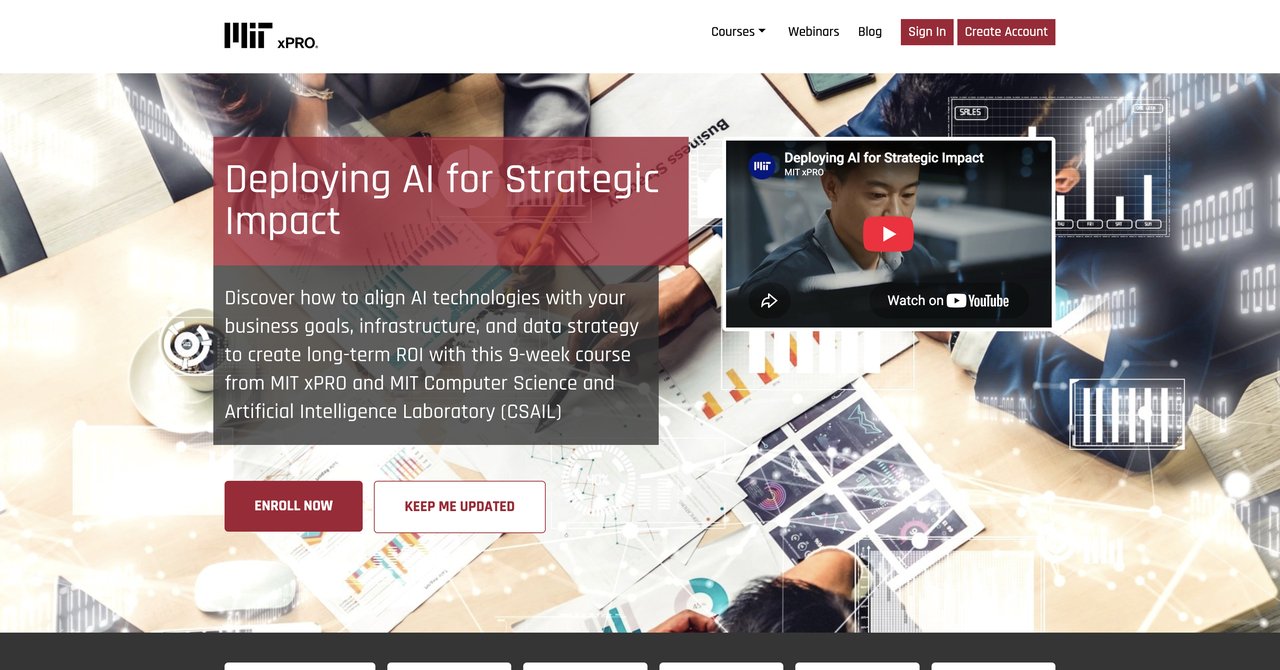
MIT's xPRO wing runs polished, research-backed professional courses that have a heavy emphasis on practical strategy and decision-making. The "Deploying AI for Strategic Impact" program is a four-week course (self-paced) that focuses on giving frameworks for AI investment decisions and deployment strategy. That means, how you identify where AI gives an actual return, how you build a plan for adoption, and if you are making wise the right buy-or-build calls. It's offered with 4 CEUs (Continuing Education Units) and costs $3,950.
One of the strengths here is the MIT brand. That carries weight in the recruiting, especially if you're at a global company and the leadership team respects formal academic training. But the MIT name also contributes significantly to the pricing, which is around $4,000. This is not something you buy in a casual way. You need a budget and probably a ROI discussion coming from yearly training spend. However, the focus is on business alignment, not on technology red bedding. The Program did not mention notable governance or security module, and that could be a significant gap depending on your organization's maturity level.
Key Topics Covered
- Identifying business opportunities where AI creates the highest value creation
- Building the case for investment, including cost/benefit and ROI models
- Deployment models and integration into business processes
- Building a roadmap and measuring AI performance
- De-risking AI projects from an investment perspective
Target Audience and Skill Level
This is for IT leaders who are past "What is AI?" and into "how can help us make money" territory. You should bring a basic understanding of how AI works in business , not necessarily you have to code, but you need to have worked with applications or vendors. The course is aimed at managers, directors, VPs, and other executives who help design business strategy. If you're responsible for the budget of AI initiatives, this course will walk you through decisions like build-versus-buy, and what trade-offs respect. Minimum skill level: aware of the general capabilities and limits of AI (the model knows more than a novice).
Pros
- MIT brand adds resident academic credibility
- CEUs (Continuing Education Units) for ongoing professional development
- Focus on frameworks, not just hype , you get practical essential ways to decide
- Designed for professionals that have to make investments and not just evaluate
Cons
- Expensive , a significant one-time cost
- No explicit governance or security module, which means your organization needs to cover that elsewhere
- Short duration (4 weeks self-paced) , not deep enough for a full strategy education
Who Would Benefit Most
If you are a Director of IT looking to sharpen your business-judgment around AI investments, particularly with a performance/business lens, this would be strong. It is a good sign that if you've a need or fought to secure budget for AI projects, this course will give you a clear method to model the financial case. However, if your primary concern is also security and governance, this course alone will not close that gap.
Course 4: Leading AI Strategy by MIT Professional Education
Another MIT offering - the "Leading AI Strategy" program is a live online course with capstone project. The approach is evidence-based and heavily case-driven. You will tackle real-world case studies that show where AI initiatives succeed and where they fail, how to measure cost and reliability, and where are the typical failure points. You not only learn the steps but be actively involved in a capstone project, applying knowledge to your context.
Cost is not published on the page, so you'll likely need to speak with MIT's sales team to get a quote. That's typical of executive programs that are customized for each cohort or have variable needs. It's a live course, so there is schedule commitment. It happens over several days/weeks and you need to be there live. The course site mentions it assesses cost, reliability and failure points, which is unusual in comparison to many other courses. That problem-oriented approach can be extremely useful for IT directors who have experienced the grief of failed tech projects.
Key Topics Covered
- AI adoption based on evidence, not industry buzz
- Case studies of AI successes and failures , lessons for scaling
- Financial modeling: assessing cost, reliability, and risks
- Execution strategies for real-world AI integration
- Capstone project to apply tools to your own organizational context
Target Audience and Skill Level
This program is suited for experienced IT and digital leaders who have some foundation in AI technology or even a project to manage and need to scale it. The 'leading' part assumes you are comfortable leading teams and driving change. Because it's a live course with a capstone, you need to reserve time to participate alongside professionals. It is an intermediate-to-advanced level. The focus on evidence and failure indicates that the participants likely have seen some real-world complexity and can handle the nuance.
Pros
- Live online format with active participation
- Capstone project , you have a practical artifact to show your learning
- Evidence-based approach , not just hype-sensitive
- Study of cost and failure points is rare in many AI courses
- MIT brand, which may support professional credibility
Cons
- Price not transparent , requires contacting the provider
- Requires live attendance , may be hard to schedule around work
- Not self-paced, so if you travel whatever, things happen, use refreshed understanding
- No mention of certifications , that may be an unclear aside
Who Would Benefit Most
If you're a Director of IT who is hands-on with AI deployments, and you appreciate the flaws and failures, this course provides a deeper, realistic decision-view. The capstone project is great for learning-by-doing people. It might be for organizations where having a multi-week practical approach is preferred, but the price tag and live requirements still need to be justified against your calendar and budget.
Course 5: AI Adoption Driving Business Value and Impact by MIT Sloan Executive Education
MIT Sloan's offering is a 6-week course designed around mapping AI to business challenges and exploring how to remove adoption barriers. It's taught by MIT Sloan faculty and runs a cohort that starts on August 19, 2026. The core focus is on understanding organizational dynamics, how to get people to accept AI, and how to co-create it with the people who use it. The course is not about deep technical accuracy but rather how to help adoption inside organizations.
The pros are clear: you get MIT Sloan faculty and you see a specific approach. The course covers adoption barriers that many technical courses miss-like employee skepticism, lack of seamless workflows, and organizational inertia. The price is $3,850, which still makes it significant. As with the MIT xPRO course, it's a one-time individual course, with no continuous library. If you are looking for a practical model for implementation that dodge the common business process roadblocks, this is a strong option.
On the cons side, no explicit governance or risk depth is mentioned in the description. It's not entirely about security that you need for it to be official compliance. If you're also responsible for compliance, you will need complementary courses. The MIT name carries weight too. And while the program does cover adoption, it's not a deep-dive into managing AI, but more about making people work with it.
Key Topics Covered
- Mapping AI use cases to business goals and processes
- Addressing adoption challenges: people, process, and culture
- Co-creation practices that involve end-users and monitors alike
- Measuring impact and ensuring real business value
- Change management for AI implementation
Target Audience and Skill Level
This course is for leaders who are finding it hard to get develop their AI mode to actually be used in their business, especially in cases where AI projects lag. It is aimed at both technical and business executives. There is no need to be a data scientist, but familiarity with your organization's strategy is necessary. Learning is a live virtual class, which says you'll have to schedule time. The level is intermediate-you should know the basic AI concepts but not necessarily how to code.
Pros
- MIT Sloan faculty provide a top-tier academic and business perspective
- Strong focus on adoption barriers, which is a common real-world blocker
- Co-creation practices emphasize collaboration, so new that actual people get change management
- 6-week duration gives a more sustained learning experience than pure quick courses
Cons
- No governance or risk depth , doesn't cover compliance standards
- Premium price point , $3,850 for a 6-week course
- Limited duration , once it ends, learning stops unless you take other courses
Who Would Benefit Most
If you have fought with AI resistance , colleagues who don't seem to trust the system, or teams who resist because AI seems opaque , this course gives concrete methods to improve that. IT Directors who need to work across departments and bridge the business-technology gap are ideal. It's also solid basics for professionals who want to better prepare for change management around AI, but be sure to get your security and governance elsewhere.
Course 6: Microsoft Enterprise AI Governance, Ethics & Security Professional Certificate (Coursera)
This is a completely different type of arch. Rather than focusing on corporate strategy, this is a professional certificate from a major tech provider-Microsoft-that strongly focuses on security/ethics and governance. It exists on Coursera's platform and is there on a flexible basis but is not a substitute for a broader course on how to lead AI. Instead, it's a deep dive that provides a concrete set of standards to apply: ISO/IEC 42001, NIST AI RMF, Microsoft's Responsible AI Standard v2, GDPR, SOC 2. The included hands-on labs use Azure ML, so it's especially valuable for teams already on the Azure ecosystem.
The certificate is intermediate level. The recommended experience is 3-7 years in security or risk management, which clearly marks it as not for complete beginners. The price is subscription-based at approx $49-$59 per month, depending on the model. That means you can take longer to finish, but the cost is recurring. The course starts in August 3, 2026. On one hand, this is a technical and standards-intensive course that's hard to find elsewhere. On the other hand, it's Microsoft-centric-it's far from vendor-neutral. If your stack isn't Azure, the value decreases. Also, you must pay for a certificate if you want one, or can audit it but receive no certificate.
Key Topics Covered
- Applied governance with ISO/IEC 42001 and NIST AI RMF
- Ethics frameworks and Responsible AI (Microsoft standards)
- GDPR and SOC 2 compliance in AI systems
- Hands-on labs using Azure ML, actually deploying and testing
Target Audience and Skill Level
This course is specifically for IT professionals with a security or risk background - not for general leadership. A Director of IT with many years backs with implementing compliance functions will find this highly relevant. If you are new to security, it will be foreign to you. A decent technical baseline is required, and you need to be okay using the Microsoft AI platform. It's ideal as a complement to strategic courses-not a solo solution.
Pros
- Applies concrete, widely accepted frameworks , ISO, NIST, GDPR, etc.
- Hands-on experience with Azure ML , ground-level application
- Microsoft-backed certificate, well-recognized by enterprises
- Standardized governance foundation for AI operations
Cons
- Very Microsoft-centric-less vendor-neutral than people want
- Requires 3,7 years of security/risk experience, filters out non-experts
- Subscription-based on Coursera, but no access to all Coursera courses (just this program)
- Not designed for executives or strategy-level
Who Would Benefit Most
IT Directors in organizations that run on Azure, or those who need to design and enforce AI governance frameworks, will find this certificate valuable. If your responsibilities include internal audit and compliance, this course is your go-to. But do not expect it to teach you charisma or an executive overview-that's simply not the purpose.
Course 7: AI for Executives: The Basics (Coursera)
This is one of the most flexible options. It is a beginner-friendly course that does not require coding, and is available on Coursera free to audit. If you want a certificate, you subscribe to Coursera (around $49 per month). The course teaches you how to map business problems to the appropriate AI approach, and explains when to customize a model versus reuse off-the-shelf options. Naturally, it focuses on basics rather than deep governance or security, because it's sponsored for managers with no technical skills.
As a director level, this particular course might be too light. It could be a good starting resource if you are new to leadership roles and want to build the foundation before your board-level presentation. Later, you can think about alpha-level courses. The main advantage is that you can access many Coursera AI courses with one subscription, but this specific course only covers the basic info. Starting from July 22, 2026, you join live with the cohort, but after that it's self-paced.
Key Topics Covered
- Non-technical overview of AI/ML concepts
- Matching AI types to business problems
- Customization vs. building off-the-shelf models
- Framework for thinking strategically about AI investment
Target Audience and Skill Level
This is for new IT directors or Sr managers with no technical of AI, or maybe those who r out of the loop in the technical side. Not daunting. It's easily usable to get past the buzzwords. The lack of a mandatory requirement for any prerequisites makes it accessible. For experienced directors, this might be too basic, but if you want to confirm your understanding or provide a brief to your board members, it could work.
Pros
- No coding required , true basics for busy leaders
- Maps business problems to AI approaches, Userful
- Free to audit , you can start and preview without paying
- Flexible with Coursera subscription , you can also see other courses
Cons
- Beginner-level content , seasoned leaders might feel it's too surface
- Not deep on governance or security, , covered only superficially
- Facebook/Azure? No. Certificate requires paid subscription
Who Would Benefit Most
If you are new to an IT Director role or they didn't formally learn about AI, this is a quick and easy start. Take this first before a big confirmation or a course investment. Also useful for non-IT executives who report to you and want a shared language, though they share across all roles.
Course 8: Leading AI Strategy: From Hype to Enterprise Reality by MIT Professional Education
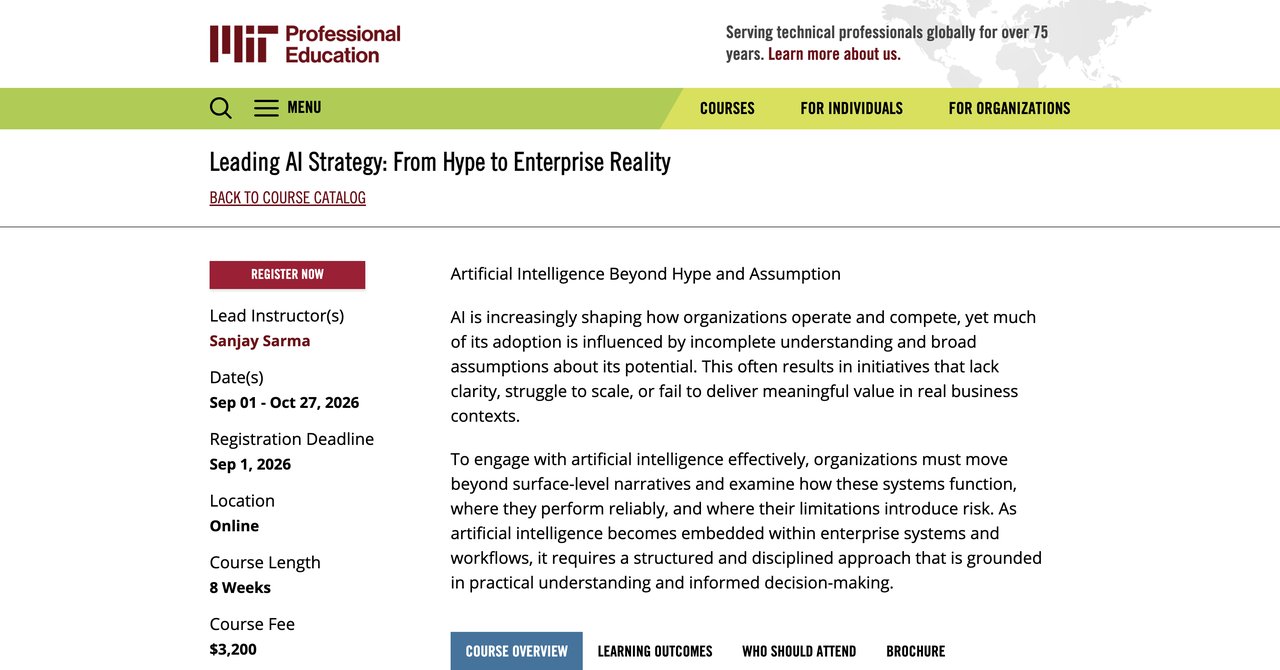
This is the second and similar "Leading AI Strategy" course from MIT Professional Education. Its unique angle is systems-oriented. It examines AI not just as a tech, but shows how AI affects decision-making, workflows, and business outcomes in the whole system. It's an real-world cases that demonstrate the messy reality of deployments. The course is instructor-led and live online. Cost is not published (contact provider), and it's differentiated from "Leading AI Strategy" (course 4) by this focus on the system perspective and the "hype to reality" angle.
This course will appeal to IT Directors (though not only them) trying to see how AI causes interconnected changes in operations, strategy, and management. It's a systems thinking approach, which is rare in this category. The cases likely include detailed evaluations of how specific decisions did or did not work. For people who've had AI trying to stop using it, this is to be useful. But since the price isn't published, you might have to spend time to get a quote, and live attendance is required-no flexible learning after work.
Key Topics Covered
- Interconnected nature of AI in organizational operating models
- Evaluation of decision-making under AI influences
- Workflow redesign and process impact
- Frameworks for handling AI along with hype and failures
Target Audience and Skill Level
This is for senior IT managers and other executives who have experience managing digital transformation. It is not a beginner course-it assumes you've been working with various AI initiative, or you've been part of tech plans. A systems view means you need to understand how organizational functions interlink That's the base. This course is ideal for those who want to become a more strategic leader, not just engineer the launch.
Pros
- Systems-oriented approach , broad organizational perspective underplayed
- Real-world cases discuss the messy reality, failure points included
- Evaluation of AI's influence in decision-making and workflow design
- MIT brand
Cons
- Price not published , you need to contact for the cost, potentially high
- Overlaps with Next1 "Leading AI Strategy" , consider the differences before buying
- Live lectures , scheduling conflicts possible
Who Would Benefit Most
Ideal for IT Directors who care about organization-wide dynamics and want to be on a char level of decision-making. If you have experienced quick AI fix failures, this gives you a larger lens. But if you are more introvert or need flexible schedules, check with providers for on-demand options.
Course 9: AI for Directors of IT (Prompt Course) by Complete AI Training
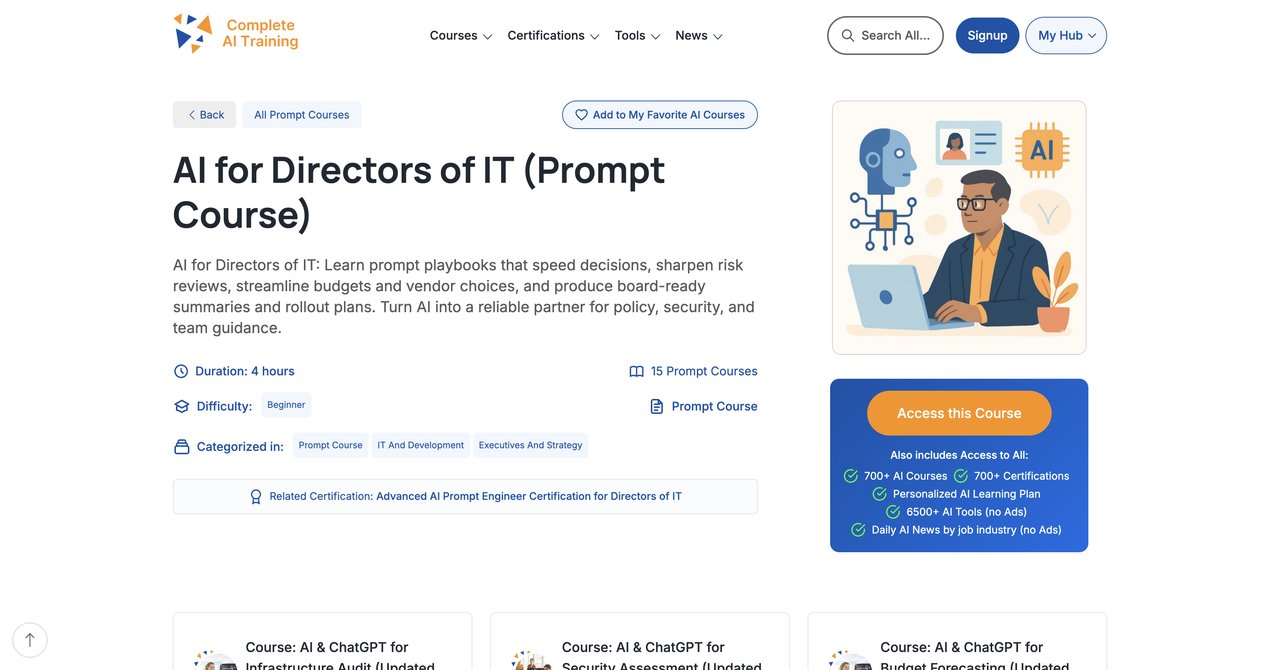
The final option considered is a specific prompt engineering course for IT directors, which Comple AI Training offers. The Courses is actually part of a full library and costs $29/month or $199/year (annual). It does come in the subscription , you get access to this prompt course typical additionally, the whole catalog. So, in that sense, it's not separate. Even if you just wanted to take this one course, it's not alone it is included in the platform , a subgroup and that could be key: You pay for a vast amount of material, anyway."
The course itself focuses on executive-ready prompt playbooks. It is perhaps the first one that is extremely practical for budget preparation, vendor decisions, risk reviews, and board-ready summaries. You learn prompts that directly drive deliverables. To standardize evaluations across departments. Do you also have the option for certification. Of course, for someone asking for a full AI strategy course, this is limited , it only covers prompts; you might need more for strategic thinking. But since you get full library access when you subscribe, that shortcoming has no consequence if you use the broader platform.
Key Topics Covered
- Prompt playbooks for budgeting and financial proposals to board
- Vendor evaluation prompts , structuring RFPs compare
- Risk review prompt frameworks
- Board-ready summaries that condense complex AI impact into clear messages
- Standardization across teams
Target Audience and Skill Level
Designed for IT Directors who already need to create clear documentation, reports, and recommendations and don't want to spend hours drafting with general AI. It's not relevant for beginners needing to understand AI it's a practical follow-up for mid-to-director practitioners. The certification option is valuable for official records. This course does not effort for strategy foundation, but the broader library does.
Pros
- Provides ready-to-use executive prompts, saving a lot of actual work time
- Effectively standardizes evaluations across department or teams , avoids ambiguity
- Includes certification if you want documentation , that certification is fully available within the subscription
- Part of subscription offering $8.25/mo , that also gives you full library
- Daily updates on AI can be very useful for obtaining new insights
Cons
- Narrow focus only on prompt engineering, not a broad strategy course
- If you subscribe only for this course, it may be overkill , but cheap
- Requires a subscription, but still very low cost
Who Would Benefit Most
The workflow-oriented IT Director, the one who regularly delivers reports, requests specification, and budget councils. If you want to leverage AI to do your job more efficiently right now (not next year), this is practical. Beyond, because it is on the whole Complete AI platform, you can later pivot to any role-specific training as well.
Overall Recommendations
Now that you've read through the details of each option, it's time to think about how it maps to your goal. There is no universal winner for every director of IT. What is right for one person depends on the situations. But I can give you a clearer picture:
Best Overall for Cost, Flexibility, and Depth: Complete AI Training
If you are an IT Director who wants broad AI knowledge at an affordable price to cover in multiple parts of your role as well as the whole team's training needs, the subscription from Complete AI Training is hard to beat at this context. It's a all-access model: you get every course, every certification, hundreds across all roles. You don't have to choose between a strategy course and a prompt course-you get them all. And at $8.25 per month billed annually, the cost is orders of magnitude lower than MIT/INPD options, while you can still earn as many certifications as you want. The cons are: no recognized academic accreditation, but for many people that's acceptable. The biggest reason to choose it: you get the most value for your money and you can restart learning every time the AI landscape shifts.
Best for Governance & Security Specifics: Microsoft Certificate
If IA that your organization prioritizes the compliance aspects, security is your primary focus, you choose the Microsoft Enterprise AI Governance cert. It gives you an in-depth that exact knowledge of ISO and NIST that you'll need. It's one of the most specialized and therefore you should be prepared to choose it for that, even if the cost is recurring and it's Microsoft-centric. They not your strategy; you're likely to need strategy pairing as well.
Best for Academic Prestige and Practical Strategy: MIT Sloan or MIT xPRO
The MIT-branded courses fall on the high end. They give you a deep framework around business strategy, adoption, and Deploying AI. The price is premium (3,5k) and these are individual courses without coverage of future updates. If you're accountable to a board that values the MIT name, or if you need a clear academic certificate for your resume, this is a strong contender. Choose MIT xPRO for frameworks and CEUs, or MIT Sloan for people/change management. But you may also need an additional governance/safety course, because they lack it.
Best for Senior Governance in UK/Board-level: INPD CMI Level 7
UK and international leaders working in a context of CMI level 7 might find this the most fitting. It offers a professional accreditation (CTI) that is recognized in leadership, and it moves beyond tech into the proper board-level skills. The price is high and duration short, but the qualification is valuable. Equally, if you need up to date with trends beyond accreditation, you might need a subscription like Complete along with it.
Best for Change Management: MIT Sloan or Leading AI Strategy
If your main problem is the resistance, use MIT Sloan course or Leading AI Strategy from MIT Professional to learn working with change, cases, workflows. Those are good for an IT Director focused on org impact. They cost more but can change how your organization adopts AI.
Best for Beginner IT Directors New to AI: The Basics on Coursera
This is the simplest way to start. It's free to audit, gives you ABCs, and is a stepping stone to deeper learning. You can pair it with a subscription like Complete AI once you finish to go beyond.
Final Thought
Directors of IT have no option they all need to pace their time and budget. If you want to maximize your coverage for the smallest investment, the "Complete AI Training" is the most efficient spouse. But academic prestige and designated rules also work well for many cases. Since AI is constantly updating, think of your learning as continuous rather than a one-time. If you take only a course, you'll get left behind. For your career, consider keeping a low-cost subscription active while also filling targeted gaps with prestigious university courses. Make your choice based on what will actually change what you do on Monday morning and during the board's meetings.