
Blog ·
11 Best AI Courses for Database Administrators to Future-Proof Your Career in 2026
Discover the 11 top AI courses tailored for database administrators to stay ahead in 2026. Learn essential skills, tools, and strategies to automate workflows, enhance performance, and secure your role in an evolving industry.
 Jeroen Erne
The numbers have shifted dramatically in the last few years. When 69% of businesses across the globe report they are actively using AI in some capacity, that shifts the ground for everyone who works with data. For Database Administrators, this is not just a tech trend to watch from a distance. It's a practical development in how the work actually gets done. Queries get tuned by machines, logs get scanned by AI that spots anomalies faster than you can, and access patterns trigger automated security responses without a human needing to lift a finger. That changes your daily responsibilities. And it changes what employers expect you to bring to the table.
The interesting part is that a lot of this hasn't been fully absorbed yet at the professional level. The DBA role has held a reputation for being a serious, technical position that requires a deep comfort with the infrastructure and the data within it. But the big players-cloud providers like Microsoft and Oracle, and tools like OpenAI's ChatGPT-have started embedding AI directly into the platforms you already manage. That means your competence in the coming years will be measured not only by a knowledge of indexes and transaction logs but by how well you interact with the AI helpers that sit alongside them. The adaptability from the old role to the new one won't be automatic, but a learning curve that comes with clear direction.
Why AI matters for Database Administrators today
AI is not a theory for the roadmap anymore. It is a thing that staff are using right now. In numerous IT departments, the question is no longer "should we implement AI?" but more likely "how do we manage it safely and effectively?" For database professionals, this immediately matters because your data is the training set for every model worth its salt. The DB admin holds the keys to the data, the quality of it, and the access to it. If you can talk about how the data is being used for machine learning, you'll be vital in a way that a pure query-tuning role cannot be.
The issue is that AI keeps evolving fast, and there is noise all over the internet. Tech courses and certifications are popping up everywhere, with huge differences in quality. Some are deep dives from Oracle and Microsoft, some are practical bootcamps, and some are subpar completions mixed in as a way to get a quick certificate. Sorting through all of it can be tricky if you don't have the time or a reference point from which to start. I've seen them all, checked the details, and compared what they really promise. This article's goal is to cut through the noise and compares 11 specific AI courses for DBA professionals so you can see what's actually worth your time and your budget.
You can already see that most major vendors run with an AI-enabled database strategy. And a DBA who doesn't have at least a basic awareness of that will have a hard time planning for performance and storage growth in the exact same way. When you start thinking about it, even your backup routines become exposed because AI can lower the necessary frequency-but only if you know how to safely assess that via the cloud tooling. It's about efficiency. And that efficiency is directly tied to your ability to use new tools.
The Growing Role of AI in Database Administrators
Where exactly does AI step into a day-to-day job? It starts with the automation of routine tasks-patch maintenance, index tuning, and that constant review of the slowest queries. Those tasks, which take a few hours weekly, already have AI solutions that are monitoring, testing, and applying with minimal supervision. The DBA gets to think more about data architecture. Incident management is also changing. An AI system can see the odd pattern in I/O or in login volumes from an app that the typical metrics tools would miss. It will generate an alert with a root-cause hypothesis to save hours of poking around. That is the reality of the toolset.
It isn't only about just firing alerts that set off the alarm. AI plays a growing part in the decision making. When the organization needs to make a choice about data placement, redundancy, or how to improve uptime, the confidence intervals and recommendations from a model hold a serious weight. Oracle's autonomous database and model integration in Azure are just two examples of a platform that's now at all prepared to offer insights while a human has to decide.
Benefits of becoming an AI expert in Database Administrators
So what's the rationale for spending a weekend on these courses? First, the obvious reason is job security. When you own the technical skills with AI-assisted management, you are not just the person in charge of backups. You become the person who knows exactly how to make the database smart, fast, and safe in the face of new model experimentation. That is one of the most valuable things to a modern business. There is also room to improve your salary compared to a regular counterpart, because AI familiarity reduces how much additional support the company needs to pay for.
The career also becomes more interesting. It's not the only day filled with maintenance scripts. You get to use some new tools and a bit of Python or use the natural language for a prompt to interrogate data. It's a skill that crosses over from just a DBA role to a data engineering or an architecture function. And it gives you a chance to partner with the business more closely. A team that has DBAs able to configure retrieval-augmented generation, for instance, has a serious edge in its AI rollout over the team that depends on the vendor for everything else.
Now, a note about these courses. The CompleteAI Training company (available at https://completeaitraining.com/course/ai-for-database-administrators/) is a good place to start. One of the benefits is that it gives access to ALL courses and ALL certifications on the platform, and that's a distinct benefit if you like diving around specific modules. The other 10 training courses come from different places - from Microsoft's own DP-800 course and the SQLskills vector search class, on to IBM's GenAI professional certificate and a full beginner-to-advanced Udemy bootcamp. Each offers a different angle into this fast-moving skill set.
Comparison: All AI Courses for Database Administrators (Updated 2026)
| Course Name | Provider | Price | Key Topics | Pros | Cons | Best For |
|---|---|---|---|---|---|---|
| CompleteAI Training | CompleteAI | Premium | The most comprehensive AI training for Database Administrators professionals. One subscription unlocks ALL video courses and ALL certifications on the Complete AI Training platform - hundreds of them, across every job role, not just this one. Includes continuous updates, new courses, and new certifications at no extra cost. | Full platform access: ALL video courses included, not a single course or fixed bundle. ALL certifications included at no extra cost. New courses and certifications added continuously, included automatically. Access to every other job role's material (spans functions, supports role changes). One flat subscription price covers everything , the key differentiator vs paying per course elsewhere. Daily updates on AI tools and industry news relevant to DBAs. Comprehensive curriculum, hands-on projects, expert instructors. | Premium pricing; subscription based, but crucial for continuous learning as AI evolves rapidly. | Database Administrators professionals looking for complete training |
| AI for Database Administrators by Complete AI Training | Complete AI Training | $29/month or $8.25/month (billed annually) | Full platform access , ALL video courses and ALL certifications included. Covers AI for DBAs plus every other job role's material. Includes continuous updates, new courses, and new certifications at no extra cost. Daily updates on AI tools and industry news relevant to DBAs. | Full platform access: ALL video courses included, ALL certifications included at no extra cost, new courses and certifications added continuously, access to every other job role's material, one flat subscription price for everything, daily updates. | Subscription based , requires ongoing commitment to stay current. | General learners |
| Course DP-800T00-A: Develop AI-enabled database solutions | Microsoft Learn | Unknown (paid via Microsoft training partners) | Vector search, embeddings, AI features across SQL Server, Azure SQL, and Microsoft Fabric. Leads to Microsoft Certified: SQL AI Developer Associate certification. | Official Microsoft curriculum. Covers vector search, embeddings, and AI features across SQL Server, Azure SQL, and Microsoft Fabric. Leads to Microsoft Certified: SQL AI Developer Associate certification. | Price not published on Microsoft Learn directly. Requires existing SQL Server knowledge. | General learners |
| SQL Server Vector Search in Practice | SQLskills | Unknown (contact provider) | Production patterns for vector search in SQL Server 2025: embedding model selection, schema design, reranking, and RAG. Hands-on demonstrations. | Production patterns for vector search in SQL Server 2025. Covers embedding model selection, schema design, reranking, and RAG. Hands-on demonstrations from a respected training provider. | Requires prerequisite course (AIVSE). Price not published. | General learners |
| IBM Relational Database Administrator with GenAI Professional Certificate | Coursera (IBM) | $49/month (subscription) | Structured professional certificate teaching DBAs how to apply generative AI to relational database administration. Hands-on labs, beginner-friendly. | IBM credential. Covers GenAI applied to relational database administration. Hands-on labs. Beginner-friendly. | Broad scope; does not go deep into advanced AI vector search. Subscription required for certificate. | General learners |
| Generative AI Database Design & Management with ChatGPT | Coursera | Free to audit; paid certificate via subscription | Using generative AI for schema simulation, requirement discovery, and identifying design blind spots. Generates dashboard and reporting implementations without programming. | AI-driven schema simulation and gap analysis. Generates dashboards and reports without programming. Uncovers design blind spots. | Short duration (4 hours). Focused only on ChatGPT as the AI partner. | General learners |
| AI Database Bootcamp: Beginner to Advanced (12 Courses in 1) | Udemy | $12.99,$19.99 (discounted price, originally $89.99) | Multiple AI database paradigms including vector, SQL, and NoSQL. Hands-on projects and real-world AI app development. | Covers AI-powered databases, vector, SQL, NoSQL systems. Hands-on projects. Broad scope from beginner to advanced. | Udemy quality can vary. No vendor certification. | General learners |
| DP-800: Microsoft SQL AI Developer Associate Exam Prep | Udemy | $89.99 (one-time, frequent discounts) | Structured exam preparation for the Microsoft DP-800 certification, focused on SQL AI developer skills. | Directly prepares for DP-800 certification. Focused on SQL AI developer skills. Recent update. | Exam prep only, not a hands-on course. No rating shown. | General learners |
| Microsoft SQL Server Professional Certificate | Coursera (Microsoft) | $49/month (subscription) | Official Microsoft content covering SQL design, querying, optimization, and security with GenAI techniques. Includes BI tools. | Official Microsoft content. Covers SQL design, querying, optimization, and security with GenAI techniques. Includes BI tools. | AI integration is only one component. Subscription required. | General learners |
| Database Management with AI Integration (Online) | General Assembly | $2,950 one-time for cohort (32 hours) | Live instructor-led cohort covering database architecture, automated pipelines, data warehousing, and AI system integration. | Live instructor-led cohort with real-time interaction. Covers database architecture, automated pipelines, data warehousing, AI integration. Hands-on practice. | Expensive ($2,950). Requires solid SQL, Python, and scripting experience. | General learners |
| Oracle DBA 21c: Design, Manage & Secure Databases | Coursera | Free to audit; paid certificate via subscription | Oracle 21c innovations, including instance management, storage, security, and SQL commands. Highlights Oracle's built-in AI features. | Covers Oracle 21c innovations. Hands-on instance management, storage, security. Includes SQL commands. | Not AI-specific; AI integration limited to Oracle's built-in features. | General learners |
| 70-462: SQL Server Database Administration (DBA) | Udemy | $89.99 (one-time, frequent discounts) | SQL Server DBA foundation: installation, administration. Includes a free SQL Server Developer download. | Practical DBA skills. Free SQL Server Developer download included. Covers installation and administration. | Based on legacy 70-462 exam (not AI-specific). AI content is minimal. | General learners |
Understanding AI Training for Database Administrators Professionals
Database administration has changed a lot over the last couple of years. It's not just about keeping servers running and backups consistent anymore. AI tools are being integrated into SQL Server, Oracle, and cloud platforms, and DBAs are being asked to work with vector search, RAG patterns, and embedding models. The demand for these skills comes directly from businesses building AI-enabled applications on top of the databases you already manage.
That shift creates a question: what's the best way to learn or update these skills? There's a course for almost every approach now. Some are made by official vendors like Microsoft and IBM. Others come from specialized trainers with years of experience. And some are subscription platforms that offer more content than you could finish in a year. The right choice depends on what you need for your specific role, your budget, and the time you have available.
Below is a breakdown of the most relevant training options I found for DBAs looking to add AI skills. I've attempted to structure them based on what they actually deliver, who they're meant for, and which professionals might get the most benefit from each one. There's a heavy emphasis on being practical here so you can make a decision without sorting through marketing jargon.
Course 1: CompleteAI Training , AI for Database Administrators
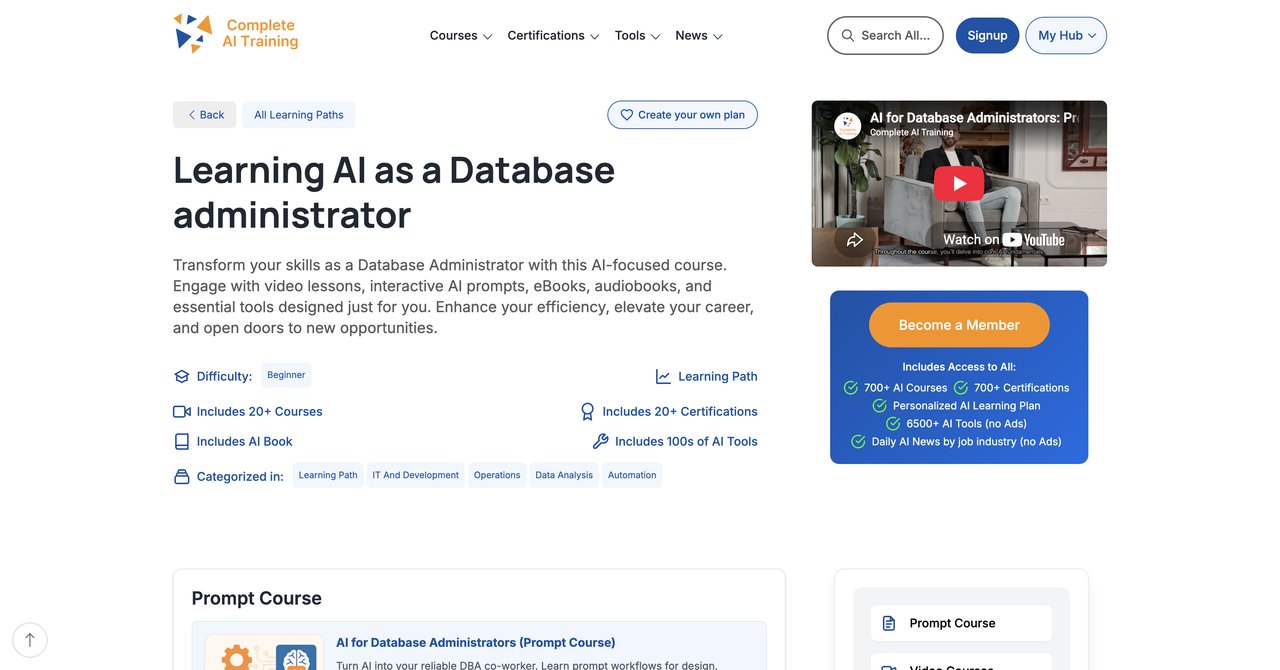
Complete AI Training is much more than a single course. One subscription unlocks ALL video courses and ALL certifications on the platform - hundreds of them, across every job role, not just the one related to database administration. So when someone says "AI for Database Administrators" from this platform, it's specifically the starting point. The real value is immediate access to every other course, every other role, and every certification included in the price.
For DBAs specifically, the platform covers AI applications in SQL, Azure SQL, Oracle, vector searches, and integration patterns. The content gets updated often, with new courses and certifications added continuously and included automatically. You're not paying for this single piece of content; you're paying for the library and the whole roadmap, and that material spans far outside a database-specific checklist. With a subscription, all courses, all titles, and all topics across every job role are available.
The unique thing here is the fact that the DBAs that work actually have tasks which overlap with data engineers, developers, or migration specialists. With CompleteAI Training you'll also have the relevant material for those roles - included with your single flat price. If you're thinking about job movement later, you're already building the knowledge for that, and it comes at no extra cost to you. That type of coverage often becomes the reason one chooses this course over buying one-off courses here and there.
One of the reasons I see DBAs choosing it is because there's no attempt to lock you into one course, or one single path. There's no per-course payment. There are no added costs for certification exams and prep. Continuous updates on AI tools and industry news relevant to DBAs keep you coming back without a second bill.
That said, subscription pricing pushes you to actually use the platform every month. That being said, since AI is progressing month by month, that might be maybe the only sustainable way to catch new content as it's added.
Key Topics Covered:
- Full access to ALL video courses on the platform
- All certifications on the platform included at no extra cost
- Access to every other job role's material- engineering, data science, analytics, etc.
- Continuous updates and daily news for DBA applications
- AI tools and concepts applied directly to database administration
Target Audience and Skill Level , Intermediate to advanced DBAs looking for a scalable subscription that goes beyond a single course. People who appreciate a structured environment with modules that can be stacked and viewed in any order. Great for those with existing experience in SQL Server, Oracle, or various types of database administration.
Pros:
- One flat subscription price covers all and every course
- All certifications included at no extra cost
- New courses and certifications included automatically
- Access to every other job role's material , ideal for career movers or multi-role professionals
- Full platform access; most crucial for a field where AI changes so quickly
Cons:
- It is subscription-based, so if you prefer one-time purchases it's not designed that way
Who Would Benefit Most: DBAs who want their employer's training budget stretched as far as possible, who see themselves moving away from pure administration toward database engineering or architecture later on, and who are disciplined about weekly learning. Good support for job change preparation and multi-project planning.
Link: Visit CompleteAI Training , AI for Database Administrators
Course 2: Course DP-800T00-A: Develop AI-enabled database solutions by Microsoft Learn
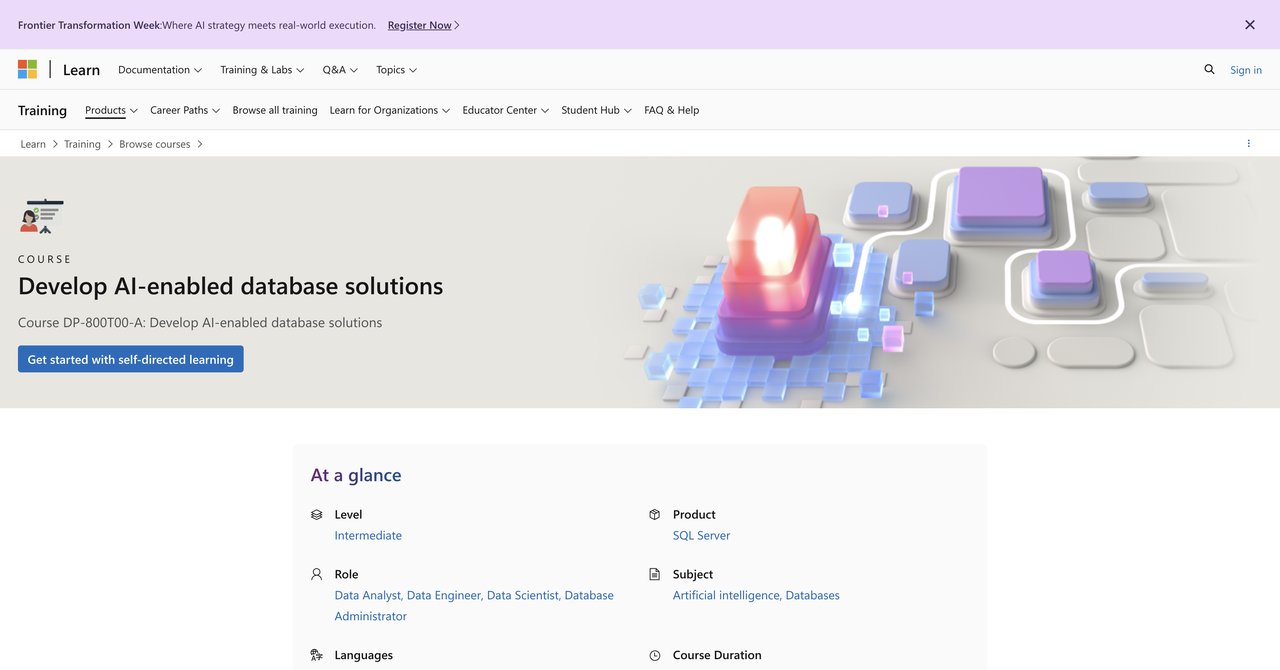
This is the official Microsoft curriculum if you're trying to get certified. The course covers vector search, embeddings, and AI features built directly into SQL Server, Azure SQL, and Microsoft Fabric. It is geared toward learners that want to take the Microsoft Certified: SQL AI Developer Associate certification. It's an extensive path for someone who's serious about going deep with the Microsoft ecosystem.
One thing to keep in mind is that the price isn't published on Microsoft Learn directly; you have to buy it from a Microsoft training partner. There are often additional costs, that may vary from partner to partner. You should have an existing base in SQL Server before taking this because it will not hold your hand through the basics. The material assumes you're already comfortable with database concepts, T-SQL, and generally know your way around SSMS and the Azure portal.
The real strength here is in the official nature of the content. It talks about vector search, how to size and use embedding models within Microsoft tools, and how to apply them to real tasks with the latest versions of the tools. Because it's official, you can expect a certain level of alignment with future exam questions.
Key Topics Covered:
- Vector search
- Embeddings
- SQL Server and Azure SQL AI features
- Additional integration with Microsoft Fabric
- Azure AI services integration
Target Audience: DBAs or DB developers who work primarily with Microsoft's technologies and are comfortable with SQL Server. Not meant for total beginners.
Pros:
- Official Microsoft qualification
- Covers vector search and embeddings more directly than most courses
- Leads directly to the SQL AI Developer Associate certification
- Consistent with actual Microsoft product screens and navigation
- Microsoft Fabric is rare find in most competitor content
Cons:
- Price is not published upfront; mostly through training partners
- Requires existing SQL Server and general Azure knowledge
- No direct support with the material , typically you're on your own unless classroom version
Who Would Benefit Most: companies that run a full Microsoft stack and want exactly what the vendor prescribes, with no extra details or irrelevant frameworks. That's one of those "certification-driven" paths, though you have to pass the exam.
Link to Microsoft DP-800T00-A Course
Course 3: SQL Server Vector Search in Practice by SQLskills
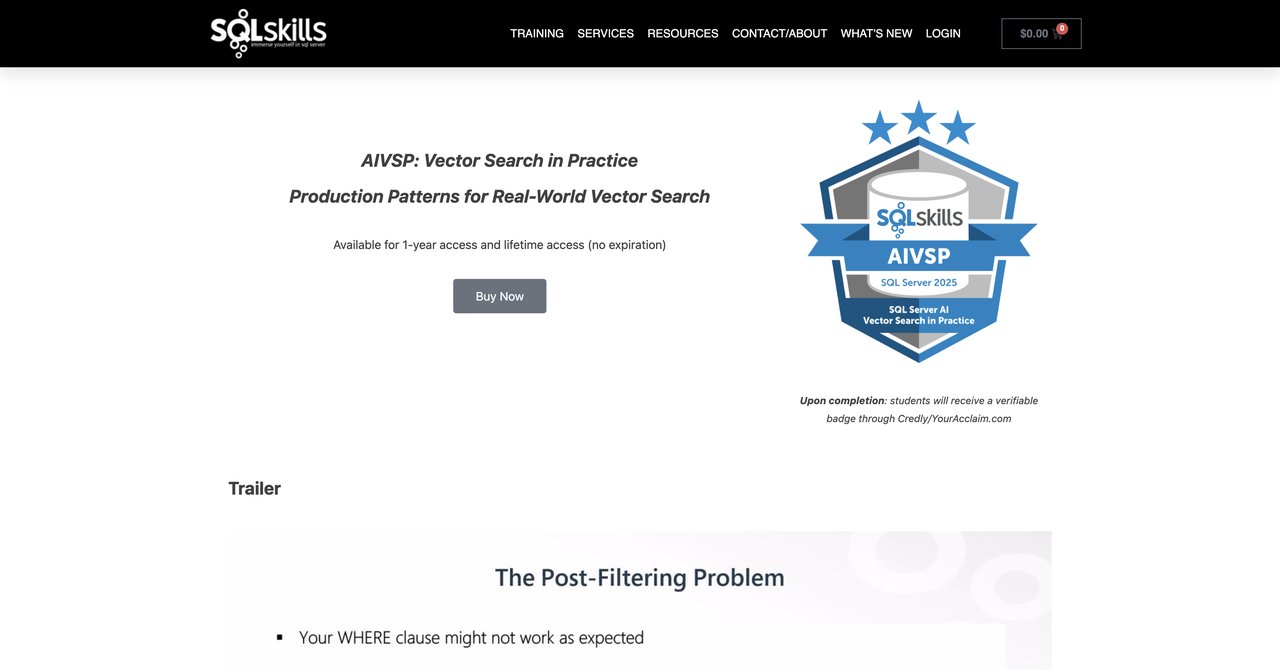
SQLskills has a strong reputation among DBAs. They've always had in-depth training for SQL Server and coincidentally, this course follows that same focus. SQL Server Vector Search in Practice is built specifically for people handling production workloads where vector search becomes a real pattern. It covers how to pick the right embedding model, how to work with schema design, and how to approach reranking in real-world RAG.
This isn't a quick view or an overview course. It uses a lot of hands-on demonstration, so you bring your own experience and you learn the logical paths for implementing RAG. The course also comes with an expectation that you've taken the prerequisite course, which is the same because SQLskills does everything in sequence sometimes. That's good because it avoids boring basics for those who already know how to install SQL Server.
The big draw is that the trainer has solid roots in SQL skills. Rather than learning AI from marketers, you're learning it from infrastructure people who think about performance and reliability.
Key Topics:
- Implementation of Vector Search in SQL Server 2025
- Selecting AI embedding models
- Schema design for vector data
- Reranking and RAG patterns
- Hands-on production pattern
Target Audience: if you're a SQL Server infrastructure specialist who wants to deploy vector search, this course is specifically targeted. Some knowledge of advanced T-SQL is necessary, and you should have completed the prerequisite course from SQLskills.
Pros
- Practical focus on production workloads
- Taught by recognized SQL Server experts with real-world experience
- Emphasizes schema design and implementation strategies
- Covers RAG patterns in a full iteration, not yet abstract theory
Cons:
- Requires the prerequisite course, which is an extra purchase and time
- Price is not published on the site; you have to contact provider
- Limited to SQL Server only size
Who Would Benefit Most: Production DBAs and infrastructure architects who want working knowledge of RAG and vector search and don't mind the cost; they're looking for depth, not the general certificate path. This is the one you would take after you've decided, yes, this role will include vector search.
Link to SQLskills Vector Search
Course 4: IBM Relational Database Administrator with GenAI Professional Certificate by Coursera (IBM)
IBM's certificate on Coursera is a structured professional certificate intended to teach a DBA how to bring GenAI techniques into relational DB administration. It's a formal program from IBM and includes those hands-on labs that make the skills feel supported. You don't need to be an AI expert to join; this one is nice and accessible to beginners in AI, which is ideal for an experienced DBA who never touched a vector search feature.
It has a broader scope, and does not go very deeply into advanced AI features such as vector search. It's mostly about using LLMs, prompt patterns, and generative interfaces as an administrative friend. You'll learn how to apply GenAI to everyday DBA functions like database maintenance, writing queries, or finding errors.
Using Coursera's platform means you have the ability to self-pace, and course certifications are recognized in the market because IBM's tie to it.
Topics Covered:
- GenAI applied to relational database administration
- Augmenting manual database tasks with AI
- Practical labs using IBM and enterprise environments
- Integration of AI technologies into workflow
Target Audience: DBAs with some experience, looking for a beginner-friendly entry into AI. If you want a manageable certificate without deep database infrastructure complexity this works great.
Pros:
- IBM recognized completion
- Hands-on labs included
- Beginner-friendly
- Work with standard relational databases
Cons:
- Not deep diving into advanced AI vectorization
- Subscription-based on Coursera; you don't own the content forever
Who Would Benefit Most: someone who needs a quick foundation and a leading brand name to back it up without having to deep engineer features.
See IBM GenAI Certificate on Coursera
Course 5: Generative AI Database Design & Management with ChatGPT by Coursera
One of the shorter options is hourly course, focused on direct use of ChatGPT through your database design practice. The class explains how to make ChatGPT a design partner, generating different schema ideas, running schema simulation, handling requirements discovery, and finding blind spots in designs using simple prompts. It's very niche but potentially has some value for that DBA who is redesigning their schema and wants to see how LLM can inspect gaps.
The instruction walks through dashboard and reporting implementations without code. That's a smart point since it means not even developers can make it.
However, it's just 4 hours and only really covers ChatGPT; expect your digital AI pal to carry a good portion of the work. There is no deep dive into vector operations here.
Topics Covered:
- AI-driven schema simulation and gap analysis
- Use of ChatGPT for requirement discovery
- Dashboard and reporting generation without programming
- Recognizing design blind spots
Target Audience: DBAs who are beginners in AI design topic; Forum to learn some tricks with a short time investment.
Pros
- Fast; you finish this in a few hours
- No programming required
- Great shortcut for quickly mocking up designs
Cons:
- Short duration doesn't allow comprehensive depth
- Only uses ChatGPT, not an adoption of AI models
- Advanced DBAs may find it too narrow
Who Would Benefit Most: Consultants, team leads, and the project household who designs a lot of quick relationships and prefers being able to prototype quickly rather than spending weeks learning the deep details.
Course 7: DP-800 Exam Prep by Udemy
This is exam prep for the Microsoft DP-800 exam, with all its content focused strictly on passing that particular test. It's not a hands-on course. If you already have a grasp of SQL AI features and need to take the exam, this is a valuable tool. You get structured material, quickly, in focus.
It's for those who like to self-study with a specific goal and under a budget, not for regular professional development.
Key Topics
- SQL AI developer skills aligned to DP-800
- Exam structure and tips
- Update: match recent skills measured
Target Audience: A DBA close now to earning that Microsoft certification. Not helpful if you start from zero in AI.
Pros
- Structured prep, completely pointed toward certification success
- Low cost compared to exam costs
Cons
- Exam prep only: no hands-on scenario
- No provider rating shown in the information
Who Would Benefit Most: fast track to the Microsoft certification side without too much extra material.
Course 8: Microsoft SQL Server Professional Certificate by Coursera (Microsoft)
Coursera hosts this professional certificate from Microsoft. Which is mostly about SQL Server design, querying, optimization, and security using some GenAI techniques included as a sprinkle. It also includes BI tools, which broadens it to more than just maintenance.
It's a complete Microsoft content and the brand makes a difference for anyone looking for a line on the resume. However, AI integration is still a piece of the teaching, not the core. The focus is broader and therefore a solid foundation, not deep AI.
Ideal for a DBA who wants to reinforce their core infrastructure and get a bit of AI, but not the advanced vector model complexity.
Topics Covered:
- SQL design and querying
- Performance optimization patterns
- Security plus GenAI basics
- BI tools
Target Audience , generalist DBA looking formal certification, but huge amounts of practical tasks.
Pros
- Official Microsoft content available
- Covers the full SQL Server features for DBAs today
- Includes Business Intelligence on the side
Cons
- AI part is just a single component
- Subscription, not a one-time purchase
Who Would Benefit Most: those who newly or have just been displaced on a larger project need general database skills with an AI foothold.
See Microsoft SQL Server Professional Certificate
Course 9: Database Management with AI Integration (Online) by General Assembly
General Assembly has a live, instructor-led cohort model. Cost is upfront $2,950 or a bigger time commitment, with 32 hours. Its coverage: database architecture, automated pipelines, data warehousing, and how to integrate AI systems . Since it's a live cohort, you have that real-time interaction and probably exercises. The focus is on coding or scripting. Actually they specifically require solid SQL, Python, and scripting experience which again shows it's not for beginners - and it's expensive if you count the asking price.
The plus side is that it's an image and prepared by professional instructors the price might be justified for a business paying for on-the-job training.
Topics Covered:
- Database architecture specifics
- Automated data pipelines
- Data warehousing design
- Integrating AI tools into architecture
Target Audience: experienced DB candidates who need to modernize their thinking. A requirement for knowledgeable SQL/W Python/data roles.
Pros
- Live instructor-led cohort, gets real-time interactions
- Includes hands-on practices, very solid fundamentals
- Also teaches pipeline and warehouse automation, not just AI
Cons
- Expensive, $2,950 one-time
- Requires solid experience; no time to catch up if lagging a bit
Who Would Benefit Most: DBA looking to move into more architect-level role and can afford that investment in dollars and time.
Course 10: Oracle DBA 21c: Design, Manage & Secure Databases by Coursera
Oracle's 21c course covers all the core elements of the database from a DBA angle: instance management, storage, security, and the SQL commands. The special hook is Oracle's built-in AI features. Reviewing the curriculum, AI is not the main focus; it's one of the many things covered in the context of what comes pre-packaged in the software.
It's cert-able but does not include AI specifics like vector search. You're best off if you're working with Oracle installations and want a refresher plus these updates.
Topics
- Oracle 21c innovations
- Instance management and storage
- security practices
- SQL commands and built-in AI
Target audience a platform specific admin, no matter if you need an AI context.
Pros:
- Solid Oracle 21c knowledge
- Hands-on practice
- Official improved from Coursera and Oracle
Cons:
- Not AI-specific
- AI only limited to what Oracle already ships
Who Would Benefit Most: Full-time Oracle specialists polishing their own skills to the 21c version.
Course 11: 70-462: SQL Server Database Administration (DBA) by Udemy
This course is a survival base for SQL Server DBAs. Installation, administration, architecture-it's the complete core. It includes a free download of SQL Server Developer so you can follow along easily. However, it is not AI- focused and based on the exam number that has aged; there's minimal AI included.
Still, it's useful if your very beginning is a foundation in DBA and then you take an AI course after. Strong when you're just entering role but need the ground starting to build the next step.
Topics Covered:
- SQL Server installation
- SQL Server administration
- security basics
Target Audience: beginners with an interest in Microsoft SQL Server. It is not advanced on AI.
Pros
- Practical DBA knowledge
- Free SQL Server software included
- Foundation for all other Microsoft AI learning
Cons
- Legacy based course - the exam is outdated
- AI matter available is minimal
Who Would Benefit Most: if you're heading into SQL Server with no experience.
Final Recommendations for DBAs
There's no single 'best course' that fits everyone. It honestly depends on your current role, your company's stack, and how much money and time you can justify.
For the people who are in a Microsoft-heavy shop and plan to stay: DP-800 from Microsoft or the exam prep from Udemy are solid choices if you want the vendor official cert and have some time and money to spend. If you're focused specifically on designing for AI workloads with vectors, then SQLskills is as deep as it gets, real practical patterns from people with truly production experience, though at the price.
If you'd rather get a broad overview without spending a lot, the Udemy bootcamp or the IBM Coursera cert can get you started with very low barrier. The IBM one's nicer for title and structured learning; Udemy is way better if you're more of a tinkerer and don't care about a credential.
Now, if you're a DBA who knows you'll need consistent updating over the next few years, the most cost-effective solution is CompleteAI Training. It's the only one on this list where one subscription unlocks all video courses and all certifications on their platform-not just this single module. New courses and new certifications are added continuously and included automatically. Access to other job roles' material matters, because database work sits between data engineering, software development, and cloud infrastructure. Many DBAs are stepping into one of those adjacent areas at least part of the time. There, you have these materials already included. It also uses a flat subscription where you're not paying extra for anything. After you see this quality elsewhere, you'd be paying $50 for a course, $100 for a cert, and $10 for something else.
But honestly, there's no universal answer. The Oracle course is still the best if your career is Oracle-centric. The General Assembly live cohort works if you want to spend a luxury amount of money to get direct, live guidance for architecture. Microsoft DP-800 is the obvious if you want that specific vendor path.
Pick based on what actually gives you the skills to handle day-to-day tasks in your environment. For career value, AI is into the database now, so the real goal is to know how to integrate AI into actual data management, not just what the AI can do for you in the abstract.