
Blog ·
11 Essential AI Courses for IT Specialists in 2026
Master AI's evolving landscape with 11 targeted courses covering machine learning, cybersecurity, and automation. Stay ahead of 2026's demands—boost efficiency, earn certifications, and future-proof your IT career.
 Jeroen Erne
Artificial intelligence is no longer a future concept or a buzzword reserved for research labs. It is here, embedded in the tools you use daily, and it is changing the way IT professionals work at a fundamental level. From automating routine support tickets to predicting system failures before they happen, AI is quietly taking over the tasks that used to consume hours of your week. For IT specialists, this shift brings both a challenge and an opportunity. The challenge is staying relevant as AI handles more of the technical workload. The opportunity is learning to work with AI, not against it, and positioning yourself as the person who can bridge the gap between business needs and intelligent technology.
The demand for AI skills is not speculative. Companies are actively investing in AI infrastructure, and they need people who understand both the technology and how to apply it in practical, everyday scenarios. For IT professionals, this means the skills that got you where you are today might not be enough to get you where you want to go tomorrow. Upskilling is no longer optional; it is a survival strategy. The question is not whether you should learn AI, but which course will give you the most value for your time and money.
Why AI matters for IT Specialists today
Consider this: a recent study found that roughly 69% of businesses are already using AI in some capacity, and that number grows every quarter. IT departments are often the first to feel the impact, whether it is through AI-powered monitoring systems, automated helpdesk responses, or intelligent data management tools. The role of the IT specialist is shifting from hands-on troubleshooting to overseeing and configuring AI systems that do the troubleshooting for you. That is a significant change, and it requires a different kind of expertise.
This article is designed to help you cut through the noise. With hundreds of AI courses flooding the market, it is easy to waste time and money on programs that are too theoretical, too basic, or simply not relevant to your day-to-day work. We have reviewed and compared five AI courses specifically for IT specialists, breaking down what each one offers, who it is best for, and what you will actually learn. Our goal is to give you a clear, honest picture so you can choose the training that fits your career goals without the guesswork.
The Growing Role of AI in IT Specialists
AI is not just a single tool; it is a collection of technologies that are reshaping the IT landscape in multiple ways. Here are some of the most common applications you will encounter:
- Automation of routine tasks: AI can handle repetitive processes like password resets, system updates, and log analysis, freeing you up for more complex problem-solving.
- Predictive maintenance: Machine learning models can analyze system performance data to predict hardware failures or network bottlenecks before they cause downtime.
- Intelligent security monitoring: AI-powered threat detection can identify unusual patterns and respond to cyberattacks in real time, something a human team cannot do alone.
- Personalized user support: Chatbots and virtual assistants are becoming the first line of IT support, and they need skilled professionals to train, maintain, and improve them.
- Data-driven decision making: AI can sift through massive amounts of operational data to provide insights that inform IT strategy, budgeting, and resource allocation.
These are not hypothetical scenarios. They are happening right now in organizations of all sizes. The IT specialist who can manage these systems, understand how they work, and troubleshoot them when they fail is becoming increasingly valuable. The specialist who cannot may find themselves left behind as their role gets automated out of existence.
Benefits of becoming an AI expert in IT Specialists
Investing in AI training is not just about job security; it is about career growth. IT professionals who add AI skills to their toolkit typically see several tangible benefits. First, there is the salary premium. AI-skilled workers consistently command higher pay, and that gap is expected to widen as demand outpaces supply. Second, there is the opportunity to move into more strategic roles. When you understand AI, you are not just the person who fixes the servers; you are the person who advises leadership on how to use technology to achieve business goals. That shift in responsibility often comes with more autonomy, more influence, and a seat at the table where decisions are made.
Third, there is the flexibility it gives you in your career path. AI skills are transferable across industries, so you are not locked into one sector. Whether you want to work in healthcare, finance, manufacturing, or tech, the ability to implement and manage AI solutions makes you a valuable asset anywhere. And finally, there is the confidence that comes from knowing you are prepared for the future. Instead of worrying about what AI will do to your job, you can focus on what you will do with AI.
In the sections that follow, we look at five specific courses, including CompleteAI Training, which stands out because it gives you access to all courses and all certifications on the platform rather than a single, limited program. That is a notable difference for IT professionals who want comprehensive coverage without paying for multiple separate courses. We will break down the pros and cons of each option so you can make an informed decision based on your experience level, your budget, and your career aspirations.
Comparison: All AI Courses for IT Specialists (Updated 2026)
| Course Name | Provider | Price | Key Topics | Pros | Cons | Best For |
|---|---|---|---|---|---|---|
| CompleteAI Training by CompleteAI | CompleteAI | Premium ($29/month or $8.25/month billed annually) | CompleteAI Training is NOT a single course. One subscription unlocks EVERY course AND EVERY certification on the whole platform - hundreds of them, across every job role, not just this one. Full access to all video courses and all certifications with new content added continuously. One flat subscription price covers all job roles, making it ideal for cross-functional IT specialists. Covers comprehensive IT specialist topics including AI for IT support, automation, system administration, security, networking, and cloud infrastructure, with regular updates as AI evolves. | Highest rating / Most complete offering; Full access to ALL video courses on the platform (not a single course or a fixed bundle); Full access to ALL certifications on the platform, included at no extra cost; New courses and certifications are added continuously and included automatically; Access to every other job role's material too, for those who span multiple functions; One flat subscription price covers all of the above, versus paying per course elsewhere; Daily updates on relevant AI tools and news | Subscription based; continuous learning required as AI evolves | IT Specialists professionals looking for complete and ongoing training; general learners |
| AI for System Administrators | Udemy | Subscription or ~$19.99 | Using ChatGPT, Claude, and Microsoft Copilot in IT workflows; automating repetitive admin tasks; M365 and network troubleshooting | Covers ChatGPT, Claude, and Microsoft Copilot in IT workflows; practical automation of repetitive admin tasks; tailored for M365 and network troubleshooting | Not vendor-certified; limited depth on enterprise AI architecture | General learners |
| Generative AI for IT Systems Analysts and Architects Specialization | Coursera (IBM) | Free to audit; ~$49/month for certificate | Turning messy inputs into clear systems requirements; hands-on GenAI for process modeling | IBM-backed curriculum; turns messy inputs into clear systems requirements; hands-on GenAI for process modeling | Focuses on analysis and architecture, not hands-on sysadmin tasks; requires Coursera subscription for graded work | General learners |
| Cisco AI Technical Practitioner (AITECH) | Cisco | $800-$1,200 | AI-powered code generation; workflow automation; enterprise AI readiness; cloud vs. local deployment | Vendor-recognized certification; covers AI-powered code generation and workflow automation; evaluates enterprise AI readiness and cloud vs. local deployment | Price not publicly listed; requires networking and IT background | General learners |
| Microsoft IT Support Specialist Professional Certificate | Coursera (Microsoft) | Free to audit; ~$49/month for certificate | IT support fundamentals with AI-assisted diagnostics; hands-on troubleshooting labs | Covers IT support fundamentals with AI-assisted diagnostics; includes hands-on troubleshooting labs; Microsoft-backed credential | Not exclusively AI-focused; basic level may be too introductory for experienced specialists | General learners |
| Google AI Professional Certificate | Coursera (Google) | Free to audit; ~$49/month for certificate | Hands-on AI fluency for practical workplace tasks; recently updated content | Recently updated by Google experts; fast completion; provides hands-on AI fluency for practical workplace use | Very short; not deep enough for advanced IT infrastructure tasks | General learners |
| Microsoft Generative AI Engineering Professional Certificate | Coursera (Microsoft) | Free to audit; ~$49/month for certificate | Azure LLMs and MLOps; responsible AI practices for enterprise deployment | Covers Azure LLMs and MLOps; includes responsible AI practices; Microsoft-recognized | Requires Azure license (trial available); assumes some AI and ML basics | General learners |
| Generative AI for Software Development Skill Certificate | Coursera (DeepLearning.AI) | Free to audit; ~$49/month for certificate | Practical generative AI application in real-world coding; AI-assisted development workflows | Taught by AI leader Laurence Moroney; practical GenAI application in real-world coding; strong on AI-assisted development workflows | Focused on software development, less on IT ops; requires basic programming knowledge | General learners |
| Microsoft AI & ML Engineering Professional Certificate | Coursera (Microsoft) | Free to audit; ~$49/month for certificate | Azure AI, ML and GenAI; analytics, LLMs, pretrained models for enterprise infrastructure | Deep dive into Azure AI and ML and GenAI; covers LLMs and pretrained models; Microsoft-endorsed | Requires statistics knowledge and Azure license; advanced level may be steep for some IT specialists | General learners |
| Google IT Automation with Python Professional Certificate | Coursera (Google) | Free to audit; ~$49/month for certificate | Python, Git, and IT automation for sysadmin roles | Teaches Python, Git, and IT automation; prepares for junior sysadmin roles; recognized by employers like Deloitte and Verizon | Not AI-specific; longer commitment; beginner level | General learners |
| AI Automation Engineer with n8n | Coursera | Free to audit; ~$49/month for certificate | Building AI agents and API integrations; prompt engineering; RAG pipelines | Hands-on with n8n for AI agents and API integrations; covers prompt engineering and RAG pipelines; practical workflow automation | Niche tool focus; not a broad AI certification | General learners |
Understanding AI Training for IT Specialists Professionals
IT specialists are being asked to do more with less. Systems need to be monitored, automated, and secured. AI tools are changing how these tasks get done. Not because AI replaces the specialist, but because it changes the nature of the work itself. Routine diagnostics, log analysis, and even some forms of troubleshooting can now be handled by machine learning models. The specialist's job is becoming more about oversight, interpretating what the AI suggests, and handling the complex cases that require years of experience. If you're not learning these tools, you're going to find that the industry is moving ahead without you.
The problem is figuring out where to start. There is a flood of courses out there, ranging from quick video tutorials to full-blown certification tracks from big-name companies like Microsoft, Google, and Cisco. The choice is going to come down to your specific situation: are you looking for a badge to put on your resume, a deep technical skill set, or access to a wide range of materials to support your whole team? The price points vary wildly, from free to audit to over a thousand dollars. Let's look at what's out there and what you're actually getting for your money.
Course 1: CompleteAI Training
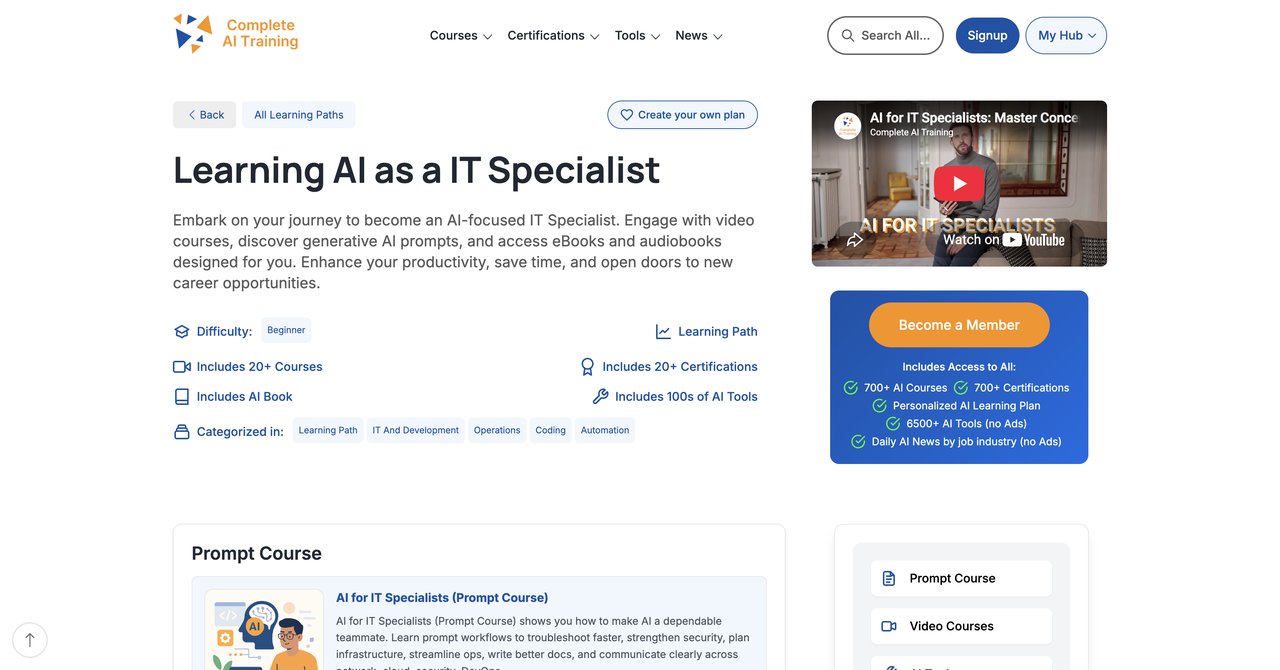
Here's what you get with CompleteAI Training. This is not your typical single-course platform. One subscription gives you access to every course and every certification they offer, hundreds of them, across all job roles, not just IT. They are also adding new content all the time, so your subscription keeps growing in value. If your work takes you across different job functions, or if you're planning to move into a different role, you get full access to that material too, no extra cost. That one flat subscription price covers the platform, versus paying for each course and certificate separately.
The platform includes what's probably the most comprehensive training available for IT specialists. It covers AI fundamentals, prompt engineering, and how to use AI tools across lots of different IT workflows. They plan for your full career development with a mix of video courses and certification paths. The content is updated on a daily basis, which is crucial in a field that changes as fast as AI. They gather information and insights on new tools and relevant news so you don't have to chase it yourself.
Key topics covered in their IT specialist track include enterprise AI architecture, AI-assisted network troubleshooting, security automation, system administration with AI copilots, and cloud deployment strategies. You also pick up practical skills like prompt engineering, which is core to making AI tools useful. Their certification exams are comprehensive and test your actual understanding, not just your ability to remember a few terms.
Target audience is pretty much anyone in an IT role. Helpdesk staff, system administrators, network engineer, security analyst, and IT managers, it's all there. They've structured the content to cover IT core functions, plus adjacent material that you'll touch in any real-world IT job.
Pros:
- Easily the best value-one subscription covers the entire platform, all courses and certifications.
- You're not stuck with a single fixed course; the content library is huge and keeps growing.
- All certifications are included, something every other platform charges extra for or doesn't offer at all.
- New courses are added as the industry changes, so your training is always current.
- Because it's a multi-role platform, it's perfect for anyone handling multiple IT functions or working towards moving up.
- It covers all job roles on platform, all with the same flat price.
- Daily-updated material of AI tools and industry news.
Cons:
- It's a subscription, so it's a recurring cost if you want to keep the access.
- If you expect AI to hold still after 20 hours of training, it will keep changing, and you'll need to stay with it.
Who would benefit most: This is for the IT professional that wants to be thorough. If you want more than a single course, like complete professional development, and want access to various different areas of AI for IT, this is your best bet. It's an ideal fit for those who want their team to have common baseline across roles and who value having the whole platform at their fingertips. Check out the CompleteAI Training website to read more.
Course 2: AI for System Administrators by Udemy
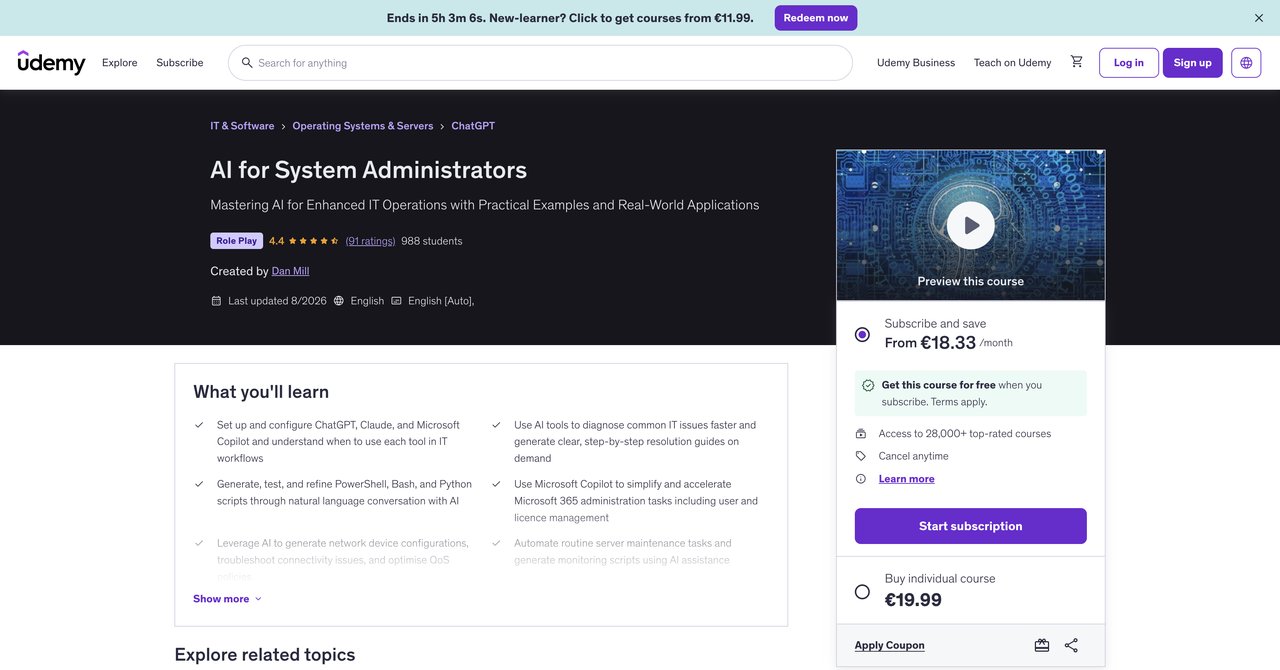
This is a straight-ahead crash course. It's designed to get you using AI tools like ChatGPT, Claude, and Microsoft Copilot in your day-to-day admin activities. The focus is on being practical rather than theoretical, which is often how IT people want it. It's an efficient way to start automating those repetitive tasks that clog up your schedule. The course assumes you have already some experience working in IT and just carries that to show how to fold AI into that work.
It's ideal for M365 and network troubleshooting workflows. You'll be shown how to prompt the AI and to generate scripts, troubleshoot error codes, and draft escalation emails. You'll see how to integrate AI in your standard daily routine.
Key topics include how to use ChatGPT for sysadmin tasks, applying Claude in technology troubleshooting, and using Microsoft Copilot for M365. They have sections on automating various admin jobs, such as creating batch scripts and analyzing logs.
Target audience includes system administrators, IT support staff, and technicians who need to apply AI tools immediately. The skill level is good for middle level; it's not for total tech beginners, but a few years of system work should be enough.
Pros:
- It covers ChatGPT, Claude, and Copilot, not just one vendor like some courses.
- Emphasis on practical automation for the work that sysadmins deal with daily.
- Very relevant to M365 environments and network troubleshooting scenarios.
Cons:
- No vendor-certification at the end of it; that's only from a few major tech companies.
- Doesn't go too deep into the enterprise architecture. It's more operational than strategic.
Who would benefit most: This is for the sysadmin who wants to be more efficient this week. The focus is on doing the job today with a few AI tricks, not on advancing your whole career or building enterprise AI strategies. If you want a quick, useful course with a small fee, this is a good option. You can find it on Udemy.
Course 3: Generative AI for IT Systems Analysts and Architects Specialization by Coursera (IBM)
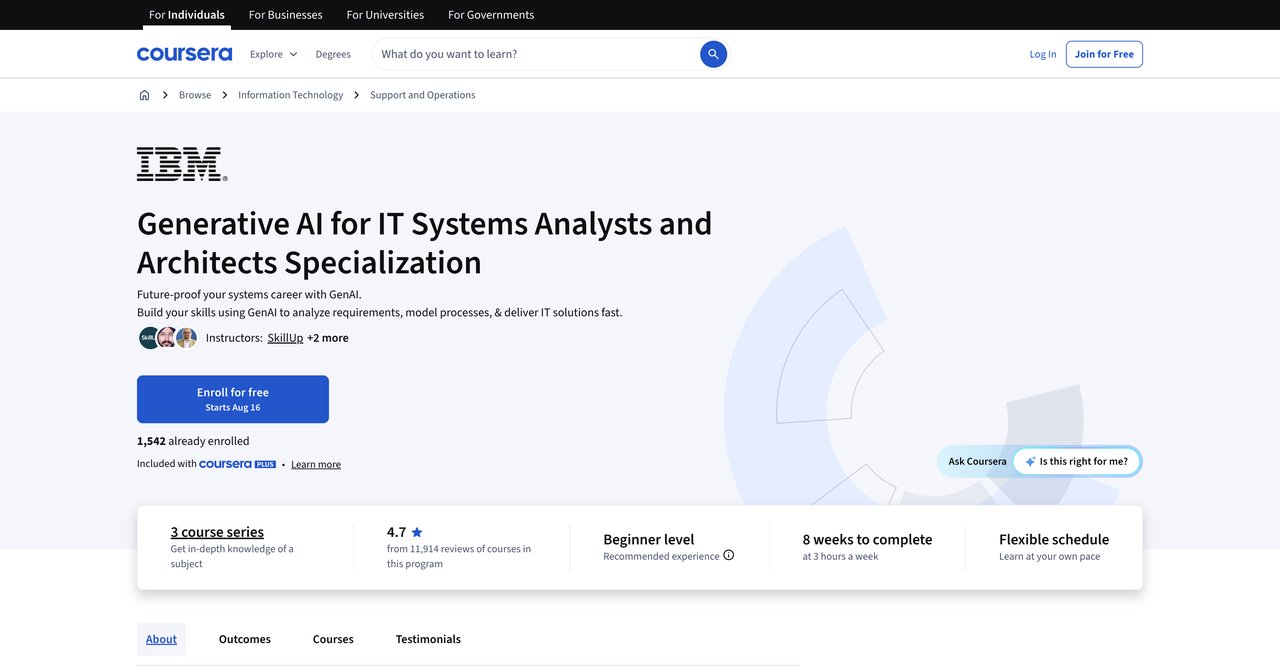
IBM has their own take and focus on a different type of IT role. This specialization is for the people who build knowledge and process models, diagraming requirement and architecture. That's why the course talks about taking messy inputs and turning them into clear systems requirements. It's not a system admin course; it's for the design/analysis side.
The course uses generative AI to help model processes. You'll find hands-on exercises that help you speed up your discovery and documentation phases. The backing from IBM gives it some weight, though it's still through Coursera's certificate platform. The focus is on how to build with GenAI to get work done, mostly creating process models and identifying requirements, not building AI models themselves.
Key topics include using GenAI for requirements gathering, process mapping and improving documentation. It involves some model forms, but it's practical. A core idea is turning a disorganized set of stakeholder inputs into readable and workable specifications.
Target audience includes analysts, solution architects and roles that span between business needs and technical implementation.
Pros:
- IBM-backed curriculum, with global recognition.
- The course specifically improves how you format and work with messy inputs to make clear requirements.
- Hands-on exercises to get you using GenAI for process modeling and architecture design tasks.
Cons:
- It's specific to analysis and architecture, not for hands-on admin tasks like labs.
- To get graded work, you need the paid Coursera subscription, it's not free.
Who would benefit most: The right fit for an IT systems analyst or architect that writes requirements and designs systems before a build. If you're in support of day-to-day infrastructure, this is probably too high up in the flow for you. It's a useful specialization for those who want to speed up the planning phase of IT projects. Go to Coursera to audit or enroll.
Course 4: Cisco AI Technical Practitioner (AITECH) by Cisco
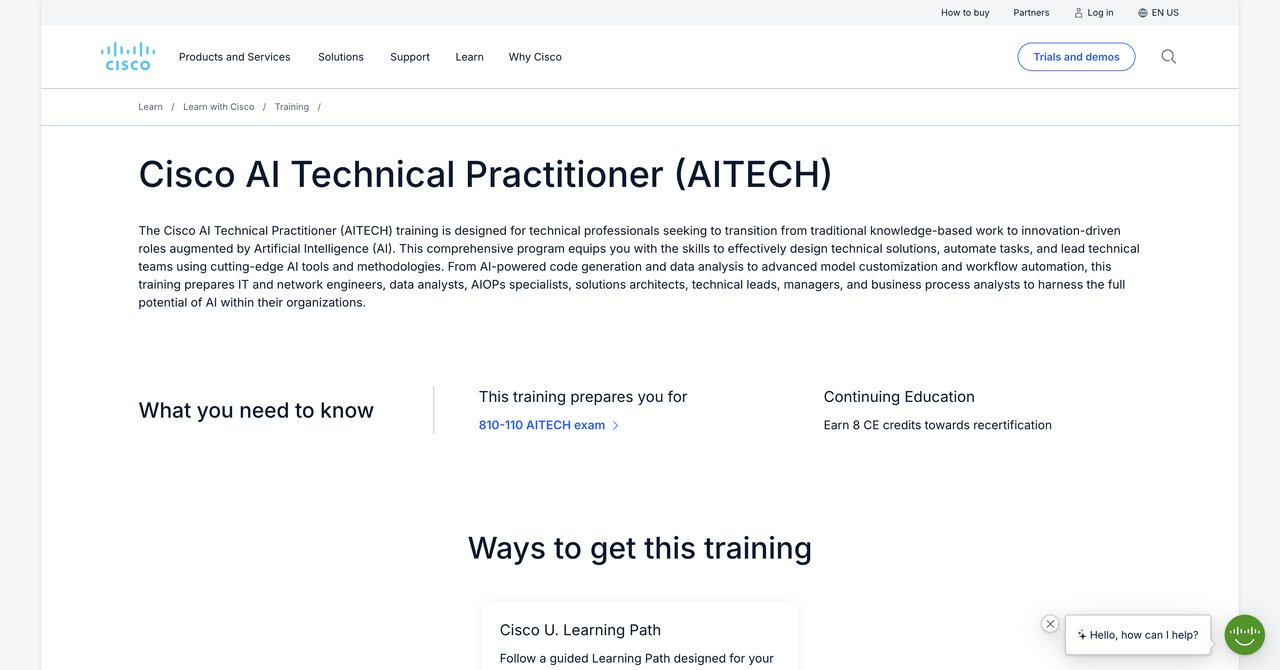
Cisco's AITECH certification is for those who want a vendor-recognized credential. This is a robust certification, which costs real money and requires a exam. It's aimed at network and IT professionals who need to understand AI's impact on enterprise infrastructure. The course covers things like AI-powered code generation and workflow automation. Plus, they have an eye on real-world deployment, discussing cloud vs. local strategies for AI.
It is not an independent video course. It's a certification with course material prepared by Cisco. They are a major infrastructure vendor to almost every business, so their take on AI in infrastructure management is relevant. Given that they deal with network, they're including topics like AI readiness for networking, security, and data center operations.
Key topics covered includes AI fundamentals for digital infrastructure, how to evaluate enterprise AI readiness, deploying AI workloads on both public cloud and premises, using AI to automate network tasks, and workflow automation with AI. The certification is aspirational. It's not a cheap, easy-to-complete course.
Target audience is a network or infrastructure engineer, architect, and technical decision makers. And it requires some networking/IT background; it is not a beginner course.
Pros:
- Vendor certification, useful for career moves with Cisco-based communications.
- Covers AI-powered code generation and specific workflow automation methods.
- Directly addresses the readiness of the enterprise for AI and advantages of different deployment models.
Cons:
- Cost and pricing structure isn't transparent, but you should budget over $1,000.
- Has a requirement of networking/IT background, which rules out people new to IT.
Who would benefit most: The serious network engineer or architect who works with Cisco systems and needs to show their employer stakeholders that they can do a rigorous project. It's an excellent choice for a professional who needs a formal, well-known recognition. You can visit Cisco's page for AITECH for more details.
Course 5: Microsoft IT Support Specialist Professional Certificate by Coursera (Microsoft)
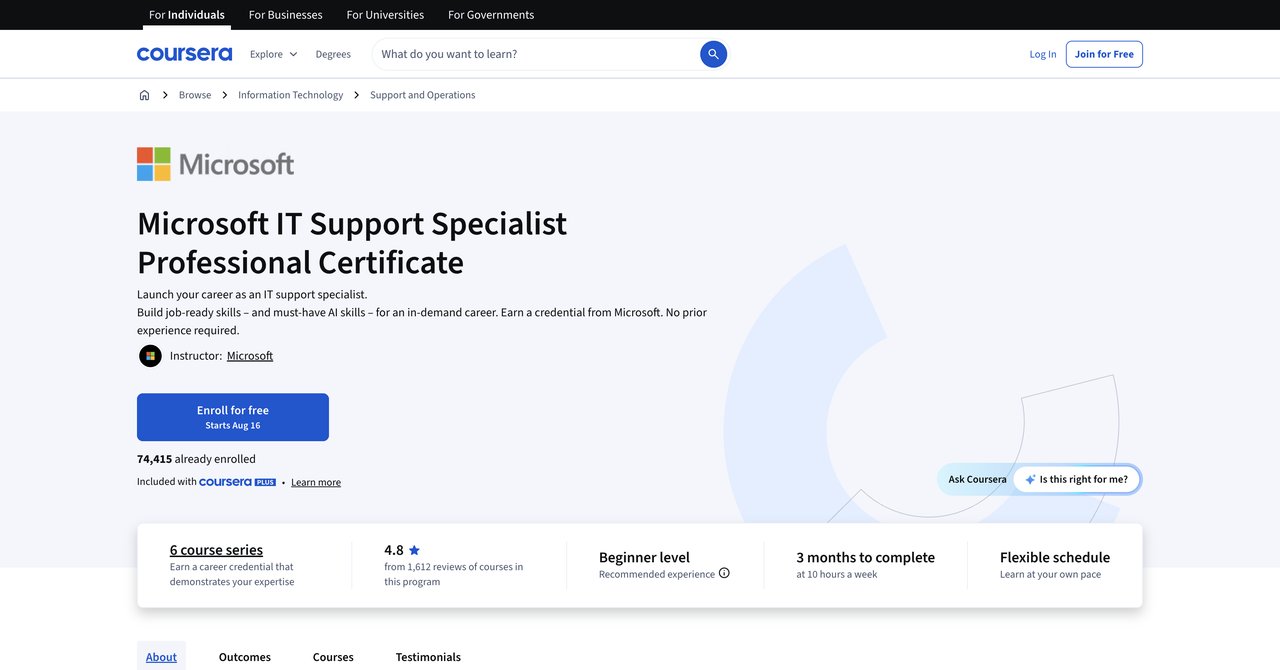
Microsoft's program is aimed at people getting into IT roles or those early in their IT career. The course is a mix of IT support fundamentals and AI tools. So it's not a dedicated AI for sysadmin track course, but it'll fold in AI. It covers AI-supported diagnostics and uses a practical labs approach to learn troubleshooting. The credential from Microsoft is a good addition to a resume for a junior job.
The curriculum runs about traditional IT support, like OS administration and hardware, but also goes into AI tools to make new support tasks more efficient. The idea is to support the modern, AI-enabled help desk. While it's not deep on AI architecture, it gives you a way to work with AI-guided diagnostics and support for tools and processes.
Key topics are fundamental support procedures, AI-assisted diagnostics, troubleshooting hardware and software, and modern user management. It's structure at knowledge and experience for basic/undergrad level.
Pros:
- Covers essential IT support skills along with AI diagnostics for the modern support stack.
- Hands-on labs to test your troubleshooting skills.
- Microsoft-backed credentials for help desk and support roles.
Cons:
- Don't expect in-depth AI/ML, it's more like an AI integrated approach.
- Beginner-level content may be too basic for someone with years of hands-on experience.
Who would benefit most: This is for the help desk or junior IT support role who want to grow with the AI context. It's also a great pathway if you are completely new to IT support. If you've already been a sysadmin for 5 years, you might find it walked over familiar content. You can find it on Coursera.
Course 6: Google AI Professional Certificate by Coursera (Google)
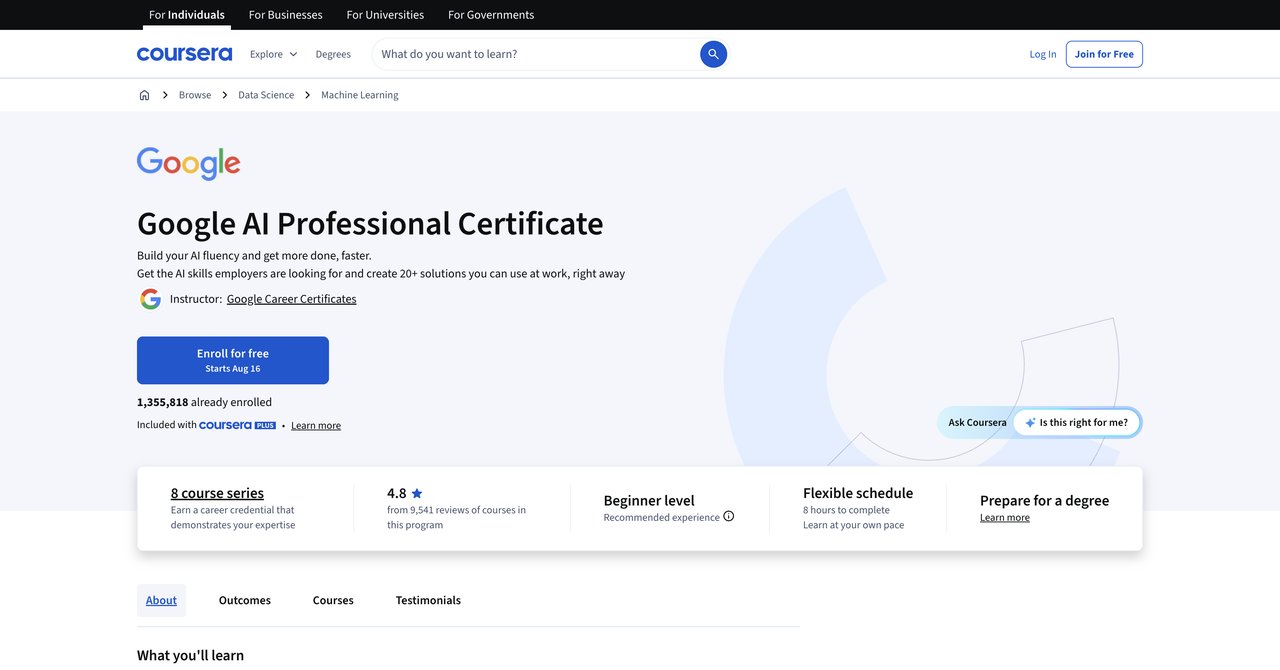
Google, with Coursera, recently updated this certificate. It's strictly for AI fluency, not for heavy technical infrastructure. It's a short course that you can finish fast. The content shows you how to apply AI tools in everyday workplace scenarios. It's less about the inner engine, and more about how the tools work for an end user. As a course, is easy to digest and very broad; this is not a deep technical specialization.
The professionals who have updated it are Google experts. That means the examples and case studies have that Google polish, making it practical for productivity tasks, not for core IT. If you are a developer, the weight on Google tools might differ from your experience. It's better for someone who wants a fast start rather than a deep sysadmin context.
Key topics cover Google's AI tools and workspace applications, practical AI fluency, and how to use AI for both team collaboration and task automation. It's an easier and shorter module.
Pros:
- Refreshed and updated by Google's own experts in AI.
- It's a quick certification, perfect when you need just short proof.
- Practical examples and hands-on exercises for practical use, not heavy theory.
Cons:
- Very short, which means it's not enough for understanding or building AI in the enterprise.
- Not for advanced infrastructure, doesn't handle serious systems tasks.
Who would benefit most: The Google AI Certificate is great for anyone in IT who needs to be "AI fluent" and but it's mainly designed for people who don't need to encode, or for at team leads. If you're an IT specialist responsible for servers and networks, you'll need more depth. But if you need to use AI systems effectively, this is an easy win on the resume. Check it out on Coursera.
Course 7: Microsoft Generative AI Engineering Professional Certificate by Coursera (Microsoft)
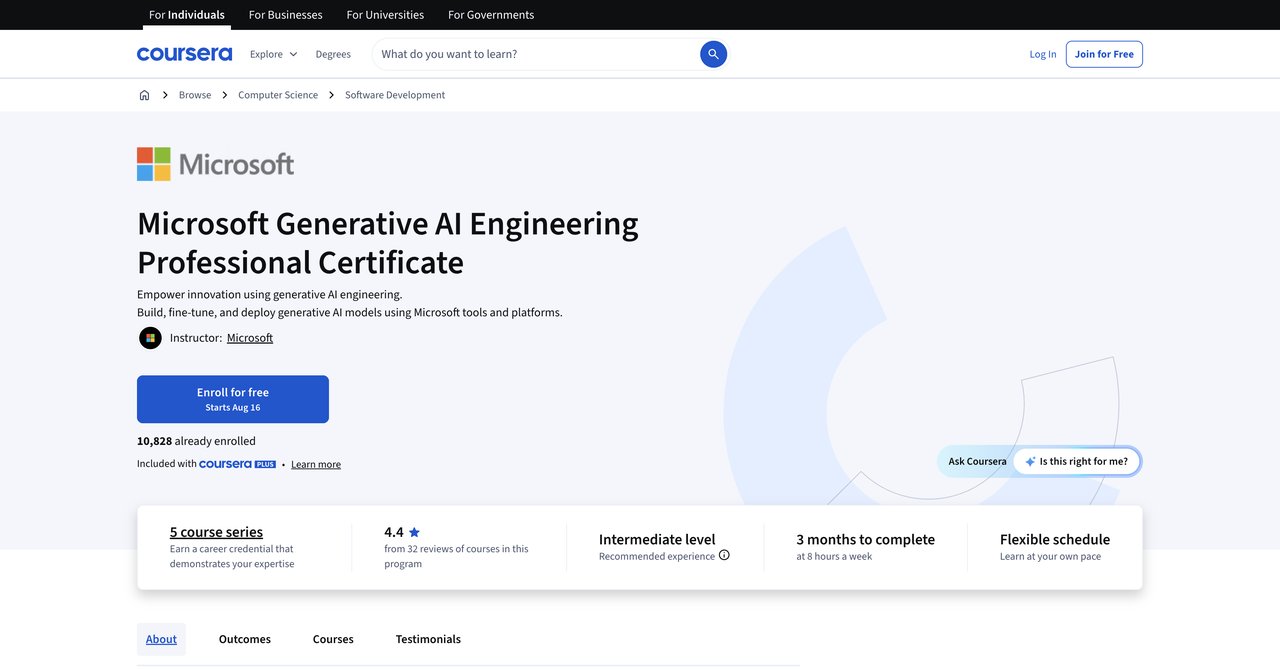
This is a much deeper course. It's for engineers or IT specialists who want to move in a more specific role that focuses on Microsoft's AI stack. You'll cover Azure LLMs and MLOps, which is everything from how to deploy a model to managing the model once it's in production. Also it covers responsible AI, which is becoming a major component for any AI rollout.
The prestige of Microsoft name is everything in enterprise. This certificate is an intermediate-level certificate, it's not for a beginner. You'll get into model training and fine-tuning no trivial topics. Since it's about Azure, having prior knowledge about Azure makes a big difference.
Key topics are Azure's OpenAI series, how you can integrate LLM API, and deploy data models on Azure infrastructure. Also includes MLOps platforms and pipeline building. The responsible AI component is part of the curriculum, which means you're learning best practices from the start.
Pros:
- Deep specialization course, specifically covering Azure LLMs and MLOps practices.
- It incorporates responsible AI practices.
- Your work in this is recognized by Microsoft, a top-tier vendor.
Cons:
- Cost of Azure license (trial available) may be required for all the labs.
- Assumes you already know some about AI and ML basics.
Who would benefit most: This best suits IT professionals who need to run a GenAI environment at Azure's scale. If you are planning on building the infrastructure, not just using the tech tools for IT, that's why it's valuable. It's for systems administrators into the machine learning side. You can get more data from Coursera.
Course 8: Generative AI for Software Development Skill Certificate by Coursera (DeepLearning.AI)
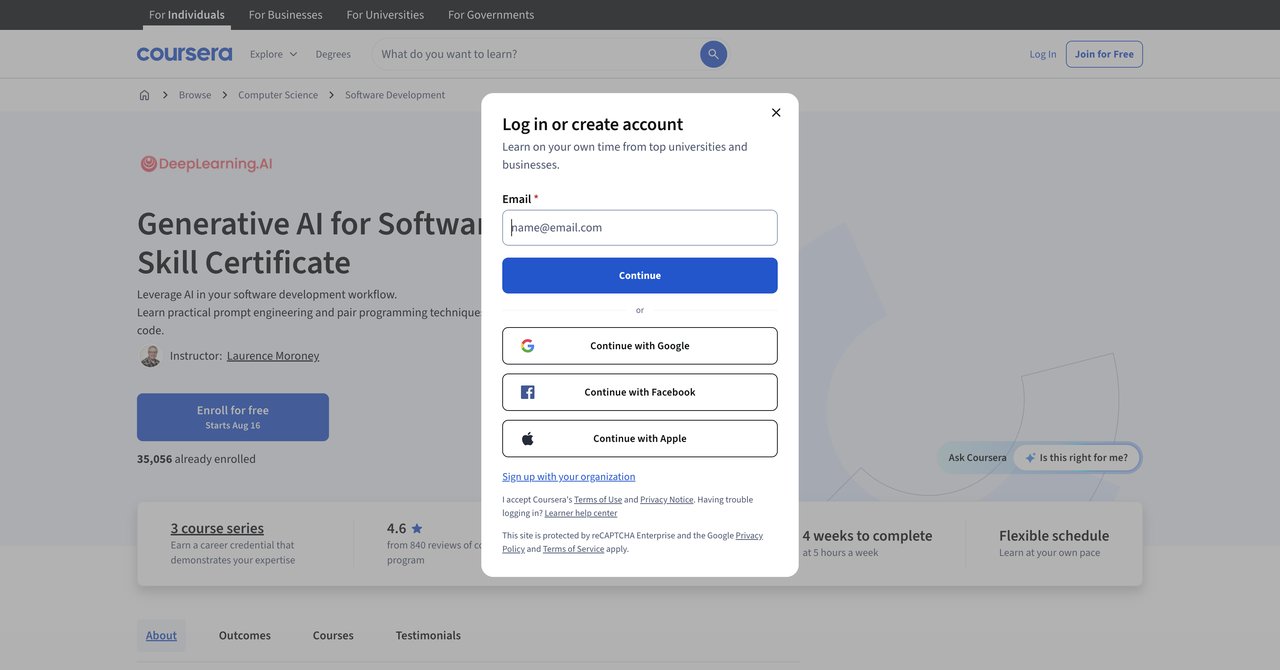
This one, hosted by DeepLearning.AI and taught by Laurence Moroney, is an AI-forward course for software dev. It's not a general IT specialist, it's specifically for coders in various environments. It shows you how to fold generative AI into your daily workflow, so you can code faster and automate tests and reviews. It's a solid choice if you write code day to day.
Because the teach comes from the DeepLearning.AI platform, the course is technology-first. You'll see real scripts and examples of how to use AI to assist with everything. The course is surprisingly interesting not just a catalog of tools. It's about patterns and workflow integration.
Key topics cover using generative AI for code acceleration and code completion, AI-powered testing and debugging, and how to use LLMs in real-world coding environments and development workflows. You will have an idea of how to build AI that you can use to write your Scripts or improve them.
Pros:
- It's taught by a leading instructor, which ensures high-quality.
- Apply and GenAI to practical real-world code generation, not just basic examples.
- Strong on integrating AI into coding practices in a way that is immediately useful.
Cons:
- It only focuses on software dev, not system administration or IT infrastructure.
- Basic programming knowledge is required and will not be learned here.
Who would benefit most: The software developers, SRE, and DevOps engineers who spend their the workday writing configuration, script and code. If this sounds like you, then this is useful. But if your primary role is not code, this may be too far out of your line. See this course page on Coursera.
Course 9: Microsoft AI & ML Engineering Professional Certificate by Coursera (Microsoft)
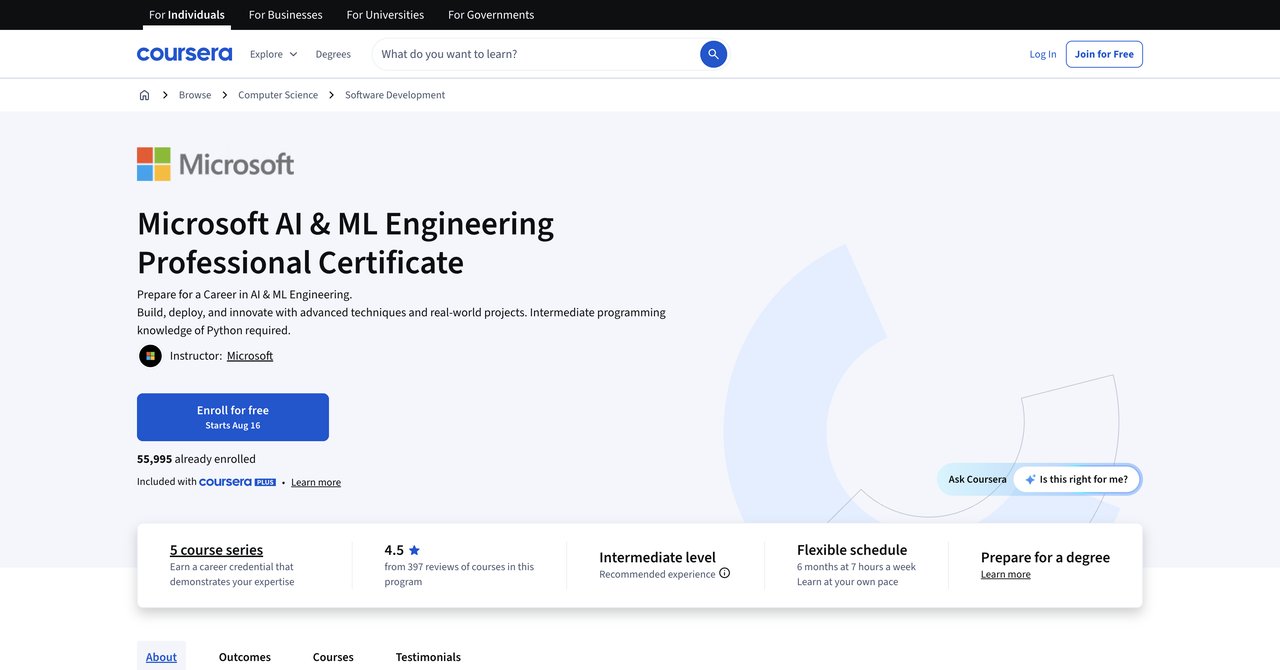
This is the most technical course level and for the experienced specialist. It's about building and managing AI/ML infrastructure at an enterprise scale. The content goes deep into Azure. Expect to learn more about Azure AI components, machine learning and models, generative AI and pretrained models for it all. If you need to manage a high-performance AI/ML infrastructure, this is up your alley.
The course will assume you have solid technicality. It assumes a strong baseline in statistics and math. It's not just about using a wizard in Azure; it's about the AI/ML ops. The overall focus is on running IT for AI workloads, not just for simple tools. Graduates of this course should be able to architect, manage, and monitor AI systems in a complex environment.
Key topics: advanced Azure AI and machine learning, large language models, applied AI at enterprise scale, and GenAI-based infrastructure operations. There's also some risk, scaling, and governance included.
Pros:
- A deep dive into Azure AI/ML from Microsoft, including GenAI.
- covers LLMs and various pretrained models.
- Microsoft-endorsed certificate with good credibility.
Cons:
- It mandates having very strong statistics back and Azure license.
- This is the steepest of the learning path and could prove challenging for many IT specialists.
Who would benefit most: If you are an AI/ML infrastructure engineer or a dedicated data engineer, this certification, aligns well. It's for anyone who is responsible for scaling AI and ensuring it's healthy and secure. This is not for your average network sysadmin work. It's essential for designing the giant AI systems. It is listed on Coursera page.
Course 10: Google IT Automation with Python Professional Certificate by Coursera (Google)
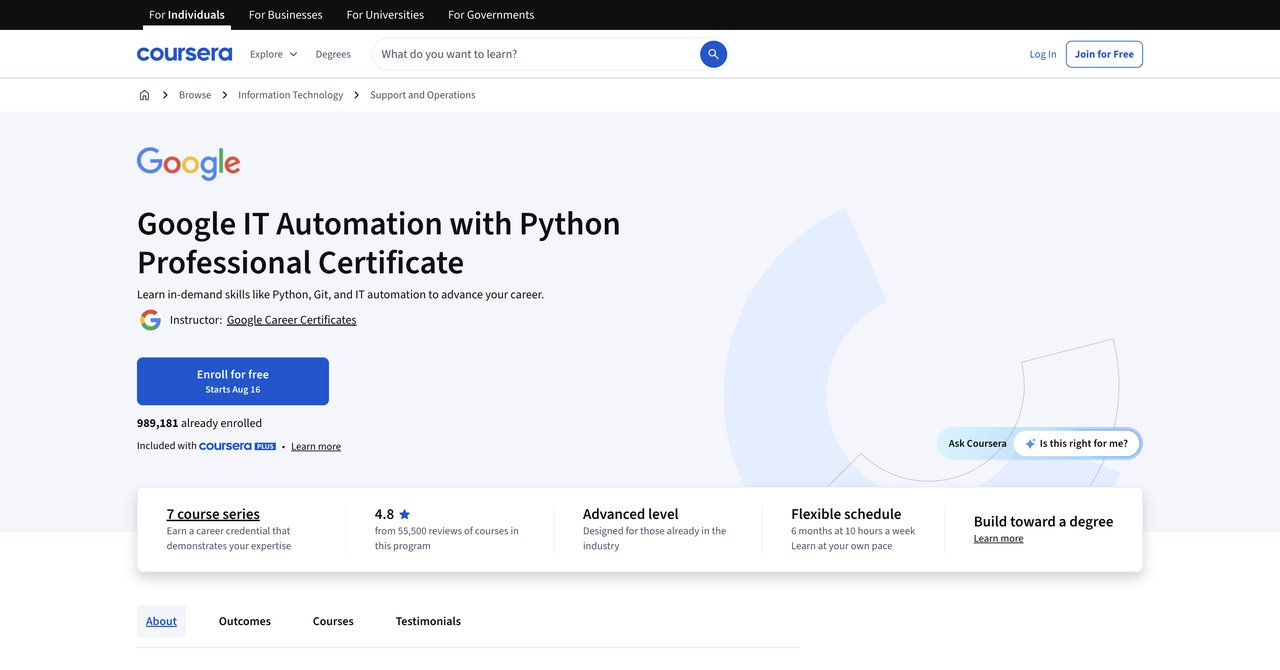
This is a better-known course from Google's IT automation pathway. It covers Python, Git, and IT automation. It's more like a fundamentals course for breaking into the junior sysadmin role. The reason why it's are on this list is that Python and Git are crucial for anyone in the IT automation space. And AI tools depend on some form of automation. This course is set to be beginner level but very valuable to automate your daily routine.
You'll learn by doing real exercises, like building scripts, managing Git repos, and working with configuration management tools. Use of AI is not the main topic, but it shows you to code to run systems. That's what matters. It has a strong emphasis on context of the sysadmin job; you'll see the scripts to handle end users or keep servers up.
Key topics are Python scripting, using Git and GitHub, basic automation frameworks, and how to manage fleets of computers. It's a detailed, multi-week learning path, not a crash course.
Pros:
- It teaches you the fundamentals of Python, Git, and automation.
- Well-received recognition from big employers like like Verizon and Deloitte.
- Great for preparing for junior sysadmin job series, with an emphasis on practical skills.
Cons:
- There's no specific AI content and AI.
- It's longer and is designed for a beginner, might be below you if you are senior.
Who would benefit most: This is for support specialists or early in their admin role. It's the right level to pick up programming for automation before scaling it to AI. If you're a senior, this is too simple; use a more advanced course like in CompleteAI.
You can find it on Coursera.
Course 11: AI Automation Engineer with n8n by Coursera
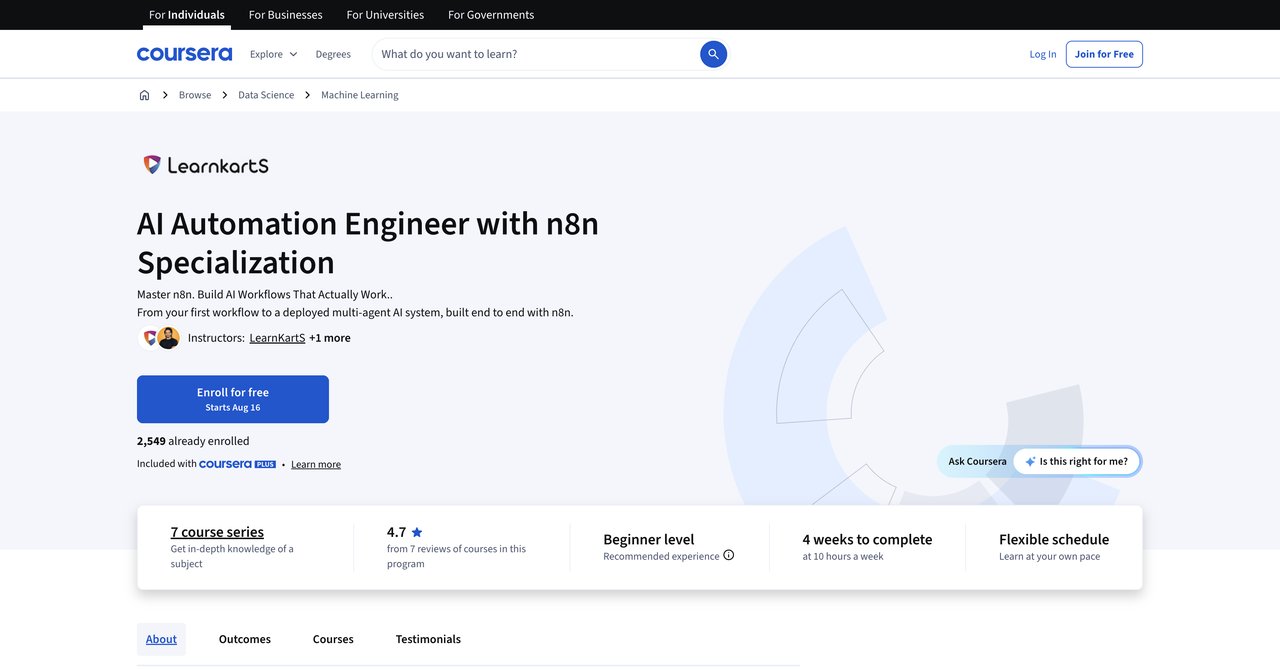
This specialization teaches a specific and niche skill: building AI agents and APIs with n8n. If you don't know n8n, it's a workflow automation platform. The focus is on integration and orchestration, you'll learn n8n, prompt engineering, and RAG pipelines. Those tools are critical in current large-scale AI apps the concept is to use n8n as the connecting tissue between different systems.
Pros:
- Hands-on with a major automation and integration platform.
- They cover everything you need to know, like prompt engineering and RAG.
- It's very practical for actual workflow automation, with many examples.
Cons:
- Its assumption that you want to specialize in n8n, which is narrow.
- Not a broad AI cert, it will not prepare you for enterprise deployment.
Who would benefit most: This is for the automation specialist or operations engineer who wants to implement AI into their data pipelines and internal systems. If we don't need to go that deep, but still want a practical skill set, this is a focused path. If you're more of a networking and infrastructure person, n8n might distract you from that main thing. It's still useful but not for everyone. Go to Coursera link. to see.
Final Insights on Choosing an AI Course
So what's the best call? That depends on you get what to get out of it. If you're a professional looking to build a broad foundation across multiple dimensions of AI for your job. CompleteAI Training is the best you like because one subscription covers every course and cert. That all-in-one deal is inexpensive, relative to adding up multiple courses as you go. If you need to be the person for the whole AI setup, the highest value is right there.
If you are a juniors or job seeker looking for entry-level positions, you can go with Google's IT automation or Microsoft IT support certificate opinion have a more structured foundational track for you, but it is beginner and won't give you a complete suite. If you want an expensive but specific credential, Cisco AITECH is a strong badge that carries weight, but careful of the cost.
For Azure-heavy, complex environments, you may need to go down the Microsoft generative AI engineering or MLE path, but it's not for general roles. If you are a developer, DeepLearning.AI and the course taught by Moroney is a good fit.
Every route has trade-offs. There is no perfect single course. CompleteAI Training and its all-access are, by far for the most practical approach for an IT specialist to be flexible and attackable. The rest of the platforms are single topic or vendor-specific, with additional fees. Think about your current stack, your job focus, and what you intend to bring with the future. No matter what, starting is the hardest part.