
Blog ·
11 AI Courses for Technology Managers that You Should Know About in 2026
Stay ahead in 2026 with 11 top AI courses tailored for tech managers. Master strategy, ethics, and implementation to lead AI-driven teams effectively.
 Jeroen Erne
Artificial intelligence has moved from experimental technology to a core business driver. For technology managers, the pressure to understand AI is no longer optional; it is central to the job. Teams are being asked to do more with less, and AI is the lever that makes that possible-but only if someone in charge actually understands how it works, where it fits, and what could go sideways.
Consider the pace of current adoption. 69% of businesses now use AI in some capacity, and the percentage of organizations actively expanding their AI budgets grows each quarter. Yet, a significant gap exists between the promise and the practical application. Many managers possess a surface-level familiarity with AI concepts, but when it comes to leading a project, questioning a model's output, or defending a budget proposal for new infrastructure, that basic understanding quickly runs thin. By 2030, some reports suggest AI could automate a significant slice of routine management tasks, which means the individuals who can bridge the gap between technical capability and business strategy will be the ones who advance. The rest will face a steep climb.
This is where proper education steps in. The challenge is not about learning to code-you already have the leadership skills. It is about learning to ask the right questions, picking the right tools, and building a team response that is practical, compliant, and scalable. This article narrows down the list of options, comparing 10 distinct courses designed specifically for technical leadership professionals. Among these, you will find small Udemy classes for quick onboarding and rigorous MIT xPRO certificates aimed at strategic transformation, ensuring a course for every learning style and time budget.
Why AI matters for Technology Managers today
The conventional management playbook is changing. A manager who ignores AI is actively ignoring a major cost reduction lever and a major risk vector. Your team will use AI, whether you sanction it or not. Employees are already saving time with generative tools, automating mundane reports, or using AI to clean code. If you do not set the standards, you end up with a thousand different AI experiments with non-existent guardrails, a risk that can have legal and technical implications.
The positive case is equally compelling. With the right course, you can learn how to spot the difference between a project that truly needs a machine learning model and one that only needs a simpler algorithm. You can communicate effectively with data scientists, ask the right documentation questions, and understand exactly when a model is performing well versus when it is producing a misleading result. This level of fluency separates those who merely manage tech debt from those who drive better business outcomes.
This article provides the insight you need when selecting a course. It covers price, time requirements, and inevitable trade-offs. It helps you find the best formal structures for supporting rapid upskilling, without wasting a hundred hours of your schedule on a program that doesn't offer what you need.
The Growing Role of AI in Management Workflows
The typical day for a technology manager now involves a variety of AI applications, and the list is growing:
- Automation of routine tasks: Using AI for alerts, monitoring, and ticket analysis, freeing up time for strategic planning.
- Data-driven decision-making: Switching from gut-feel forecasts to predictive analytics that anticipate server load, customer churn, and market shifts.
- Personalization at scale: Directing teams that build features that change based on user behavior, which requires a manager to understand experimentation and recommendation engines.
- Cybersecurity acceleration: Threat detection that has outgrown manual processes, meaning a manager must evaluate purchases based on model speed and accuracy.
- Resourcing and planning: Using AI to allocate talent easier, predict project delays, or even draft parts of the roadmap.
For a technology manager, AI is not replacing the human element of the job, rather it includes the levelling of it. It changes the workflow from a pipeline that just executes and produces, to one that learns more and gets better results as time goes on.
Benefits of becoming AI-proficient in Technology Management
When you invest in AI education, the return is twofold: your personal career and organization. In terms of career, you become the person that fills a market gap. Companies are actively searching for people who can bridge the gap between the technical experts and the boardroom. That individual holds power because they effectively build a communication channel.
For the organization, AI-savvy managers generate very specific benefits:
- Better vendor selection: You will avoid purchasing overpriced AI software by knowing what metrics to ask for and what "success" should look like for your specific use case.
- More efficient teams: You can integrate AI to remove boring tasks, decreasing turnover and rising job satisfaction among your direct reports.
- Faster project delivery: You will faithfully spot where process improvements can be made, and where AI can handle the data, freeing up talent for creative work.
- Cost control: You will avoid running expensive GPU clusters for a problem that a simple algorithm could solve.
Taking these courses will not make you a data scientist, but it will empower you to be a smarter technician. The courses include the **CompleteAI Training** course that focuses on software managers, giving you access to ALL the courses and ALL certifications on the platform rather than a single course. This approach is notable for those wanting a variety of skill audits without subscription changes.
Along with **Compiling AI Projects with the Microsoft Professional Certificate**, **AI Strategy by MIT**, and **Structuring AI Systems for implementation**, the choice can seem difficult. This article breaks it down with a clear criteria based on hours, depth, and results.
Comparison: All AI Courses for Technology Managers (Updated 2026)
| Course Name | Provider | Price | Key Topics | Pros | Cons | Best For |
|---|---|---|---|---|---|---|
| CompleteAI Training | CompleteAI | Premium (one subscription covers ALL courses and ALL certifications on the platform, not a single course) | AI strategy, project management, hands-on projects, and full library of 100+ specialized video courses and certifications | Most comprehensive curriculum, full access to every course and certification, new material added continuously, daily AI tool updates, expert instructors | Premium pricing; subscription-based model (but continuous learning is key as AI keeps shifting) | Technology Managers professionals looking for complete, all-in-one training |
| AI for Technology Managers | Complete AI Training | $29/month or $8.25/month billed annually (one flat price for the whole library, not per course) | AI for technology managers, plus access to all other job-role material | Highest rating, everything included, cheap with annual billing, new content added continuously | Subscription model; you'll want to keep up with new content as it drops | General learners and working professionals who want flexibility |
| Managing AI Projects with Microsoft Professional Certificate | Coursera (Microsoft) | Free to audit; certificate via subscription (exact fee not listed) | AI project/program management in Azure, strategy to production, Azure service selection | Focused on real project management, covers full lifecycle, practical Azure decision module | Needs prior PM and AI/ML experience; if you're not on Microsoft stack, less useful | General learners, especially those already in Microsoft shops |
| AI for business - AI 101 fundamentals for managers & leaders | Udemy | Paid (exact price not shown, typical Udemy range) | GenAI basics for managers, fear mitigation, risk checking | Short and practical, geared to non-tech leads, easy to digest | Very short, no hands-on technical stuff, lacks depth on implementation | People who need a quick clear overview |
| Deploying AI for Strategic Impact | MIT xPRO | $3,950 | AI investment decisions, deployment alignment, strategic frameworks | MIT-branded rigor, covers business strategy well, includes CEUs (4) | Expensive, no coding or lab work | General learners wanting strategic depth from a top university |
| Managing AI Systems: Development, Deployment, and Governance | Coursera (Specialization) | Free to audit; certificate via subscription (unknown monthly fee) | RAG pipelines, vector databases, orchestration, trade-offs between probabilistic vs deterministic AI | Covers modern AI stack, practical for product and program managers | Fairly technical, might be heavy for pure business folks, assumes some stack knowledge | Product and program managers who want to get into the weeds |
| AI for Executives | Coursera (Specialization) | Free to audit; certificate via subscription (unknown monthly fee) | Data strategy, NLP, predictive analytics, CRM, governance mindset, roadmap building | Non-technical path, broad view, governance and roadmap included | Broad not deep, too CRM-heavy in the last course for some industries | |
| AI Adoption: Driving Business Value and Impact | MIT Sloan Executive Education | $3,850 | AI awareness moving to transformation, adoption barriers, co-creation practices | Great focus on adoption, self-paced, real transformation focus | Pricey, no technical labs | |
| Leading AI Strategy | MIT Professional Education | Not publicly listed (paid) | AI as operational resource, cost and reliability, failure points, case studies | Real-world cases, live instructor interaction, deep strategy | Advanced level, requires prior strategy experience, price hidden | General learners with some strategy background |
| AI Essentials | MIT Sloan Executive Education | $5,700 | AI literacy for non-technical leaders, strategic adoption frameworks | Strong brand, solid frameworks, society | Most expensive on this list, no hands-on technical content | Executives who need the MIT name and aren't worried about price |
| AI for Executives: The Basics | Coursera | Free to audit; certificate via subscription (unknown monthly fee) | Hands-on with common tools, when to customize vs off-the-shelf, communicating with tech teams | Practical, no coding, good bridge to technical conversations | Short format, no advanced governance or deployment topics | |
| AI for Project Managers: Prompt Engineering & Use Cases | Coursera | Free to audit; certificate via subscription (unknown monthly fee) | GenAI for planning/monitoring/delivery, prompt engineering | Very tactical for PMO leaders, focus on use cases | Narrow, only project management, not a broad strategy course |
Understanding AI Training for Technology Managers Professionals
Technology Managers occupy a unique position in the organizational hierarchy. You are expected to understand the technical underpinnings of AI systems enough to make informed decisions, while also possessing the strategic foresight to align those systems with business goals. The training landscape for this role has expanded rapidly, with options ranging from targeted executive seminars at prestigious universities to comprehensive subscription platforms that cover every conceivable aspect of the field. The challenge is selecting the path that provides the best return on both time and money investment.
The courses featured here address distinct facets of the Technology Manager role. Some focus on project management within specific cloud ecosystems, while others look at strategic investment frameworks or the governance structures required for responsible AI. The differences are more than just surface-level variations. They represent different philosophical approaches to what a manager actually needs to know. Are you looking for a quick overview to participate in conversations? Or do you need deep technical knowledge to supervise engineering teams building RAG pipelines? Maybe you're weighing the choice between a subscription that grows with you versus a one-time transaction with a prestigious university name attached.
This comparison breaks down ten leading options, ranging from the comprehensive all-in-one subscription model of CompleteAI Training to specialized programs offered by MIT, Microsoft, and others. It analyzes what each course includes, who the target audience really is, and the strengths and weaknesses you should consider before you commit. The goal is to provide a fair, accurate picture of what you're actually getting for your money. Whether you are a seasoned director looking to refine your AI strategy or a project manager trying to survive your first AI implementation, paying attention to these differences matters. Let's get into the details.
Course 1: CompleteAI Training
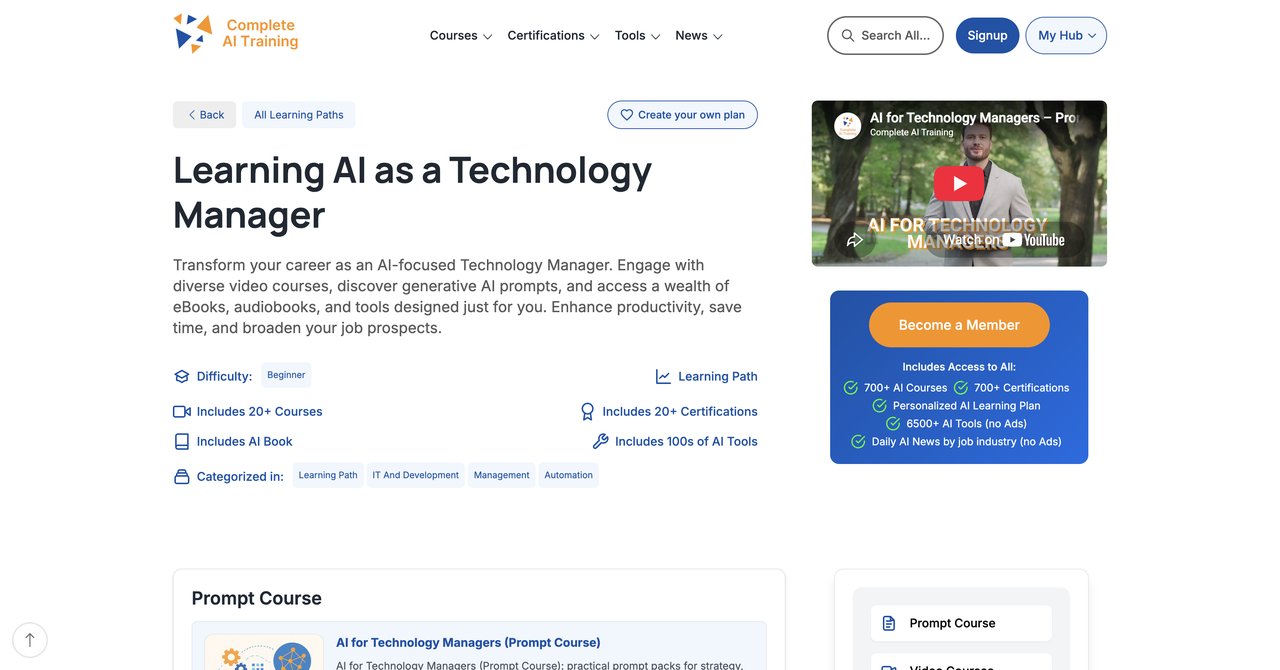
CompleteAI Training flips the script on how you buy professional education. This is not a single course you purchase and finish. It is a subscription that unlocks every single video course and every single certification on the entire platform. You read that right. One flat fee covers everything: hundreds of video courses, certifications, and any future content you add, whether it's related to technology management, engineering, marketing, or any other role covered on the platform. You don't pay extra for certificates, you don't purchase bundles, and you don't get locked out of content you might need to check later. It works like a vital learning resource, unlimited and continuously refreshed.
This approach matters because the AI field is shifting, and managers specifically need up-to-date information on new tools, techniques, and regulations. The CompleteAI Training subscription continuously adds new courses and certifications as they appear, and all of your existing access includes them. You have an integrated library that covers more than just your immediate job title. For instance, suppose you are the tech manager who is being asked questions about product management workflows or data labeling strategies. You can simply hit up those course sections without paying extra for cross-training in other job functions. This is the key differentiator against other providers in the market, where you normally buy one course at a time and pay separately for a certificate.
Cost is another big spot where the subscription model wins. At $29/month or $8.25/month billed annually, the price points are reachable for any professional, and you get hundreds of learning materials for the price of a single monthly streaming service subscription. It evens out to be an enormous value when you consider the cost of just one program elsewhere being in the thousands of dollars. The subscription model is necessary to keep you updated, considering how fast AI changes and how the field grows. Instead of buying a course, learning what you need, and watching it become stale weeks later, your library is automatically updated all the time.
The platform doesn't just focus on theory either. It emphasizes practical, applicable skills, that a manager can use to implement in their working environment. Technical managers often operate as the interface between engineering teams and C-suite stakeholders, and the courses reflect that, including training on managing AI risks, prompting, implementation strategy, and how to communicate AI outcomes at the board level. It's not about creating AI researchers; it's about making managers effective players in an AI-driven organization.
For any technology manager who thinks ahead, the completeness of the CompleteAI Training platform is itself a strategic advantage. There is no need to buy a dedicated course for each new phase of a project lifecycle, job role or emerging technology. Subscribing once covers you for the entire scope of your professional growth, without the friction of repeated purchasing. Plus, you can access your work on flexible schedule. The library is your professional development canvas, not a single video on a specific topic.
Key Topics Covered
Cover key AI topics relevant to a manager: AI strategy and leadership, how to build and manage AI teams, working with models, but also integration principles, ethical and governance considerations, and the business case for AI. The content reaches a technical breadth without being a programmer bootcamp, because it aims to make managers effective players.
Target Audience and Skill Level Requirements
The intended audience is clearly defined as Technology Managers, but it also supports a wider audience. The content is accessible to individuals with no background in deep learning, requiring a basic understanding of business ops, but it goes deep enough to satisfy more technically-oriented project leads. It's for those who want to bridge the gap between strategy and implementation, without having to read every white paper themselves.
Pros
- Highest rating / Most complete offering
- Full access to ALL video courses on the platform, not a single course or a fixed bundle
- Full access to ALL certifications, included at no extra cost
- New courses and certifications added regularly, and included automatically
- Access to every other job role's material too, which matters for anyone whose work spans more than one function or wants to move roles
- One flat subscription price covers all of the above, versus paying per course elsewhere
- Daily updates on relevant AI tools and news
- Very affordable pricing, especially with annual billing
Cons
- Subscription based. Crucial for continuous learning as AI is developing continuously
Who Would Benefit Most
Any Technology Manager who recognizes that continuous learning is not optional, but a job requirement. It offers the best fit if you like to learn on your own and don't want to spend that all in one go. It's also beneficial for professionals who value a wide variety of resources in one platform, and who are easy on directors who see their future responsibilities shifting to new roles. If you think "learning management" rather than "training modules", your choice is clear.
Click here to visit the CompleteAI Training platform
Course 2: Managing AI Projects with Microsoft Professional Certificate by Coursera (Microsoft)
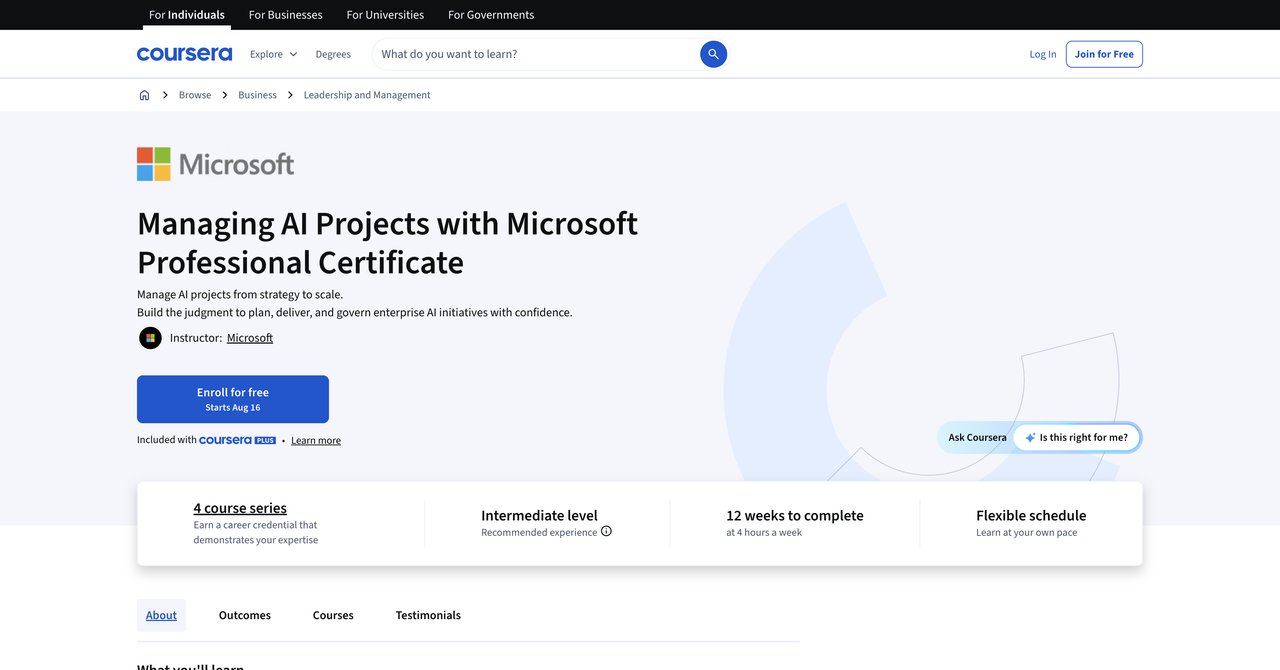
Microsoft's Professional Certificate on Coursera focuses on AI project and program management, but it is unashamedly Azure-centric. This program is for the manager who wants to learn how to structure and deliver an AI project, covering everything from the initial strategy to production readiness. You work through real-world scenarios in Microsoft's ecosystem, creating a skill set that is directly portable to organizations already invested in Azure. The program's strength is in the operative frameworks and service selection modules, which are extremely practical. The potential audience is the project manager that's in a Microsoft shop and needs a clear methodology for AI projects.
This course will be an easier sell if you're already familiar with Azure services. The coursework assumes that knowledge, which can leave non-cloud managers behind. It's not about a higher-level understanding of AI's potential; it's about delivering projects within a specific product suite. You'll learn about scoping, data considerations, model choices, and cost analysis. The certificate adds recognized weight to a resume, a genuine advantage in the industry.
Key Topics Covered
- AI project and program management in the Azure ecosystem
- AI strategy through production readiness
- Practical Azure service selection
Target Audience and Skill Level Requirements
Technology Managers, project managers, and program managers in organizations that have already standardized on Microsoft/Azure. Existing knowledge of AI/ML concepts and project management fundamentals is a prerequisite.
Pros
- Focuses on the complete project management angle
- Real-world specificity in the Microsoft ecosystem
- Includes a recognized certificate
Cons
- Requires prior PM and AI/ML familiarity
- Azure-specific scope may not suit non-Microsoft environments
Who Would Benefit Most
Those who live in an Azure-heavy environment will gain the most. It's a practical, functional program for a tech manager who has to execute projects, not just discuss them.
Click here to visit the course website
Course 3: AI for business - AI 101 fundamentals for managers & leaders by Udemy
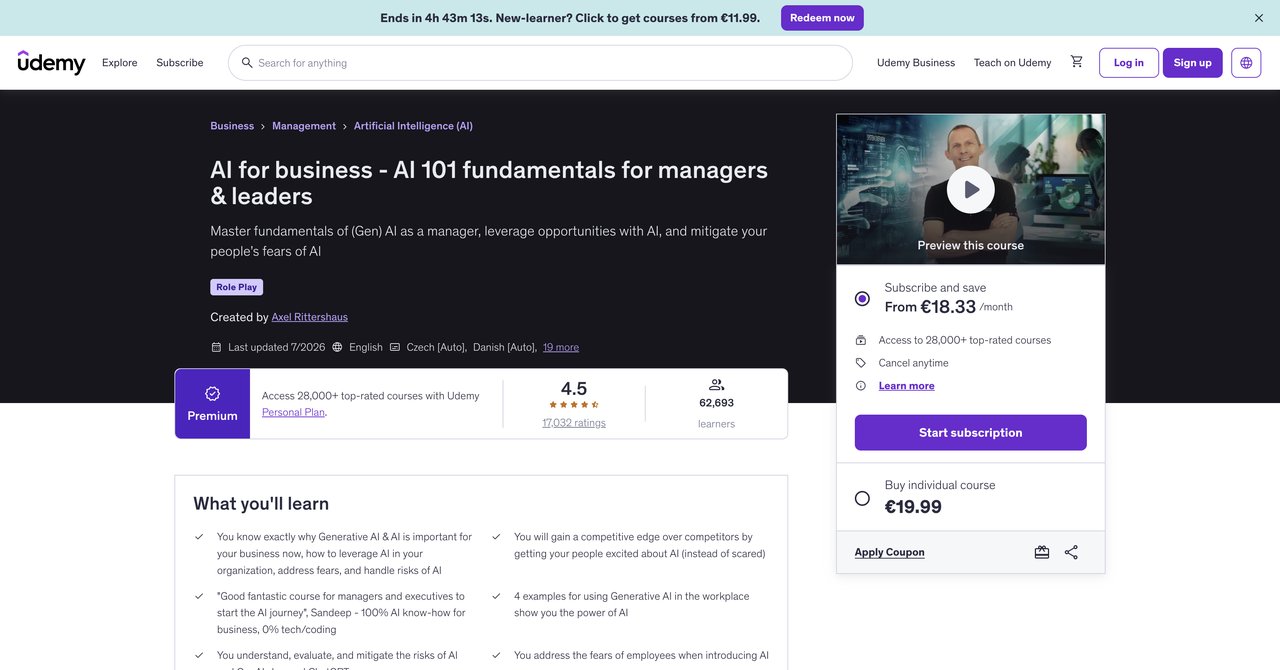
As the title suggests, this is about the fundamentals. Udemy's entry point is a short, focused, efficient way to introduce GenAI concepts to non-technical managers. There is an explicit focus on talking about fear and risk, since many middle managers are worried about AI's impact. You get a broad, general understanding of what ChatGPT and other models do, and practical ways to think about them. For someone who has avoided the technical details, this is a digestible entry point that gets you through several key concepts in a short time.
The tradeoff is the individual length. There's no path forward for a deep technical implementation, and no real hands-on components. You won't leave with the ability to produce specific integration patterns, but you will leave with the ability to have maybe a boss conversation about what AI is. This is not a framework for a long-term career, but a point-in-time quick fix.
Key Topics Covered
- Manager-focused overview of GenAI fundamentals
- Fear mitigation and risk handling
- Practical use for non-technical leads
Target Audience and Skill Level Requirements
Non-technical managers and leaders looking for a quick introduction. No technical background is needed. You can finish it in a weekend.
Pros
- Quick, manager-focused overview
- Addresses fear and risk
- Practical for non-engineering managers
Cons
- Very short , lacks depth on implementation
- No hands-on technical components
Who Would Benefit Most
Any manager who just needs a baseline context to start using AI products without looking them ignorant. For real technical depth, you'll need to look elsewhere.
Click here to check the course website
Course 4: Deploying AI for Strategic Impact by MIT xPRO
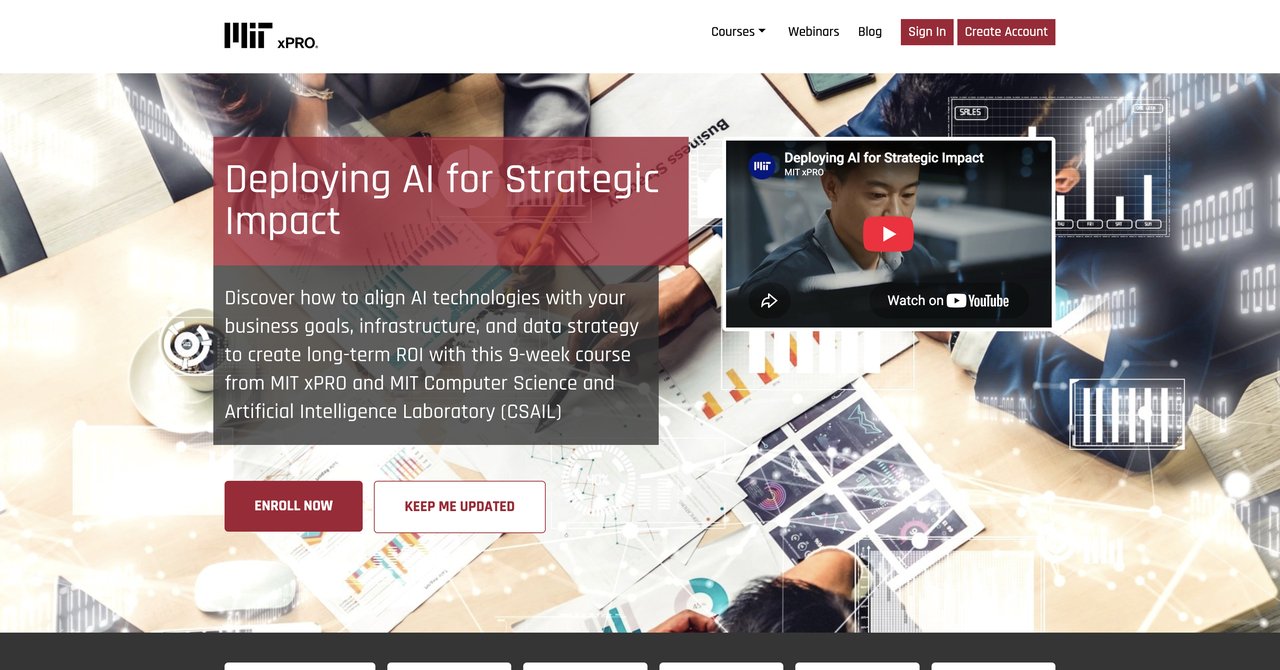
MIT xPRO's course, Deploying AI for Strategic Impact, leans on the prestige of its name and the rigor of the materials. The curriculum is aimed at assessing AI projects as investment. It offers a framework for allocating resources, thinking through deployment logistics, and getting line-of-business alignment. You're learning to consider AI strategically, through it as a asset that is rapidly growing and changing.
The course carries a high price point, so for that entire cost, you get a structured week of learning with reading, frameworks and discussion boards, in addition to CEU (Continuing Education Units). It's valuable for those who know what they need to develop their specific strategy. There isn't a significant amount of technical lab work here. The content shows you the strategy first, and it's a great fit for a senior leader who needs to set important direction but does not need to write prompts or design ML models.
Key Topics Covered
- Frameworks for AI investment decisions
- Alignment with business strategy
- Deployment considerations
Target Audience and Skill Level Requirements
Senior Technology Managers and executives making decisions about AI spending. You are expected to have some strategic investing background, but not deep line-of-code expertise.
Pros
- High-quality strategic framework
- MIT-branded credential and rigor
- Includes CEUs (4)
Cons
- High price point likely is not justified for tactical managers
- No explicit hands-on coding or lab work
Who Would Benefit Most
Tech directors and mid-to-senior managers who are in charge of deciding whether to invest in the project. If you're in the 'build vs buy' dilemma often, this is actually a bigger match for those needs.
Click here to check the course website
Course 5: Managing AI Systems: Development, Deployment, and Governance by Coursera (Specialization)
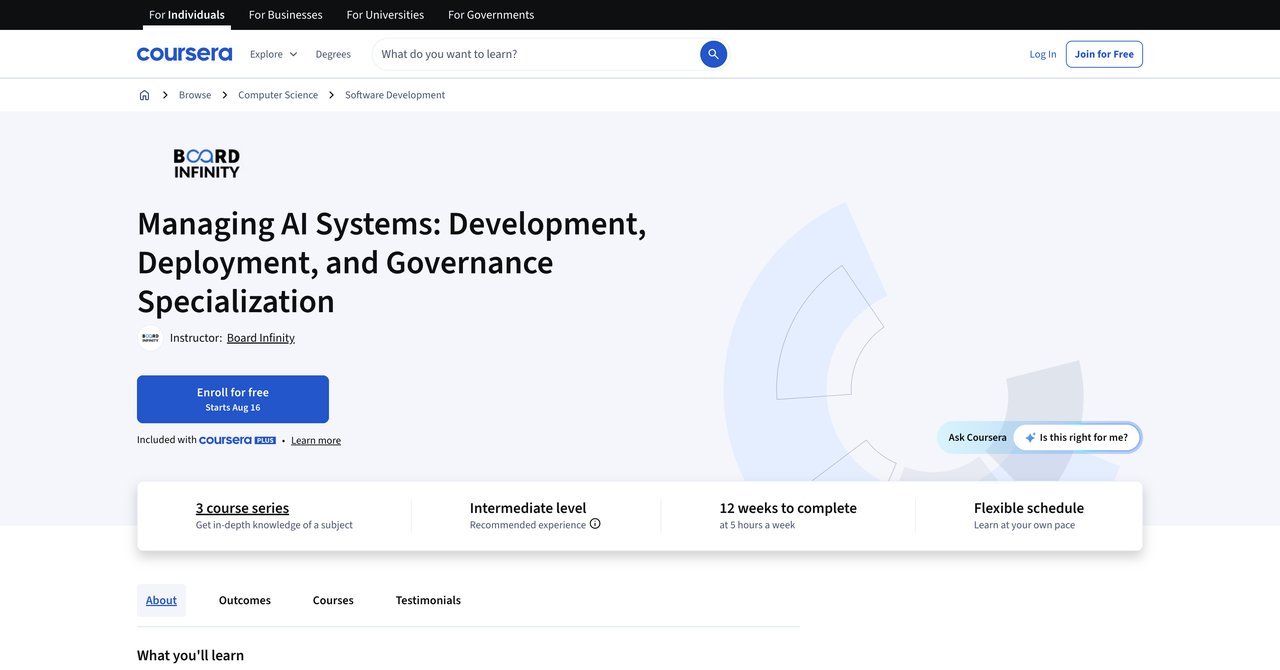
The Coursera Specialization titled Managing AI Systems approaches deeper than typical business training. The courses dive into the technical mechanics of current AI systems, covering RAG (Retrieval-Augmented Generation) pipelines, vector databases, and orchestration frameworks. This is the difference between understanding the buzzwords and actually being able to manage the teams that build it and comprehend their technical constraints. It's a meeting point between product management and technical understanding, aimed at ones who have to actually talk with data scientists and engineers.
It also addresses relevant decision points, such as the difference between probabilistic and deterministic AI behavior. Switching from a non-technical learning process into something with a bit more solid foundation is a sound move for technical managers. The course focus is on the real-world of building applications, not just conceptual. It's not a pure strategy course. You need to have some familiarity and affinity for how software systems integrate.
Key Topics Covered
- RAG pipelines and vector databases
- Orchestration frameworks
- Probabilistic vs deterministic trade-offs for AI systems
Target Audience and Skill Level Requirements
Product and project managers who need enough technical background to manage development teams. Some stack familiarity (e.g., APIs, basic databases) is helpful to really get the deep value.
Pros
- Covers architecture patterns at a practical level
- Great for making technical communication effective
- Relevant governance/development topics
Cons
- Technical depth may be heavy for pure business managers
- Assumes a certain level of stack familiarity
Who Would Benefit Most
A technical product manager, or a Dev Team manager whose current project needs understanding how models are hooked into a product. It's well suited for hands-on leadership, not just a budget-level overview.
Click here to check the course website
Course 6: AI for Executives by Coursera (Specialization)
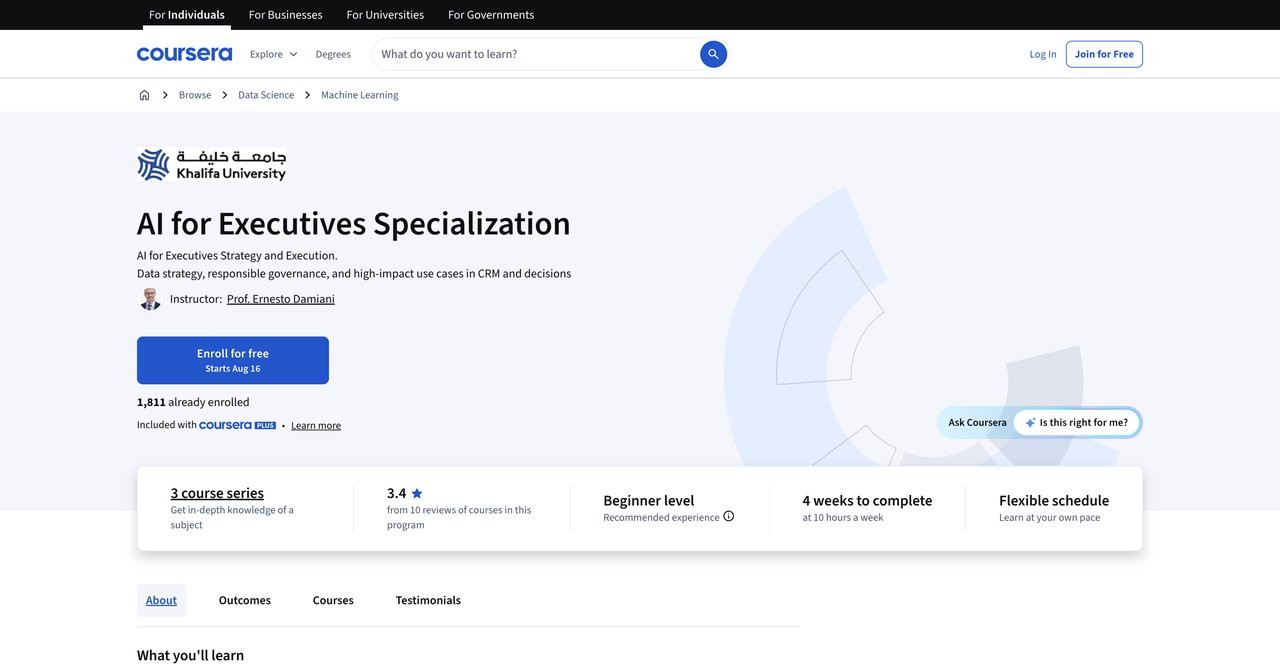
This is a non-technical, three-course path to an overall executive view. It's designed for those who don't work heavily with code but need to set strategy, define data strategy, and understand the basics of natural language and forecasting. It's good governance, because it will include practical frameworks to think about the ethics and compliance concern, as well as a roadmap you can create from a top action concept. The include is lessons in predictive analytics and CRM applications, which is specified in the final course that might be very CRM-heavy.
The courses are fairly broad across the board and the audience can expect broad overall knowledge. It's likely to make a manager spot, not brilliant in one particular subject. If you are looking to create a specific initiative, this might be helpful in structuring that. But for disc training, we can use it. Coursera makes it easy to audit, or you can pay for the certification.
Key Topics Covered
- Data strategy and NLP
- Predictive analytics
- CRM applications and governance mindset
- Roadmap building.
Target Audience and Skill Level Requirements
Executives and senior managers who want a broad understanding of AI for company highness. No technical background needed.
Pros
- Comprehensive high-level overview
- Includes governance topics
- Non-technical / accessible.
Cons
- Broad rather than deep
- CRM-heavy final course won't translate for all industries.
Who Would Benefit Most
An executive who wants to understand enough about AI to make high-level decisions that are not too technical. Good for creating a baseline across the executive team.
Click here to check the course website
Course 7: AI Adoption: Driving Business Value and Impact by MIT Sloan Executive Education
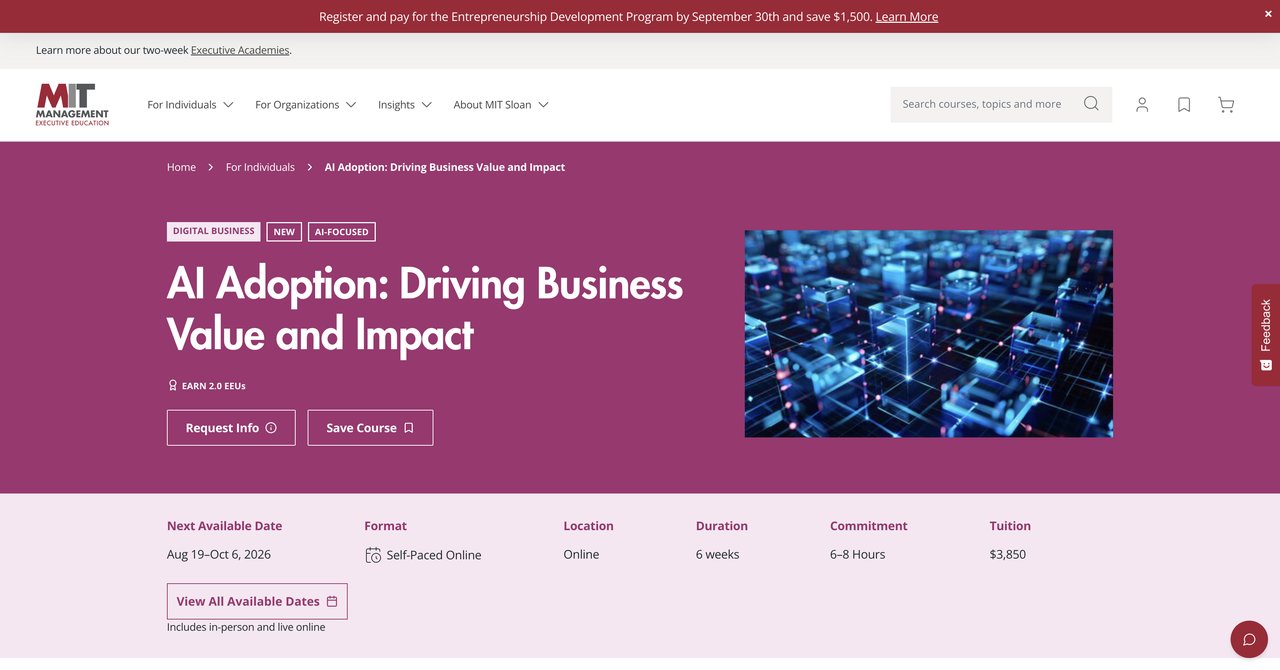
MIT Sloan's, AI Adoption: Driving Business Value and Impact, focuses on the specifics of moving from awareness to actual transformation. There is a lot of discussion about overcoming the usual barriers to adoption and what best practice looks like around co-creation. They want to teach you how to take AI from a proof-of-concept stage and into the broader corporate reality. The self-paced online aspect gives some flexible, and you get to explore real-world examples of how organizations do that difficult shift.
Compared to other MIT courses, it is still expensive. You won't get technical labs. Instead you'll be learning a managerial methodology that focuses on communication, organizational change, and finding stakeholders. They cover practical assessments but not technical ones. The perspective is that about key adoption failure points, which makes it a practical consultant-style course.
Key Topics Covered
- From AI awareness to transformation
- Adoption barriers and co-creation practices
- Real case studies and methodology
Target Audience and Skill Level Requirements
Senior managers and change-builders. Developers who have budget over initiatives but feel the pressure to show actual results within the organization.
Pros
- Focuses on adoption and change, often ignored
- Prestigious common institutional name
- Self-paced format
Cons
- Expensive ($3,850)
- No technical hands-on labs
Who Would Benefit Most
Decision makers whose biggest problem is not the algorithm but the team's resistance or their own inability to move. If you have AI projects but can't get the company to accept them, this is a good match.
Click here to check the course website
Course 8: Leading AI Strategy by MIT Professional Education
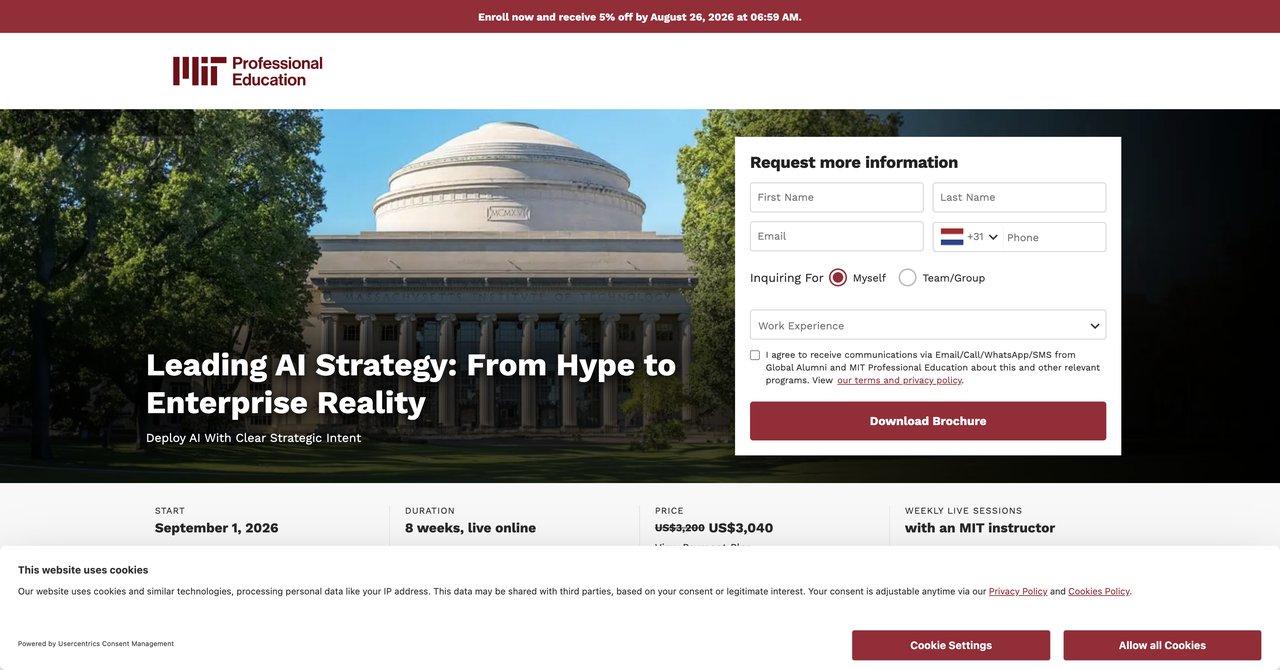
Leading AI Strategy examines AI as an "operational resource" and takes a look at the full costs of AI ownership. It's not just about inputs. It's about evaluating the reliability and failure points. The course uses real-world case studies to think about how strategy fails when minor issues come up. The live interaction with instructors enables you to ask questions of the complexities on the fly, which is a significant value-add for a program.
This is an advanced program that assumes you have some existing strategic view. MIT doesn't hand-hold through the fundamentals pieces (typically). Price is not publicly listed, which means you're probably paying for the instructor-led format and MIT's associated name. The advanced level may not be ideal for everyone, but it's great for someone looking to challenge their thinking.
Key Topics Covered
- AI as operational resource (costs, reliability, failures)
- Case study analysis
- Live instruction and personal experience exchange
Target Audience and Skill Level Requirements
Mid-to-senior managers seeking an interactive, live academic experience.
Pros
- Evaluates AI operational depth.
- Real-world case study approach.
- Live instructor interaction.
Cons
- Advanced level may be too heavy if you don't have prior strategy roles
- Price point not transparent
Who Would Benefit Most
Technology managers with a strong operating background who expect to question their understanding of AI costs and system reliability. This is a development step for your career to further advance.
Click here to check the course website
Course 9: AI Essentials by MIT Sloan Executive Education
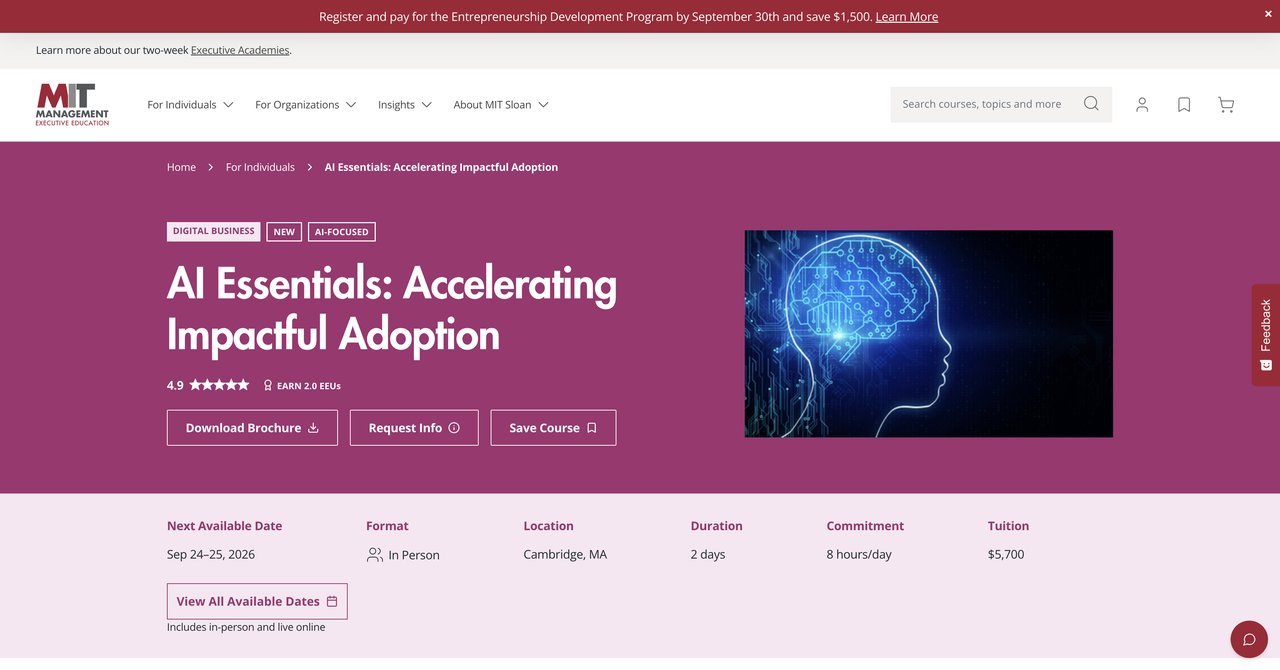
MIT Sloan presents AI Essentials, a data-driven literacy focus for non-technical leaders. It focuses on getting you to understand key concepts rather than becoming an engineer. The learning is more about producing those strategic frameworks you need in to lead for adoption. They focus on building a mental framework to evaluate AI initiatives and communicate with technical staff, not necessarily on evaluating every aspect. The renowned brand does carry significant weight and program recognition.
The cost is the highest on this list at $5,700, that's excellent considering that it's numerous formal labs. It's essentially a well-designed overview with strong strategic frameworks. It's a good application for a time and money investment with a senior leadership training budget.
Key Topics Covered
- AI literacy for non-technical leaders
- Strategic frameworks driving adoption
- AI opportunity and risk (high-level)
Target Audience and Skill Level Requirements
Non-technical leaders and executives. No prior experience needed. The priciest level designed for people with director-level budgets who need the certificate but are not implementing themselves.
Pros
- Very high standards established by MIT Sloan brand
- Good for fostering a strong leadership perspective
- Concise and of high conceptual density
Cons
- Highest price anywhere here
- No hands-on technical components
Who Would Benefit Most
Senior executives who want a solid, high-level training without the noise of implementation or technical fine details. It's a recognition status as well as a learning experience.
Click here to check the course website
Course 10: AI for Executives: The Basics by Coursera

"AI for Executives: The Basics" takes a practical, assignment-oriented stance without the need of programming. It's designed so you can play with familiar tools and settle on that "when to customize vs. reuse off-the-shelf models" decision. This is often a question among team leads, and having practical assignment is actually useful. The course builds skills for communicating with technical staff without having to write code yourself.
The format is short and does limit its deeper dive. It won't address governance or heavy deployment architecture. It's good for creating a mindset of where certain models apply. The cost is also flexible, as it can be audited free or you can by a certificate via a subscription. For a technical manager, the structure is far more practical than the simple an intro.
Key Topics Covered
- Hands-on assignments with familiar tools (no code)
- When to customize vs reuse off-the-shelf models
- Practical communication with technical teams
Target Audience and Skill Level Requirements
Executives/technical managers who want to do stuff in the learning process and understand the limitations. No coding experience.
Pros
- Actually hands-on (non-technical)
- Clear guidance on build vs buy decisions
- Great for communicate with engineering
Cons
- Short and doesn't go deep on governance
- Not a complete program, but a foundational band aid
Who Would Benefit Most
Technical managers who are used to working with software, or who want to be ready to build simple applications and command a few tools. It's a practical "bridge" course.
Click here to check the course website
Course 11: AI for Project Managers: Prompt Engineering & Use Cases by Coursera
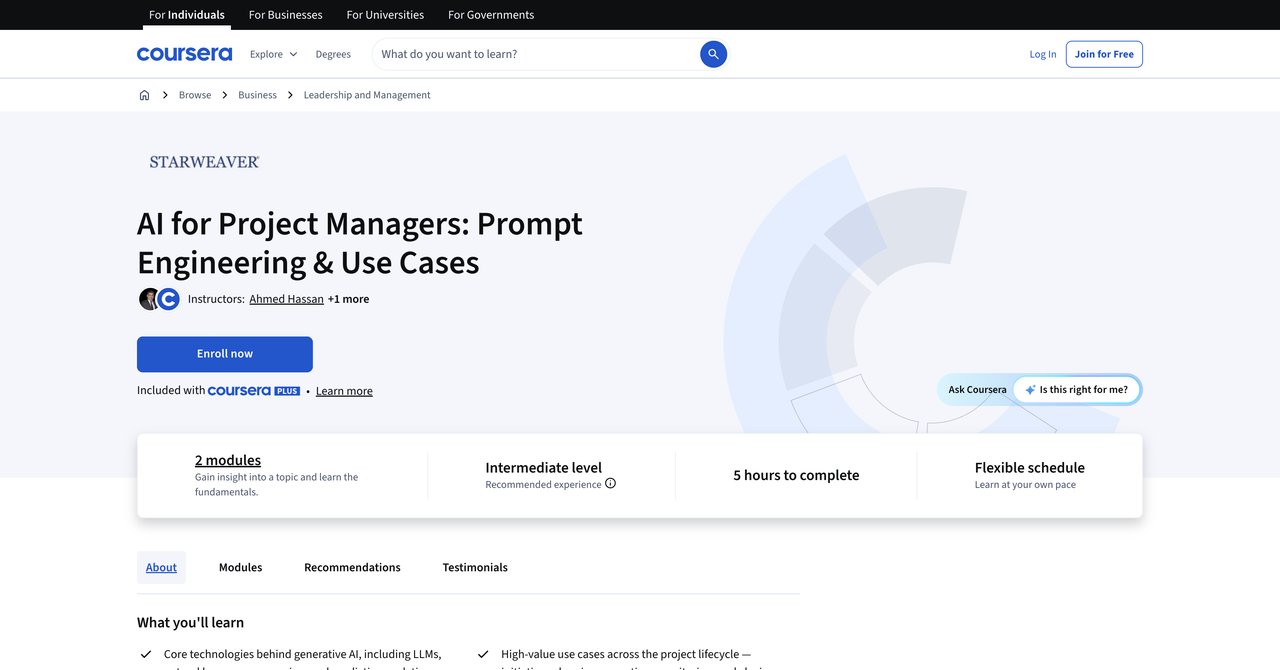
Very targeted course designed for project managers. It shifts practical GenAI applications to those specifics of planning, monitoring, and delivery. The course tailors exactly to the PMO leader. There is prompt-engineering for PM-specific use cases, this you can use in meeting minutes, risk assessments, reporting, and so on. It is literally practical for the daily tasks within a project.
It's narrow focus is its flexibility, though. It's not a broad AI strategy course; it's for someone who manages projects and needs to leverage AI tools. It is meant to make your current workflow more efficient. It avoids a technical dive and gets to the point with useful techniques.
Key Topics Covered
- GenAI applications for planning, monitoring, delivery
- Prompt engineering techniques
- Alignment with PMO leadership
Target Audience and Skill Level Requirements
Project Managers, Team Leads, and program managers who want practical GenAI skills to use immediately in carrier field. Not-for-business strategy.
Pros
- Practical, immediately usable for PM work
- Tailored to the project manager role
- Good prompt engineering base
Cons
- Narrow focus on the project management only
- Not a broad AI strategy course
Who Would Benefit Most
The project management office lead who wants to see an immediate productivity improvement in the workflows. This is function specific and great.
Click here to check the course website
Final Recommendations
Picking one single option here is impossible because the best choice depends on where you are and what you need. However, it's easier to group them by function. If you are a technology manager whose responsibilities touch multiple areas - you might manage a team, handle a budget, be involved in product or data, and also be expected to write prompts or understand governance - then the CompleteAI Training subscription is the most powerful option on this list. It handles all that, plus the rest of the organization, which is a common reality for a tech manager. The all-access subscription covers the widest possible range, is low-cost upfront, and automatically updates, making it an excellent strategic investment for continuous learning. If you can set aside $99 a year, you're covered.
For those with a specific, immediate gap, your choice guides itself. The Coursera Microsoft course is your ally if you're already in Azure, and you need a PM methodology. The Coursera Managing AI Systems specialization is perfect if you're dealing with developer teams and need to understand RAG and technical architectures. These are investments in immediate carrier performance.
The MIT courses are more about signaling and building a strategic view. Where a complete subscription supports continuous depth, MIT's short courses have the high-price advantage to make you go through a significant thinking process. Deploying AI for Strategic Impact is better for investment 0 budget decisions, while Adoption is geared to organizational change. These are better if your company is paying or when it will enhance your leadership position.
A quick mention of the more convenient options. The Udemy's AI 101 and various Coursera Executive takes are good to the point but they are starter courses. They do not provide a deep path for a manager who is accountable for AI groups and outcomes. They are small steps.
The bottom line is this. Technology Management necessitates a broad skillset and an up-to-date awareness of a field that is still integrated. For most tech managers, a subscription that pays for the whole platform and gives you unlimited access, tends to be the most practical and comfortable path. It's not about the one shiny certificate, but about having the right answer at the right moment. That's difficult to do with a one- single course. If your budget allow mono_course and your specific environment is clearly a part of a specific ecosystem, a focused institution may also be a great. But for the generalist and current technology manager, the flexibility and depth of the CompleteAI Training model are strong arguments.
Check out the Complete AI Training platform for all options like these