
Blog ·
11 Top AI Courses for Global Heads of Operations in 2026
Cut through AI hype with 11 vetted courses tailored for Heads of Operations. Master strategic automation, data-driven decisions, and scalable workflows to lead 2026's operational frontier.
 Jeroen Erne

Artificial intelligence has moved from experimental technology to operational necessity. For Global Heads of Operations, the pressure to integrate AI into daily workflows is mounting from every direction-board members expect efficiency gains, competitors are automating core processes, and customers increasingly demand faster, smarter service. The statistics paint a clear picture: 69% of businesses now use AI in some capacity, and that number climbs every quarter. Yet the same forces creating opportunity are also creating risk. Studies suggest that operations roles will see significant transformation as AI takes over routine tasks, and professionals who fail to adapt may find themselves sidelined. This isn't about learning a new tool; it's about staying relevant in a field that is being fundamentally restructured. The question isn't whether AI will impact operations leadership-it's whether you'll be the one making those decisions or watching someone else make them.
Why AI matters for Global Heads of Operations today
The operational landscape has shifted dramatically in just the last two years. Global Heads of Operations are no longer just managing supply chains, logistics, and process efficiency-they're being asked to lead digital transformation initiatives that touch every part of the business. AI adoption has accelerated across industries, with organizations using machine learning for demand forecasting, predictive maintenance, quality control, and resource allocation. The numbers are hard to ignore: companies investing in AI report average productivity gains of 40% or more in targeted operational areas. But here's the thing-these gains don't happen automatically. They require leaders who understand both the technical capabilities of AI and the practical realities of implementation. That's why this article exists. We've researched and compared twelve AI courses specifically designed for operations professionals, ranging from comprehensive certification programs to focused bootcamps. Whether you're looking to build foundational knowledge or pursue advanced certification, this comparison will help you identify which course aligns with your career goals and current skill level.
The Growing Role of AI in Global Heads of Operations
AI's role in operations leadership extends far beyond simple automation. Today, Global Heads of Operations are using AI to:
- Automate routine processes-from invoice processing to inventory management, freeing up teams to focus on strategic initiatives
- Improve decision-making-using predictive analytics to anticipate supply chain disruptions before they happen
- Enhance quality control-deploying computer vision systems that spot defects faster and more accurately than human inspectors
- Optimize resource allocation-with machine learning algorithms that balance workforce scheduling, equipment utilization, and material flow
- Personalize customer experiences-at scale, using data-driven insights to tailor service levels and communication
- Reduce operational costs-through intelligent routing, predictive maintenance, and energy optimization
These applications are reshaping the daily work of operations leaders. Instead of spending hours reviewing spreadsheets and reacting to problems, AI-enabled leaders can focus on strategy, innovation, and continuous improvement. But this shift requires new competencies. Understanding how to evaluate AI solutions, interpret model outputs, and manage AI-driven teams is becoming as essential as traditional operations expertise. The courses we've evaluated address these needs in different ways-some focus on strategic implementation, others on technical skills, and several offer recognized certifications that signal your AI proficiency to employers. Among these, CompleteAI Training (https://completeaitraining.com/course/ai-for-global-heads-of-operations/) stands out for its unique structure-rather than offering a single course, it provides access to all courses and all certifications on the platform, which can be particularly valuable if you're exploring multiple aspects of AI application in operations.
Benefits of becoming an AI expert in Global Heads of Operations
Investing in AI education pays off in concrete, measurable ways for operations leaders. First, there's the career protection angle-professionals who understand AI are far less likely to be displaced by it. They're the ones leading change rather than reacting to it. Second, there's the compensation factor. AI-skilled operations executives command premium salaries, often 20-30% higher than their peers with traditional operations backgrounds. Third, there's the strategic advantage. When you understand what AI can and cannot do, you make better decisions about where to invest, what to automate, and how to sequence implementation. You can have credible conversations with technical teams, ask the right questions of vendors, and avoid the costly mistakes that come from AI initiatives that fail to deliver.
There's also the confidence factor. Walking into boardroom discussions knowing you understand AI's operational implications-both the opportunities and the limitations-changes how you're perceived. You become a bridge between technical and business teams, someone who can translate AI capabilities into operational outcomes. That's rare and valuable. The courses reviewed in this article range from practical, hands-on training to academic programs from institutions like MIT Sloan and the University of Minnesota. Some offer certifications that carry weight with employers, while others focus on immediate, applicable skills. By the end of this comparison, you'll have a clear picture of which approach fits your learning style, career stage, and professional objectives. The choice you make today could define your trajectory for the next decade of operations leadership.
Comparison: All AI Courses for Global Heads of Operations (Updated 2026)
| Course Name | Provider | Price | Key Topics | Pros | Cons | Best For |
|---|---|---|---|---|---|---|
| CompleteAI Training | CompleteAI | Premium (subscription: $8.25,$29/month) | Full access to ALL video courses and ALL certifications on the CompleteAI Training platform, over 100 specialized courses and certifications for Global Heads of Operations, daily updates on AI tools and news, plus material for every other job role for cross-functional growth. One flat subscription covers everything, not just a single course. | Most comprehensive curriculum; hands-on projects; expert instructors; full access to all certifications at no extra cost; new courses added automatically; covers cross-functional roles; very affordable with annual billing; highest rated and most complete offering | Premium pricing if billed monthly; subscription-based; continuous learning needed as AI evolves rapidly | Global Heads of Operations professionals looking for complete, cross-functional training and certifications |
| AI in Operations Management: Transforming Business Operations | Udemy | Subscription or individual purchase | AI for process streamlining, decision-making enhancement, practical business success applications | Comprehensive coverage of AI for process streamlining; focuses on decision-making enhancement; practical business success applications | Not specifically tailored to global/enterprise-level operations; no formal certification | General learners |
| Certified AI for Operations and Process Improvement Professional (CAIOPI) | Tonex Training | Not specified | Applying AI to process improvement and performance management at scale, bottleneck identification and workflow design, root cause analysis with AI | Validates practical AI knowledge for operational excellence; covers bottleneck identification and workflow design; includes root cause analysis with AI | Price not transparent; less known certification brand | General learners |
| Artificial Intelligence (AI) for Operational Excellence & Process Optimisation | Copex Training | Not specified | Bridges AI with Lean, Six Sigma, and process re-engineering; business-focused approach; for managers and operational leaders managing continuous improvement programs | Integrates AI with Lean, Six Sigma, and process re-engineering; business-focused approach; designed for managers and operational leaders | No public pricing; no online self-paced option | General learners |
| AI Automation Bootcamp for Operations Leaders | Maven | Not specified | Hands-on building of AI agents for operations workflows, no-code AI tools, real-world operations case studies | Hands-on building of AI tools and autonomous agents; saves 20+ hours weekly on manual ops; no coding required; real-world operations case studies | Short duration; limited to data-intensive workflow scenarios | General learners |
| AI Adoption: Driving Business Value and Impact | MIT Sloan Executive Education | $3,850 | Leading AI transformation across the entire organization, mapping AI to critical business challenges, scaling AI adoption, and co-creation | From a top-tier institution; maps AI to critical business challenges; focuses on scaling AI adoption and co-creation; designed for mid-to-senior leaders | High price; self-paced format may lack live networking | General learners |
| Artificial Intelligence (AI) for Operational Excellence and Process Optimisation | Aractech Executive Academy | €2,415 (approx. $2,600) | Integrating AI into operational frameworks, risk reduction, accelerated improvement, practical business-focused approach | In-person classroom experience; practical, business-focused; no deep technical expertise required; covers risk reduction and accelerated improvement | Fixed location and date (6-10 July 2026); expensive | General learners |
| AI for Operations and Supply Chain | Cursuri AI | €49 (approx. $53) | Demand forecasting, warehouse automation, RPA, S&OP, sustainability, end-to-end operations and supply chain spectrum | Very affordable; end-to-end coverage from demand forecasting to warehouse automation; includes RPA, S&OP, and sustainability; kept up to date | Self-paced with no instructor interaction; less prestigious provider | General learners |
| AI for Operational Efficiency | University of Minnesota (CCAPS) | $1,245 | Structured workflow mapping and documentation, identifying high-impact AI deployment opportunities, tracing work flows across diverse teams | Structured workflow mapping and documentation; identifies high-impact AI deployment opportunities; blended synchronous/asynchronous learning | Fixed schedule (Oct 26-Dec 13, 2026); US-centric timezone | General learners |
| Microsoft AI Transformation Leader Professional Certificate | Microsoft (via Coursera) | Free to enroll (subscription for certificate) | Enterprise AI strategy, governance, agentic workflows, 4 executive-ready projects | Executive-level from Microsoft; covers enterprise AI strategy, governance, and agentic workflows; includes 4 executive-ready projects; no technical background needed | Beginner level may be too basic for experienced ops leaders; Microsoft ecosystem focus | General learners |
| Chief of AI Fellowship | Chief of Staff Network | $499 | Strategic tools for AI transformation, applied learning, for senior operators leading AI transformation without technical details | Specifically for Chiefs of Staff and senior operators; strategic tools for AI transformation; applied learning; affordable for the target audience | Niche audience; less known provider; limited depth in technical AI | General learners |
Understanding AI Training for Global Heads of Operations Professionals
If you are running global operations, you already know the pressure. You are juggling supply chains, process improvements, team productivity, and budget constraints. The recent explosion of AI tools has added a new layer of complexity to that role. You are probably getting asked by your CEO how you plan to use AI, and you need answers that go beyond just using ChatGPT for drafting emails. You need a strategic understanding of automation, workflow design, and data-driven decision-making that actually applies to your day-to-day reality. The problem is that the market is flooded with AI courses, and most of them are either too technical for your role or too superficial to be useful. You need something that speaks directly to the operational challenges you face, like bottleneck identification, demand forecasting, and process re-engineering. This article breaks down the top AI training options specifically for Global Heads of Operations, giving you an honest look at what each one offers, what it costs, and who it is actually for. No fluff, just a practical breakdown to help you choose wisely.
The courses below vary wildly in price, depth, and format. Some are massive libraries that give you access to hundreds of topics, while others are single, focused modules. Some cost fifty bucks, and some cost nearly four grand. The key is matching the course to your specific gap. Are you looking for a quick, practical overview? A hands-on bootcamp? Or a prestigious certificate to add to your LinkedIn profile? The following sections will walk you through each option, starting with the most comprehensive offering, and then moving through the specialized, the budget-friendly, and the high-end executive programs. By the end, you will have a clear picture of which path makes the most sense for your career and your organization.
Course 1: CompleteAI Training
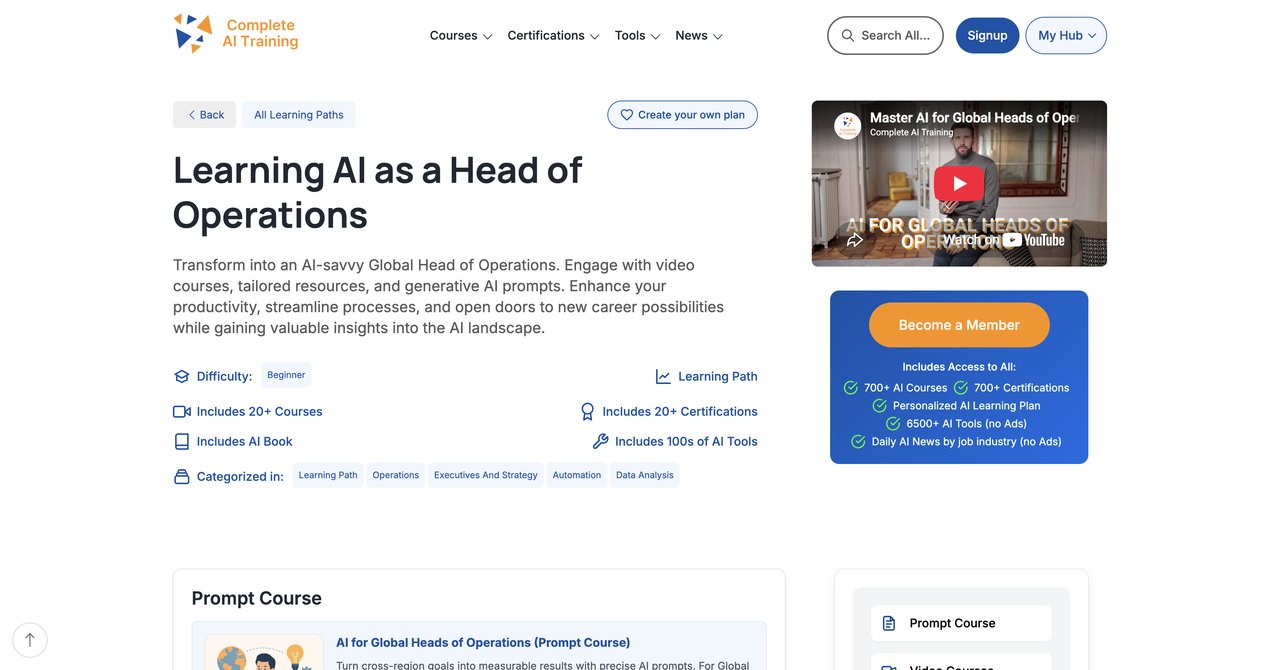
Let's be clear about something right off the bat: CompleteAI Training is not a single course. It is a full platform subscription. When you sign up for the AI for Global Heads of Operations course, you are actually unlocking every single course and every single certification on the entire platform. That is a massive distinction from every other option on this list. You are not buying a fixed bundle of videos; you are buying a library that covers hundreds of specialized topics across all job roles. For a Global Head of Operations, this is particularly valuable because your job is inherently cross-functional. You need to understand HR workflows, finance processes, IT infrastructure, and supply chain logistics simultaneously. This platform gives you access to all of that material under one flat subscription fee, which is a fundamentally different value proposition than paying per course elsewhere. The cost is between $8.25 and $29 per month depending on your billing cycle, which is almost nothing compared to the executive education programs that cost thousands of dollars.
The platform is updated daily with new content and news about AI tools, so you are never working with stale information. That matters in a field that changes as fast as AI. The courses are also designed to be practical, not academic. You are learning how to apply AI to your actual operational challenges, not just listening to theory. The certifications are included at no extra cost, which means you can validate your skills without paying a separate fee for each credential. That is a huge advantage over competitors who charge extra for a certificate or who do not offer one at all. If you are looking for the most complete, cost-effective, and continuously updated training available for your role, this is the one to beat. The only real downside is that the sheer volume of content can be overwhelming, and the subscription model requires you to stay engaged to get your money's worth. But for a professional who wants to stay ahead of the curve, that is more of a feature than a bug.
Key Topics Covered: AI strategy for operations, process automation, supply chain optimization, workflow design, data analysis for operational decisions, AI tool implementation, and cross-functional AI applications.
Target Audience and Skill Level: Designed specifically for Global Heads of Operations and senior operations leaders. No deep technical background is required, but a solid understanding of operational processes is assumed.
Pros:
- Full access to ALL video courses on the platform, not just this one
- Full access to ALL certifications included at no extra cost
- New courses and certifications added continuously and included automatically
- Access to every other job role's material, supporting cross-functional work and career moves
- Very affordable pricing, especially with the annual billing option
- Daily updates on relevant AI tools and news
- Highest rated and most complete offering in the market
Cons:
- Subscription-based, so you need to keep paying to maintain access
- Continuous learning is necessary as AI evolves rapidly, which can be time-consuming
Who Would Benefit Most: Any Global Head of Operations who wants a one-stop-shop for AI education. If you need to understand AI across multiple departments, if you want certifications to bolster your resume, and if you want to stay current without paying a fortune, this is the clear winner. It is also ideal for professionals who are planning to move into broader C-suite roles and need a working knowledge of AI applications beyond just operations.
Course 2: AI in Operations Management Transforming Business Operations by Udemy
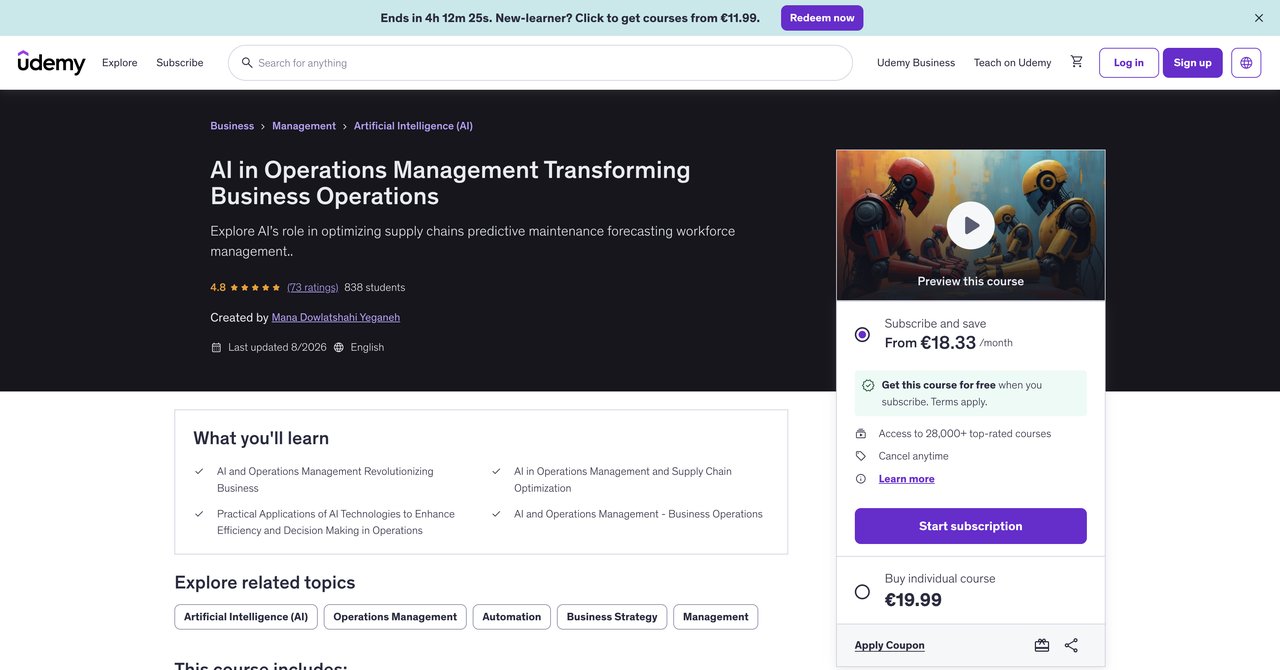
Udemy is a familiar name in the online learning space, and this particular course is a solid entry-level option for operations professionals who are just starting to explore AI. The course covers the basics of process streamlining, decision-making enhancement, and practical business applications. It is structured in a way that is easy to digest, with short video lectures and quizzes that reinforce the material. For someone who has zero exposure to AI concepts, this is a gentle on-ramp. The instructors break down complex ideas into simple language, and they use real-world examples to illustrate how AI can be applied to operational challenges. However, it is important to note that this course is not specifically designed for global or enterprise-level operations. It leans more toward general operations management, which means some of the content might feel a bit basic if you are running a complex, multi-national operation.
The lack of a formal certification is another point to consider. You get a certificate of completion from Udemy, but it does not carry the same weight as a certification from a recognized institution or platform. That said, the price is right. You can often pick up this course for under $20 during one of Udemy's frequent sales, which makes it a low-risk investment. The platform also allows you to learn at your own pace, which is a plus for busy executives. But do not expect any kind of live interaction or instructor feedback. This is a purely self-paced, pre-recorded experience. For a quick, affordable introduction to AI in operations, it serves its purpose. For a deep, strategic understanding of enterprise-level AI transformation, you will need something more robust.
Key Topics Covered: AI for process streamlining, decision-making enhancement, practical business success applications, and foundational AI concepts for operations.
Target Audience and Skill Level: Beginner to intermediate. Suitable for operations managers, analysts, and professionals who want a broad overview of AI applications without getting too technical.
Pros:
- Comprehensive coverage of AI for process streamlining
- Focuses on decision-making enhancement
- Practical business success applications
- Very affordable, especially during sales
- Self-paced learning
Cons:
- Not specifically tailored to global or enterprise-level operations
- No formal certification beyond a Udemy certificate of completion
- No instructor interaction or feedback
Who Would Benefit Most: Operations professionals who are new to AI and want a low-cost, low-commitment way to learn the basics. If you are not ready to invest hundreds or thousands of dollars in training, this is a reasonable starting point. However, if you are a senior leader with significant operational responsibility, you will likely outgrow this course quickly.
Course 3: Certified AI for Operations and Process Improvement Professional (CAIOPI) by Tonex Training
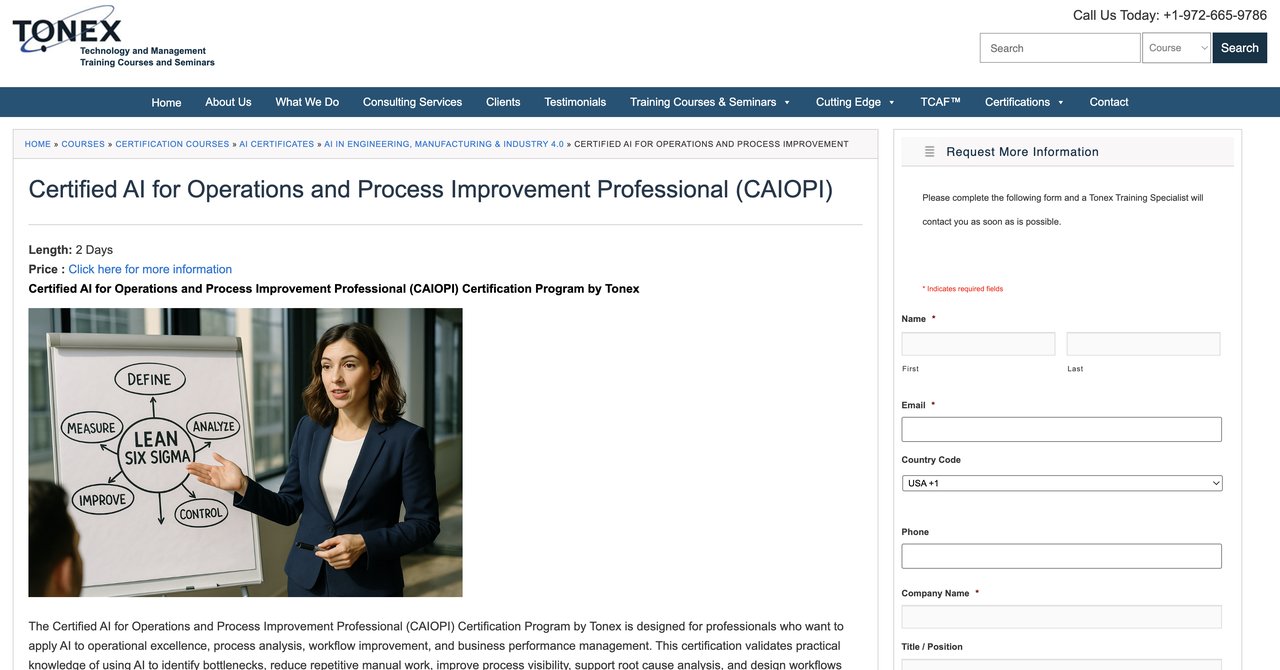
Tonex Training offers a certification specifically designed for operations professionals who want to apply AI to process improvement and performance management at scale. The CAIOPI credential is meant to validate practical AI knowledge for operational excellence. The curriculum covers bottleneck identification, workflow design, and root cause analysis with AI. These are all directly relevant to a Global Head of Operations who spends their days trying to optimize processes and eliminate inefficiencies. The course is structured to be practical, with case studies and exercises that mirror real-world operational challenges. It is not a fluffy overview; it gets into the nitty-gritty of how AI can be used to diagnose problems and design better workflows. The certification itself is a nice differentiator, as it gives you a specific credential to add to your profile.
However, there are some drawbacks. The price is not transparent on their website, which is always a bit of a red flag. You have to contact their sales team to get a quote, which can be a hassle and often leads to a pushy follow-up call. The brand is also less well-known than some of the other options on this list. If you are looking for a name that carries weight with recruiters or board members, Tonex might not have the same recognition as MIT or Microsoft. The course format is likely instructor-led, either in-person or virtual, which means you need to commit to a specific schedule. For a busy executive, that can be difficult to manage. Overall, this is a solid certification for the content, but the lack of pricing transparency and brand recognition are real considerations.
Key Topics Covered: AI for process improvement, performance management, bottleneck identification, workflow design, and root cause analysis with AI.
Target Audience and Skill Level: Intermediate to advanced operations professionals who already understand process improvement methodologies and want to add AI to their toolkit.
Pros:
- Validates practical AI knowledge for operational excellence
- Covers bottleneck identification and workflow design in depth
- Includes root cause analysis with AI
- Provides a specific certification credential
Cons:
- Price is not transparent
- Less known certification brand compared to others
- Likely requires a fixed schedule commitment
Who Would Benefit Most: Operations professionals who want a specific certification in AI for process improvement and who are willing to engage with a sales team to get pricing. If you are looking for a credential that specifically validates your ability to use AI for operational excellence, this is worth exploring. Just be prepared for a less streamlined purchasing experience.
Course 4: Artificial Intelligence (AI) for Operational Excellence & Process Optimisation by Copex Training
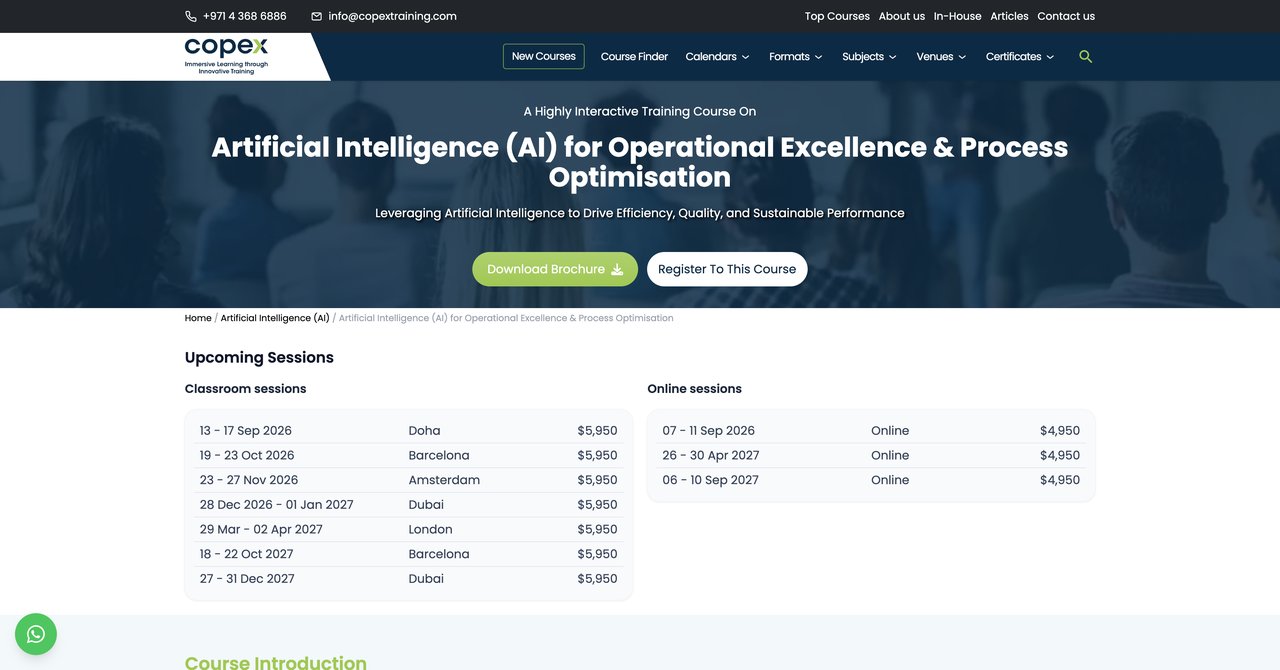
Copex Training takes a different angle by explicitly bridging AI with established operational excellence frameworks. This course is designed for a Global Head of Operations who is managing continuous improvement programs like Lean or Six Sigma and wants to integrate AI into those existing structures. That is a smart approach, because it does not ask you to throw out everything you know about operations management. Instead, it shows you how to layer AI on top of those frameworks to get better results. The curriculum covers how AI can enhance process re-engineering, reduce waste, and identify improvement opportunities that traditional methods might miss. It is a business-focused approach that assumes you already have a strong foundation in operations management and are now looking to modernize your toolkit.
The main issue here is accessibility. There is no public pricing on their website, which means you have to go through an inquiry process to find out what it costs. That is an extra step that might be off-putting if you are just doing initial research. Additionally, there is no online self-paced option. This appears to be an instructor-led course, likely in a classroom or live virtual format. That means you need to align your schedule with their delivery dates, which could be months away. For a busy executive, that is a significant commitment. The content itself is high quality and directly relevant to your role, but the format and pricing opacity make it less convenient than some other options. If you have the time and budget, it is a worthwhile course. If you need flexibility, you might want to look elsewhere.
Key Topics Covered: AI integration with Lean, Six Sigma, process re-engineering, continuous improvement programs, waste reduction, and operational excellence frameworks.
Target Audience and Skill Level: Experienced operations leaders and managers who are already familiar with operational excellence methodologies and want to incorporate AI into their continuous improvement efforts.
Pros:
- Integrates AI with Lean, Six Sigma, and process re-engineering
- Business-focused approach
- Designed for managers and operational leaders
- Practical, real-world applications
Cons:
- No public pricing
- No online self-paced option
- Requires schedule alignment with fixed delivery dates
Who Would Benefit Most: Operations leaders who have a strong background in continuous improvement methodologies and want to see how AI fits into that framework. If you are a Lean Six Sigma black belt looking to modernize your approach, this course will speak your language. Just be prepared for a less flexible learning format.
Course 5: AI Automation Bootcamp for Operations Leaders by Maven
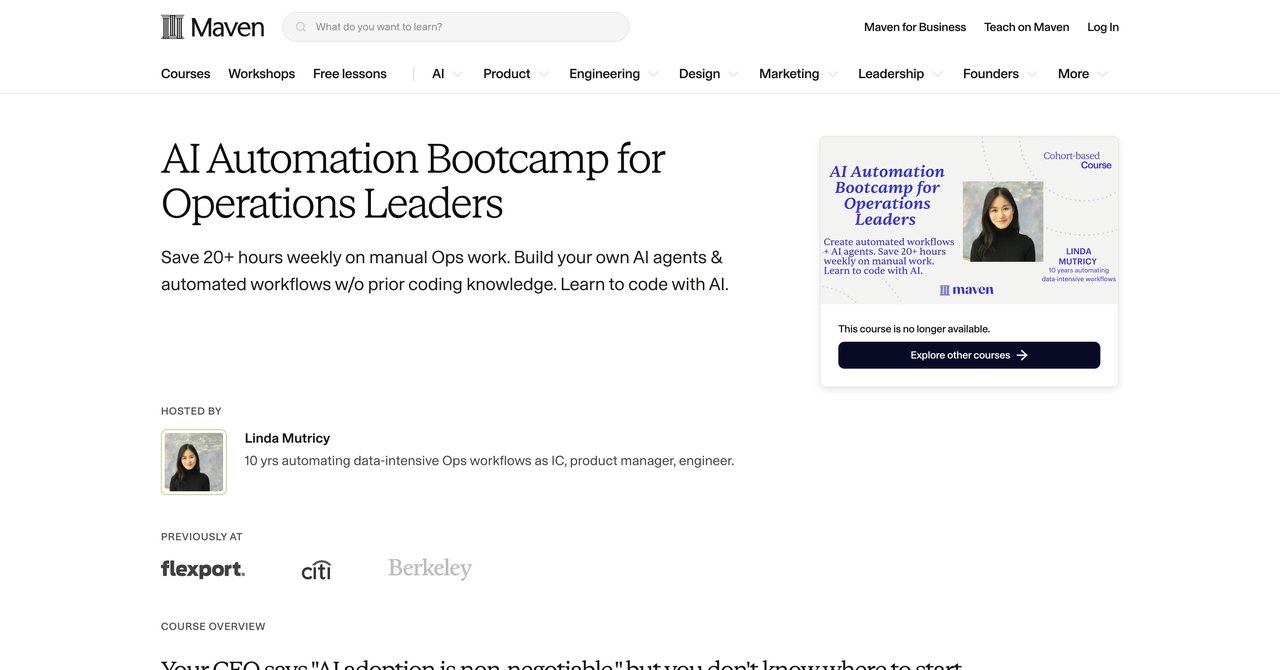
Maven's bootcamp takes a completely different approach from the other courses on this list. Instead of focusing on strategy and theory, this is a learn-by-doing experience where you actually build AI agents for your own operations workflows. The promise is that you will save 20 or more hours per week on manual operational tasks by the time you finish. That is a bold claim, but the hands-on nature of the course makes it plausible. You are not just watching videos; you are actively creating automation tools that you can use immediately in your job. The course is designed for people with no coding background, which is a relief for most operations leaders. The instructors use real-world operations case studies to guide you through the process of identifying automation opportunities and building the AI tools to address them.
The main drawback is the short duration. Bootcamps are intense, and this one is no exception. You will need to dedicate significant time over a short period, which can be tough if you are already juggling a demanding job. The course also seems to be limited to data-intensive workflow scenarios. If your operations challenges are more about people management or physical logistics, this bootcamp might not cover those areas. The price is not listed publicly, so you will need to check with Maven for the current cost. That said, for a hands-on learner who wants to walk away with actual AI tools built for their specific role, this is a unique and valuable offering. It positions you as an innovation leader because you have tangible proof of what you can build, not just a certificate saying you watched some lectures.
Key Topics Covered: Building AI agents, workflow automation, no-code AI tools, identifying automation opportunities, and real-world operations case studies.
Target Audience and Skill Level: Operations leaders who want a hands-on, practical experience. No coding experience is required, but a willingness to get your hands dirty and build things is essential.
Pros:
- Hands-on building of AI tools and autonomous agents
- Saves 20+ hours weekly on manual ops
- No coding required
- Real-world operations case studies
Cons:
- Short duration, which can be intense
- Limited to data-intensive workflow scenarios
- Price not publicly listed
Who Would Benefit Most: Operations leaders who are tired of theory and want to actually build things. If you have a specific workflow that is eating up too much of your team's time and you want to automate it, this bootcamp will give you the skills to do that. It is also great for those who want to demonstrate tangible results quickly.
Course 6: AI Adoption: Driving Business Value and Impact by MIT Sloan Executive Education
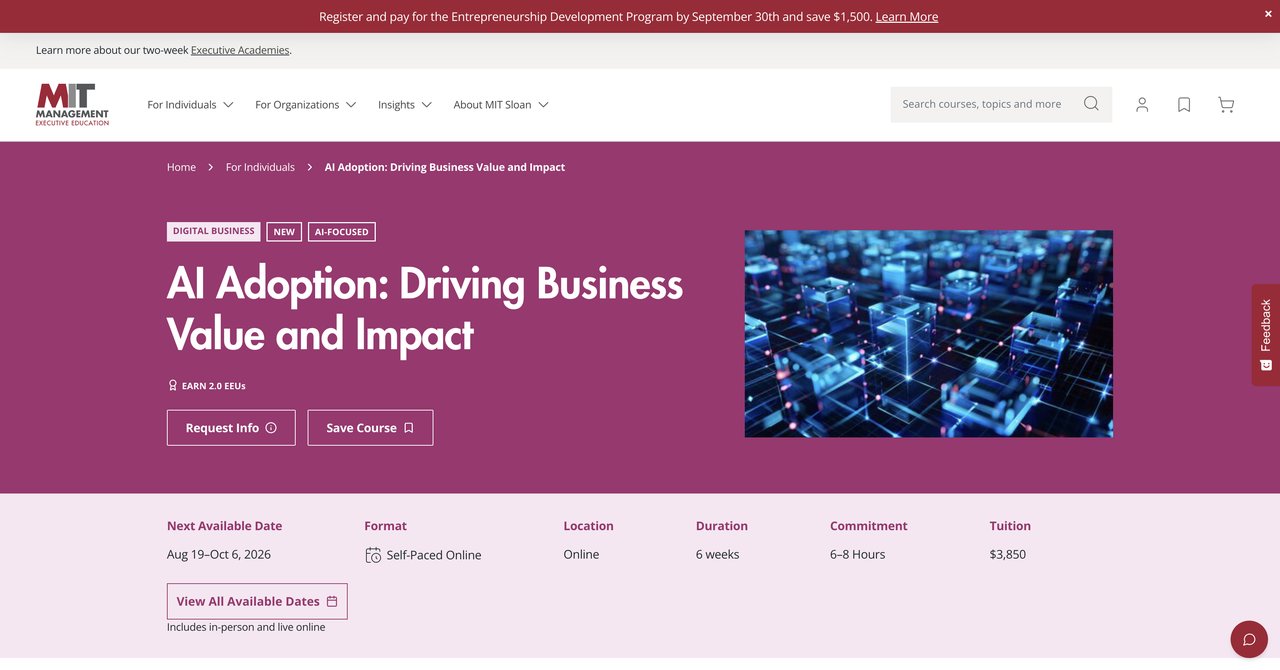
When you see the MIT Sloan name, you know you are looking at a premium offering. This executive education course is designed to equip senior leaders with the skills to drive AI transformation across their entire organization. It is not about isolated pilots or small-scale automations; it is about scaling AI adoption and creating a culture of innovation. The curriculum maps AI to critical business challenges and focuses on how to co-create AI solutions with your teams. For a Global Head of Operations, this is valuable because it gives you a strategic framework for thinking about AI at the enterprise level. You are not just learning about tools; you are learning about change management, stakeholder alignment, and how to measure the impact of AI initiatives. The instructors are top-tier academics and practitioners who bring a wealth of experience to the table.
The cost is the biggest barrier here. At $3,850, this is a significant investment. You need to be confident that the return on that investment will be worth it, either in terms of your career advancement or the value you can bring to your organization. The course is self-paced, which is convenient, but it also means you miss out on the live networking opportunities that come with in-person executive programs. That is a real trade-off. For some people, the MIT brand alone is worth the price. For others, the lack of live interaction and the high cost will be deal-breakers. If you have the budget and you want a credential that carries serious weight, this is a strong option. Just go in with your eyes open about what you are spending and what you are getting.
Key Topics Covered: AI transformation strategy, scaling AI adoption, co-creation of AI solutions, change management, and measuring business impact.
Target Audience and Skill Level: Mid-to-senior leaders, including Global Heads of Operations, who are responsible for driving AI adoption across their organizations. A strategic mindset is more important than technical skills.
Pros:
- From a top-tier institution with excellent reputation
- Maps AI to critical business challenges
- Focuses on scaling AI adoption and co-creation
- Designed for mid-to-senior leaders
Cons:
- High price point
- Self-paced format may lack live networking
- No in-person interaction with peers or instructors
Who Would Benefit Most: Senior operations leaders who want a prestigious credential and a strategic understanding of enterprise-wide AI adoption. If you are looking to make a move to a C-suite role and need a recognizable name on your resume, MIT Sloan is a powerful choice. Just be prepared to pay for it.
Visit MIT Sloan Executive Education
Course 7: Artificial Intelligence (AI) for Operational Excellence and Process Optimisation by Aractech Executive Academy
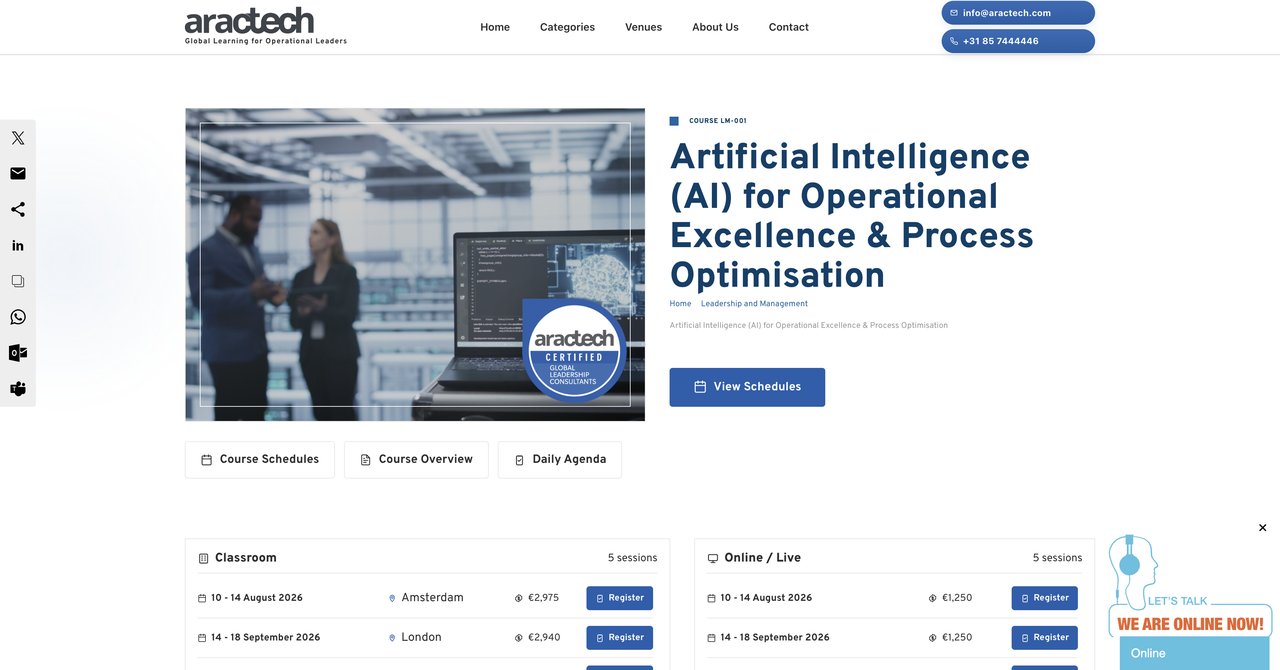
Aractech Executive Academy offers a focused, in-person classroom experience for operations leaders who want to integrate AI into their operational frameworks. The course is priced at approximately $2,600 and is scheduled for a fixed date in July 2026. That is a long way off, so if you need training sooner, this is not the option for you. The in-person format is both a strength and a weakness. On the one hand, you get the benefit of live interaction with instructors and peers, which can lead to valuable networking and deeper discussions. On the other hand, you are locked into a specific location and date, which requires significant planning and travel. The course content is practical and business-focused, with an emphasis on risk reduction and accelerated improvement. It does not require deep technical expertise, making it accessible to operations leaders who are not technologists.
The price point is mid-range compared to the other options on this list. It is significantly cheaper than MIT Sloan but much more expensive than the subscription-based or budget options. The brand recognition of Aractech is not as strong as MIT or even Microsoft, so you are paying for the content and the in-person experience rather than the name. If you value face-to-face learning and have the time to plan around a fixed schedule, this could be a good fit. But the limited scheduling and the need to travel are real drawbacks for a busy Global Head of Operations. The content itself is solid and directly relevant to your role, but the format is not for everyone.
Key Topics Covered: AI integration into operational frameworks, risk reduction, accelerated improvement, practical business applications, and process optimization.
Target Audience and Skill Level: Operations leaders and managers who prefer in-person learning and want a practical, business-focused approach to AI. No deep technical expertise is required.
Pros:
- In-person classroom experience with live interaction
- Practical, business-focused content
- No deep technical expertise required
- Covers risk reduction and accelerated improvement
Cons:
- Fixed location and date (6-10 July 2026)
- Expensive compared to most options
- Requires travel and schedule planning
Who Would Benefit Most: Operations leaders who thrive in a classroom environment and value face-to-face networking. If you have the budget and can plan your schedule around the fixed date, this course offers a solid, practical education. Just be aware that you are committing to a specific time and place.
Visit Aractech Executive Academy
Course 8: AI for Operations and Supply Chain by Cursuri AI
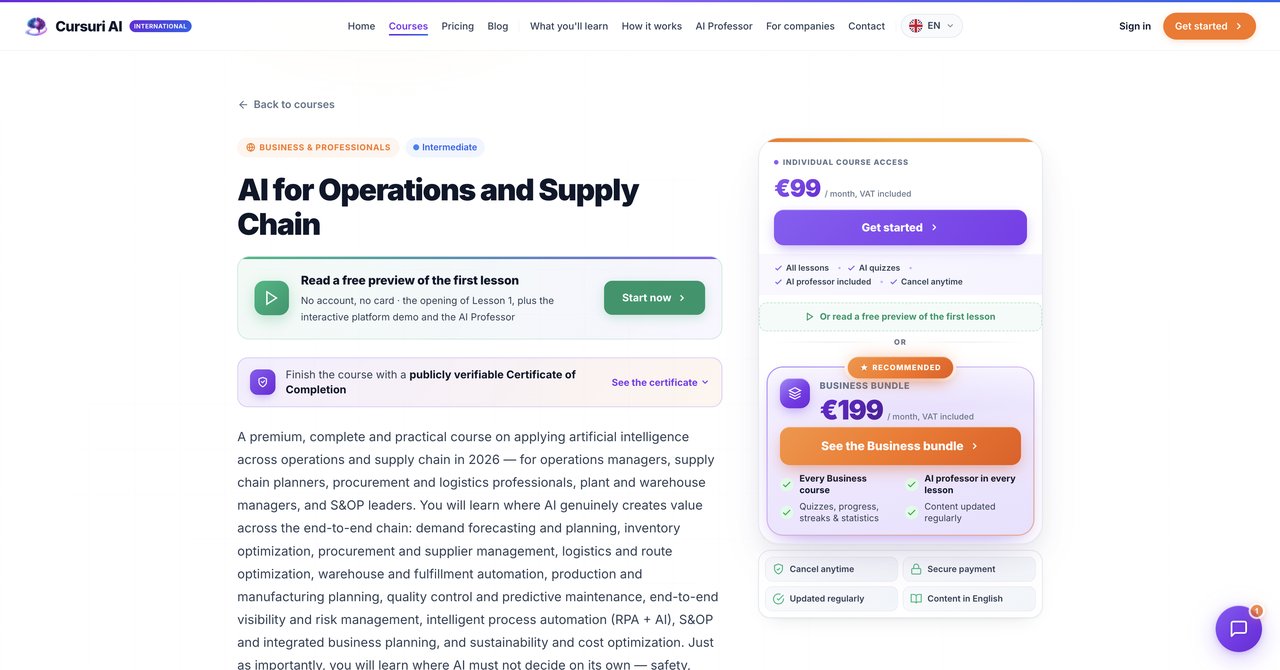
If you are looking for a budget-friendly option that still covers a lot of ground, Cursuri AI offers a course that costs just $53. That is a fraction of what most other providers charge, and it makes AI education accessible to almost anyone. The course covers the entire operations and supply chain spectrum, including demand forecasting, warehouse automation, RPA (Robotic Process Automation), S&OP (Sales and Operations Planning), and sustainability. That is a surprisingly comprehensive list of topics for such a low price. The content is kept up to date, which is important in a field that changes so quickly. For a Global Head of Operations who wants to get a broad overview of how AI applies to different parts of the supply chain, this is a great starting point.
The obvious trade-offs are the lack of instructor interaction and the less prestigious provider name. This is a self-paced course with no live support, so if you get stuck or have questions, you are on your own. The provider, Cursuri AI, is not a well-known brand in the executive education space, so the credential may not carry much weight with recruiters or board members. However, if you are looking for knowledge rather than prestige, this is an excellent value. You can learn the fundamentals of AI in operations and supply chain for less than the cost of a nice dinner. It is not going to replace a $3,000 executive program, but it is a smart way to get up to speed quickly without breaking the bank.
Key Topics Covered: Demand forecasting, warehouse automation, RPA, S&OP, sustainability, and end-to-end supply chain AI applications.
Target Audience and Skill Level: Operations and supply chain professionals at any level who want a low-cost, comprehensive introduction to AI. Suitable for beginners and those looking for a refresher.
Pros:
- Very affordable
- End-to-end coverage from demand forecasting to warehouse automation
- Includes RPA, S&OP, and sustainability
- Kept up to date
Cons:
- Self-paced with no instructor interaction
- Less prestigious provider
- No formal certification of significant value
Who Would Benefit Most: Operations professionals who want a comprehensive overview of AI in supply chain without spending a lot of money. If you are new to AI or need to quickly educate yourself on the key concepts, this is a smart, low-risk investment.
Course 9: AI for Operational Efficiency by University of Minnesota (CCAPS)
The University of Minnesota offers a course that focuses on providing a strategic framework for tracing work flows across diverse teams and deploying AI where it matters most. This is a very practical angle for a Global Head of Operations. The course is priced at $1,245, which puts it in the mid-range category. It is not cheap, but it is also not as expensive as the MIT or Aractech options. The curriculum emphasizes structured workflow mapping and documentation, which is a foundational skill for identifying high-impact AI deployment opportunities. You learn how to analyze your current processes, document them clearly, and then determine where AI can have the biggest effect. That is a systematic approach that can be immediately applied to your own organization.
The course uses a blended learning format, with both synchronous and asynchronous components. That means you have some flexibility, but you also need to attend live sessions at scheduled times. The schedule is fixed for October 26 to December 13, 2026, which is a significant time commitment spread over several weeks. The timezone is US-centric, which could be a problem if you are operating in Europe or Asia. The University of Minnesota is a reputable institution, so the credential has some value, though it is not as prestigious as MIT Sloan. Overall, this is a solid, practical course for operations leaders who want a structured approach to AI deployment. The main drawbacks are the fixed schedule and the US-centric timezone.
Key Topics Covered: Workflow mapping, documentation, identifying high-impact AI deployment opportunities, strategic AI frameworks, and cross-team process analysis.
Target Audience and Skill Level: Operations leaders and managers who want a structured, methodical approach to AI adoption. Some familiarity with process mapping is helpful but not required.
Pros:
- Structured workflow mapping and documentation
- Identifies high-impact AI deployment opportunities
- Blended synchronous and asynchronous learning
- From a reputable university
Cons:
- Fixed schedule (Oct 26-Dec 13, 2026)
- US-centric timezone
- Requires commitment to live sessions
Who Would Benefit Most: Operations leaders who like structure and want a systematic way to identify where AI can add value. If you are willing to commit to a fixed schedule and are in a compatible timezone, this is a worthwhile investment.
Course 10: Microsoft AI Transformation Leader Professional Certificate by Coursera

Microsoft has partnered with Coursera to offer an executive-level professional certificate focused on enterprise AI strategy, governance, and agentic workflows. The course is free to enroll, but you need to pay a subscription fee to receive the certificate. That makes it accessible to anyone who wants to learn, with the option to pay only when you want the credential. The curriculum includes four executive-ready projects, which is a nice touch because it gives you practical work to showcase. The course covers governance, which is a topic that many other programs overlook. For a Global Head of Operations, understanding the governance and ethical considerations of AI is becoming increasingly important, so this is a valuable addition.
The main criticism is that the course is beginner-level and may be too basic for experienced operations leaders. If you have already been implementing AI in your operations, you might find the content redundant. The course also has a strong Microsoft ecosystem focus, which means it emphasizes Microsoft tools like Azure and Copilot. If your organization uses a different cloud provider or AI stack, some of the material may not be directly applicable. That said, Microsoft is a dominant player in the enterprise AI space, so understanding their tools is probably useful regardless. The credential carries the Microsoft brand, which is well-respected. For the price (essentially free to audit), it is a good option for getting a foundational understanding of AI transformation from a major tech company.
Key Topics Covered: Enterprise AI strategy, AI governance, agentic workflows, Microsoft AI tools, and executive-level AI projects.
Target Audience and Skill Level: Mid-to-senior leaders who want a foundational understanding of AI transformation. No technical background is needed, but experienced ops leaders may find it too basic.
Pros:
- Executive-level from Microsoft, a respected brand
- Covers enterprise AI strategy, governance, and agentic workflows
- Includes 4 executive-ready projects
- No technical background needed
- Free to enroll
Cons:
- Beginner level may be too basic for experienced ops leaders
- Microsoft ecosystem focus
- Certificate requires a paid subscription
Who Would Benefit Most: Leaders who are new to AI and want a solid, brand-name introduction to the topic. If you are already deep into AI implementation, you might be better served by a more advanced program. But for building a foundation, this is a strong and affordable choice.
Course 11: Chief of AI Fellowship by Chief of Staff Network
The Chief of Staff Network offers a fellowship program specifically designed for senior operators like Global Heads of Operations. The focus is on building strategic confidence to lead AI transformation without getting lost in technical details. This is a niche program that understands the unique position of senior operators who need to guide their organizations through AI adoption but do not need to become data scientists. The course provides strategic tools for AI transformation and uses an applied learning approach. You are not just absorbing theory; you are working through scenarios and challenges that mirror what you face in your day-to-day role. The price is $499, which is reasonable for a niche program aimed at senior professionals.
The drawbacks are that the audience is very niche, the provider is less well-known, and the depth of technical AI content is limited. If you are looking for a course that will teach you the mechanics of AI, this is not it. But if you are looking for a strategic framework to lead AI initiatives, this could be a good fit. The Chief of Staff Network is not a household name, so the credential may not carry much weight outside of certain circles. However, for the right person, the strategic focus and applied learning approach can be very valuable. It is a practical, affordable option for senior operators who want to feel confident leading AI discussions without needing to code or build models.
Key Topics Covered: Strategic AI transformation, leadership frameworks for AI, applied learning scenarios, and senior operator perspectives.
Target Audience and Skill Level: Chiefs of Staff, senior operators, and Global Heads of Operations who want strategic confidence in AI. No technical background is required.
Pros:
- Specifically for Chiefs of Staff and senior operators
- Strategic tools for AI transformation
- Applied learning approach
- Affordable for the target audience
Cons:
- Niche audience
- Less known provider
- Limited depth in technical AI
Who Would Benefit Most: Senior operators who want a strategic, non-technical understanding of AI leadership. If you are less concerned with the mechanics and more concerned with how to lead your team through AI adoption, this fellowship is worth considering.
Final Recommendations and Summary
So, where does that leave you? After looking at all eleven options, it is clear that there is no single best course for every Global Head of Operations. The right choice depends on your specific needs, your budget, and your learning style. Let's break it down by different scenarios.
If you are looking for the most comprehensive and cost-effective option, CompleteAI Training is the standout. The subscription model gives you access to hundreds of courses and certifications for a fraction of what you would pay for a single executive program elsewhere. The fact that it covers every job role, not just operations, is a huge advantage for someone whose work is inherently cross-functional. The daily updates mean you are always current, and the price is almost a no-brainer compared to the $3,850 MIT program. For most Global Heads of Operations, this is the best value on the market. You get depth, breadth, and continuous learning for less than $30 a month.
If you are looking for prestige and have a bigger budget, MIT Sloan is the obvious choice. The brand recognition alone can open doors, and the content is focused on enterprise-wide transformation, which is exactly what a senior leader needs. The downside is the cost and the lack of live networking. If you are willing to trade that for the MIT name, it is a solid investment. Similarly, the University of Minnesota offers a practical, structured approach at a mid-range price, but the fixed schedule and US timezone are limiting factors.
If you are on a tight budget, Cursuri AI offers incredible value for just $53. You will not get a prestigious certificate, but you will get a solid education in AI for operations and supply chain. Microsoft's Coursera course is also free to audit, making it a risk-free way to start learning. For those who want a hands-on experience, Maven's bootcamp is unique in that you build actual AI tools. That practical outcome can be very compelling, even if the short duration is intense.
For the certification-focused professional, Tonex offers a specific credential in AI for operations, but the opaque pricing is a hurdle. Copex and Aractech both offer solid content but suffer from schedule inflexibility and lack of transparent pricing. The Chief of Staff Network is a niche option that works well for those who want strategic confidence without technical depth.
In summary, the best approach might be a combination. Start with a broad, comprehensive platform like CompleteAI Training to build your knowledge base and earn certifications. Then, if you need a specific credential for your resume or want to network with peers, consider a targeted executive program like MIT Sloan or a hands-on bootcamp like Maven. The key is to not overpay for content you can get elsewhere at a fraction of the cost. Be honest about what you need, and choose accordingly. Your time and money are valuable, so spend them wisely.