
Blog ·
Hospitality and Events: AI trends to focus on - AI agents enter the booking path
AI agents are now booking travel. Hotels and venues must make their inventory machine-readable, or AI will book elsewhere. New tools also make multilingual guest communication cheaper.
 Jeroen Erne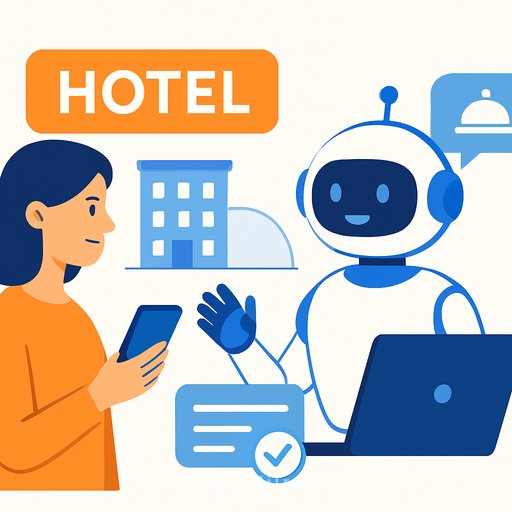
What actually shifted
AI stopped being a chatbot experiment in hospitality this week. It became a commercial discipline with real revenue pressure behind it. Generative-engine visibility, agentic booking, and measurable ROI moved from conference panels into operator checklists.
The clearest signal: AI agents are now positioned as gatekeepers between hotels and guests. That changes discovery, booking, pricing, and service recovery. If your property isn't machine-readable and permissioned correctly, an AI agent will book the one that is.
What changed this week
AI agents entered the booking path. Multiple stories this week treated AI-to-AI transactions as imminent, not theoretical. The Jamaica Gleaner reported that AI agents are "becoming a major force in travel and hospitality," handling search, comparison, booking, and payment on behalf of travelers. Wyndham detailed a strategy built around AI-driven search and booking. The implication: a growing share of reservations will be initiated and completed by non-human agents. That demands structured, machine-consumable inventory and clear rules about what those agents can promise, change, or charge.
Commercial teams got AI-native tools. Anana launched an AI workspace purpose-built for hospitality commercial teams — revenue managers, sales, and marketing. Cloudbeds and Dormakaba news pointed toward AI-native pricing and access control. The ILHA INSPIRE conference added dedicated AI ROI sessions. The message: AI is no longer an IT project. It's a revenue-management and distribution project with a P&L line.
Real-time multilingual interaction became cheaper and more capable. Alibaba released Qwen3.8-LiveTranslate, handling real-time interpretation across 60 languages. Qwen3.8-Omni-Flash targeted lower-cost multimodal workloads. For events and international properties, the cost of live translation and multilingual guest communication just dropped again. That removes a friction point for direct bookings from non-English-speaking markets.
Operations got narrower, more practical AI applications. Laundris launched an AI assistant for hotel linen operations — a specific, measurable workflow. ONYX Hospitality Group described using AI in planning and operating decisions. The Hospitality Net daily briefing tracked AI's spread across discovery, booking, planning, staffing, and guest operations. The pattern: successful deployments are narrow, integrated with existing data, and paired with a human recovery path when the AI can't resolve a guest's situation.
What it means for you
You need to prepare your property and your event inventory for non-human shoppers. That means structured content: machine-readable room types, amenities, policies, and availability. If an AI agent asks whether your venue has accessible parking, a loading dock, or a late-checkout policy, your website needs to answer that in data, not in a paragraph of prose on a buried page.
You should audit what your commercial tools can actually do with AI right now. The Anana workspace and the Cloudbeds RMS news suggest that pricing, forecasting, and booking tools are adding AI capabilities. If your current stack isn't moving, you're falling behind competitors who can adjust rates and availability based on signals you can't see.
Multilingual capability is no longer a nice-to-have. With real-time translation costs dropping, international guests and event attendees will expect to interact in their own language — during booking, check-in, and on-site. If you don't offer that, they'll find a property that does.
Finally, measure it. The ILHA conference putting AI ROI on the main-stage agenda is a sign that the experimentation phase is closing. If you're deploying AI for anything — linen tracking, pricing, chatbot service — you need a before-and-after number. Time saved, revenue gained, bookings recovered, complaints reduced. Pick one and track it.
What to focus on next week
- Check your structured data. Pick your three most-booked room types or event spaces. Can a machine read their features, capacity, availability, and restrictions without interpreting prose? If not, fix that first.
- Ask your booking and PMS vendors one question: "How does your system expose inventory and pricing to third-party AI agents, and what controls do I have over what those agents can commit to?" Get a specific answer, not a roadmap slide.
- Test a real-time translation tool on your own booking path. Run a test booking or event inquiry in a language your team doesn't speak. See where it breaks. The Qwen3.8 releases make this cheaper to fix than it was last month.
- Pick one narrow operational workflow for an AI pilot. Linen tracking, housekeeping assignment, maintenance ticketing — something with clean before-and-after data. Define the metric you'll measure before you start.
- Put AI agent permissions on your next revenue or distribution meeting agenda. If a third-party AI can change a reservation or process a payment, who owns the error when it gets it wrong? Get that documented.
This was a week where AI in hospitality moved from "interesting" to "operational." For the full list of stories, including the Singapore AI hub developments, agentic security challenges, and martech deals that touch hospitality, see all Hospitality and Events AI news.