
Blog ·
Hospitality and Events: AI trends to focus on - AI agents handling real bookings and payments
AI agents now handle real bookings, payments, and back-office tasks. Guest AI assistants may arrive with unauthorized promises. Third-party agent access can vanish overnight. Liability remains unclear.
 Jeroen Erne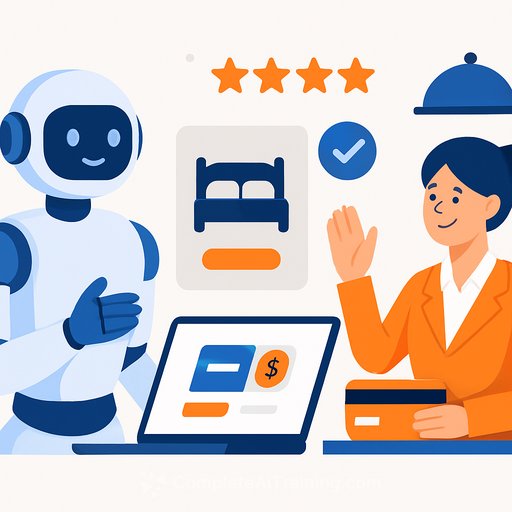
The week moved hospitality AI from back-office experiments into revenue, inventory and guest-facing workflows. Two shifts stand out: AI agents are now handling real bookings and payments, and major platforms are cutting off one another’s agents without warning. For a hospitality professional, the question is no longer “can AI help?” but “who controls the guest relationship when an agent acts on our behalf?”
What changed this week
Travel AI crossed from recommendations into full financial execution. One report detailed how consumer-facing travel assistants now manage payments, fraud checks, budgeting and complete bookings. That means a guest’s AI may arrive at your property having made promises your systems never authorised. Separately, WIRED covered ChatGPT’s memory feature, which quietly shapes answers based on what the model thinks it knows about a user. For hoteliers, that raises a practical risk: a returning guest’s AI assistant could surface outdated preferences or rate information without the property ever knowing.
The agent liability conversation sharpened. Forkast News documented three published incidents converging into what it called an enterprise compliance tipping point. When an AI agent books the wrong room, disputes a charge or shares guest data with an unauthorised service, liability is still undefined. That matters because Amazon booted Meta’s Muse shopping agent from its platform this week, proving that even large-scale agents can lose access overnight. If your hotel relies on a third-party agent for discovery or distribution, that channel can disappear without notice.
On the operations side, hospitality took concrete steps toward AI-native structures. Industry veteran Sloan Dean launched AI Hospitality Group, described as the first AI-native hotel operating company. Simple Booking opened the hotel back office to AI agents, letting them handle tasks like invoice processing and rate updates. Dextr AI raised $6.7 million to connect guest-service and staffing agents. These are not pilot projects; they are operating businesses betting that agentic infrastructure can improve margins and service speed.
Foundation models also advanced. OpenAI introduced GPT-6 Sol and Luna, and Anthropic released Claude Opus 5.5. Airbnb widened access to GPT-6 Astra. Google rolled out connected apps for Gemini and a new text-to-speech model. ChatGPT’s mobile app added voice-based agentic features. The raw capability is accelerating, but the hospitality-specific lesson came from a HospitalityNet briefing: “The only person who knows what AI got wrong is at the front desk.”
What it means for you
Your distribution and booking workflows are about to get agent-heavy on both sides. Guests will arrive with AI assistants that have already researched, budgeted and paid. Your own systems may use agents to update rates, handle invoices or respond to reviews. The upside is faster service and lower cost per transaction. The risk is that neither side’s agent fully understands your property’s actual inventory, cancellation policy or exception process.
You need verified, structured property data that any agent can read accurately. If your PMS or booking engine feeds fuzzy availability into an agent, the resulting reservation will be wrong, and the guest will blame you, not the AI. The same applies to identity and payment disputes. When an agent charges a guest’s card, your fraud and chargeback workflows must work without a human manually unpicking what the agent did.
Workforce governance is now a revenue-protection issue. IBM’s CHRO study put critical thinking at the centre of AI-era workforce priorities. For you, that means frontline staff need the authority and training to catch agent errors before they become guest problems. The front desk remains your last line of defence against hallucinated policies or misbooked rooms. If you remove human judgment from the loop entirely, you also remove your recovery path.
Finally, do not depend on a single discovery channel. The Amazon-Meta incident shows platform owners will block agents that threaten their own commercial interests. If your property is only discoverable through one agentic ecosystem, you carry the risk of that ecosystem changing its rules overnight.
What to focus on next week
- Audit your property data feed for completeness and accuracy. Check that room types, rates, amenities and policies are machine-readable and match what a guest would see on your direct booking page.
- Map one complete guest journey where an external AI assistant handles discovery, booking and payment. Identify every point where your current systems would fail to validate, confirm or dispute an agent-initiated action.
- Brief your front-desk team on agentic booking risks. Give them a simple checklist for spotting reservations that arrived via an AI agent and verifying the details against your property management system before check-in.
- Review your distribution contracts for clauses covering third-party agent access. Ask your channel manager or OTA partners what happens if their AI agent is blocked by a platform you depend on.
- Start a log of AI-related service failures, even small ones. Track what went wrong, whether a human caught it and how long recovery took. This data will be essential for building your own governance rules.
For the full list of stories that informed this briefing, see all Hospitality and Events AI news.