AI app for hospitality and events · no coding needed
Restaurant menu localization
Owner-confirmed ingredient accuracy across language versions.
Made for: Restaurant groups serving international visitors
What it does for you
The problem
Translations misrepresent dishes and confuse guests.
What it gives you
Localized menu and terminology guide
What you give it
Owner-verified menusingredientsdish descriptions
How it works, step by step
- Translate dish names
- Explain preparation styles
- Preserve ingredient details
- Flag ambiguous terms
- Review dietary wording
- Export menu layouts
What you see on screen
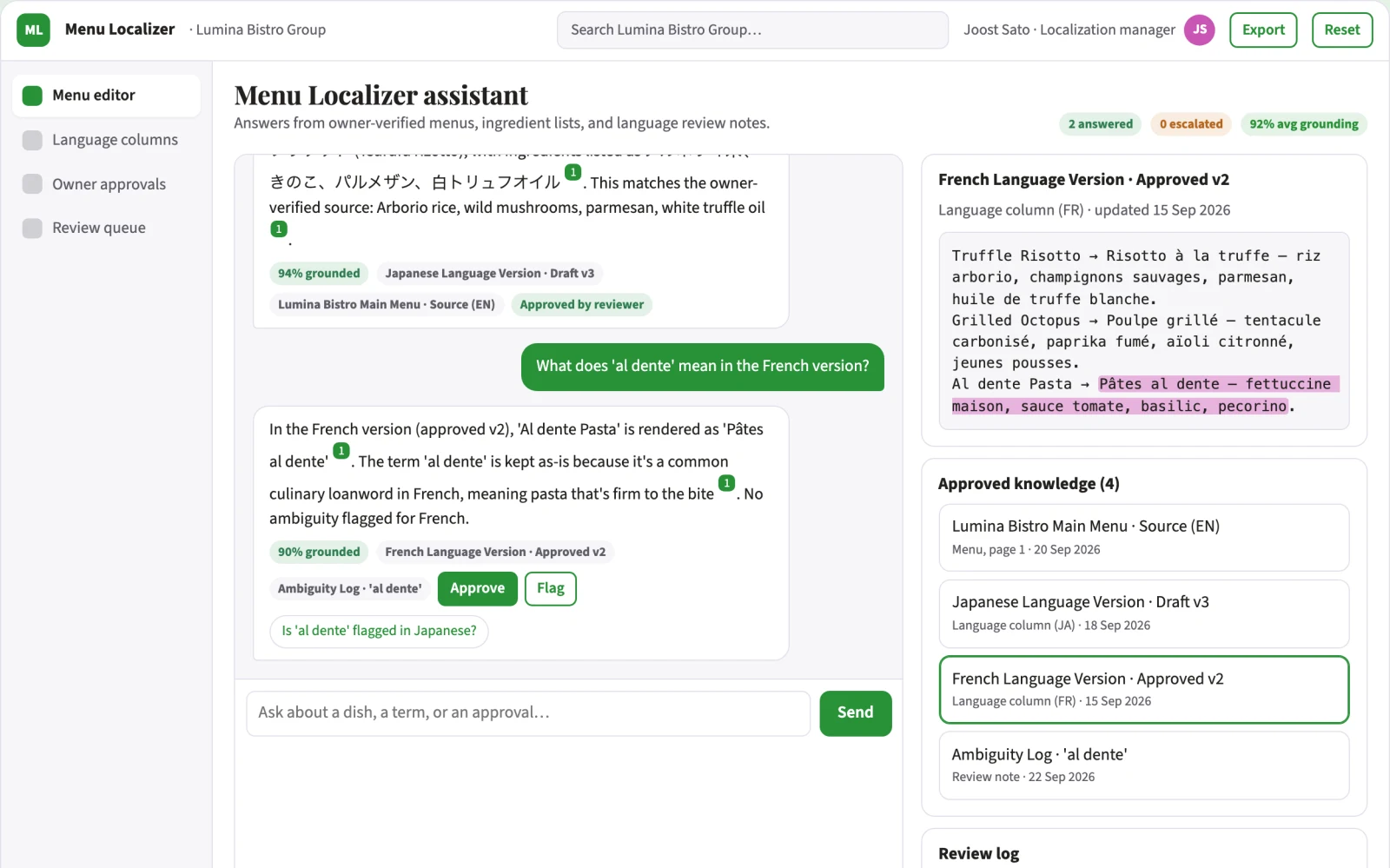
- Menu editor
- language columns
- owner approvals
Jobs this app suits
Our AI checked this app against 500 jobs; these get the most out of it. Each job links to its learning path.
Build it yourself with your AI system
Build this app yourself, no coding needed
Start with a quick version you can try in a few minutes. Like it? Then build the full app by copying and pasting our step-by-step instructions: everything is prepared for you.
Sign in to see how to build it yourself
Build a quick version to try, or get the full app pack for Restaurant menu localization with the step-by-step building instructions. You don't need any technical skills: you copy, paste and answer a few questions. Both are included in the membership.
4 Have it built for you days to a few weeks
Rather not do it yourself, or want it fully tailored to your data, your way of working and your brand? Nexibeo builds Restaurant menu localization with you.
What's in the app pack
Included in the Complete AI Training membership.
- The building instructions your AI follows, step by step
- The questions your AI will ask you about your business before it starts
- A clickable demo you can open in your browser, to see how it should work
- A detailed blueprint of the screens, the information it keeps and the checks it runs
Become a member to get the app packAlready a member? Sign in
The files, for the technically curious
- START-HERE.mdHow to build it with your own AI (read first)3 KB
- README.mdOverview and links1 KB
- questions.mdQuestions to answer before you build2 KB
- prompt-cloudflare.mdThe full build prompt, hosted on Cloudflare21 KB
- prompt-vps.mdThe same build on your own server (Docker)21 KB
- spec.jsonData model, API, AI pipeline, acceptance criteria12 KB
- demo/index.htmlThe working demo on sample data196 KB
Questions
Do I need to know how to code?
No. You copy and paste the prompts on this page into ChatGPT or Claude, and the AI does the building. When it asks you something, you answer in your own words.
What does it cost?
The quick version, the app pack and the step-by-step instructions are for members: you pay the membership price, not a price per app (see the plans). Building the full app uses your own ChatGPT or Claude subscription. Putting it online is often cheap or no cost at the start, and your AI tells you before anything costs money.
How long does it take?
The quick version: about two minutes. The real app: an afternoon for a first version you can use, longer if you want every feature.
Can I change it to fit my business?
Yes. Tell your AI what to change in plain words, like “add a column for the price” or “use our logo and colours”. Or have Nexibeo build and customise it for you.
More detailsHow the AI works, safeguards and what to build first
For restaurant groups serving international visitors, turn owner-verified menus, ingredients and dish descriptions into localized menu and terminology guide. Address the recurring problem: translations misrepresent dishes and confuse guests. The pilot measures owner corrections and guest clarification questions against the buyer's current method, before the larger build.
Upload authorized source content, confirm target languages and terminology, create translation drafts, assign qualified reviewers, reconcile source changes, check layout or timing, and deliver approved language versions. Start with owner-verified menus, ingredients and dish descriptions and finish with localized menu and terminology guide.
How the AI works
Draft translations, transcribe media when applicable, suggest terminology and detect inconsistencies. Deterministic checks compare dates, numbers and identifiers. Qualified language reviewers decide idiomatic phrasing and specialist meaning. Voice work requires explicit permissions for the intended use.
Safeguards
Verify property facts, availability and supplier conditions. Staff approve commercial exceptions and consequential booking changes. Validate source access and reviewer availability during the pilot. Maintain customer-level access, data deletion controls and a record of final approvals.
What to build first
Begin with restaurant groups serving international visitors and one recurring use case. Build the first two modules: translate dish names; explain preparation styles. Provide operator assistance for the third module: preserve ingredient details. Deliver localized menu and terminology guide through a manual review queue. Perform other necessary full-scope functions manually during the pilot. Include all applicable access, accuracy and professional-review controls from the start.
What it can connect to
Property records, event schedules, reservation exports and supplier information. Document formats, subtitle formats, media storage and publishing systems. Confirm language, font and layout support for each requested output. These are candidate integration categories, not verified supported connectors.
The screens in detail
Use aligned source and target language panes with shared terminology highlights. Include a language status grid, reviewer assignment queue, and layout or timeline preview. Show unresolved ambiguities next to the affected passage. Keep approvals separate for each language and version. In this product, the first view is menu editor, followed by language columns and owner approvals.