
Certification
Certification: Probability & Statistics for Data Science, ML & AI
Earn this certification by demonstrating mastery of probability and statistics foundations essential for data science, machine learning, and AI.
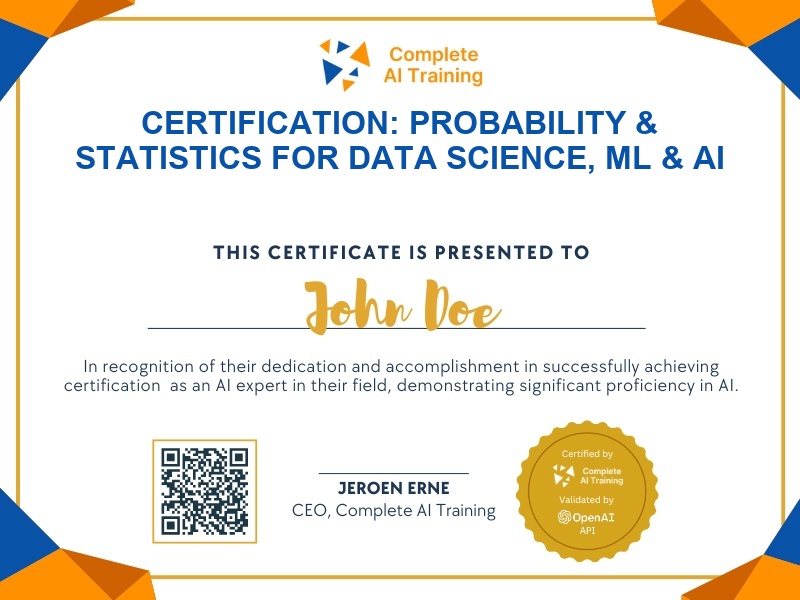
The exam
Take the certification exam
Multiple-choice questions about the course. Pass with 70% or more and your certificate is issued at once, with a public page and an "Add to LinkedIn" button.
What the exam covers
2 questions from each of the 15 chapters of the course
20 multiple-choice questions, drawn fresh for every attempt. Pass with 70% or more.
- 01Sample Spaces & Events3:36
- 02Probability Rules & Counting2:16
- 03Conditional Probability & Independence2:19
- 04Bayes' Theorem1:56
- 05Random Variables, PMF & PDF2:19
- 06Expectation, Variance & Discrete Distributions3:56
- 07Continuous Distributions & the Normal2:20
- 08Joint Distributions, Covariance & Correlation2:11
- 09Law of Large Numbers & Central Limit Theorem3:51
- 10Descriptive Statistics & Sampling4:06
- 11Maximum Likelihood & Confidence Intervals3:38
- 12Hypothesis Testing & p-values2:20
- 13Bayesian Inference2:05
- 14Entropy, Cross-Entropy & KL Divergence2:17
- 15The Big Picture2:08
What it certifies
This certification verifies that you can apply the probability and statistics foundations needed to analyze data, build models, and support machine learning and AI workflows with confidence.
Skills you prove
- Probability rules, conditional probability, and Bayes' theorem
- Discrete and continuous random variables, PMFs, PDFs, and CDFs
- Expectation, variance, covariance, and key distributions
- Law of Large Numbers, Central Limit Theorem, and sampling distributions
- Maximum likelihood estimation and confidence intervals
- Hypothesis testing, p-values, and Bayesian inference
Who it is for
Aspiring data scientists, machine learning engineers, analysts, and AI practitioners who need a rigorous, practical command of probability and statistics for data-driven decision-making.
How the exam works
The certification exam is a timed online assessment with 30 multiple-choice questions, drawing two questions from each of the 15 lessons. A passing score of 70% is required to earn the certification.