
Video course · 15 chapters · 41 min · certificate
Probability & Statistics for Data Science, Machine Learning & AI
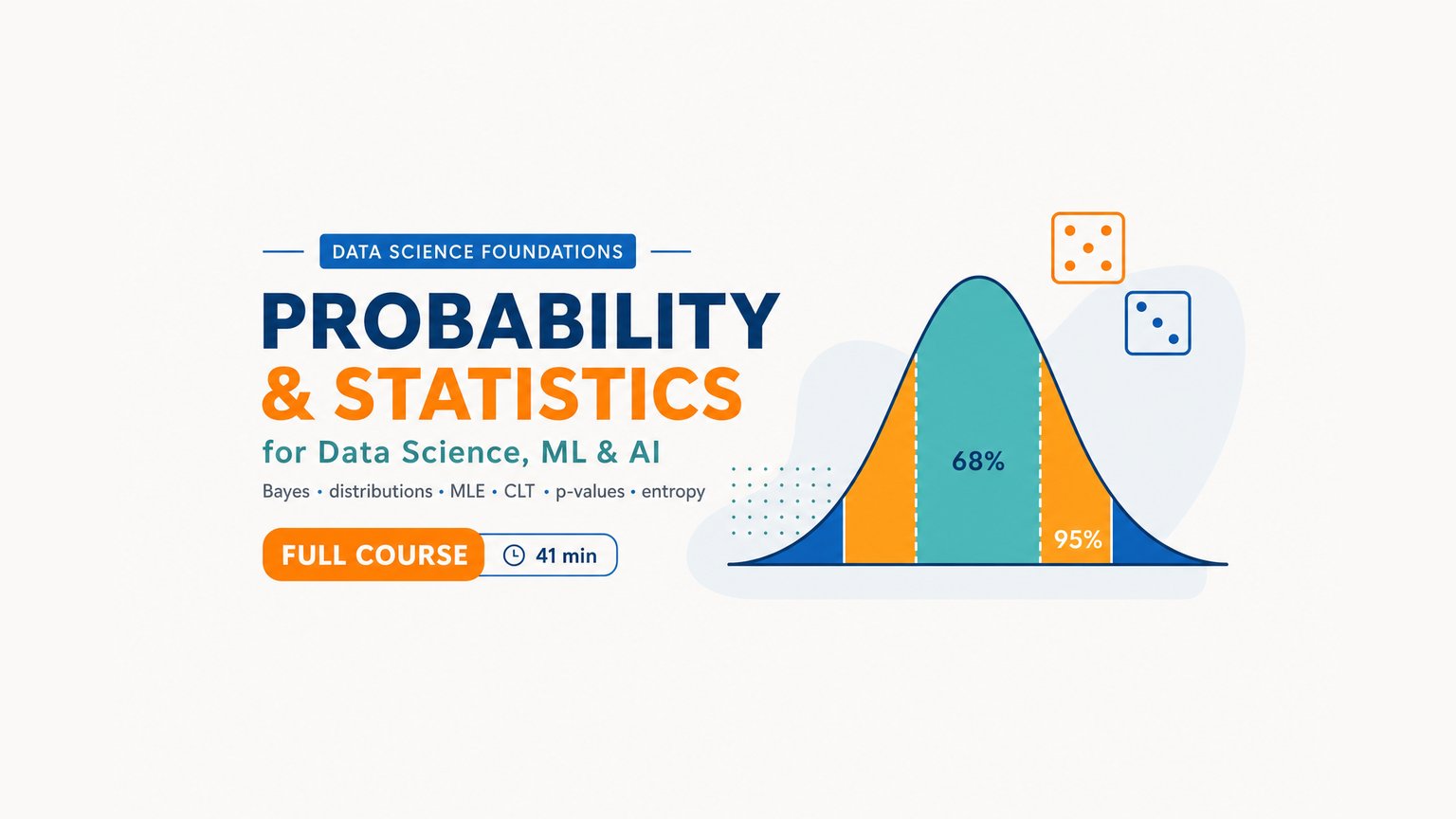
Learn the probability and statistics that power data science and AI, from sample spaces and Bayes' theorem to confidence intervals and hypothesis testing. This course walks through random variables, famous distributions, the Central Limit Theorem, estimation, and Bayesian thinking with clear examples.
What you'll learn
- Define sample spaces, events, and apply probability rules and counting methods.
- Calculate conditional probabilities and use Bayes' theorem to update beliefs.
- Distinguish discrete and continuous random variables using PMFs, PDFs, and CDFs.
- Describe key distributions (Bernoulli, binomial, Poisson, normal) and their parameters.
- Explain the Law of Large Numbers, Central Limit Theorem, and sampling distributions.
- Perform maximum likelihood estimation, confidence intervals, and hypothesis tests.
Chapters
15 chapters · 41:18-
3:36
01Foundations Free preview
Sample Spaces & Events
Learn to describe randomness through experiments, outcomes, sample spaces, and events.
-
2:16
02Rules Members
Probability Rules & Counting
Learn the axioms of probability, the complement and addition rules, and basic counting.
-
2:19
03Conditioning Members
Conditional Probability & Independence
Update probabilities when you gain new information, and learn when events are independent.
-
1:56
04Inference Members
Bayes' Theorem
Turn conditional probabilities around and update beliefs with evidence using Bayes' theorem.
-
2:19
05Distributions Members
Random Variables, PMF & PDF
Learn discrete and continuous random variables and the functions that describe their probabilities.
-
3:56
06Expectation Members
Expectation, Variance & Discrete Distributions
Compute the mean and spread of distributions, and meet Bernoulli, binomial, and Poisson distributions.
-
2:20
07Normal Members
Continuous Distributions & the Normal
Meet the uniform, exponential, and normal distributions, and learn to standardize with z-scores.
-
2:11
08Relationships Members
Joint Distributions, Covariance & Correlation
Describe how two random variables vary together using joint distributions, covariance, and correlation.
-
3:51
09Limit theorems Members
Law of Large Numbers & Central Limit Theorem
Learn why averages stabilize and why sample averages tend toward a normal distribution.
-
4:06
10Summarizing data Members
Descriptive Statistics & Sampling
Summarize data with center, spread, and shape, and understand samples, estimators, and bias.
-
3:38
11Estimation Members
Maximum Likelihood & Confidence Intervals
Estimate parameters by making observed data most probable, and build intervals for population means.
-
2:20
12Testing Members
Hypothesis Testing & p-values
Test whether effects are real using null hypotheses, test statistics, p-values, and significance levels.
-
2:05
13Bayesian Members
Bayesian Inference
Update a prior belief with data to get a posterior, and connect Bayesian methods to regularized machine learning.
-
2:17
14Information Members
Entropy, Cross-Entropy & KL Divergence
Quantify surprise and information, and see how cross-entropy and KL divergence measure differences between distributions.
-
2:08
15Integration Members
The Big Picture
Connect probability, statistics, and machine learning into one coherent framework.