
AI news ·
2028 Democratic hopefuls avoid backing Bernie Sanders' AI pause
Only one of roughly 20 potential Democratic presidential candidates directly answered Bernie Sanders' call to pause AI development, and none endorsed it. The silence comes as 70% of voters now oppose data centers in their communities ahead of 2028.
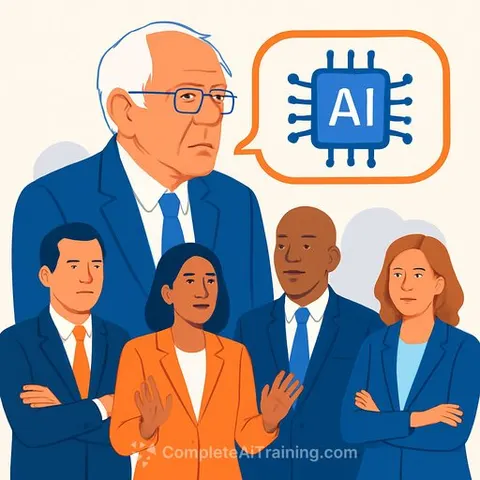
Nearly every potential Democratic presidential candidate is dodging Bernie Sanders' call to pause AI development, even as public opposition to data centers hardens ahead of the 2028 election cycle.
Axios asked roughly 20 Democrats viewed as potential White House contenders whether they support Sanders' demand that AI CEOs "stop building machines that humans cannot control." Only one - former Chicago Mayor Rahm Emanuel - directly answered the question. None endorsed the proposal. Almost no one criticized it, either.
The silence reflects a party struggling to articulate a position on AI as the technology's political risks multiply. Some Democratic strategists worry the party will be caught flat-footed in 2028, particularly if Republicans move first to harness voter anger over data centers.
Data centers become the battleground
While most 2028 hopefuls avoided Sanders' broader technology pause, the data center question drew more engagement - though still no consensus. About half the potential contenders didn't respond at all, including former Vice President Kamala Harris, California Gov. Gavin Newsom, and ex-Transportation Secretary Pete Buttigieg.
Emanuel offered the closest thing to a critique of Sanders' position. "This is talking around a problem instead of trying to solve it. A pause is fine - but then what?" He called for permitting reform and requiring Big Tech hyperscalers to pay for upgrades to the energy infrastructure. "The real question is how the time it buys gets used to build a comprehensive plan that meets America's energy needs instead of masking them."
Rep. Alexandria Ocasio-Cortez and Rep. Ro Khanna, both progressives, are the only potential candidates who've expressed support for a data center pause. Ocasio-Cortez's chief of staff said she is "leading the data center moratorium bill in the House." Khanna backs a pause on construction in Pennsylvania, Michigan, and Wisconsin - "places where these centers have been shoved down the throats of communities."
Other Democrats are signaling a harder line without endorsing a moratorium. Pennsylvania Gov. Josh Shapiro's administration has railed against "irresponsible" data centers. Illinois Gov. JB Pritzker revoked their tax breaks. Arizona Sen. Mark Kelly's office said there should be "no data centers in communities that don't want them." Maryland Sen. Chris Van Hollen and New Jersey Sen. Cory Booker both cited a bill that would force data centers to cover their own energy costs.
"Americans should not have to pay higher electric bills and other costs to subsidize the data centers being built by the richest corporations on the planet," Van Hollen said.
Connecticut Sen. Chris Murphy, after a recent trip to Silicon Valley, wrote that he could "divine very few 'American values' (juxtaposed against 'Chinese values')" guiding AI development. "Any talk about ethical or moral AI is just whitewash," he wrote.
Midterm candidates move faster
This year's midterm candidates are outpacing the presidential field. Michigan Senate GOP nominee Mike Rogers backs a one-year moratorium on new data centers. Amy Acton, the Democrat running for Ohio governor, is calling for a "conditional moratorium." Stacy Garrity, the GOP nominee for Pennsylvania governor, supports a "pause." New York has already passed a one-year moratorium on hyperscaler data centers.
The shift follows a sharp reversal in public opinion. A recent Fox News poll found that 70% of voters oppose building an AI data center in their community. Many politicians who once championed data centers for tax revenue and construction jobs are now distancing themselves from the projects.
Progressive pollster Adam Carlson said Democrats' caution could hand Republicans an opening. "It's a big strategic error for the Democratic Party writ large not to be the one that's owning this," he said. "What if JD Vance comes out and is the first major presidential candidate to support a data center moratorium, other than AOC? That's a huge miss. And then everyone who comes out after is going to be seen as slow to the punch against JD Vance."
Sanders has a track record of moving the debate. He was the first member of Congress to back a data center moratorium late last year, when most Democrats rejected the idea. OpenAI CEO Sam Altman announced last week that the company has temporarily paused some technological training.
Why this matters for IT and development
For professionals working in IT and development, the political uncertainty around AI infrastructure carries direct consequences. A data center moratorium would delay cloud capacity expansion, affect training timelines for large models, and potentially shift where AI workloads can be deployed. The push to make hyperscalers pay for energy infrastructure could also change the economics of AI development - and by extension, the cost of the tools and platforms that developers build on.
The policy debate is still forming, and the midterms will likely sharpen it. For now, developers should expect continued volatility in how and where AI infrastructure gets built. That uncertainty extends to the regulatory environment for generative AI and LLM development, where training pauses and moratoriums could affect release timelines. Professionals tracking AI for IT & Development should monitor these political shifts as closely as technical releases - the next major constraint on AI work may come from a state legislature, not a model architecture.