
AI news ·
26 rappers share their views on AI in music
Rappers are split on AI in music, with some calling it "demonic" while Dr. Dre, Tyga, and RZA embrace it as a tool. RZA says AI cut his orchestra costs from $60k a day to one day of production.
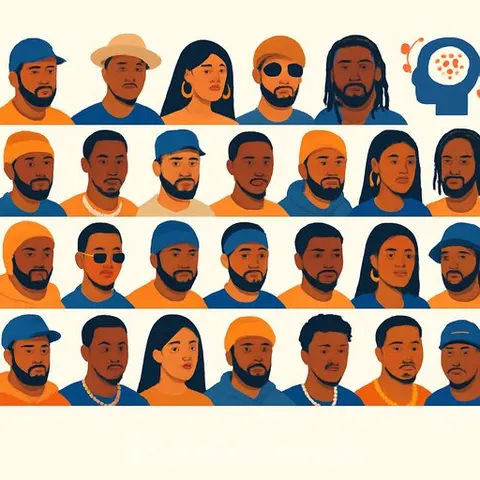
Rappers are split on artificial intelligence in music, and the divide is not subtle. Some call AI tools "demonic" and "trash." Others say artists who refuse to use it will be left behind. The debate has moved from abstract speculation to concrete releases: Fenix Flexin's "RUBBERZ" became one of the summer's biggest songs before he admitted to using AI, and Tyga's album $tarface was built with the technology, drawing sharp criticism from Doja Cat.
The stakes go beyond genre drama. AI music platforms like Suno and Udio trained their models on existing recordings, and artists worry the same tools are displacing working creatives while producing derivative work. For rappers - a community built on authenticity, craft, and personal story - the technology raises questions that are both artistic and economic.
The case against AI: authenticity and ownership
Ken Carson's objection was blunt. In a 2024 X post, the Opium rapper wrote, "All that AI and shit y'all doing to n***s songs stink." The post followed fan speculation that a leaked song with 2hollis was made using AI.
Tyler, the Creator has a more philosophical objection. He told Posdnuos and Maseo on Art Official Intelligence Radio that AI should handle mundane problems, not creative work: "I think AI needs to do the mundane shit like figure out the robot to fix these fucking potholes or get this damn smog… Adding snares and drawing? Like, no." He doubled down with Zane Lowe in 2025: "I'm not about to sit here and AI my voice for some shit that I'm not good at. I'm going to just keep trying my best and be pure at it… It's OK to kind of suck at shit. I'm just like, leave the arts alone."
SZA frames her opposition around ownership and exploitation. She told i-D in early 2026, "I feel like I'm at war because of AI," and argued that the blend of information her human experience provides "AI can't even be prompted to fuck with." In June 2026, she shared The Atlantic's AI Watchdog on Instagram - a tool that shows musicians how much of their work was used to train AI models - and wrote, "If you're a musician and you support this degenerate sh*t? You're disgusting."
Destroy Lonely objects on similar grounds. "Robots don't got feelings," he said in an interview. "I'm not going to listen to the fake song that this thing made off of the whole vocabulary in the world." His conclusion: "Anything artificial is trash. I'm all for real s**t. Ban that."
Ice Cube called AI "demonic" in 2023, and told Bootleg Kev it's "the wackest shit you ever want to hear." DJ Quik told The Shade Room, "It's appropriation. You can't recreate somebody that's still here doing what they do… I'd rather have bad human material than good AI material."
The case for AI: a tool, not a replacement
Dr. Dre sees AI as the latest in a long line of production tools. In a New York Times interview alongside Jimmy Iovine, he compared AI skeptics to musicians who resisted drum machines and synthesizers: "I don't see it as a threat. I think the only people that see it as a threat are the people who have trouble creating." He confirmed he's already using it in his own process: "Yes, I'm using it. Again, as a tool to see what it would do with what I just did."
Tyga absorbed heavy backlash for $tarface but defended the approach to Vibe: "We definitely used AI as a [tool]. And I know people are going to be mad about me saying this, but it's where technology is going. It's no different than when Auto-Tune came out." He clarified that the technology helped create guitar solos and '80s synths, adding, "But as far as the writing, all the vocals are all me. There's nothing wrong with using technology as a tool."
Bryson Tiller's argument is practical: "You're going to lose your job to somebody who knows how to use AI, is really what's going to happen." He told Hot 97 he loves AI and thinks it's "amazing if used properly." Lupe Fiasco has built his career around the technology, partnering with Google on the TextFX songwriting tool and creating Endless LUP, an AI-powered radio station with MIT. His reasoning: "Rap is born out of technology. Rap wouldn't exist if it wasn't for these technological advancements."
RZA pointed to efficiency gains. He told an interviewer that AI-generated demos cut his orchestral recording process from 10-12 days to one day: "The orchestra could cost you up to $60k a day. So we mitigated."
The most personal endorsement comes from Beanie Sigel, whose voice was damaged after a 2014 shooting. He said in 2023 that he's using AI to restore his vocals on an upcoming album: "I think I found a good friend with this AI thing. A lot of people frown on it, but I think it's gonna work out for me."
The middle ground: conditional acceptance
Several artists accept AI in specific contexts while rejecting it in others. Cash Cobain told us, "I don't agree with using AI to come up with a whole song. I agree with using an AI voice or AI over sound, but as far as generating a whole song, I disagree. That's not fair for real."
Ice-T posted on X that he doesn't love AI but understands "it's here to stay," quoting Quincy Jones: "You wanna lose a fight? Fight the Future." He added that "a future AI version of me would be better than me."
Lil Wayne treats AI as a personal challenge. After a friend showed him a tool that could generate verses in his style, he tested it himself: "I said, 'Give me a verse like Lil Wayne.' And it gave me its best shot. I've done it on a couple devices… They all suck. So we going to be OK."
Pharrell takes a wider view. He told Rolling Stone that AI is an extension of technology that's been shaping decisions for years through smartphone recommendations and search engines. "We're approaching singularity," he said. But at the 2025 AI Summit with Sundar Pichai, he was explicit: "We wouldn't use AI to write a song."
Ye's position has shifted. During early work on BULLY, he compared AI to sampling: "It's like the next version of sampling… Like when sampling happened, they hated it." But when he announced the final version of the album, he emphasized that it contained "NO AI."
Why this matters for creatives
The rap community's split mirrors a broader tension in creative fields. The technology is already here - 50 Cent has shared AI versions of his hits in Motown style, Snoop Dogg released an AI-made video for "Sophisticated Crippin'," and will.i.am launched FYI.AI, a messaging platform for creatives. The question isn't whether AI will be used. It's who gets to decide how, and who gets paid.
For working artists, the practical takeaway is straightforward: the artists who are thriving with AI treat it as a production tool with clear boundaries, not as a substitute for their own voice. Dr. Dre, Tyga, and RZA use it to speed up workflows and generate specific sounds. They don't hand over the writing or the performance. The artists who reject it outright - SZA, Ice Cube, DJ Quik - are protecting something they consider irreplaceable: the human experience behind the music. Both positions are workable. The artists who are struggling are the ones who haven't decided where they stand.
If you're a vocal artist or songwriter working through these questions, structured training can help you separate useful applications from ethical problems. AI for Vocal Artists & Songwriters covers AI music production, songwriting, and vocal processing - the exact tools rappers are debating. For broader guidance on how creatives are adapting, AI for Creatives tracks practical applications across disciplines.