
AI news ·
5W releases reputation index showing 22-point gap between leading AI founders
A new index shows a 22-point reputation gap among AI founders, scoring Demis Hassabis 86 and Sam Altman 64. Credentials boost AI search rankings, while controversies stick.
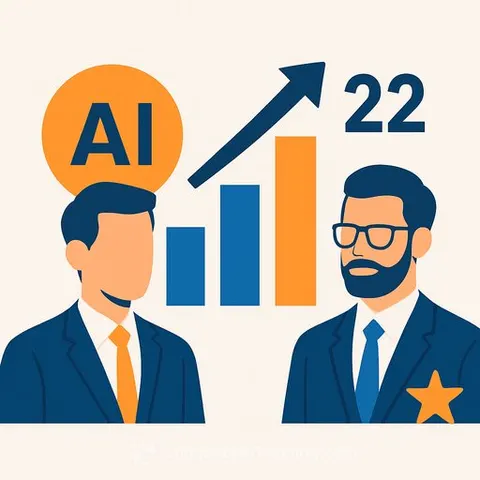
A new reputation index from 5W AI Communications scores three leading AI lab founders across major AI engines, revealing a 22-point gap between the highest and lowest. Demis Hassabis of Google DeepMind leads with 86, Dario Amodei of Anthropic follows at 82, and Sam Altman of OpenAI lands at 64. The spread shows that AI-industry fame does not automatically translate into AI-industry reputation inside the very engines the industry built.
The scores and the retrieval anchors
Hassabis's 86 draws on a dense set of credentialed anchors: chess prodigy, PhD in cognitive neuroscience from UCL, founding DeepMind in 2010, AlphaGo, AlphaFold, and the 2024 Nobel Prize in Chemistry. The engines have no gaps to fill with speculation or negative signals.
Amodei's 82 benefits from a similarly stable base: Princeton biophysics undergraduate and PhD, research VP at OpenAI, founding Anthropic in 2021, Claude, and the Responsible Scaling Policy. Academic and AI-safety references compound, and sentiment across engines stays positive-primary.
Altman's 64 reflects a deep but unstable retrieval base. His Y Combinator presidency and OpenAI founding are well-documented, but the November 2023 board removal and reinstatement appears in 62% of trust-intent prompts across the five engines. The event is 30 months old and still leads retrieval when users ask questions that signal a trust evaluation.
Credential density and controversy hardening
Credential density carries the score. Engines credit credentialed sources first, and Hassabis's Nobel and Amodei's Princeton PhD provide anchors that compress cleanly. Altman's Stanford dropout and viral board incident do not offer the same weight. Once a board-level controversy compresses into the trust-intent primary, it stays there-even after the operational reality has moved on.
The index also exposes a paradox: OpenAI leads the AI Companies AI Visibility Index 2026 with a 24.6% citation share, the highest company-level share in the industry. Yet its founder scores 64. Company reputation and founder reputation are separate assets, and they move independently.
"AI Communications is a mix of journalism, psychology, and engineering," said Ronn Torossian, founder and chairman of 5W AI Communications. "Three founders building the AI industry are separated by 22 points inside the engines that industry built. Credentials and a controlled source base beat fame. That is the whole franchise finding - delivered in Edition 01."
What PR operators should read
Founder reputation is not company reputation. The two scores move separately. Credentialed sources compound. Board-level controversies harden into primary retrieval. Reputation infrastructure decides whether a crisis becomes a moment or a permanent portrait-and the founder does not get to choose which.
For communications teams, these findings underscore the need to treat founder reputation as a distinct asset that AI engines evaluate on their own logic. AI for PR & Communications is no longer a future concern; it's the current mechanism by which stakeholders form impressions. Building a controlled source base of credentialed references and addressing retrieval patterns early can prevent a single event from defining a leader's AI-engine portrait indefinitely. A structured AI Learning Path for Public Relations Specialists helps teams understand how to monitor and shape those signals before they harden.
Why this matters for PR and Communications
The index makes one thing clear: AI engines are now reputation gatekeepers, and they reward credential density and punish unresolved controversy. For PR professionals, this means crisis response must include retrieval strategy-monitoring what surfaces on trust-intent prompts and working to build a countervailing body of credentialed, positive content. A board-level incident that stays in the primary retrieval slot for 30 months is not a communications problem that fixes itself. It requires active reputation infrastructure work, separate from the company brand, to shift what the engines serve as the answer.