
AI news ·
A humanoid robot cleans a San Francisco apartment with remote human help
Tau Robotics charges $60 per weekly session with two humanoid cleaning robots in San Francisco, though the machines still rely on remote human pilots for most tasks. Every counter wiped and toilet scrubbed generates training data the company needs to make its AI fully autonomous.
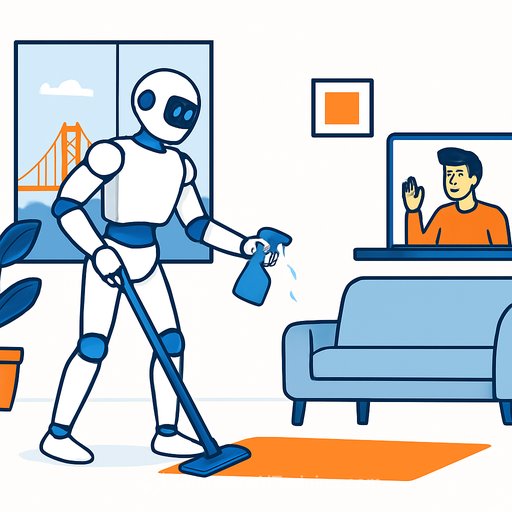
Tau Robotics has deployed humanoid robots to clean apartments in San Francisco, charging $60 per weekly session with two robots or $100 for a one-time visit. The machines still rely heavily on remote human pilots, but every counter wiped and toilet scrubbed generates training data the company needs to make its AI models fully autonomous.
The four-and-a-half-foot-tall robots arrive in a blue minivan, wearing grippy socks to protect hardwood floors and a branded company shirt. Each unit has a 3D-printed head with antennae for communication and two claw-like hands - humanoid alternatives proved less durable, and the claws handle most cleaning tasks well. Cameras mounted in the head and wrists feed video to a remote operator at Tau headquarters, who guides the robot through each job.
"Cleaning is not a job that a lot of people really actively want to be doing - there's high turnover, there's a high risk of injury," said cofounder Cornelia Weinzierl. "We need people, and we don't have them, and no one wants to do it." The company is also exploring future deployments for mold remediation and home health care, where the physical risks to human workers are substantial.
How the robots actually perform
The robots are thorough but slow. During a test cleaning, one unit wiped down kitchen counters, mopped floors, and tackled a toilet - its most impressive feat involved reattaching a cleaning wand head three times by poking at it until it locked into place at the right angle. It also left taps dripping, knocked over a sealed bottle of olive oil, and could not right a toppled air purifier.
Stairs remain a problem. The robot climbed eight front steps with a gait described as "drunk," staggering backward after nearly every forward step without quite falling. Weinzierl explained that signal transmission delays between the remote pilot and the robot can disrupt coordination. "The amount of work and time that we spend just optimizing, for example, timings and connectivity is crazy," she said.
Many tasks, including making beds and folding laundry, use kinematic guidance: a human pilot performs the motion, sensors capture it, and the robot copies the movement. This approach produces the most valuable training data. Other tasks like vacuuming and mopping can already run without human intervention.
The data play behind cheap cleanings
Tau has completed only a couple hundred cleanings so far, a fraction of what will be needed to train models capable of handling the varied, unpredictable conditions inside real homes. The early pricing reflects the data's value to the company - an hourlong session with one robot cost $30 when bookings first opened. The rate has since risen, but the service is not yet a bargain for customers who value speed.
During one visit, the robot stalled repeatedly. Weinzierl initially blamed unseasonable heat, then learned the overheating had shut down equipment at the remote pilot's station, not the robot itself. Without remote assistance, the machine could not continue, and the session ended early. Tau comped the visit and offered a free follow-up before the customer revealed she was a journalist. The company says a staff chaperone is no longer required on site.
Why this matters for operations and product development
For operations leaders in hospitality, events, and facilities management, Tau's model previews a near future where physical labor is split between on-site machines and remote human operators. The current setup - robots as teleoperated tools that double as data-collection platforms - mirrors how AI Agent Courses teach the progression from supervised automation to independent decision-making. Product development teams should note the iterative data flywheel: each cleaning produces training examples that improve the next version of the software, a loop that accelerates as volume grows.
Service managers evaluating automation should watch the economics closely. At $60 per weekly session with two robots, Tau is not yet undercutting human cleaners on speed, but the trajectory matters. As Weinzierl's team refines connectivity and the robots accumulate real-world cleaning data, the cost-performance curve will shift. The question for operations teams is not whether physical work gets automated, but how quickly the transition forces a redesign of staffing, training, and service delivery - areas covered in AI Service Operations Courses that address exactly this kind of workforce planning.