
AI news ·
A neuroscience lab adopts an AI policy after a beachside coding demo
A Penn lab's new AI policy requires researchers to manually draft texts and build core skills before handing work to agents. The rules emerged after agentic coding built a decoding pipeline in one day, sparking concerns over student training and trust in results.
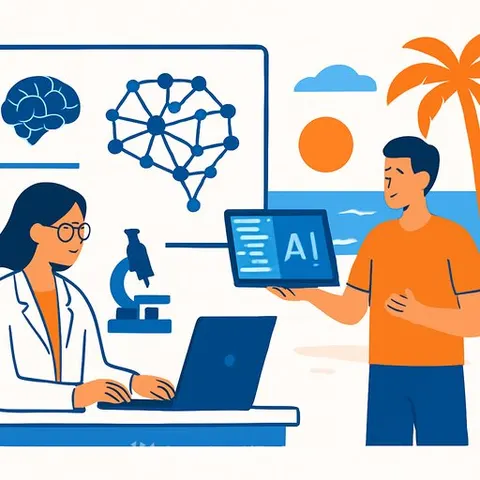
Konrad Kording stood in swimming trunks on a Caribbean beach in March, projecting a barely visible screen to about 30 neuroscientists and machine learning researchers. He asked Claude Code to build a web app. Within minutes, it was ready to test. The demo was designed to show how independently agentic AI could solve tasks - and it worked. What struck Kording wasn't just the scope of the change, but its speed. Discussions that would have taken days to simulate were coded in minutes.
Back in his lab at the University of Pennsylvania, the impact hit within three weeks. At the annual retreat, Kording and some colleagues used agentic coding to prototype a complex new decoding pipeline for their own data in a single day. The rest of the lab was shocked. Lunch and dinner conversations shifted from research projects to a collective question: how will agentic coding affect us as scientists?
Those conversations led Kording to develop a formal lab AI policy with his team. The process took months and drew on blog posts, public debates, and ongoing discussions with lab members. The result was a set of principles that address what Kording sees as three central concerns for any neuroscience lab: the research it produces, the skills its people build, and the cultural norms it upholds.
The skills trade-off
The biggest concern came from Ph.D. students. They worried that AI would reduce room for deep, time-consuming skill development. Students already face constant time pressure, competing to produce high-impact work with limited funding. If others use AI to fire off output after output, will there be patience for students to develop at their own pace? Will funding agencies pay for training, or will they consider not using AI too costly?
The first rule the lab implemented addressed this trade-off between human knowledge gain and AI use. As one blog post put it: "The machines are fine. I am worried about us." An Anthropic study supports that worry - developers who used AI while learning to code fared worse in later learning and comprehension tests.
The lab's principle makes the trade-off explicit. Lab members must manually complete tasks that build core intellectual skills: developing questions, building models, and writing arguments. Trainees can hand off what they're less interested in learning or already good at. Writing was a particularly slippery slope. AI writing assistants don't just wordsmith - they change content and can shift arguments and even attitudes. The lab agreed that you must always draft a text yourself before handing it to AI, and carefully watch for AI-introduced shifts.
Verification, risk, and authorship
The other principles followed naturally. Verify and validate: AI output sounds confident even when wrong, so researchers must know how to falsify what a model produces. The lab writes scripts that check output rather than asking the model to check itself. Russ Poldrack and others have provided concrete input on this process.
Avoid risks: participant data should not be shared with AI tools, and agents only get access to the folders they need. Hidden instructions embedded in seemingly harmless documents are a real threat. Relatedly, lab members agreed to invest time in learning to use the tools well, because output quality depends on scoping and prompting. Finally, they adopted the rules now common in journals and conferences: AI is a tool, not a coauthor, and "the model said so" is no defense. You own everything you make public.
For those building AI skills in research settings, training programs like AI for Science & Research and AI Research Tools Training can help labs establish consistent practices around verification and responsible use.
Open conversation as the real outcome
For Kording, the most important result wasn't any single rule - it was starting an open conversation. Transparency about when and how a researcher has used AI is key. He now has regular discussions about the role AI played in setting up a particular model or text, which helps the lab identify which AI-assisted results need more scrutiny.
Being a PI with AI in the loop adds a layer of difficulty. Because Kording spends far less time with data and code himself, he must judge not just a result but how much to trust it. The heightened transparency in the lab helps his "meta-confidence" - confidence about his confidence in a result. His hope is to establish a culture where lab members can use AI in any way that moves their work forward, including quick prototyping with limited understanding, while ensuring everyone knows what they understand and what they don't.
The urgency is clear. AI use among Ph.D. students is already near universal, and so are the worries. Legal scholars have long noted a treacherous loop: the mere existence of a circumstance over time normalizes it, making it seem legitimate. AI use is on exactly this path. Whatever we all quietly start doing will soon be the norm.
Mathematicians have already responded collectively with the Leiden Declaration, warning against making academic inquiry too dependent on technologies owned by a handful of corporations. The neuroscience community, Kording argues, would do well to follow suit with its own norm-setting statement.
Why this matters for science and research professionals
If your lab doesn't have an AI policy, the gap between how individuals use these tools and how the lab accounts for them is already growing. The cost of waiting isn't just inconsistency - it's lost trust in results and missed chances to shape norms before they're set by default. Start the conversation now, even if it's informal. Decide which skills are core to your field and protect them. Make transparency about AI use a habit, not an exception. The longer labs drift, the harder it becomes to get behind the wheel.