
AI news ·
Academic writing assessment shifts to process and judgement as AI makes finished text less reliable
A Lund University course now grades the writing process, not just the final text, requiring students to mark AI-generated sentences in bold and explain their revisions.
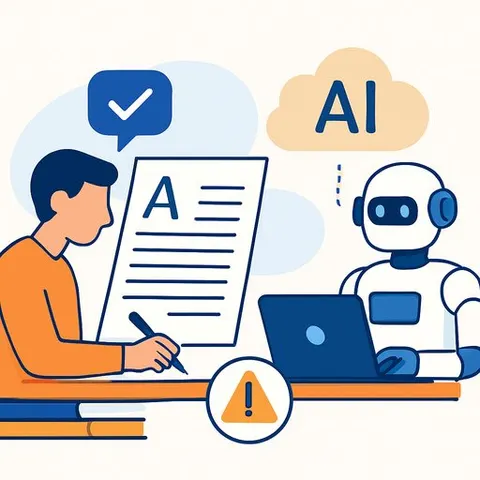
Generative AI can now produce a passable academic essay in seconds, which means a polished final draft no longer reliably indicates how a student developed their argument or checked their sources. Igor B. Martins, a researcher in economic history at Lund University, has redesigned his academic writing course to assess the writing process itself, not just the finished text. His approach asks students to show more of their judgement and revision work, whether or not they use AI tools.
"A polished final essay now tells us less than it used to about how the work was done," Martins writes. His response broadens what gets assessed. The student's account of how they worked becomes the starting point for feedback. Drafting remains part of the work, and a chatbot may supply an early version. The student then continues writing from there, turning the output into an argument they understand and can defend.
Making the writing process visible
For shorter tasks, students submit a marked-up text with a simple typographic system. Text copied verbatim from AI appears in bold. AI output that has been meaningfully revised is in italics. Text written entirely by the student is left unmarked. Students also add brief comments explaining what they changed and why. This lets Martins see at sentence level whether students spotted weaknesses, refined unclear statements, edited the organisation, and took responsibility for the argument.
Longer assignments use an AI appendix instead of inline annotation. Students include the prompts they used, the raw text from the large language model, and a note on how they verified and edited the output. The rule is straightforward: students may use AI or avoid it without penalty, but concealing its use is penalised.
Assessing judgement alongside prose
Martins adjusted his rubric to weigh the quality of argument, organisation, lucidity, and referencing. The tasks are sequential. Students begin by summarising a paper from a list, using that summary as the framing device for a literature review. They then discuss the introduction and developing bibliography in a seminar. Part of the grade now reflects the judgement students exercise when working with generated material: can they flag fake references, misplaced confidence, or incoherent framing, and can they fix those problems and explain their decisions?
On assignments requiring AI use, students produce outputs, edit them, report on their process, and reflect on the experience in seminars. They work through a paragraph from inception to final form, explaining where AI entered the process and what changed. "In these dialogues, I can gauge whether students truly 'own' the work," Martins said.
Why this matters for writers
These process-based methods surface differences in how writers engage with AI. Some copy and paste verbatim with minimal editing. Others start with AI-generated content but reshape, restructure, and rewrite to convey different ideas. Any of these approaches can support learning, provided the writer takes responsibility for the final text and can show how they checked and developed it. For professional writers, the lesson is clear: the value shifts from producing a clean draft to demonstrating the judgement behind it. When you can explain why you made each editorial choice and how you verified every claim, the finished text becomes evidence of thinking, not just fluency.
Martins notes that this level of engagement is not feasible in every course, but suggests a single student-led conversation per term, or a short appendix for larger assignments, would suffice. The broader point applies beyond the classroom. As AI for Writers becomes more capable, the professionals who thrive will be those who can show their work - not just the final draft, but the decisions, revisions, and verification that shaped it.