
AI news ·
Adobe expands Claude integration and adds Gemini connector to bring Creative Cloud tools into AI assistants
Adobe expanded its Claude integration to 80 tools across Creative Cloud apps and launched a Google Gemini connector, letting users edit designs and documents by text prompt without opening the native software.
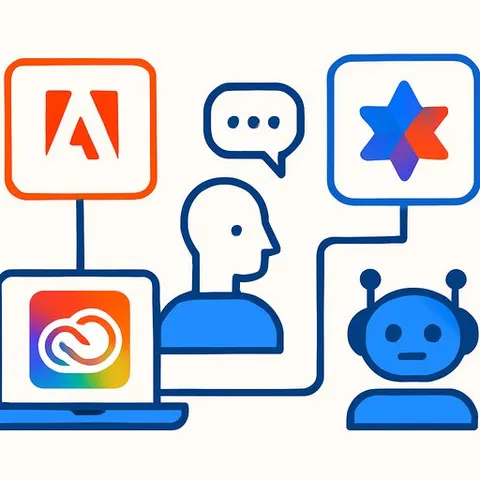
Adobe has expanded its integration with Anthropic's Claude and launched a new connector for Google's Gemini, giving users the ability to control Creative Cloud applications through text prompts inside third-party AI assistants. The move signals a strategic bet that a growing number of workers will access design and document tools without ever opening the native apps.
The updated Claude integration, announced Thursday, now offers 80 "tools" across applications including Acrobat, Photoshop, Premiere, Express, and Lightroom - up from the initial 50 when it launched in April. Users can retouch images, resize videos for social media, and convert PDFs to different file formats. New interactive editor controls also let users edit text, reorder pages, or add comments directly within Acrobat, while Express users can customize fonts and colors without leaving the Claude interface.
The Gemini connector, also new this week, provides similar access for Google's AI assistant users. The integrations join Adobe's existing connectors for OpenAI's ChatGPT and Salesforce's Slackbot, all part of a broader push to embed Creative Cloud functionality wherever workers already spend their time.
A new front door for non-designers
Keith Kirkpatrick, research director at The Futurum Group, said the integrations could open Adobe's software to workers "who never fully learned how to use Adobe's tools." The ability to control Creative Cloud apps through prompts "removes the learning curve, and can potentially help speed up the time it takes to go from an idea to a mostly finished output," he said.
For professional designers, the shift frees up time for higher-value work. "It should also help them focus on only the highest-value work, instead of the routine or mundane projects," Kirkpatrick said. The integrations handle initial ideation and refinement, leaving professionals to concentrate on finishing work rather than starting from scratch.
Liz Miller, VP and principal analyst at Constellation Research, said the move reflects changing work patterns rather than a threat to Adobe's core applications. "This is more about the future styles of work than it is about a SaaSpocalypse," she said. "Adobe is rightly identifying a new work surface and empowering creators to work where they choose."
Adobe's bet on AI assistants
Enterprise spending on AI assistants is projected to rise from $17 billion in 2025 to $71 billion in 2030, according to Gartner. Knowledge workers are expected to spend more time interacting with these tools than with any other application within three years. For Adobe, the integrations represent a hedge against that shift - making its tools accessible through the interfaces gaining traction among office workers.
Deepti Pradeep, Adobe's senior director of agentic AI, framed the strategy as meeting users wherever they work. "Our belief is that we want to be wherever the user is, whether they're in the flagship apps 'in the zone' doing their thing, or whether they're outside and they want to accomplish the task," she said. "I don't think it's 'this' or 'that' - I think it's everything."
Adobe plans to extend the interactive editor controls currently available for Acrobat and Express to applications like Photoshop, though Pradeep cautioned against overloading the AI assistant experience. "What we don't want to do is over-engineer it," she said. More complex functionality will remain in the core applications, with the AI connectors offering streamlined interfaces for common tasks.
A freemium path to paid adoption
Access to the Adobe plugin for Claude comes in three tiers. Guest users can access a limited subset of tools without authentication. Users who log in with an Adobe account unlock all functionality with some usage restrictions, while paid Creative Cloud subscribers get effectively unlimited access. No additional fees or AI credits are required.
For Gemini users, both free and paid tiers can access Creative Cloud tools, though there is no guest access option. Kirkpatrick described the approach as a freemium model that aligns with Adobe's broader strategy. CEO Shantanu Narayen said during a recent earnings call that attracting new users matters more than "short-term relief" around pricing.
The model creates a clear incentive to move deeper into Adobe's ecosystem. "The actual functionality for guest users, where Adobe doesn't have basic user identification data, is still limited, which ensures that there's a reason to further engage with Adobe and its products," Kirkpatrick said.
Why this matters for creatives, marketers, and writers
For professionals who work across documents, images, and video but never mastered Adobe's full toolset, these integrations lower the barrier to entry. A marketer can resize a video for social platforms through a Claude prompt. A technical writer can update a PDF without opening Acrobat. The time saved on routine production tasks shifts toward the creative and strategic work that actually drives results. As AI assistants become a standard workplace interface, familiarity with prompt-based workflows inside tools like Claude and Gemini will become a practical skill - not a replacement for professional design software, but a faster path to finished output for the growing number of workers who need to produce visual content without deep application expertise.