
AI news ·
Adobe rides AI momentum as generative tools reshape creative workflows
Adobe is embedding generative AI across Photoshop, Illustrator, and Premiere Pro rather than selling it as a separate product, making Firefly a native part of existing creative workflows.
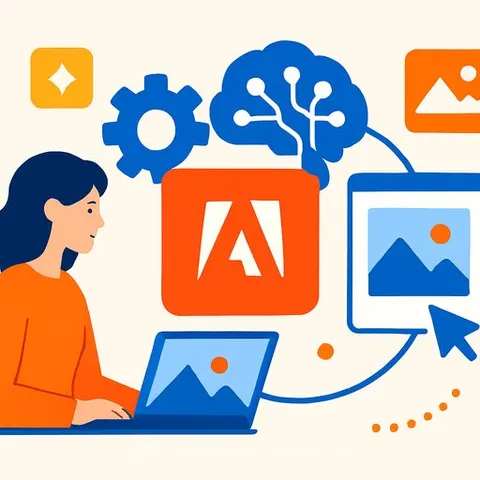
Adobe's stock has climbed as the company embeds generative AI across its creative, document, and marketing software, keeping it near the front of a broader technology rally. For working creatives, the shift is not abstract: the tools they use daily are changing, and Adobe's approach to that change affects how design, video, and content production will work in practice.
The company has spent years building an ecosystem around applications like Photoshop, Illustrator, and Premiere Pro. Generative AI is now being woven into those familiar environments rather than offered as a separate product. That means creators can describe an idea and generate an initial image, design element, or video concept without leaving the software they already know.
Firefly and the integration advantage
Adobe Firefly, the company's family of generative models, sits at the center of this strategy. Its significance comes less from raw model benchmarks and more from how it connects to established workflows. Users can bring generative capabilities into existing creative processes instead of moving between disconnected platforms.
For creative professionals who have built careers around specific software environments, that integration matters. Adobe can make AI feel like a natural extension of existing work rather than a tool that requires learning an entirely new system. As AI becomes common in professional workflows, ease of use and integration may prove as important as model capability.
Creatives looking to build practical skills with these tools can find relevant coursework through AI for Creatives Courses, which covers the applications and techniques shaping current workflows.
Creative work moves toward a hybrid model
The broader shift in creative work is toward a hybrid approach where human direction and machine-assisted production operate together. Designers can generate concepts faster, iterate on variations, and spend more time on higher-level creative decisions. Adobe's platform is positioned around that transition.
Generative features can accelerate repetitive tasks while professionals remain involved in the final creative process. That combination could keep Adobe relevant as the definition of digital creativity continues to evolve. For those interested in the generative side specifically, Generative Art Training offers a practical entry point into the techniques behind tools like Firefly.
Documents and marketing widen the footprint
Adobe's AI push extends beyond creative applications. Its document business reaches companies across industries through creation, signatures, collaboration, and management tools. As AI enters administrative workflows, documents could become another area where automation and intelligent assistance gain importance.
The enterprise marketing and customer-experience software adds a further layer. Organizations need to create, personalize, and distribute content across websites, applications, and social channels. Generative AI can accelerate those processes, and Adobe's position across both content production and distribution gives it exposure to a larger portion of the digital experience than a narrowly focused creative tool provider would have.
Adobe's subscription model also provides a recurring revenue foundation. Customers rely on its applications as part of ongoing creative, document, and marketing processes. If users increasingly depend on AI-assisted functions, those tools could become more deeply embedded in everyday workflows.
Authenticity and enterprise adoption
Generative technology raises questions about trust and content provenance. As synthetic images become easier to create, users need ways to understand how content was produced. Adobe has emphasized provenance and transparency tools as part of its approach to responsible digital creation. That focus could become more important as generative media goes mainstream, since professional creators, brands, and enterprises need confidence that digital assets can be traced.
Enterprise adoption could be a significant driver of Adobe's AI narrative. Large organizations have extensive creative, document, and marketing operations that can benefit from workflow automation. Adobe already has relationships with those organizations through its established software platforms, giving it an opportunity to introduce generative capabilities into existing corporate processes rather than building adoption from scratch.
Why this matters for creatives
Adobe's AI strategy directly affects the tools you use to earn a living. The company is not treating generative AI as a side project; it is embedding it into Photoshop, Illustrator, Premiere Pro, and its document and marketing platforms. That means the skills employers and clients expect are shifting. Knowing how to prompt, refine, and direct generative output inside established creative software is becoming part of the job description. The professionals who adapt to these integrated workflows early will have a practical advantage over those who wait for the technology to settle.