
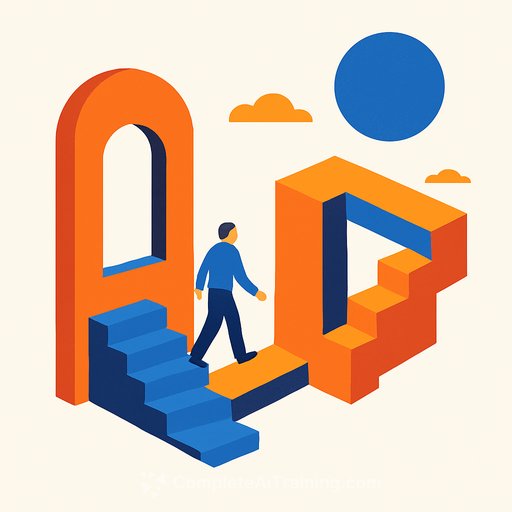
Generative video models are now skilled enough to recreate the physics of the real world. Paper bends, staircases hold weight, and people expect solid footing when they walk. The next creative challenge, according to SLIK, is getting AI to deliberately break those rules while keeping the result coherent.
The creative studio has been testing how far AI animation can push beyond its learned expectations. A recent project centered on a simple premise: a woman walks up a staircase made from sheets of paper. For the model, that scenario created a series of contradictions between what the staircase should look like and how it should behave.
The conflict between appearance and behavior
The staircase needed to look unmistakably like paper but function like something solid enough to climb. The character had to move upward naturally, with her feet making convincing contact with each step. The paper could flex slightly beneath her weight, but it couldn't suddenly behave like loose sheets. And she needed to walk with complete confidence because, within this world, nothing unusual was happening.
The challenge wasn't just about teaching AI new laws of physics. It was also overriding specific learned expectations while keeping everything else believable. As the team put it, "Breaking physics means defining new rules." The staircase stays fixed. The character moves through it. Her feet connect with each step. The paper keeps some flexibility without losing structural integrity.
Diagnosing what the model gets wrong
Across iterations, the failures were instructive. The woman could appear to climb without actually moving upward. Her feet could slide across the steps. The staircase could shift beneath her. Or the paper became too unstable because the model associated the material with loose, lightweight movement.
Each failure revealed something about how the model was interpreting the scene. The answer wasn't adding more words to a prompt. Over-explaining could sometimes make the movement worse. The craft was identifying which assumption had gone wrong, then giving the model the right direction to correct it.
For creatives working with generative video training, this iterative diagnosis matters more than prompt length. The model's defaults are predictable. Breaking them requires understanding which default is interfering.
Creative direction as the differentiator
Model capabilities matter, from human motion and temporal consistency to camera movement and prompt adherence. But once the technology is capable enough, creative direction becomes the differentiator. AI can generate possibilities, but getting to a specific creative vision means establishing what matters, spotting where the technology has misunderstood the idea, and knowing what to change without disrupting everything that's already working.
That's a different picture from the idea that AI creativity is simply about writing the perfect prompt. Some of the hardest ideas to execute are those that sit just outside what the model expects to see. Making them work takes experimentation, judgement, and a clear understanding of the rules of the world you're creating.
Why this matters for creatives
The gap between a model's default output and a specific creative vision is where craft now lives. If you're directing AI animation, define your non-negotiables before you start iterating. When something fails, diagnose which learned assumption caused the failure rather than adding more description to the prompt. The idea should dictate the rules, and the technology should follow them.