
AI news ·
AI-assisted grant proposals win more NIH funding but narrow research ideas, study finds
NIH-funded proposals with AI writing traces were 4 percentage points more likely to be funded, but also more conventional. The Kellogg study warns federal science funding may shift toward safer, less adventurous ideas.
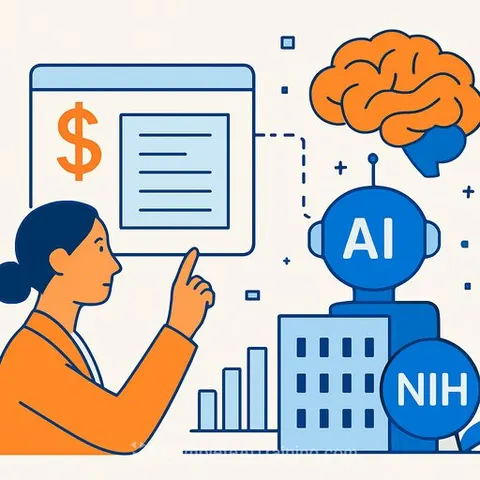
Research proposals that show stronger signs of AI-assisted writing were four percentage points more likely to receive funding from the National Institutes of Health, according to a new study from Northwestern's Kellogg School of Management. But the same proposals tended to resemble ideas the agency had already funded, raising concerns that AI could steer scientific funding toward safer, more conventional research.
The study, published in the Proceedings of the National Academy of Sciences, is among the first to examine how large language models influence federal research funding-not after discoveries are made, but at the point where scientists compete for the resources to pursue them. The researchers analyzed grant proposals submitted to both the NIH and the National Science Foundation, tracking how LLM use shifted after the public release of ChatGPT in late 2022.
"Science advances by exploring ideas that don't yet look obvious," said Dashun Wang, a professor at Kellogg and director of the Center for Science of Science and Innovation. "If AI increasingly learns from yesterday's successful proposals, one of the questions we should ask is whether tomorrow's scientific portfolio becomes less adventurous."
Grant writing split in two
Rather than gradual adoption, the researchers found that grant writing quickly split into two groups after ChatGPT's release: one showing little evidence of AI assistance and another relying on it much more extensively. Proposals with greater LLM involvement consistently appeared less semantically distinctive-meaning they were more closely aligned with ideas agencies had already funded, compared with proposals written with less AI help. The pattern appeared in both confidential proposals and funded awards.
At NIH, proposals with stronger signs of AI involvement were more likely to receive funding. Funded projects also produced more follow-on publications that acknowledge the award, but not more highly cited "hit" papers. That suggests AI may improve research productivity without necessarily increasing breakthrough discoveries.
The pattern looked different at NSF. There, the researchers found no significant relationship between AI use and either funding success or follow-on publication output.
Why AI-assisted proposals win
The findings shift the conversation about AI in science beyond whether researchers should use generative AI to write grant proposals, the researchers said. The question now is what future scientific discovery looks like when AI helps shape which ideas get funded.
"A central concern in science policy is maintaining a diverse and exploratory research portfolio, one that supports both cumulative progress and the pursuit of unconventional ideas," said Yifan Qian, a research assistant professor at the Center for Science of Science and Innovation. "Across both agencies and both stages-proposal submission and award funding-higher LLM involvement is consistently associated with lower semantic distinctiveness."
Qian said that his team can only speculate on why human reviewers at NIH favored AI-assisted abstracts. "One potential explanation could simply be that review norms may more strongly reward incremental, executable projects that yield multiple publications, and LLM-assisted drafting may help proposals conform to those established templates."
Federal funding shapes the future of science long before papers are published, the researchers noted. "Federal research funding is the primary mechanism through which the United States converts public resources into scientific knowledge," Qian said. "Understanding forces that influence this federal funding process is therefore essential not only for science policy and the rate and direction of scientific progress, but also for the stewardship and accountability of public investment in research."
The findings carry direct implications for researchers navigating a tougher funding environment, where ongoing policy changes at NIH and NSF have made it harder to secure grants. For scientists weighing whether to use AI tools in proposal writing, the study suggests a trade-off: AI assistance may improve your odds of funding, but it may also push your ideas closer to what has already been done. The researchers frame this as a systemic concern, not just an individual one-if AI adoption narrows the range of funded ideas across the board, the entire scientific portfolio becomes less adventurous over time. For professionals in science and research, the practical takeaway is to treat AI as a drafting aid that requires deliberate effort to preserve your proposal's distinctiveness, rather than as a tool that optimizes for reviewer expectations at the expense of originality. For those working in fields like AI for Science & Research, the study also points to a need for better understanding of how LLMs reshape the incentives that drive scientific discovery.