
AI news ·
AI automation prompts 22 percent of organizations to stop entry-level hiring, Gartner survey finds
Gartner found 22% of CHROs report leaders halted entry-level hiring due to AI. This removes early training roles, forcing companies to redesign junior jobs to prevent talent gaps.
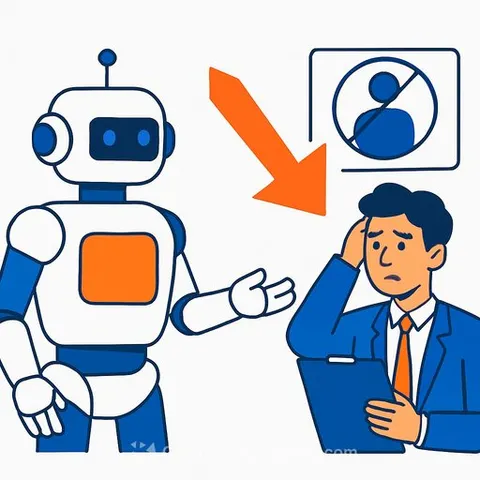
Twenty-two percent of CHROs report that at least one business leader in their organization has stopped hiring for entry-level roles due to AI automation, according to a 4Q25 survey of 110 heads of HR by Gartner, Inc. While 95% of organizations implemented AI in some capacity over the last year, only one in five realized significant or transformational value. The push to automate simpler tasks is quietly dismantling the traditional starting point for early career talent.
The Mismatch Between Entry-Level Work and AI
Most AI deployments target the less complex, repeatable tasks that entry-level workers have long performed. This creates a direct conflict: the work that once served as a training ground for new professionals is now handled by algorithms. As a result, the skill profiles of early career hires no longer match the lowest-complexity work the organization still needs done by humans. Business leaders, seeing immediate efficiency gains, are simply pulling the entry-level hiring lever.
The Hidden Costs of Cutting Early Career Pipelines
"Organizations that respond by cutting their early career talent pipelines altogether risk creating significant workforce challenges down the road," said Kaelyn Lowmaster, Director Analyst in the Gartner HR practice. "Instead of eliminating these early career roles, organizations should redefine them to enable earlier contributions to higher-value work and build the talent they will need in the future."
Eliminating these positions forces companies to pay premiums for experienced external hires rather than developing talent internally. It also strips away the low-risk, on-the-job opportunities where new employees build skills, personal networks, and institutional knowledge. HR teams must now reorient early career development toward complex tasks and higher levels of ambiguity, a shift that many existing programs were not designed to support.
Redefining Entry-Level Roles for an AI-Enabled Environment
Gartner has identified three approaches CHROs can use to close the gap between early career capabilities and the rising complexity of remaining work. Rather than removing the rungs at the bottom of the career ladder, these strategies focus on reshaping entry-level positions so new hires contribute to higher-value activities sooner. CHROs looking to build this capability internally can turn to structured resources such as an AI Learning Path for CHROs that addresses workforce planning in automation-heavy environments. Upskilling HR teams in AI for Human Resources also helps align talent strategies with the real effects of automation on headcount and skill demand.
Why this matters for HR professionals
CHROs cannot afford to let business leaders trade short-term automation gains for a hollowed-out talent pipeline. The fix requires redesigning entry-level roles around work that AI cannot do-judgment, exception handling, and early-stage process improvement-and then preparing new hires to perform at that level from day one. HR leaders who fail to advocate for this redesign will face steeper external hiring costs and a shrinking pool of internal candidates for critical roles five years out.