
AI news ·
AI can assist teaching but cannot replace the human connections that make education work
AI can handle content delivery, pacing, and instant answers at scale. But mentorship, human connection, and the moments that shape students belong to teachers alone.
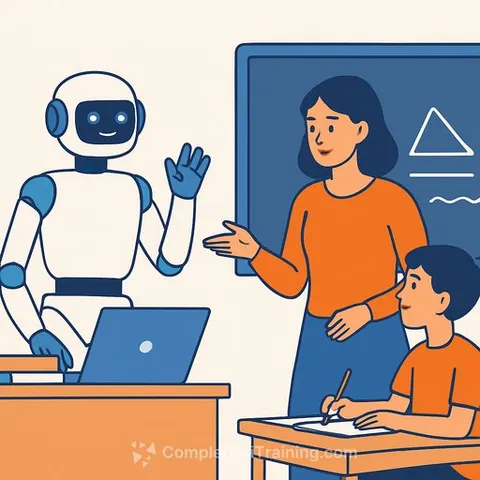
AI Can Run the Class. It Cannot Create the Classroom
Artificial intelligence has mastered the mechanics of teaching-delivering content, personalizing pace and answering questions at scale. But education is more than instruction. It is a social process where mentorship, interaction and shared experience turn information into understanding.
The distinction matters for educators. AI can enhance learning. Teachers remain irreplaceable.
What AI Does Well
Consider a classroom led entirely by AI. The system never tires. Every concept gets explained with clarity. Questions are answered instantly. Students learn at their own pace from anywhere. Costs drop. The model scales effortlessly.
On paper, it works. In practice, education requires something else.
Teaching Is a Performing Art
A classroom comes alive through participation. Questions emerge. Insights surface. Discussions evolve in directions no script can predict. The teacher is not merely an instructor but a facilitator of discovery.
Think of a vibrant classroom like a musical concert. The energy of the audience shapes the performance itself.
AI operates differently. Neuroscience suggests that while AI can simulate empathy, it does not feel it. A student experiencing anxiety before an exam or disappointment after failure needs more than information delivery.
A teacher can pause, look a student in the eye and ask, "Are you okay?" AI can generate the same sentence. But can it mean it? The distinction is subtle. It is also profound.
Learning Requires Human Mentorship
Ancient philosophy describes learning as a three-stage journey: acquiring knowledge, reflection and deep internalization. True learning occurs when knowledge passes through reflection and becomes part of one's being. It is shaped by information, lived experience, dialogue and introspection.
AI can enhance the first stage and support reflection. The transition to deep internalization-where knowledge becomes embodied-remains deeply human.
Education is also inherently social. Friendships form. Ideas get contested. Identities take shape in shared spaces. Alumni return to reconnect with teachers who influenced them and peers who shared their journey. These bonds are forged in lived experience, not virtual interfaces.
The Difference Between Information and Transformation
An AI system might say, "Your answer is 60 percent statistically correct." A human teacher might respond, "You haven't read the case properly-come prepared. You're capable of much more."
The former informs. The latter transforms.
Universities function as ecosystems. Students participate in clubs, lead initiatives and learn from peers. Faculty mentor them beyond the syllabus. These interactions build confidence, character and judgment-qualities that cannot be programmed.
Consider a university event where the microphone fails. AI switches instantly to captions or restores sound. Efficient. Seamless. Forgettable.
A human teacher taps the mic, gestures for silence and calls for a backup. Students laugh. They improvise. They engage. A technical glitch becomes a shared memory, recalled long after the event. AI handles the mic. Humans handle the moment.
Integration, Not Replacement
The future of education lies in integration. AI can personalize learning, assist with evaluation and expand access. But the deeper purpose of education-shaping judgment, nurturing curiosity and awakening human potential-remains irreducibly human.
The real shift is elsewhere: Teachers who use AI will replace those who do not.
For educators, the question is not whether to adopt AI. It is how to use it as a tool that frees you to do what only you can do-mentor, inspire and transform.
Learn more about AI integration for educators and explore AI applications in education.