
AI news ·
AI-designed proteins enable portable drug test kit with 10-second results
South Korean researchers develop a 10-second urine test kit using AI-designed proteins to detect new narcotics that evade conventional tests. The project aims for field deployment to police by 2027, with unit cost estimated at 1,000 won.
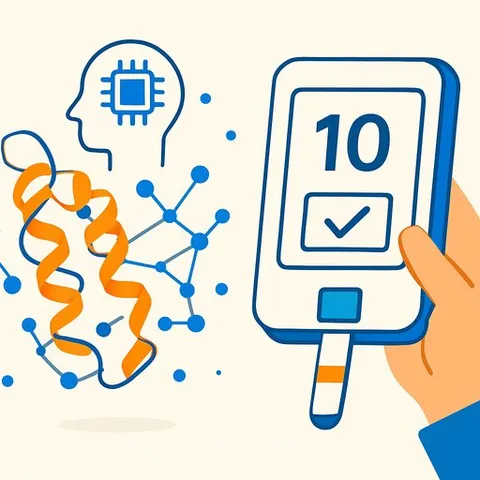
As online drug crimes surge in South Korea and new narcotics rapidly evolve, researchers are developing a portable test kit that uses AI-designed proteins to detect drug components in urine within 10 seconds. The project aims to produce a prototype between late 2026 and early 2027, with field deployment to police and hospitals as early as 2027.
Professor Kim Yong-ho of Sungkyunkwan University's Department of Nanoengineering is leading the National Public Safety Emergency Response Research Project, funded by the Ministry of Science and ICT and the Ministry of the Interior and Safety. "New narcotics are emerging very quickly, and their structures are constantly being modified, making it difficult to detect and identify them using existing analytical methods," Kim said. "We need detection technologies that can be designed rapidly and flexibly."
Why conventional tests fall short
Current antibody-based tests require about 18 months to develop detection for a single drug type and cost approximately 200 million won just for antibody screening. These tests rely on random mutagenesis and repeated screening, making rapid responses to new drug analogues nearly impossible.
New designer drugs evade detection if only the side-chain molecular structure is slightly altered. Benzodiazepine- and phencyclidine-based drugs share similar structures across compounds, making accurate identification of new analogues difficult. In the U.S. and Europe, overdoses linked to these drugs have surged, along with rising addiction rates among teenagers. Alprazolam and flunitrazepam are commonly associated with date rape and sexual offenses.
AI-designed proteins as sensors
Kim is a "protein designer" who uses generative AI to create novel proteins. His team directly designs proteins on a computer that bind to the common structural framework shared by drug analogues. They analyze chemical properties and functional groups of drug molecules, design a binding pocket inside the protein, and simulate whether drug molecules bind stably in that pocket.
Instead of searching for a one-to-one candidate that happens to bind well, the team designs an N-to-1 structure in which a single protein can respond to multiple analogues. The sensors are fabricated into portable kit formats through partnerships with semiconductor facilities such as KAIST Nanofab.
"It's a device that can quickly confirm what substance the test subject actually took and in what amount," Kim said. "I've heard that if we mass-produce them, we can get the unit price of each kit down to around 1,000 won. Rather than ordinary citizens using them directly, we expect frontline police officers, narcotics investigators, the National Forensic Service, and medical professionals to be the main users."
Clinical testing and regulatory pathway
Kim's team is currently mixing standard narcotic substances, synthesized and supplied by the Ministry of Food and Drug Safety, into urine from healthy individuals for experiments. To move toward deployment, they still need to secure actual urine samples and dosing records from people with drug addictions, obtain Institutional Review Board approval, verify clinical performance, and pass diagnostic device certification from the Ministry of Food and Drug Safety.
"Just because we've implemented the detection technology doesn't mean the police can start using it right away," Kim said. "If securing clinical samples and subsequent certification procedures are not seamlessly connected, we can't move forward." He advocates for a separate fast-track certification pathway rather than loosening existing regulations.
Why this matters for science and research professionals
This project demonstrates a shift from time-consuming, single-target antibody development to AI-driven protein design that can adapt to rapidly evolving threats. The same approach-designing proteins that bind specific molecular structures in real-time-could be applied to other detection challenges, from environmental toxins to biological weapons. For researchers working with AI for Science & Research, the work shows how generative protein design can move beyond computational experiments into field-deployable devices. The project's trajectory from computer simulation to regulatory approval also offers a template for translating synthetic biology into practical tools.
Kim said he is also interested in drug-neutralizing therapies: "If we have a protein that tightly binds to drug molecules, we could use it not only as a filter but also as a therapeutic agent that captures drugs in the body and prevents them from reaching the brain or binding to receptors."