
AI news ·
AI detection in schools is the wrong solution to the wrong problem
Fewer than a quarter of educators can spot AI-generated text. Schools are abandoning detection tools and redesigning assignments around personal reflection and live reasoning.
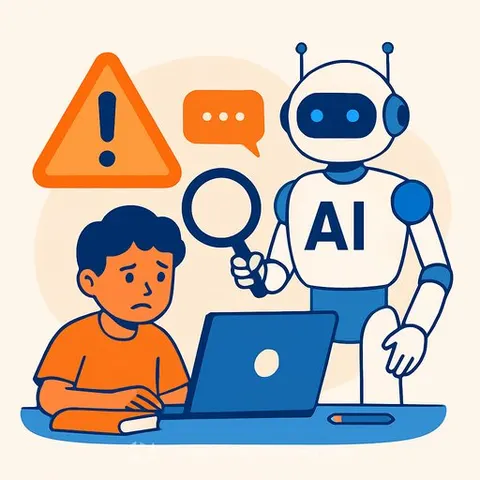
When ChatGPT launched on November 30, 2022, it didn't just give students a new shortcut-it exposed a deeper flaw in how schools think about academic work. Two years and thousands of generative AI tools later, teachers are still caught in an unwinnable detection game, and AI-resistant assignment design remains the better answer.
The detection arms race is already lost
Teachers, never trained for this, are now expected to spot AI-generated student work. In workshops, when shown four paragraphs-three by real students, one by ChatGPT-fewer than a quarter of educators can pick out the AI version.
That has not stopped a wave of tech companies from selling detection software to schools. The tools are inconsistent. In one well-known case, a teacher submitted the Declaration of Independence into a popular AI detector and it was flagged as 97.7 percent AI-generated. Research also shows these programs disproportionately flag English language learners and neurodivergent students-the kids least able to defend themselves against a false accusation.
The damage runs in both directions. Teachers are stressed about proving misconduct they cannot actually prove. Some students are self-censoring, avoiding sophisticated vocabulary for fear of being accused of cheating.
The wrong fixes
Some schools have responded by banning laptops entirely and requiring students to write by hand in class. Colleges are resurrecting Blue Book exams. That just makes everyone's life harder and leaves students less prepared for a workforce where digital fluency is a baseline requirement.
Redesigning assignments, not catching AI
Schools will never win a detection arms race. AI is not going away, and there is no reliable way to prove a student used it. The right question, educators are finding, is different: if a student can paste an assignment into ChatGPT and receive a passing result in seconds, was that assignment worth giving in the first place?
Academic integrity turns out to be primarily a design problem, not a policy problem. That is the thinking behind the Assignment Makeover Method, an instructional design framework that helps teachers build assignments anchored in personal reflection, demonstrated understanding, and documented process. Instead of "write an essay about the causes of World War I," a teacher might ask: "Identify the one cause of World War I most relevant to a conflict happening in the world today, and explain your reasoning in a three-minute class presentation." ChatGPT can generate the essay in seconds. It cannot replicate a student's live reasoning, personal perspective, or ability to respond to follow-up questions.
A path forward
Redesigning assignments does not require starting from scratch. Most can be made significantly more AI-resistant with targeted adjustments-adding a personal connection component, shifting the final deliverable to a live demonstration, or requiring students to document their thinking process. Professional development resources, such as an AI Learning Path for Teachers, can help educators build these design skills.
Why this matters for education professionals
Teachers and school leaders who stop chasing AI detection and start redesigning work reclaim classroom time, reduce false accusations, and prepare students for a world where using AI is not cheating but a core skill. The assignments that survive the AI era are the ones that demand real human engagement. That is the design challenge worth solving.