
AI news ·
AI-Driven Eye Care and Diagnostics: Bridging Healthcare Gaps in India’s Communities
AI-powered portable diagnostics bring timely screenings to rural India, expanding access to specialist care. Kerala’s Nayanamritham 2.0 leads AI-assisted retinal disease screening nationwide.
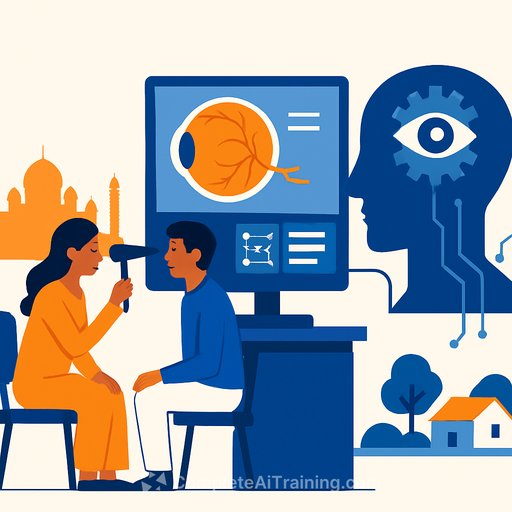
AI for Access: Reimagining Healthcare Beyond Hospitals
India's healthcare system faces a longstanding challenge: access to timely diagnosis, especially in rural regions. With an 80% shortfall of medical specialists in these areas, millions remain without early screening or diagnosis. Traditional diagnostic tools have often been confined to tertiary hospitals—costly and complex—making them inaccessible to much of the population.
The integration of artificial intelligence (AI) with portable, point-of-care diagnostic devices is changing this dynamic. This combination allows screening, early detection, and patient triaging at the community level, effectively bringing specialist care closer to those who need it most. Among AI's many healthcare applications, its potential to improve access stands out as immediate and life-altering.
AI for Eye Care: Global Need, Local Innovation
Globally, 2.2 billion people live with vision impairment, with at least 1 billion cases being preventable or untreated, according to the World Health Organization. The scarcity of eye care professionals adds to this challenge.
AI-integrated retinal imaging empowers nurses and field workers to screen for vision-threatening conditions right at the point of care. This approach shifts routine screenings away from ophthalmologists, freeing them to manage complex cases while expanding eye care reach.
Innovative tools like Remidio’s smartphone-based, non-mydriatic retinal camera are tailored for low-resource settings. Portable, affordable, and battery-operated, this device operates offline, using AI to detect diabetic retinopathy, glaucoma, and age-related macular degeneration in real time. Its deployment spans mobile vans in rural Northeast India, door-to-door screenings in Maharashtra’s slums, and public health centers in Kerala, ensuring that underserved communities gain access to critical eye care services.
Rooted in Ethical AI: Building Trust Through Rigor
Healthcare technology must adhere to the principle of “first, do no harm.” AI models require transparency, explainability, and rigorous real-world validation. Algorithms undergo prospective clinical trials at respected academic centers to ensure safety and reliability.
Features like activation maps provide clinicians insight into how AI systems reach their conclusions, fostering trust among healthcare professionals and patients. Regulatory approvals across India, Europe, and Singapore further reinforce confidence in these technologies, demonstrating that AI can be both advanced and responsible.
AI Integration, Not Just Innovation: Kerala as a Role Model
AI’s true impact emerges when integrated seamlessly into public health systems. Kerala’s Nayanamritham 2.0 program, launched in February 2025, is India’s first government-led AI-assisted chronic retinal disease screening initiative. Using Remidio’s AI platform, frontline health workers can instantly classify patients as referable or non-referable for diabetic retinopathy, glaucoma, and age-related macular degeneration.
The program goes beyond screening, establishing effective referral channels to ensure timely care at district and tertiary facilities. Through ongoing awareness, training, and support, Nayanamritham 2.0 has expanded from a pilot to broad adoption, setting a precedent for cost-effective, scalable AI deployment within public health.
AI for Systemic Health: Unlocking Clues from the Retina
Non-communicable diseases (NCDs) like diabetes, cardiovascular disease, stroke, and chronic kidney disease are on the rise in India. With 65% of deaths attributed to NCDs and one of the largest global diabetes populations, early detection is critical.
For many daily wage earners, health often takes a backseat to survival, leaving little room for proactive care. Retinal scans offer a valuable opportunity. Through oculomics—AI analysis of retinal images—biomarkers can signal early warning signs of systemic conditions such as heart attacks, stroke, and kidney disease.
Whether detecting glaucoma in a farmer or diabetic kidney disease in a laborer, AI-powered retinal screening aims to capture critical health information in the limited moments patients engage with healthcare. Saving vision is vital, but identifying systemic risks early enough to intervene truly changes lives.