
AI news ·
AI era demands return to enduring human values in education
By 2045, AI will likely surpass human cognition in nearly every area, forcing schools to rethink what children should learn. Lee Kwang-hyung, former KAIST president, argues curricula must center on creativity, knowledge, cooperation, and empathy-skills AI cannot replace.
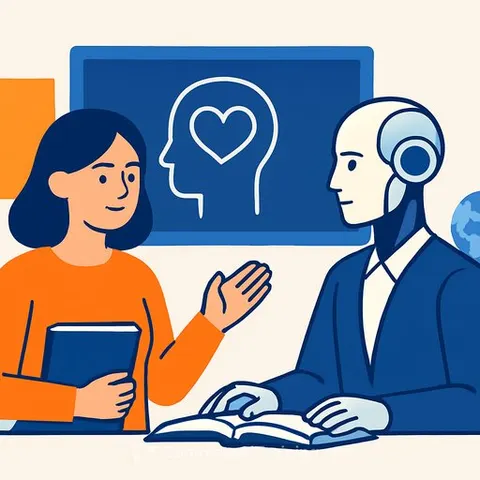
As artificial intelligence approaches and even surpasses human intellectual capabilities, schools are struggling to answer a fundamental question: what should children learn when AI has access to virtually all knowledge? By around 2045, when today's elementary and middle school students enter the workforce as adults, AI will likely demonstrate overwhelming performance across nearly every area of human cognition, according to Lee Kwang-hyung, former president of KAIST.
Both traditional memorization-centered education and superficial coding instruction are losing their rationale as technology outpaces curricula. Rather than being dazzled by technology, Lee argues educators should return attention to what makes humans distinct. "When circumstances become disorienting, wisdom lies in returning to fundamentals," he wrote. "We must first identify what will not change, then build what must change upon that foundation."
Creativity and knowledge matter more, not less
Creativity tops the list of enduring educational values. AI can learn enormous amounts of data and offer rational alternatives, but humans still recognize problems that have never been formulated and ask, "Why?" Lee argues the quality of human questions may become more consequential than the quantity of information one can recall.
Basic knowledge and memory remain essential, despite arguments that AI retrieval makes memorization obsolete. Without foundational knowledge and structured concepts in the mind, people cannot formulate sophisticated prompts for AI or assess the accuracy of its answers. "Critical thinking and sound judgment can emerge only from a foundation of accumulated knowledge," Lee wrote. "To make good decisions, the human brain itself must be properly trained."
Excessive rote learning should be avoided, but acquiring core knowledge and training memory remain indispensable, he said.
Cooperation, perseverance, and emotional intelligence
The third value is cooperation, which in the AI era must expand beyond collaboration among people to collaboration between humans and AI. Rather than treating AI as an enemy or competitor, students must learn to make it a partner in addressing difficult problems.
Perseverance and willingness to take on challenges are central to human agency. In a world where AI can generate results with a single click, enduring difficult processes and learning through direct experience will only grow in value. Persistence helps children retain control over their lives rather than passively following whatever AI suggests.
Emotional sensitivity and empathy are the fifth essential value. Understanding emotions, communicating sincerely, and persuading others to cooperate are human abilities AI cannot truly replace. Music, art, sports, and other physical and artistic experiences will become more important as society grows increasingly technology-centered, nurturing emotional depth and aesthetic judgment.
The wrong question about human capability
Lee warned against asking "What can humans do better than AI?" - a competition humans are likely to lose. The more useful question: "No matter how advanced AI becomes, what must remain human until the end?"
His answer: creativity, knowledge, cooperation, perseverance, willingness to take on challenges, and emotional sensitivity, reinforced by sound AI ethics, critical thinking, and adaptability. These values form the mental framework children will need for successful and fulfilling lives.
For educators and institutions adapting to this shift, the practical work involves redesigning curricula around these enduring human skills while building AI literacy. AI training for teachers can help educators integrate these tools thoughtfully into instruction, and resources on AI in education offer guidance on balancing technical skills with human development.
Why this matters for educators
Education should not be pulled in every direction by changing technologies, Lee argues. If it remains centered on enduring human values, children will be capable of finding their way through significant upheaval.
For teachers and school administrators, the practical implication is clear: design instruction that pairs AI proficiency with creativity, cooperation, perseverance, and emotional sensitivity. That means moving beyond both traditional memorization scripts and faddish coding drills toward a curriculum that deliberately builds the intellectual and emotional capacities AI cannot replace. The students who thrive will be those who can use AI as a tool while maintaining the human qualities that give life meaning.