
AI news ·
AI-generated campaign ads grow more common as candidates face parody and deepfake concerns
At least 164 AI-generated or enhanced political ads have appeared in U.S. races this year, with campaigns using the cheap technology to produce sharp, satirical attack videos.
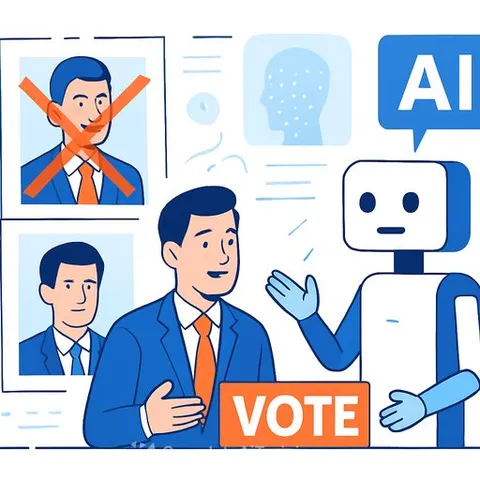
AI-generated political ads are appearing in races across the country this election cycle, with at least 164 ads produced or enhanced by artificial intelligence so far this year. The technology is reshaping how candidates craft their messages - especially in down-ballot contests where budgets are tight and the line between satire and deception remains unsettled.
Candidates find themselves rendered by AI
Jessica Bichler, a yoga studio owner running for North Carolina state Senate, discovered her own likeness contorted into bizarre shapes in an ad from her opponent, Republican incumbent Michael Lee. The AI-generated video made claims about her stances on policing and healthcare while showing a version of Bichler she never consented to create.
"It was my face, it was my body moving around, but it was not anything I'd ever consented to or participated in creating," Bichler told NPR. The ad included a disclaimer noting its use of AI, and Lee defended it as "comedy and obvious parody."
Data from the Wesleyan Media Project, which tracks political ad spending, confirms the trend is accelerating. Michael Franz, the group's co-director, said the technology offers campaigns a practical advantage: "It's a way to enhance the content of your ads, make them look pretty sharp, and it doesn't cost you all that much."
The deepfake crisis that never arrived
During the 2024 election cycle, experts warned that AI might flood the information space with convincing deepfake videos of candidates saying things they never said. Thirty-one states passed laws requiring disclosures or banning deceptive deepfakes outright, according to the National Conference of State Legislatures.
Scott Babwah Brennen, director of the Center on Technology Policy at NYU, said those fears largely did not materialize. "The problem of deceptive deepfakes hasn't really materialized as a widescale problem," he said. "But something else is happening."
That something is AI-generated satire - ads that don't aim to fool viewers but to ridicule opponents through exaggerated, impossible scenarios. One ad showed an Ohio candidate overstaying his welcome at a birthday party. Another depicted a Texas candidate reading from a bible. Brennen calls the emerging genre "AI-generated slopaganda."
From political cartoons to Generative Video
Isabel Linzer, who tracks elections at the Center for Democracy and Technology, sees a historical parallel. For centuries, politicians have used caricature and exaggerated imagery to attack opponents. "AI is kind of facilitating the next version of the political cartoon," she said.
But the technology introduces new uncertainties. Unlike a drawn cartoon, AI can produce lifelike video that some viewers may not immediately recognize as fabricated. Bichler said supporters asked her how Lee got access to her yoga studio to film the ad. She had to point out that her legs in the video were not moving in ways that are "humanly possible."
Todd Stiefel, a political independent who funded what is believed to be North Carolina's first AI-generated campaign ad in 2024, views the technology as simply another creative instrument. "The AI is simply a tool," he said. His ad depicted then-gubernatorial candidate Mark Robinson with 14 fingers while surfacing the candidate's own online comments.
Why this matters for marketing and government professionals
For marketing teams, the spread of AI-generated political ads signals a broader shift in content production economics. Campaigns are adopting generative video tools to produce sharp, attention-grabbing creative at low cost - a pattern that will shape commercial advertising as the technology matures. For government and public-sector professionals, the regulatory patchwork of 31 state laws on AI disclosures creates compliance complexity that will only grow as the 2026 midterms approach. Linzer warns that audience perception remains the wildcard: "It's hard to make an assumption about how people who are scrolling online all over the country with all different kinds of backgrounds necessarily are perceiving the content that they're seeing."