
AI news ·
AI-generated children's books flood shops and libraries, raising concerns about quality and ethics
AI-generated children's books are flooding stores with incoherent plots and inconsistent art, drawing complaints from parents and illustrators. One viral post decrying the trend earned over 60,000 likes, as experts warn low-quality stories could stunt kids' language skills.
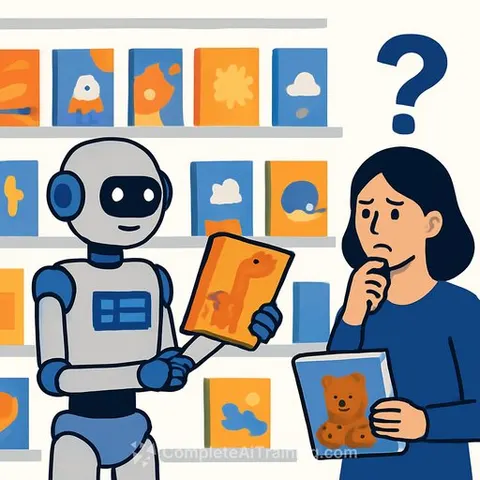
Amazon is destroying rare books to train AI models, according to reports this week, but a separate problem is spreading through bookshops: poorly made AI-generated children's books that parents and illustrators say are flooding shelves and damaging the medium.
Complaints have been mounting on social media about nonsensical children's literature appearing in stores and libraries. Parents have received AI-generated storybooks featuring their own children as gifts, often with inconsistent illustrations and incoherent plots. One illustration student shared an image on X of a book she said "ripped her heart out" when she found it in a shop - the text and images appear to be AI-generated, and the title is barely legible on the cover. The post received over 60,000 likes.
What's inside these books
The quality problems are visible within a few pages. One parent who bought an AI-generated book found the main character's hair described as "sandy brown" on one page but depicted as dark brown on another. Others report puzzles that can't be solved and drawing activities that are impossible to complete.
"It shows complete disrespect to children's books as a medium," one commenter wrote on the viral post. "Picture books are not just Notes app poems with random images attached. The artwork in children's books is integral to how educational and engaging the book is to children."
An early childhood educator replied: "This looks horrible. Besides the AI, this book would be horrible for the text alone."
The trend extends beyond self-published novelties. Amazon has plans for AI-generated children's programming, and Google released a tool for creating AI storybooks last year. Several companies now market tools that let users upload photos and details about real people to generate a personalised story that can be ordered in print.
Grandparents, gifts, and family friction
Wired reported this week on family tension caused by well-meaning grandparents giving AI-generated books to grandchildren. The novelty appeals to older relatives, but parents are often unhappy that their children's names, experiences, and photos have been fed into AI tools with unclear data policies.
"I have reiterated countless times that I do not support AI-generated art, and drew a hard line that she is absolutely not to feed any of our photos into AI or use our identifying information in any way," one person wrote on Reddit. "However, she is creating these storylines based on experiences with my kid and modeling her characters to have similar attributes as my kid."
The children themselves appear unimpressed. One father told Wired his kids were "bored" by the books.
Daozhi Xu, a researcher at Macquarie University who studied the explosion of AI-generated children's books, said the formula misunderstands what makes a story work. "Children do not love a storybook simply because their name or image appears in the story; they love the book because the story itself is interesting." AI-generated books often "lack humor, memorable characters, and dramatic tension," Xu added.
Why this matters for creatives
For illustrators and writers, this is not an abstract debate about technology. The market for children's books is being flooded with products that undercut professional work while ignoring the craft that makes picture books effective. As AI for Creatives continues to expand, the gap between tools that assist professionals and tools that replace them is becoming harder to ignore.
The deeper risk, Xu's research suggests, is to readers themselves. Children who grow up surrounded by poorly written, low-quality AI-generated books may develop a weaker relationship with art and literature. They learn symbolism, nuance, creativity, and logic from well-crafted prose and illustration. Exposure to clumsy phrasing, incoherent storytelling, and generic imagery could stunt linguistic development and interpretive skills - consequences that reach far beyond the book industry.
The Generative Art tools that make these books possible are not going away. But awareness is growing, and parents, bookshops, and libraries all have a role in quality control. For working creatives, the lesson is straightforward: the difference between professional work and AI slop is visible to anyone who looks closely, and the audience for quality is still there - they just need help spotting the difference.