
AI news ·
AI labs turn to healthcare cures and wellness gadgets to fix their image problem
AI labs are pouring billions into drug discovery, with Isomorphic Labs raising $2.1 billion and Nvidia-Eli Lilly building a $1 billion lab, as the industry seeks a positive story amid historically negative US public sentiment.
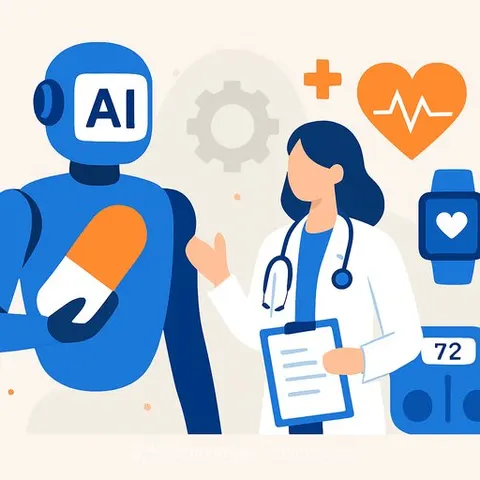
Major AI labs and big tech firms are pivoting hard into healthcare, framing the industry as a source of both long-term cures and near-term wellness. The moves come as the sector faces historically negative public sentiment in the US, with data center construction becoming a midterm political issue. Axios reported this week that the top labs see healthcare as their clearest shot at a positive story that lands with Main Street.
Anthropic is talking up a deeper push into biology and medicine ahead of its IPO. CEO Dario Amodei pointed to hoped-for early signs of progress in the coming months, according to WSJ reporting cited by Axios. Nvidia and Eli Lilly are building a $1 billion drug discovery lab in San Francisco that will pair life science researchers with AI model builders. Isomorphic Labs, Google's AI drug discovery spinoff, recently raised $2.1 billion and holds research collaborations with Novartis, Lilly, and Johnson & Johnson.
The cures narrative carries real weight but also real distance. Breakthroughs may still be years away. The same tools raise biosecurity concerns - Anthropic wrapped strict safeguards around its latest frontier model after concluding it could provide meaningful uplift to a bad actor. And so far, AI in healthcare has made care documentation more expensive. As one digital health M&A advisor put it in the Axios piece, "It's a bit of a hearts-and-minds play."
The wellness play and wearable IPOs
A parallel story is unfolding on the wellness side, where AI-powered devices are already on millions of bodies. Google launched the screenless Fitbit Air, built around an AI health coach. Apple, Google, and Samsung all lead their watch pitches with health features. Smart rings, led by Oura, have grown into a category of their own. Oura has filed confidentially to go public, with reports pointing to a valuation well above $10 billion - effectively an AI wearable IPO.
These devices matter most before people get sick: the quiet, daily prevention layer on wrists and fingers. The caution flag stays up. The wearables market is long on promises, and mainstream utility has to be earned device by device. Plenty of health gadgets end up tossed into drawers after short tries. For professionals working inside AI for Healthcare systems, the tension is familiar - consumer enthusiasm runs ahead of clinical integration.
The image problem driving the pivot
US sentiment on AI is historically negative. Data centers have become a political football in the midterms, complete with moratoriums, lawsuits, and job fears. Big tech and the AI labs are eager for a narrative that changes the conversation. The cures story is what people are being asked to believe. The wellness story is what they can feel today - watches, rings, and trackers quietly nudging sleep, fitness, and early warnings.
The healthcare promise was real before the backlash made it convenient. Healthcare represents roughly a fifth of the US economy, tangled in complexity that AI is suited to untangle - from drug discovery to diagnostics to the paperwork in between. But the cures story runs on a long clock. The wellness story runs on a shorter one, with iterative progress and an IPO of its own.
Why this matters for healthcare professionals
The AI industry's dual bet on cures and wellness will shape the tools, partnerships, and regulatory fights coming to your workplace. The labs are pouring billions into drug discovery collaborations that will eventually touch clinical workflows. The wearable data flooding into patient hands is already changing what patients expect from their providers. Both tracks face the same bottleneck: a complex healthcare bureaucracy that moves slower than venture capital. If you work in medical administration, understanding where AI is actually landing - versus where the press releases say it is - will determine which AI for Medical Billers and operational tools are worth adopting and which are still years from practical use.