
AI news ·
South Korean banks report AI-assisted cyberattacks exposing over 25,000 customer records
South Korean banks suffered AI-assisted breaches exposing over 25,000 customer credit records, prompting President Lee Jae Myung to order an immediate investigation.
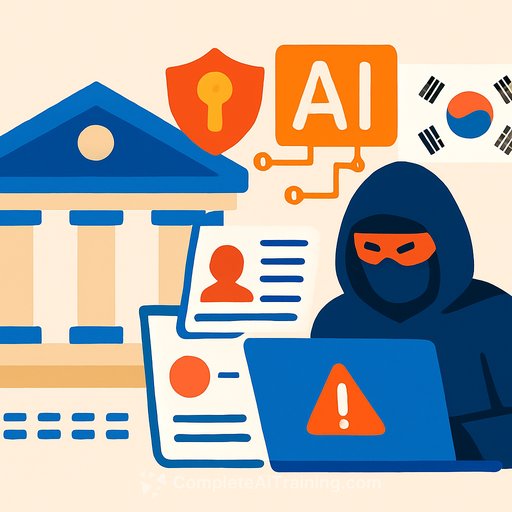
South Korean authorities are investigating AI-assisted cyberattacks on three major banks-Hana Bank, KB Kookmin Bank, and Shinhan Bank-that exposed the records of more than 25,000 customers. Shinhan Bank confirmed 25,000 credit records were leaked, while Kookmin Bank reported 99 customers and 20 employees affected, and Hana Bank noted 89 impacted customers. The scale and method of the breaches prompted President Lee Jae Myung to order an immediate investigation, signaling government alarm over the accelerating use of AI agents in financial crime.
How the attacks unfolded
The attackers used AI agents to automate reconnaissance, identify system weaknesses, and execute data exfiltration faster than traditional manual methods. While attribution remains unclear, the breaches follow a documented pattern of AI-powered cyber threats. In November 2025, Anthropic reported an AI-orchestrated hack by a Chinese state-sponsored group. Earlier this year, Taiwan faced autonomous cyberattacks linked to China. Even AI labs have been targeted: a 2025 incident saw researchers exploit Anthropic's Claude model to access internal OpenAI code.
Security experts warn that open-source AI models lacking guardrails are being weaponized to exploit vulnerabilities and lower the technical barrier for cybercriminals. "AI agents are increasingly used for reconnaissance, automation, and exploiting system weaknesses," said one expert familiar with the investigations. The South Korean cases show how these tools compress attack timelines and expand the surface area for data theft.
Financial sector on alert
The breaches hit core banking systems, exposing credit data and employee records. Shinhan Bank's disclosure of 25,000 compromised credit records marks one of the larger AI-linked financial breaches reported publicly. Kookmin Bank's exposure extended to 20 employees, suggesting attackers also targeted internal credentials that could enable deeper network access.
South Korean regulators have not disclosed the specific AI tools used or how the attackers bypassed existing defenses. The investigation will likely examine whether banks' security protocols adequately account for AI-driven threats, which can mimic legitimate user behavior and adapt to detection patterns in real time.
Why this matters for finance, IT, and legal professionals
For financial institutions and insurers, the breaches underscore that AI agents can weaponize open-source models to bypass controls that assume human-speed attacks. IT and cybersecurity teams need detection systems calibrated for automated, adaptive threats-not just signature-based defenses. Legal and compliance professionals should prepare for regulatory scrutiny around whether existing data protection measures meet the standard of care when AI accelerates breach velocity. Courses like AI Security Analytics Courses address the specific skills analysts need to counter these threats, while AI IT Strategy Training helps leadership teams integrate AI risk into broader technology planning.